
打新策略

Search documents
今年34只新股上市首日涨3倍以上,普通人如何分享翻倍收益?
2 1 Shi Ji Jing Ji Bao Dao· 2025-12-24 10:20
Core Viewpoint - The new stock market has shown significant profit potential this year, with new listings in December, such as Muxi Co. and Moer Thread, experiencing price increases of 4-6 times, leading to a renewed enthusiasm for new stock subscriptions [1] Group 1: New Stock Performance - As of December 23, the average price increase on the first day of new stock listings compared to the issue price is 251.63%, with an average closing price increase of 257.87% [1] - A total of 34 new stocks have seen their first-day closing prices rise more than three times their issue prices [1] - The average price increase for new stocks in December reached 278.83%, driven by strong demand for domestic GPU leaders Muxi Co. and Moer Thread [1] Group 2: High-Performing New Stocks - Several new stocks have recorded first-day closing price increases exceeding 400%, including: - Dapeng Industrial: 1,211.11% increase - Sanxie Electric: 785.62% increase - Muxi Co.: 692.95% increase - Jiangnan New Materials: 606.83% increase [2] - The average price increase for new stocks listed on the Beijing Stock Exchange is notably high at 354.69% [2] Group 3: Investment Products and Strategies - Ordinary investors can participate in new stock subscriptions indirectly through financial products and funds that employ new stock strategies [3] - Some "fixed income+" financial products use new stock subscriptions as a means to enhance returns, with over 30 new stock financial products launched this year averaging annualized returns above 3%, and some exceeding 4% [3][4] - Specific products with annualized returns over 4% include: - Shangyin Wealth's product with a 5.1% return - Sunshine Orange's product with a 4.27% return [4] Group 4: Participation in New Stock Subscriptions - Investors holding stocks can directly participate in new stock subscriptions by meeting certain market value requirements [6] - The Shanghai and Shenzhen stock exchanges require an average market value of over 10,000 yuan for the previous 20 trading days to qualify for new stock subscriptions [6]


A股:新股再现上市首日涨10几倍,股民:弱势行情无疑!
Sou Hu Cai Jing· 2025-11-22 02:52
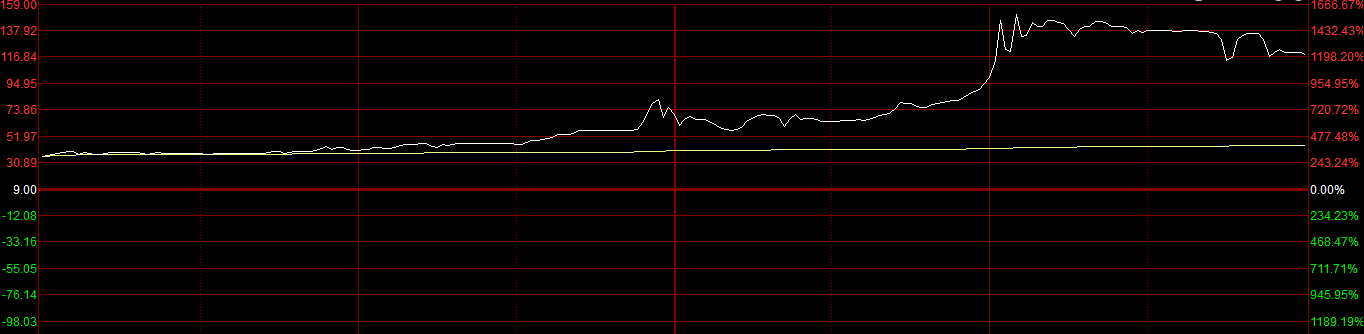
Core Viewpoint - The recent debut of Dapeng Industrial on the A-share market has sparked renewed enthusiasm for new stock offerings, contrasting with the overall market downturn [1][5]. Group 1: Dapeng Industrial's Performance - Dapeng Industrial's initial offering price was 9 yuan, but it opened at 35.09 yuan, achieving a remarkable increase of 289.9% on its first day [1]. - The stock price peaked at 159 yuan during trading, representing an increase of nearly 17 times from the issue price, setting a new record for first-day performance of new stocks [1][3]. - The closing price was 118 yuan, still reflecting a gain of over 12 times from the initial offering price, despite a drop from the day's high [3]. Group 2: Market Context and Investor Sentiment - The surge in Dapeng Industrial's stock occurred amidst a broader market correction, similar to the previous case of Mengguli, which also saw significant gains during a weak market [5]. - This phenomenon raises questions among seasoned investors about whether new stocks are more likely to perform well in bearish markets or if such occurrences are merely coincidental [5]. - The event has reinvigorated interest in new stock investments, highlighting the effectiveness of new stock strategies while also serving as a reminder of the inherent risks involved [5].
中资美元债&点心债市场和分析框架:信用海外掘金
2025-11-10 03:34
Summary of Key Points from Conference Call Industry Overview - The conference call discusses the **offshore bond market**, specifically focusing on **Chinese dollar bonds** and **dim sum bonds**. The former is denominated in USD, while the latter is denominated in offshore RMB and is primarily issued in Hong Kong [1][2]. Core Insights and Arguments - **Market Dynamics**: The offshore bond market has seen a contraction since 2021 due to the Federal Reserve's interest rate hikes and real estate risks. However, a rebound in issuance is expected in 2024 with anticipated rate cuts, although net financing remains negative [1][12]. - **Dim Sum Bonds Growth**: The dim sum bond market has been expanding, benefiting from the advantages of RMB financing and the Southbound Trading initiative, with a notable increase in the proportion of municipal investment bonds [1][12][13]. - **Pricing Factors**: The pricing of Chinese dollar bonds is influenced by historical returns, yield spreads, and credit ratings. High-yield bonds exhibit significant volatility and are closely tied to credit risk. Dim sum bonds are priced based on offshore RMB government bond rates, affected by liquidity in both onshore and offshore RMB markets [1][14][15]. Important but Overlooked Content - **Investment Strategies**: Various investment strategies are discussed, including curve trading, event-driven trading, and swing trading, each with its own advantages and requiring market environment adjustments [2][23][24][25]. - **Regulatory Environment**: The regulatory framework for offshore bond issuance is relatively lenient, with different disclosure requirements based on the type of issuance (e.g., SEC 144A, Reg S). Most Chinese issuers prefer Reg S due to lower compliance costs [5][8][18]. - **Default Resolution**: Common default resolution strategies include bond swaps, debt-to-equity conversions, bankruptcy liquidation/restructuring, and discounted buybacks/extensions. The effectiveness of these strategies largely depends on the underlying company's value performance [27][28]. Market Characteristics - **Issuance Structures**: The most common issuance structure in both markets is direct issuance, followed by guaranteed structures and maintenance agreements. The Chinese dollar bond market has a higher proportion of guaranteed structures compared to the dim sum market [7][12]. - **Investor Behavior**: Investors are increasingly focused on short-term liquidity rather than long-term value, reflecting a shift in risk appetite and market conditions [2][28]. Conclusion - The offshore bond market, particularly Chinese dollar and dim sum bonds, is influenced by macroeconomic factors, regulatory environments, and investor behavior. The anticipated changes in interest rates and market dynamics will play a crucial role in shaping future investment opportunities and risks in this sector [1][12][19].
2025年8月打新策略环境与收益回顾
Zhong Xin Qi Huo· 2025-09-03 07:07
Report Summary 1. Industry Investment Rating No industry investment rating is provided in the report. 2. Core Viewpoints - The Hong Kong Stock Exchange launched a large - scale IPO mechanism reform on August 4, 2025, aiming to balance the new - share allocation ratio between institutional and retail investors [2]. - In August 2025, the number of new stocks was small, and the new - share subscription opportunities were limited. The new - share subscription yield was thin, and the basis difference dragged down the portfolio return. This situation may continue in September [2][3]. 3. Summary by Related Catalogs 3.1 New - share Subscription Rules - The Hong Kong Stock Exchange's IPO reform requires issuers to allocate at least 40% of new shares to institutional investors, who can participate in new - share pricing through a 40% book - building allocation share [2]. - The retail investors' allocation ratio has decreased. For example, when a new stock is over - subscribed 100 times, the retail allocation ratio drops to 35% [2]. - The initial public shareholding ratio is set according to market capitalization brackets, with the initial public shareholding ratio of H - shares decreasing from 15% to 10% [2]. - At least 25% of an issuer's shares after listing should be freely tradable to prevent excessive concentration of chips [2]. 3.2 Market Environment - In August 2025, only three new stocks were listed on the main board and the Star Market and ChiNext, with a total market capitalization of less than 10 billion yuan. The new - share subscription success rate and the number of offline institutional subscriptions decreased significantly compared to the first half of the year [2]. - In September 2025, it is expected that 3 new stocks will be listed on the Star Market and ChiNext, and new - share subscription opportunities remain limited [2]. 3.3 New - share Subscription Yield - With a 150 - million - yuan stock bottom - position, the offline new - share subscription portfolio yield in August was about - 0.33%. The significant loss was mainly due to the impact of the market on the basis difference [3]. - In August, due to a deep discount at the beginning of the month and a large influx of speculative funds into the futures market, the discounts of IF and IH accelerated to converge. The monthly bottom - position hedging loss was about - 0.42%, and the new - share income could not cover the cost of discount convergence [3]. - In September, the IF discount is still deep, and the impact of the basis difference on the portfolio strategy cannot be underestimated. It is recommended to wait for the IF discount to converge and more new - share subscription opportunities to appear before making in - depth arrangements [3].
量化策略|港股IPO市场解析及打新策略研究
Jin Rong Jie· 2025-08-20 02:29
Core Viewpoint - The Hong Kong IPO market is experiencing a revival in 2025, driven by both internal and external factors, with significant increases in fundraising and improved investor sentiment [2][5]. Group 1: IPO Market Performance - As of August 11, 2025, the IPO fundraising amount reached HKD 129.2 billion, representing a 147% increase compared to the total for 2024, with an average fundraising size of HKD 2.4 billion, the highest since 2022 [2]. - The first-day loss rate for new listings is at its lowest since 2018, at 28%, with average first-day returns of 15.1% and median returns of 3.4% [2]. - The revival of the IPO market is attributed to the Hong Kong Stock Exchange's continuous optimization of listing regulations, encouragement from mainland China for companies to list in Hong Kong, tightening of financing in A-shares, and increased regulatory scrutiny of Chinese concept stocks in the U.S. [2]. Group 2: IPO Process and Pricing - The Hong Kong IPO process consists of eight key steps, including hiring sponsors, preparing for listing, submitting applications, and pricing, with a market-oriented pricing mechanism influenced by institutional investors [3]. - Public investor enthusiasm plays a crucial role in the allocation of shares through the mechanism of price adjustment [3]. Group 3: Post-Listing Performance - Analysis of IPO data from 2018 to August 11, 2024, shows that absolute and relative returns for newly listed companies have weakened, with median absolute returns of 0.8%, 0.0%, -1.6%, and -23.5% for the first day, first week, first month, and one year, respectively [3]. - Small-cap stocks (market cap below HKD 1 billion) perform better on the first day but see significant declines in subsequent returns, while large-cap stocks (market cap above HKD 1 billion) exhibit more stable prices but experience larger corrections starting from the sixth month due to lock-up expirations [3][4]. Group 4: Investor Sentiment and Strategies - For small-cap stocks, early profit-taking is recommended due to their tendency to decline rapidly after initial gains, with public investor sentiment being a key factor influencing post-listing performance [4]. - For large-cap stocks, the median absolute return remains around zero in the first three months, suggesting a need for careful selection of projects, with high public sentiment and new economy sectors showing better performance [4]. Group 5: Role of Cornerstone Investors - Cornerstone investors should focus on in-depth research of individual stocks and be aware of the negative impacts of lock-up expirations, as data indicates that non-new economy sectors outperform new economy sectors in excess returns after seven months [5]. - The presence of cornerstone investors does not significantly influence the long-term excess returns of IPO projects, indicating a low success rate and high risk-reward ratio for long-term investments in the Hong Kong IPO market [5].
“打新定期跟踪”系列之二百二十五:近期北交所待上市新股较多
Huaan Securities· 2025-08-11 14:35
- The report does not contain any quantitative models or factors for analysis[1][2][3]
2025年6月打新策略环境与收益回顾
Zhong Xin Qi Huo· 2025-07-02 11:55
Report Summary 1. Report Industry Investment Rating No information provided. 2. Core Viewpoints - The relaxation of the Sci - tech Innovation Board's new - share subscription system is expected to increase new - share subscription opportunities. The policy expanding the scope of the fifth listing standard on the Sci - tech Innovation Board may encourage more technology companies to list, increasing institutional offline new - share subscription opportunities [2]. - In June, the number of institutional participants in the inquiry increased marginally, and the activity was higher than the average level in the first half of the year. With the continuous loosening of IPO policies, more institutional investors are expected to participate in the offline new - share subscription market, but the winning rate may remain low [2]. - In June, both the hedging and new - share subscription ends saw a recovery in returns, and the overall strategy return increased month - on - month. For example, with a 200 - million - yuan stock bottom position, the monthly new - share subscription return rate for the main board and the STAR Market and ChiNext was about 1.02%, and the return from new - share subscription alone was about 0.9% [3]. 3. Summary by Relevant Catalogs 3.1 New - share Subscription Rules - On June 18, the CSRC issued an opinion to enhance the system's inclusiveness and adaptability on the Sci - tech Innovation Board. It expanded the scope of the fifth listing standard, allowing unprofitable companies in more cutting - edge technology fields such as artificial intelligence, commercial aerospace, and low - altitude economy to list. As of early July, some unprofitable companies have applied to list on the Sci - tech Innovation Board [2]. 3.2 Market Environment - In June, 3 out of 6 new stocks belonged to the TMT sector, and 2 belonged to the new energy and automotive sectors. The technology and electrical concepts attracted high institutional attention. On June 20, Everbright Wealth Management entered the new - share subscription market through hybrid products, marking the official entry of wealth management funds into the market [2]. 3.3 New - share Subscription Returns - In June, with a 200 - million - yuan stock bottom position, the monthly new - share subscription return rate for the main board and the STAR Market and ChiNext was about 1.02%, and the return from new - share subscription alone was about 0.9%. In May, the strategy's decline was affected by the convergence of IF discount. In June, due to the ex - dividend disturbance, the IF basis declined, and the hedging end obtained a small amount of additional return. Three new stocks on the main board had a first - day increase of more than 2.5 times, contributing to the increase in strategy returns [3].