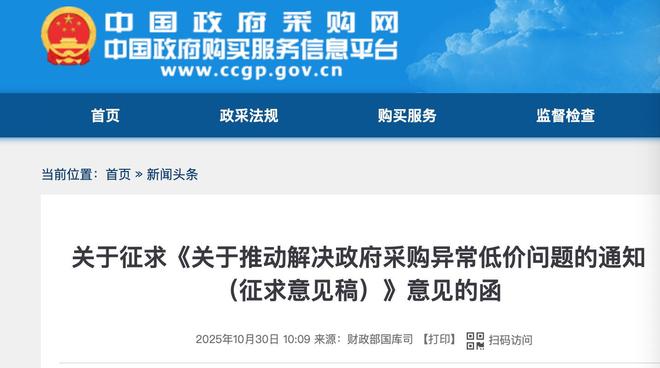
政府采购异常低价

Search documents
三管齐下遏制恶意低价竞争 ——解读财政部关于“政府采购异常低价”新政
仪器信息网· 2026-02-28 09:02
Core Viewpoint - The article discusses the government's efforts to combat malicious low-bidding practices in public procurement, emphasizing the need for effective measures to prevent such behaviors and ensure fair competition in the procurement process [1]. Group 1: Strengthening Government Procurement Demand Management - Government procurement demand management is fundamental to procurement activities, and establishing clear and reasonable procurement requirements is essential to prevent abnormal low bidding [2]. - The Ministry of Finance's 2021 "Government Procurement Demand Management Measures" provides guidelines for procurement entities to establish scientific procurement demands [2]. - Conducting thorough market research is crucial to formulating clear procurement requirements and setting a reasonable maximum price for projects [3]. Group 2: Setting Reasonable Procurement Packages - Properly dividing procurement packages based on professional types is necessary to attract specialized suppliers and enhance service quality [5]. - An example illustrates the risks of not separating procurement packages, leading to issues with service delivery and increased costs [5]. Group 3: Introducing Lifecycle Cost Concepts - For projects with long-term operational costs, procurement requirements should encompass the entire lifecycle, including maintenance and consumable supplies [6]. - Failure to consider lifecycle costs can lead to situations where low initial bids result in high subsequent costs, as seen in a case where a medical device was procured at a low price but incurred high consumable costs later [6][7]. Group 4: Strengthening Abnormal Low-Bid Review - The article outlines four scenarios that trigger the review of abnormal low bids, including bids significantly below the average of compliant bids and the maximum project price [8][9][10]. - The procurement entity has the discretion to adjust the thresholds for triggering reviews, with a maximum increase of 65% [11]. Group 5: Enhancing Contract Performance and Acceptance Management - Contract performance and acceptance are critical to ensuring compliance with procurement agreements, especially when low bids are involved [14]. - Procurement entities must ensure contracts reflect commitments made by suppliers regarding low bids and include punitive clauses to enforce compliance [14][15]. - Monitoring supplier performance and conducting timely acceptance checks are essential to uphold contract standards and address any non-compliance [15].


斩断政府采购“内卷”链条
第一财经· 2026-02-02 15:50
Core Viewpoint - The article discusses the implementation of the Ministry of Finance's notification aimed at addressing the issue of abnormally low prices in government procurement, promoting a healthy market order characterized by quality and fair pricing [2]. Group 1: Government Procurement Overview - In 2024, the total amount of government procurement in China is expected to exceed 3.3 trillion yuan, accounting for over 12% of national fiscal expenditure, covering various sectors including goods, services, and engineering [2]. - Abnormally low prices in government procurement are identified as a significant issue, particularly the extreme cases of "1 yuan bidding" or even "0 yuan bidding," which, while seemingly absurd, occur more frequently than expected [2][3]. Group 2: Causes and Implications of Low Bidding - The phenomenon of zero-price bidding is linked to a long-term strategy where companies prioritize future revenue over immediate costs, similar to the business model in the printer industry where low-priced machines are sold alongside high-priced consumables [3]. - The article highlights that the low bidding behavior is a form of "involution" that depletes both corporate development potential and fiscal efficiency, ultimately harming public interests [3]. Group 3: Regulatory Measures - The notification emphasizes the need for improved management of procurement projects, particularly in sectors with high usage of consumables, such as printing and medical equipment, to prevent suppliers from charging additional fees outside of contractual agreements [3]. - To combat the issue of abnormally low bidding, there is a call for the enhancement of the legal framework governing government procurement, including the revision of laws to clearly define standards and responsibilities related to low pricing [7][5]. Group 4: Responsibilities and Accountability - The notification establishes four warning mechanisms for detecting abnormally low bids, allowing evaluation committees to request explanations from bidders, with non-compliance leading to invalid bids [8]. - It is crucial to clarify responsibilities among all parties involved in procurement to ensure accountability, with consequences for non-compliance, thereby fostering a sustainable procurement ecosystem [8].

一财社论:斩断政府采购“内卷”链条
Di Yi Cai Jing· 2026-02-02 12:59
Core Viewpoint - The issuance of the "Notice on Promoting the Resolution of Abnormal Low Bidding in Government Procurement" aims to address the chaotic and harmful competition characterized by abnormal low bidding, promoting a market order of quality and reasonable pricing [1][5] Group 1: Government Procurement Market Overview - In 2024, the total amount of government procurement in China is expected to exceed 3.3 trillion yuan, accounting for over 12% of national fiscal expenditure, covering various sectors including goods, services, and engineering [1] - Abnormal low bidding has become a significant issue in government procurement, with extreme cases such as "1 yuan bidding" and even "0 yuan bidding" being more common than expected [1][2] Group 2: Long-term Profit Models - Some companies engage in "0 yuan bidding" with the expectation of generating continuous revenue from subsequent services, similar to the model used in the printer industry where low-priced machines are sold alongside high-priced consumables [2] Group 3: Regulatory Framework and Responsibilities - To prevent abnormal low bidding, there is a need to improve the legal framework, including amendments to the Government Procurement Law and related regulations to clearly define standards and responsibilities [3][4] - The "Notice" establishes four warning mechanisms for detecting abnormal low bidding, allowing evaluation committees to request explanations for significantly low bids, which can be deemed invalid if not satisfactorily justified [4] Group 4: Conclusion and Future Directions - The essence of abnormal low bidding is internal consumption and unsustainable competition, necessitating strengthened regulations and clearer responsibilities to create a healthy and sustainable government procurement ecosystem [5]
中经评论:政府采购异常低价不可取
Jing Ji Ri Bao· 2026-02-02 00:05
Core Viewpoint - The Ministry of Finance has issued a notice to address the issue of abnormally low bidding in government procurement, aiming to promote a market order characterized by quality and fair competition [1][4]. Group 1: Government Procurement Market Overview - The government procurement market is a significant part of the domestic market, with the total procurement amount expected to exceed 3.3 trillion yuan in 2024, accounting for over 12% of national fiscal expenditure [1]. - The market encompasses all areas including goods, services, and engineering, and is essential for advancing the construction of a unified national market [1]. Group 2: Issues with Abnormally Low Bidding - Instances of abnormally low bids, such as a fully automated biochemical immunization assembly line bid at 1 yuan and vocational training projects at 0 yuan, raise concerns about the sustainability and quality of services provided [2]. - Suppliers often resort to bidding at prices far below costs to win contracts, which can lead to risks in project execution and compromise on quality, resulting in "low-price bidding and low-quality performance" [2]. Group 3: Causes of Abnormally Low Bidding - The phenomenon of abnormally low bidding is attributed to several factors, including aggressive competition among suppliers, poorly defined procurement budgets, and lack of clear procurement needs [2]. - Inadequate supervision and evaluation of contract fulfillment also contribute to the exploitation of low bidding practices [2]. Group 4: Solutions and Recommendations - To address the issue, it is essential to strengthen demand management in government procurement, ensuring that procurement needs are scientifically and clearly defined [3]. - The new guidelines introduce quantifiable standards for identifying abnormally low bids and outline specific procedures for initiating reviews, enhancing operational feasibility [3]. - Post-contract supervision must be reinforced to ensure compliance with contract terms, and suppliers should focus on improving product quality and service levels rather than competing solely on price [3].
【财金视野】政府采购异常低价不可取
Sou Hu Cai Jing· 2026-02-01 23:26
Core Viewpoint - The Ministry of Finance has issued a notice to address the issue of abnormally low bidding in government procurement, aiming to promote a market order characterized by quality and fair pricing [2][3]. Group 1: Government Procurement Market Overview - The government procurement market is a significant part of the domestic market, with the total procurement amount exceeding 3.3 trillion yuan in 2024, accounting for over 12% of national fiscal expenditure [2]. - The market encompasses all areas including goods, services, and engineering, necessitating the elimination of unreasonable restrictions and barriers to foster a fair competitive environment [2]. Group 2: Abnormal Low Bidding Phenomenon - Instances of abnormally low bids, such as a fully automated biochemical immune assembly line bid at 1 yuan and vocational training projects at 0 yuan, raise concerns about the sustainability and quality of such bids [3]. - Suppliers often resort to bidding at prices far below costs to win contracts, which can lead to risks in project execution and compromise on product and service quality [3]. Group 3: Causes of Abnormal Low Bidding - The phenomenon is attributed to various factors, including aggressive competition among suppliers, poorly structured procurement budgets, and unclear procurement needs [3][4]. - Inadequate supervision and non-standardized acceptance of performance also contribute to the exploitation of low bidding strategies [3]. Group 4: Solutions and Recommendations - To address the issue, it is essential to strengthen demand management in government procurement, ensuring that procurement needs are scientifically and clearly defined [4]. - The implementation of a review process for abnormal low bids has been established, enhancing operational feasibility and clarity in identifying such bids [5]. - Post-procurement, there is a need for rigorous performance acceptance to ensure compliance with contract terms, and suppliers are encouraged to focus on quality rather than low pricing strategies [5].

政府采购异常低价不可取
Jing Ji Ri Bao· 2026-02-01 22:09
Core Viewpoint - The government procurement market is a crucial part of the domestic market, and the recent notice from the Ministry of Finance aims to address the issue of abnormally low bidding prices to foster a fair competitive environment [1][3] Group 1: Government Procurement Market Overview - The total government procurement amount in 2024 is expected to exceed 3.3 trillion yuan, accounting for over 12% of national fiscal expenditure, covering goods, services, and engineering [1] - The government procurement process allows for the selection of bidders based on either the lowest bid method or the comprehensive scoring method, depending on the project characteristics [1] Group 2: Issues with Abnormally Low Bidding - Instances of abnormally low bids, such as a fully automated biochemical immunization assembly line winning a bid for 1 yuan and vocational training projects for 0 yuan, raise concerns about the sustainability and quality of services [2] - Suppliers often resort to bidding at prices far below costs to win contracts, which can lead to quality issues and potential hidden costs through bundled sales or additional fees [2] Group 3: Solutions and Recommendations - To address the issue of abnormally low bids, it is essential to strengthen demand management in government procurement, ensuring that procurement needs are scientifically and clearly defined [3] - The new guidelines introduce quantifiable standards for identifying abnormally low bids and outline specific procedures for reviewing such bids, enhancing operational feasibility [3] - Post-contract supervision must be reinforced to ensure compliance with contract terms, and suppliers should focus on improving product quality and service levels rather than competing solely on price [3]
顶风“作案”!仪器采购2度废标后仍0.01元中标,咱就拿异常低价没办法?
仪器信息网· 2025-11-20 04:31
Core Viewpoint - The article discusses the rampant issue of low-price procurement in the medical equipment sector, highlighting a recent case where a medical device was awarded a contract for only 0.01 yuan, raising concerns about the integrity of the procurement process and the underlying causes of such anomalies [2][7][11]. Group 1: Procurement Anomalies - A recent procurement case for an automatic biochemical immunoassay line resulted in a winning bid of only 0.01 yuan, despite previous attempts to award the contract being canceled due to irregularities [4][7]. - Another case involved a project with a budget of 3 million yuan, which was awarded for just 1,000 yuan, prompting investigations into the procurement process [9][11]. - The article notes that the normal market price for such medical equipment typically ranges from 500,000 to 2 million yuan, indicating significant discrepancies in the awarded prices [11]. Group 2: Government Response - The Ministry of Finance has proposed measures to address the issue of abnormally low bids, including strengthening procurement demand management, enhancing low-price review mechanisms, and enforcing strict compliance and accountability [12][20]. - The article emphasizes the need for improved legal frameworks and regulatory oversight to prevent such procurement irregularities from continuing [15][20]. Group 3: Underlying Causes - The article identifies that the low-price procurement phenomenon is often a reflection of a commercial bribery chain, where suppliers offer equipment at extremely low prices in exchange for exclusive contracts for consumables [13][14]. - It also highlights the role of outdated regulations and ineffective enforcement mechanisms that fail to address the root causes of these procurement issues [15][17]. - Internal governance issues within medical institutions, such as concentrated decision-making power and inadequate oversight, contribute to the prevalence of these procurement anomalies [18][19]. Group 4: Recommendations for Improvement - The article suggests that long-term solutions should include enhancing legal regulations, improving comprehensive oversight, and reforming internal systems within hospitals to mitigate risks associated with procurement [20][21].


政府采购剑指设备异常低价:医疗市场生态或迎重构
2 1 Shi Ji Jing Ji Bao Dao· 2025-11-04 09:39
Core Viewpoint - The Ministry of Finance has issued a notice to address the issue of abnormally low bids in government procurement, signaling a shift from a focus on low prices to quality and effectiveness in the medical equipment market [1][3]. Government Procurement Reform - The new draft aims to create a systematic governance framework to tackle the persistent issue of low-price bidding in government procurement, particularly in the medical sector [3][5]. - Pilot programs have been initiated in various free trade zones and cities to address the problem of abnormal low-price bids [3]. Abnormal Low-Price Bidding Issues - The medical equipment sector has seen extreme price reductions, with bids often significantly below market rates, raising concerns about quality and safety [4][5]. - Examples include a bid of 1,000 yuan for a 3 million yuan project, highlighting the risks associated with such low bids [4]. Impact on Industry Competition - Abnormal low-price bidding has led to a decline in the quality of medical equipment and services, affecting patient safety and healthcare outcomes [5]. - The competition has forced some manufacturers to shift focus from R&D to lower-end products, hindering the advancement of domestic brands [5]. New Procurement Guidelines - The draft emphasizes a full lifecycle cost approach, requiring that ongoing maintenance and consumable costs be considered in bid evaluations [6]. - It introduces a two-stage evaluation process for complex equipment, ensuring that quality is prioritized over price [6]. Monitoring and Accountability - The draft outlines clear criteria for identifying abnormal low-price bids, aiming to prevent extreme cases from occurring [7]. - Suppliers will be required to provide cost breakdowns, and the evaluation committee will verify prices against market standards [7]. Market Restructuring - The new regulations are expected to shift market dynamics, concentrating resources on high-quality companies and altering the competitive landscape between domestic and foreign brands [8][9]. - Domestic companies must transition from competing on price to emphasizing value, or risk losing market share [9]. Opportunities for Foreign Brands - Foreign brands may benefit from the new focus on quality and lifecycle costs, allowing them to leverage their technological advantages in the market [10][11]. - The policy changes will require foreign companies to adapt their pricing strategies and enhance local services to maximize their market potential [11]. Innovation and Development - The new policies are anticipated to foster innovation within the industry, encouraging companies to invest in R&D and focus on developing innovative medical devices [11]. - With a significant budget for medical equipment updates, the new regulations will direct funds towards high-quality products and services, promoting a transition to high-quality development in the industry [11].