晶圆级封装

Search documents
最新!长电、通富、华天同步调整华进半导体持股!
是说芯语· 2026-02-08 10:27
Core Viewpoint - The recent adjustment of shareholding ratios by major players in the domestic semiconductor packaging and testing industry, namely Changdian Technology, Tongfu Microelectronics, and Huada Semiconductor, aims to optimize the equity structure of Huajin Semiconductor, enhancing its technological research and development capabilities and driving high-quality industry growth [1][13]. Shareholding Changes - The shareholding ratio of Changdian Technology, Tongfu Microelectronics, and Huada Semiconductor in Huajin Semiconductor has been reduced from approximately 4.325% to 2.747% [1]. - Other notable shareholders include Beijing Zhongke Micro Investment Management Co., Ltd. and Wuxi Guochuang Chip Investment Management Partnership, which also experienced changes in their shareholding percentages [4][14]. Company Background - Huajin Semiconductor was established in 2012 as a collaborative effort among leading packaging and testing companies and research institutions, with a registered capital of 462.4682 million yuan [14]. - The company focuses on advanced packaging technologies such as TSV, 2.5D/3D, and Chiplet, and plays a crucial role in key technology breakthroughs and standard formulation within the industry [14][16]. Technological Capabilities - Huajin Semiconductor has built a leading semiconductor packaging and testing research center in China, with a team of nearly 100 researchers, over half of whom hold doctoral or master's degrees [16]. - The company has applied for over 1,300 patents, ranking among the top globally in the number of patents related to 2.5D/3D packaging and TSV technologies [16].


佰维存储IPO前募资19亿,孙成思失去一致行动人
Xin Lang Cai Jing· 2025-12-09 09:04
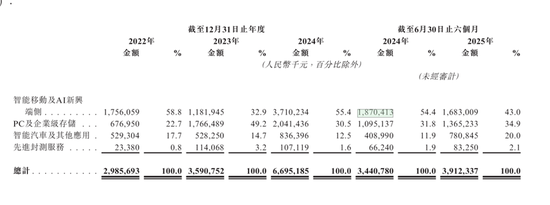
Core Viewpoint - The company, Baiwei Storage, is preparing to enter the Hong Kong capital market, with its controlling shareholder, Sun Chengsi, facing the expiration of a concerted action agreement that is not set to be renewed, potentially affecting his control over the company. Group 1: Company Background and Ownership Structure - Baiwei Storage was founded in September 2010 by Sun Rixin, who established a packaging and testing factory a year prior. Sun Chengsi, his son, took over as vice president in 2012 and became chairman by December 2022 when the company was listed on the Shanghai Stock Exchange [1][2][3]. - The ownership structure includes Sun Chengsi holding 17.65% directly, with family members and employee stock platforms collectively holding 7.09%, making him the actual controller with a total control ratio of 24.74% [4][26]. Group 2: Financial Performance and Growth - Baiwei Storage's revenue has shown significant growth, with figures of CNY 2.986 billion, CNY 3.591 billion, and CNY 6.695 billion for the years 2022, 2023, and 2024 respectively, and a projected revenue of CNY 3.912 billion for the first half of 2025, reflecting a 13.7% year-on-year increase [11][34]. - The company's revenue sources are primarily from smart mobile and AI emerging sectors, contributing 58.8%, 32.9%, 55.4%, and 43% of total revenue across the years, while PC and enterprise storage contributed 22.7%, 49.2%, 30.5%, and 34.9% [12][34]. Group 3: Sales Channels and Customer Dynamics - Direct sales revenue has increased significantly, with figures of CNY 6.87 billion, CNY 15.25 billion, CNY 32.46 billion, and CNY 17.63 billion over the respective periods, while distribution remains the primary sales channel [12][35]. - The top five customers contributed 39.6%, 32.3%, 46.7%, and 47.3% of revenue, with the largest customer contributing 10.4%, 8.9%, 17.2%, and 12.6% [13][36]. Group 4: Cost Structure and Profitability - Baiwei Storage's gross margin has fluctuated, with rates of 12.8%, -2.1%, 17.3%, and 8.9% across the periods analyzed. The gross margins for specific business lines also showed significant variability [16][39]. - Research and development expenses are the largest cost component, amounting to CNY 1.26 billion, CNY 2.5 billion, CNY 4.47 billion, and CNY 2.73 billion, with employee salaries constituting a significant portion of these costs [18][39].
日月光收购了一个晶圆厂
半导体行业观察· 2025-05-15 01:07
Core Viewpoint - The article discusses the acquisition of Yuanlong Electronics by ASE Technology Holding Co., Ltd. (日月光投控) through its subsidiary, Taiwan Fulei Electronics, with a focus on the potential privatization and restructuring of Yuanlong to adapt to the upcoming AI era [1][2]. Group 1: Acquisition Details - ASE Technology plans to acquire Yuanlong Electronics at a price of NT$9 per share, with a maximum purchase of 15,100 shares, totaling NT$136 million, representing a premium of approximately 3.09% based on Yuanlong's closing price of NT$8.73 [1]. - The acquisition period is set from May 15 to June 24, aiming to restructure Yuanlong's operations and promote business transformation [1]. - Post-acquisition, ASE Technology's stake in Yuanlong is expected to reach 68.18%, with the acquisition potentially leading Yuanlong towards privatization [1][2]. Group 2: Financial Performance of Yuanlong - Yuanlong's Q1 financial report shows consolidated revenue of NT$268 million, a quarter-on-quarter increase of 14.2% and a year-on-year increase of 24.6% [1]. - Despite revenue growth, Yuanlong reported a net loss of NT$128 million for Q1, marking the highest quarterly loss in nearly four years, with a loss per share of NT$1.06 [1]. - As of the end of Q1, Yuanlong's net asset value per share was NT$-0.42, down from NT$0.62 at the end of the previous year, putting it at risk of delisting [1]. Group 3: Market Challenges - The 6-inch power semiconductor wafer foundry market is facing pricing pressures, leading to high operational costs for Yuanlong and resulting in nine consecutive quarters of losses [2]. - The competitive landscape has intensified due to price wars from Chinese manufacturers in the MOSFET market, pushing power semiconductor manufacturers towards high-voltage technologies and third-generation semiconductor research [2]. - The integration of Yuanlong into ASE Technology is expected to leverage group resources for operational restructuring, potentially transitioning to third-generation semiconductor processes [2]. Group 4: OSAT Market Overview - According to TrendForce, the top 10 OSAT companies are projected to see a 3% year-on-year revenue growth in 2024, reaching $41.56 billion [3]. - ASE Technology leads the market with revenues of $18.54 billion, capturing nearly 45% of the market share [3]. - Other notable companies include Amkor with $6.32 billion, Changjiang Electronics with $5 billion, and Tongfu Microelectronics with $3.32 billion [3][4]. Group 5: Industry Trends - The OSAT sector is experiencing increasing technical demands, shifting from traditional manufacturing to advanced integration and packaging solutions driven by AI and edge computing [5]. - The industry is adapting to high-frequency and high-density packaging requirements, indicating a significant transformation in operational strategies [5].