智能即服务

Search documents
范式智能发布Phanthy Cloud 以"智能即服务"重塑企业AI底座
Ge Long Hui· 2026-01-26 03:30
Core Insights - The article highlights the shift in enterprise demand for cloud services from resource elasticity to intelligent, secure, and scenario-based capabilities, marking a new phase in cloud services with the introduction of Phanthy Cloud by Fan Shi Intelligence [1][9]. Group 1: Product Overview - Phanthy Cloud represents a comprehensive cloud solution that integrates AI engineering, industry modeling, and computing resource scheduling, addressing the urgent market need for quickly deployable and continuously evolving intelligent cloud platforms [3]. - The platform features a three-layer architecture: cloud layer, computing layer, and capability layer, providing a full-stack solution from resource management to intelligent application [5]. Group 2: Cloud Layer - The cloud layer of Phanthy Cloud supports seamless compatibility with public, private, and hybrid deployment models, ensuring scalability while meeting the security and compliance requirements of government and enterprise clients [5]. Group 3: Computing Layer - The computing layer incorporates a high-performance heterogeneous vGPU scheduling engine, supported by the global active computing management community HAMi, enhancing resource utilization and delivery efficiency in multi-team and multi-task scenarios [5]. Group 4: Capability Layer - The capability layer integrates three core pillars: 1. Model Ecosystem: Addresses challenges in domestic replacement by connecting to a leading community of certified models, rapidly increasing from 0 to over 10,000 models in three months [6]. 2. Engineering Platform: Utilizes the industry-leading AI development platform, enabling enterprises to develop, deploy, evaluate, and govern models autonomously [7]. 3. Vertical World Models: Transforms industry knowledge and high-quality data into reusable model assets, allowing AI to perform precise reasoning and optimization in complex decision-making scenarios [8]. Group 5: Future Outlook - The launch of Phanthy Cloud signifies a critical step towards the era of "AI-as-a-Service," focusing on building usable, trustworthy, and evolvable enterprise-level intelligent systems [9][10].


范式智能发布Phanthy Cloud 以“智能即服务”重塑企业AI底座
Zhi Tong Cai Jing· 2026-01-26 03:26
Core Insights - The article highlights the shift in enterprise demand for cloud services from resource elasticity to intelligent, secure, and scenario-based capabilities, marking a new phase in cloud services with the introduction of Phanthy Cloud by Fan Shi Intelligent [1][8] Group 1: Phanthy Cloud Overview - Phanthy Cloud represents a comprehensive cloud solution that integrates AI engineering, industry modeling, and resource scheduling, addressing the urgent market need for quickly deployable and continuously evolving intelligent cloud platforms [3] - The platform is designed to be "ready-to-use and continuously evolving," catering to enterprises' demands for a robust AI infrastructure [3] Group 2: Three-Layer Architecture - Phanthy Cloud features a three-layer integrated design that provides a full-stack solution from foundational resources to top-level intelligence [5] - Cloud Layer: Seamlessly compatible with public, private, and hybrid deployment models, ensuring security and compliance for government and enterprise clients [5] - Computing Layer: Incorporates a high-performance heterogeneous vGPU scheduling engine, enhancing resource utilization and delivery efficiency in multi-team and fluctuating load scenarios [5] - Capability Layer: Integrates ten years of AI core capabilities, including a model ecosystem, engineering platform, and vertical world models [5][6][7] Group 3: Model Ecosystem - The model ecosystem addresses common challenges in domestic replacement processes, allowing enterprises to quickly access verified model assets and significantly reduce selection and integration cycles [6] - The Phanthy Cloud has connected to a leading domestic model community, achieving a rapid increase in certified models from 0 to over 10,000 in just three months [6] Group 4: Engineering Platform - Phanthy Cloud integrates the industry-leading AI development platform, enabling enterprises to develop, deploy, evaluate, and govern models autonomously, ensuring a closed-loop and evolving AI production pipeline [6] Group 5: Vertical World Models - The platform innovatively transforms ten years of vertical world model capabilities into reusable model assets, allowing AI to perform precise reasoning, evaluation, and optimization in complex decision-making scenarios across various industries [7] Group 6: Future of AI Services - The launch of Phanthy Cloud signifies a critical step towards transforming intelligent capabilities into a new type of enterprise infrastructure, aiming to enable every business to build its own future-oriented AI capability stack with lower barriers and higher efficiency [8]

范式智能(06682)发布Phanthy Cloud 以“智能即服务”重塑企业AI底座
智通财经网· 2026-01-26 03:25
Core Insights - The article highlights the shift in enterprise demand for cloud services from resource elasticity to intelligent, secure, and scenario-based capabilities, marking a new phase in cloud services with the introduction of Phanthy Cloud by Paradigm Intelligence [1][8] Group 1: Product Overview - Phanthy Cloud represents a comprehensive cloud solution that integrates AI engineering, industry modeling, and resource scheduling, addressing the urgent market need for quickly deployable and continuously evolving intelligent cloud platforms [3] - The platform features a three-layer architecture: cloud layer, computing power layer, and capability layer, providing a full-stack solution from resource management to intelligent application [5] Group 2: Technical Features - The cloud layer supports seamless compatibility with public, private, and hybrid deployment models, ensuring security and compliance for enterprise clients while maintaining elasticity [5] - The computing power layer incorporates a high-performance heterogeneous vGPU scheduling engine, enhancing resource utilization and delivery efficiency in multi-team and fluctuating load scenarios [5] - The capability layer integrates Paradigm's decade-long AI core competencies, including a model ecosystem that addresses common challenges in domestic replacement processes, significantly reducing selection and integration cycles for enterprises [6][7] Group 3: Strategic Positioning - Phanthy Cloud aims to transform intelligent capabilities into a new type of enterprise infrastructure, focusing on building usable, trustworthy, and evolvable enterprise-level intelligent systems [8] - The platform's release is a critical step for Paradigm Intelligence in enabling businesses to construct their own AI capability stacks with lower barriers, higher efficiency, and more robust pathways [8]
机器人租赁悄然兴起,机器人“打零工”时代开启了吗?
Yang Guang Wang· 2025-12-26 23:55
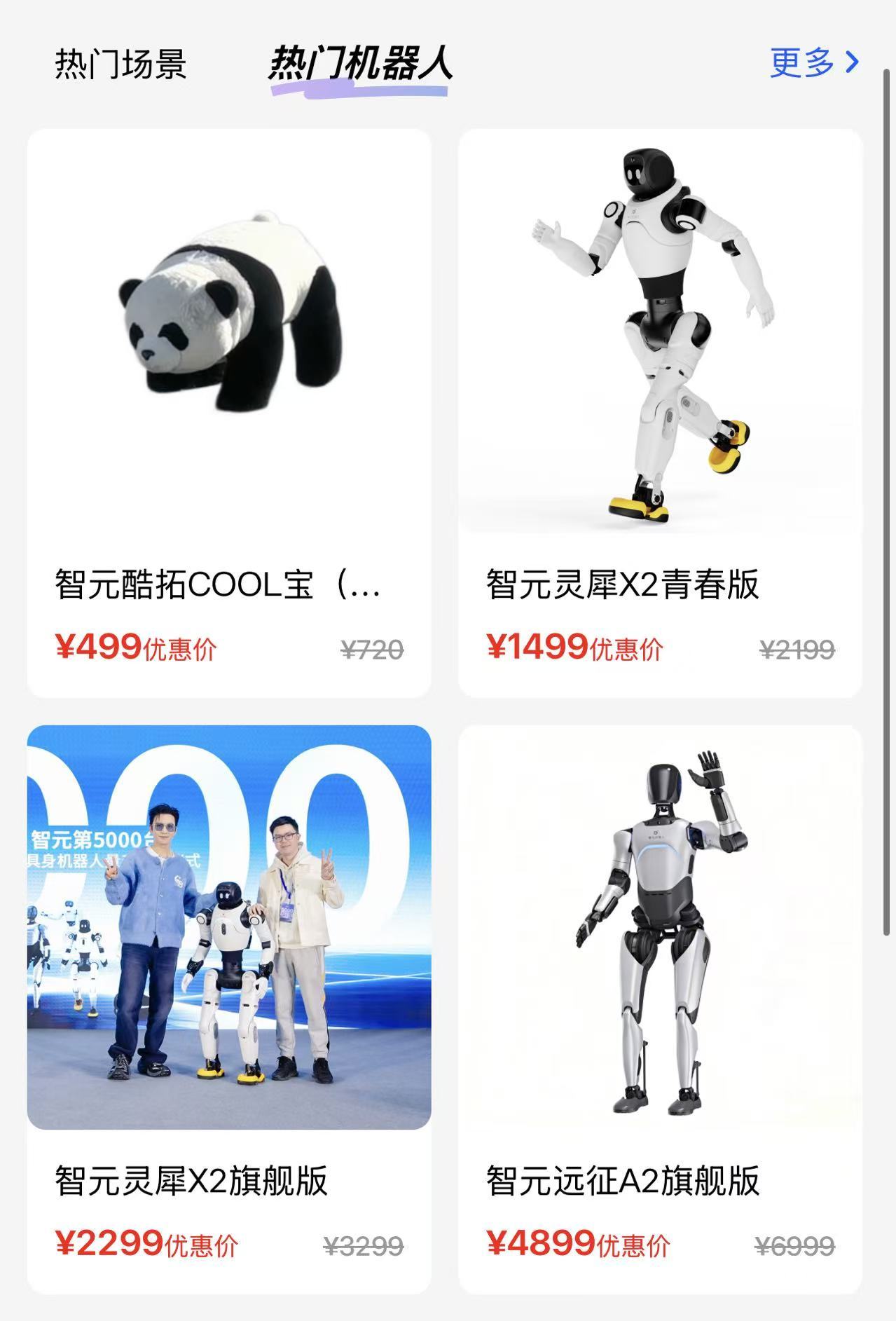
Core Insights - The demand for humanoid robots in entertainment and commercial events has surged, leading to the emergence of robot rental platforms that offer competitive pricing, significantly reducing rental costs from over ten thousand yuan to hundreds or thousands of yuan [1][9]. Group 1: Market Trends - A leading robot company in Shanghai has launched a nationwide open robot rental platform, aiming to create a convenient rental model similar to "shared power banks" [1][9]. - The platform features multiple popular application scenarios for robot rentals, including corporate events, promotional activities, weddings, and school events, with daily rental prices ranging from 500 yuan to 99,800 yuan [1][9]. - The platform's CEO reported a high volume of orders on the launch day, indicating strong market interest [1]. Group 2: Product Offerings - The platform currently offers eight popular robot products from various manufacturers, capable of performing tasks such as greeting guests, interactive dancing, and guest guidance, with rental prices between 200 yuan and 5,000 yuan per day [9][10]. - A rental company in Tianjin offers robots for as low as 200 yuan per day, with options for short-term and long-term rentals, catering to various commercial activities [10]. Group 3: Industry Challenges and Opportunities - The robot rental market is becoming a trend, with companies looking to bridge the gap between technology and real-world applications through rental services [13]. - Industry experts highlight the lack of unified technical and service standards as a significant barrier to growth, alongside high costs and limited production capacity [14]. - The future of the robot market is expected to shift towards B-end applications, focusing on specific functional needs rather than entertainment [14][15]. Group 4: Future Outlook - The rental market is transitioning from simple equipment leasing to "intelligent as a service," indicating a deeper transformation towards enterprise-level needs [15]. - Companies that can address industry standardization and intelligent service implementation challenges are likely to gain a competitive edge in the growing robot rental market [15].

机器人“打零工”时代开启,有平台日租价腰斩
第一财经· 2025-12-25 08:31
Core Viewpoint - The rise of robot rental services is transforming the market, allowing businesses to access robotic technology on a flexible basis, thus marking the advent of a "gig economy" for robots [3][4][7]. Group 1: Market Dynamics - The robot rental market has emerged significantly since the Spring Festival, driven by the performance of Yushou robots during the Spring Festival Gala, leading to a surge in demand for rental services [7]. - The current robot rental market is estimated to have surpassed 1 billion yuan, with projections for next year to reach no less than 10 billion yuan [8]. - Rental prices for robots have drastically decreased, with daily rates now ranging from hundreds to thousands of yuan, compared to previous rates exceeding 10,000 yuan per day [3][5][6]. Group 2: Service Offerings - Various types of robots are available for rent, including dance robots and robotic dogs, with services tailored for events such as annual meetings [5][6]. - Robots can perform a range of tasks including greeting guests, performing dances, and interactive activities, enhancing the event experience [6][7]. Group 3: Industry Challenges - The rapid growth of the rental market has raised concerns about the lack of standardized technology and service quality, with some low-cost providers leading to higher failure rates [9]. - The competition in the short-term rental market is intense, with risks of underutilization and price wars, prompting some companies to consider long-term rental models instead [9][10]. - The future of the robot rental market may hinge on the transition from simple equipment rental to providing intelligent services, integrating advanced data capabilities [9][10].

比尔·盖茨:用人工智能来提升工作质量
3 6 Ke· 2025-08-07 07:16
Core Insights - Companies that do not adopt artificial intelligence (AI) will soon be left behind, but it is not too late to start integrating AI into their strategies [2] - The book "AI First" serves as a guide for businesses to understand and implement AI, drawing insights from influential tech leaders [2][3] Group 1: Book Overview - "AI First: The Playbook for a Future-Proof Business or Brand" discusses the concept of "AI First" and its implications for businesses [2] - The authors, Adam Brotman and Andy Sack, emphasize the importance of integrating AI into business strategies, similar to previous digital transformations [2] Group 2: Insights from Interviews - The authors interviewed prominent figures like Sam Altman and Bill Gates to gather insights on AI's potential and impact [2][3] - Sam Altman highlighted OpenAI's mission to achieve general artificial intelligence, which could outperform human capabilities [7] - Bill Gates compared the experience of seeing ChatGPT-4 to witnessing the launch of graphical user interfaces, indicating the transformative potential of AI [8] Group 3: Practical Applications of AI - Companies should not rush to implement AI without understanding its foundational aspects; daily use of AI can enhance decision-making and productivity [9] - Leaders are encouraged to view AI as a colleague, collaborating with it in decision-making processes [10] - The book stresses the importance of developing AI-first talent within organizations to fully leverage AI's capabilities [9]