服务订阅

Search documents
瑞银下调特斯拉2025年第4季度交付量
Zhong Guo Qi Che Bao Wang· 2025-12-31 01:43
Core Viewpoint - UBS has significantly lowered its Q4 2025 delivery forecast for Tesla from the market expectation of 435,000 units to 415,000 units, representing a year-over-year decline of 16% and a quarter-over-quarter decline of 17% [1]. Group 1: Delivery Forecast and Market Conditions - UBS's downward revision of Tesla's delivery forecast indicates significant pressure on the company, despite the long timeline before the conditions for Musk's high compensation package are evaluated [1]. - Tesla's delivery volumes have shown fluctuations across major markets, including the U.S., Europe, and China, which has contributed to analysts' pessimism [4]. - In the U.S. market, Tesla's delivery volume for October and November was 80,000 units, a decrease of 23% compared to the first two months of Q4 2024 and a 26% decline year-over-year [4]. Group 2: Financial Performance and Profitability - Tesla's total revenue in Q1 2025 decreased by 9% year-over-year, with GAAP net profit at $409 million and an operating margin plummeting to 2.1% [5]. - UBS's financial projections for Tesla indicate a decline in EBIT and net income, with expected EBIT of $6.101 billion and net income of $5.403 billion for 2025 [6]. Group 3: Product Challenges and Consumer Sentiment - The Model Y has been reported as the "least reliable model" in the 2026 TÜV report, with the highest defect rate recorded in the past decade, raising concerns about quality [5]. - The "phantom braking" phenomenon in Tesla's FSD system has led to legal challenges and increased scrutiny regarding the safety of the autonomous driving technology [5]. Group 4: Future Growth Opportunities - Tesla's FSD system is crucial for the Robotaxi business, which has begun operations in Austin, Texas, with plans to expand to additional cities [8]. - The company aims to produce the Cybercab at a cost below $30,000, with operational costs as low as $0.20 per mile, potentially transforming the transportation industry [8]. - Tesla's humanoid robot, Optimus, is set to enter mass production, with plans for a third-generation model by the end of 2025, which could redefine human-robot collaboration and open new market opportunities [9].


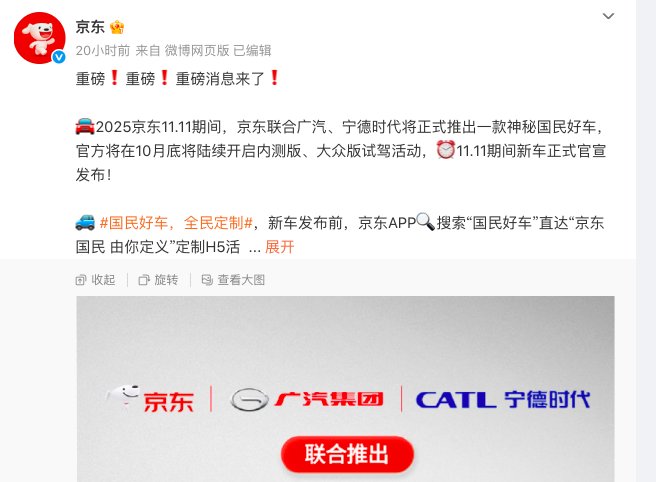
三大上市公司联手,开卖10万级“国民车”?
Tai Mei Ti A P P· 2025-10-21 05:42
Core Insights - GAC Group, JD.com, and CATL have formed a strategic partnership to redefine the sales and manufacturing process of electric vehicles, introducing a new model for the automotive industry [1][3][10] Group 1: GAC Group's Transformation - GAC Group is shifting from a traditional dealership model to a direct sales approach, facing challenges from new entrants in the electric vehicle market [4][8] - The company has experienced a significant decline in revenue and profit, with a total revenue of 426.11 billion yuan, down approximately 7.88% year-on-year, and a net profit turning negative [8][9] - GAC's collaboration with JD.com and CATL represents a strategic shift from "market for technology" to "technology for ecosystem," aiming to leverage its manufacturing capabilities and integrate with external resources [9][10] Group 2: JD.com's Role - JD.com has been building its automotive ecosystem since 2015, focusing on a full lifecycle service model for car owners, including sales, maintenance, and parts [11][12] - The company aims to redefine the car buying experience, making it as simple and transparent as purchasing electronics, and has introduced innovative service packages to enhance customer engagement [13][14] - JD.com is not involved in manufacturing but focuses on consumer insights and sales, positioning itself as a facilitator in the automotive market [11][12] Group 3: CATL's Strategy - CATL is transitioning from a battery supplier to an energy service provider through this partnership, aiming to address competitive pressures from second-tier manufacturers and in-house battery development by automakers [9][10] - The collaboration allows CATL to promote its "chocolate battery" technology and expand its service offerings, enhancing its market position [9][10] Group 4: New "Iron Triangle" Model - The partnership between GAC, JD.com, and CATL represents a new industrial division of labor, integrating manufacturing, technology, and e-commerce to create a comprehensive automotive experience [15][17] - This model shifts the focus from traditional vehicle sales to a full lifecycle service approach, potentially transforming the automotive industry's value chain [15][17] - The collaboration is seen as a proactive response to the declining profit margins in the automotive sector, with the industry profit rate dropping to 3.9% in early 2025 [15][16]



微软又“作妖”:彻底封禁所有OOBE离线安装方法
猿大侠· 2025-10-10 04:11
Core Viewpoint - Microsoft has removed traditional methods for creating local accounts during the Windows 11 setup process, requiring users to log in with a Microsoft Online Account to complete the installation [1][3][12]. Group 1: Changes in Installation Process - The latest updates (Build 26120.6772 and 26220.6772) have blocked previous workarounds for offline installation, such as using command prompts to bypass the online account requirement [1][7]. - Users are now forced to connect to the internet and log in to a Microsoft account during the initial setup, which impacts the installation experience [3][12]. Group 2: User Concerns and Motivations - Users previously opted for offline installation to avoid the risk of losing the 7-day return policy once the Windows system was activated online [9][12]. - Privacy concerns also drove users to prefer local accounts, as data stored locally minimizes the risk of personal information being exposed through cloud synchronization [11][12]. - Many users sought to avoid advertisements and unnecessary features that come with using a Microsoft account, which integrates them into Microsoft's ecosystem [11][12]. Group 3: Microsoft's Business Strategy - The push for Microsoft account usage is driven by commercial interests, allowing Microsoft to collect user data for targeted advertising and increase subscription rates for services like OneDrive and Office 365 [13]. - Tying accounts to the Microsoft Store facilitates the management of paid applications, ensuring revenue generation for the company [13].