
期权杠杆

Search documents
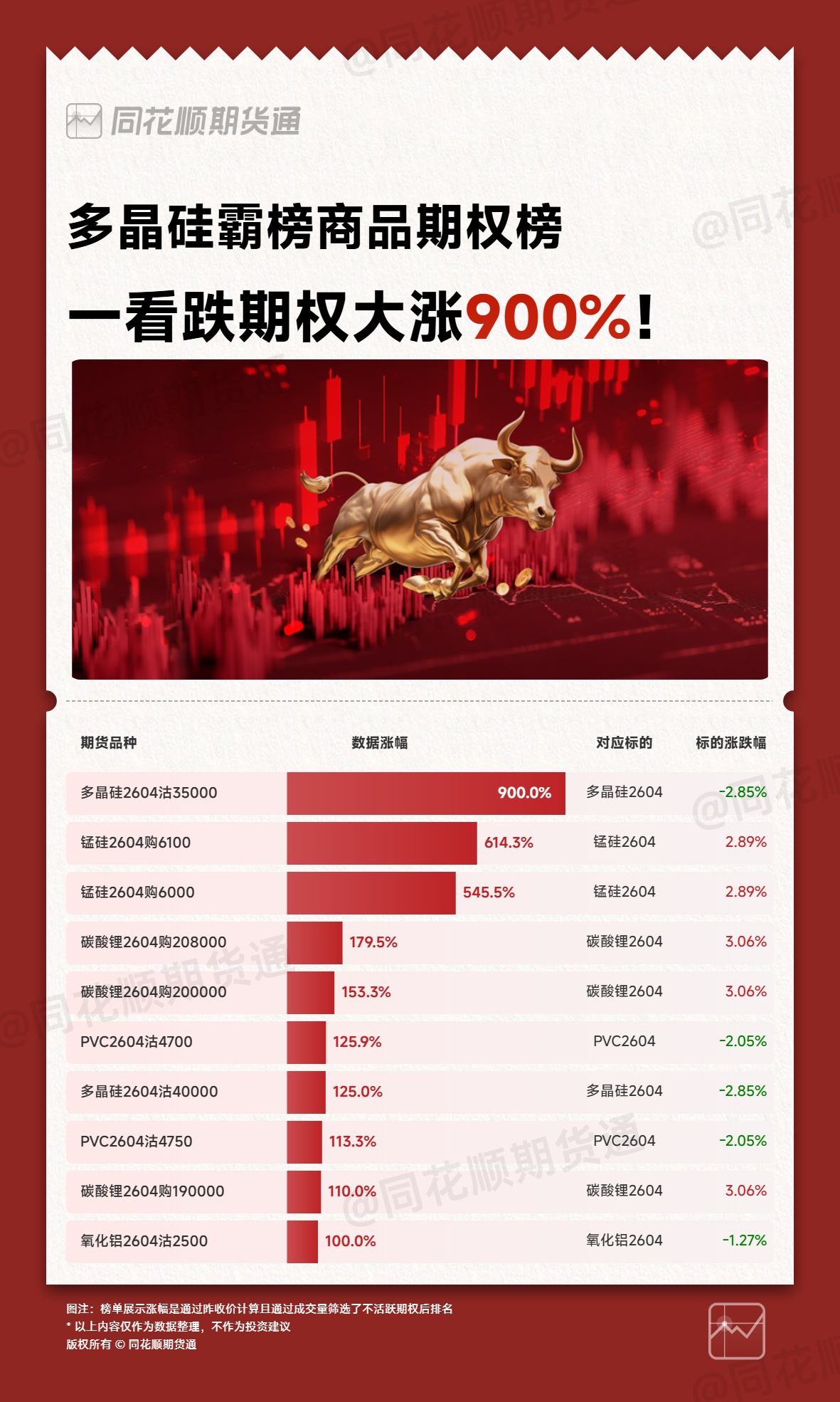
多晶硅期权大涨900%夺得期权榜首
Xin Lang Cai Jing· 2026-02-26 10:27
Core Insights - The commodity options market has experienced significant volatility, with the price of polysilicon put options surging nearly 900% in a single day, highlighting the potential for high returns from small price movements [5][9] - The top three options that saw the largest increases were all out-of-the-money options, indicating that low initial prices and premiums can lead to substantial gains when the underlying asset experiences minor fluctuations [7][9] Market Performance - Polysilicon put option 2604 at 35000 increased by 900% while the underlying asset decreased by 2.85% [3] - Manganese silicon call option 2604 at 6100 rose by 614.3% with the underlying asset increasing by 2.89% [3] - Manganese silicon call option 2604 at 6000 saw a 545.5% increase, also with the underlying asset up by 2.89% [3] Market Dynamics - The current market conditions are driven by a combination of high implied volatility, the nature of out-of-the-money options, and supportive policies affecting supply and demand [5][9] - The increase in volatility is attributed to high inventory levels of polysilicon and export policy disruptions for manganese silicon, leading to heightened market expectations for future price movements [7][9] - The fundamental factors, including supply surplus and policy changes, have led to increased investment in polysilicon, while manganese silicon is supported by export controls and supply-side reforms [7][9]

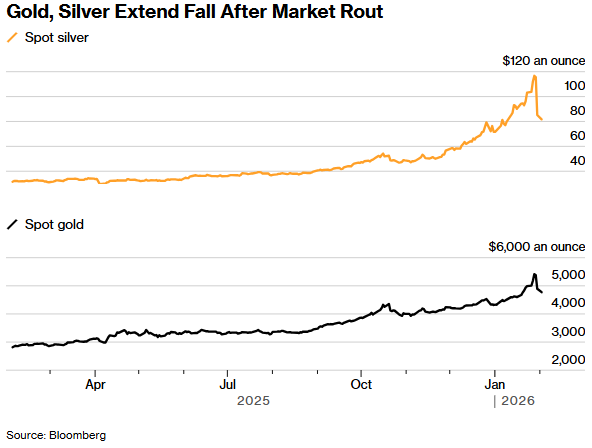
“拥挤交易”崩塌?黄金白银延续跌势 高盛预警期权杠杆加剧波动
智通财经网· 2026-02-02 02:15
Core Viewpoint - The precious metals market is experiencing a significant downturn, with gold and silver prices facing their largest declines in over a decade, following a record surge that was deemed unsustainable [1][4]. Group 1: Price Movements - Gold prices have seen a dramatic drop, with a reported decline of 2.57% to $4,740.53 per ounce, marking the largest drop in 40 years [4]. - Silver prices also fell significantly, down 1.02% to $84.84 per ounce, with intraday fluctuations showing a drop of up to 12% [1][4]. - The overall precious metals market, including platinum and palladium, has also experienced declines [4]. Group 2: Market Dynamics - The surge in precious metal prices over the past year was driven by geopolitical tensions, currency devaluation, and concerns over the independence of the Federal Reserve, leading to increased investor interest [4]. - A key trigger for the recent sell-off was the news of President Trump's potential nomination of Kevin Warsh to lead the Federal Reserve, which strengthened the dollar and negatively impacted precious metal prices [4]. - High volatility in the market was anticipated due to the extreme price movements, which have put pressure on traders' risk models and balance sheets [4]. Group 3: Market Sentiment - Market sentiment has shifted as traders react to the potential for tighter monetary policy under Warsh, who is viewed as a strong anti-inflation candidate, leading to expectations that could support the dollar and weaken precious metals [4]. - The recent surge in bullish options buying has created a "mechanical reinforcement" effect on price increases, as option sellers hedge their exposure by buying more [4].
期权杠杆科普:期权的杠杆从哪里来? ——白话期权系列之一
申万宏源金工· 2026-01-29 08:02
Group 1 - The core concept of options leverage is derived from the significant disparity between the value of the underlying asset and the premium paid for the option, allowing investors to control a larger asset value with a smaller amount of capital [1][4] - Options leverage is fundamentally different from futures leverage, as options provide a right without the obligation to execute, leading to asymmetric risk and reward profiles [2][3] - The nominal leverage ratio is calculated as the ratio of the underlying asset price to the option premium, indicating how much asset value can be controlled per unit of premium paid [5][6] Group 2 - The actual leverage ratio incorporates Delta, which measures the sensitivity of the option price to changes in the underlying asset price, providing a more accurate reflection of the potential returns [6][8] - Factors affecting options leverage include whether the option is in-the-money or out-of-the-money, the time until expiration, and market volatility expectations [9][10][11] - In-the-money options have lower nominal leverage but higher Delta, while out-of-the-money options have higher nominal leverage but lower Delta, affecting their sensitivity to price changes [9][10] Group 3 - Investors can strategically use options leverage by selecting in-the-money options for better price tracking and moderate expiration timelines to balance time decay and leverage efficiency [13][15] - The choice of strike price and expiration date reflects the investor's conviction and risk tolerance, with deeper in-the-money options being suitable for long-term bullish or bearish views [14][15] - Market expectations of volatility influence option premiums and leverage effects, with higher volatility leading to increased premiums and reduced leverage efficiency [12][11]

白话期权系列之一:期权杠杆科普:期权的杠杆从哪里来?
Shenwan Hongyuan Securities· 2026-01-29 06:51
1. Report Industry Investment Rating No information provided in the report regarding the industry investment rating. 2. Core Viewpoints of the Report - Options are known as the "king of derivatives" in the financial market, with their leverage effect being one of the most attractive yet risky features. Understanding the nature and changing rules of leverage is crucial for investors to use this financial tool effectively and avoid risks [7]. - The leverage of options is endogenous to their product design. It stems from the large disparity between the value of the underlying asset and the premium, allowing investors to control assets worth much more than their investment, thus magnifying both potential returns and risks [7]. - The leverage of options is not fixed but changes non - linearly with factors such as the price of the underlying asset, time, and volatility. There are two common ways to calculate leverage: nominal leverage and actual leverage [12]. - The actual leverage, which takes into account the Delta factor, can more accurately reflect the actual amplification of option returns relative to changes in the underlying asset price [15]. - The leverage of options is affected by factors such as the moneyness of the option, the time to expiration, and market - expected volatility. Investors should understand these factors to develop appropriate trading strategies [19]. 3. Summary According to the Table of Contents 3.1 Option Leverage Source - Options' leverage is different from that of margin trading and futures. It is embedded in the product design. Buyers pay a premium to obtain the right to buy or sell the underlying asset at a specified price in the future, creating a leverage effect [7]. - The "right leverage" of options is fundamentally different from the "margin leverage" of futures. The maximum loss of option buyers is limited to the premium, while the risk of futures is symmetric and potentially unlimited [8]. 3.2 Option Leverage Calculation - **Nominal Leverage Multiple**: Calculated as the price of the underlying asset divided by the premium. It shows the market value of the underlying asset that can be controlled per unit of premium, but it does not consider the actual relationship between option price changes and underlying asset price changes [12]. - **Actual Leverage Multiple**: Calculated as Delta times the nominal leverage. Delta represents the sensitivity of the option price to changes in the underlying asset price. Introducing Delta can more accurately reflect the actual amplification of option returns relative to changes in the underlying asset price [13]. 3.3 Option Leverage Changes - **Moneyness of the Option**: Out - of - the - money options usually have high nominal leverage but low Delta, so the low Delta offsets the high nominal leverage effect to some extent. In - the - money options have relatively low nominal leverage, but their prices move almost in sync with the underlying asset price (Delta close to 1), resulting in a relatively stable actual leverage [19]. - **Time to Expiration**: As the expiration date approaches, the time value of the option decays, causing the premium to decline and the nominal leverage to rise. At the same time, the option price becomes extremely sensitive to changes in the underlying asset price, making the actual leverage extremely high and unstable [21]. - **Market - Expected Volatility**: When market - expected volatility rises, option premiums generally increase, leading to a decrease in nominal leverage. When market - expected volatility falls, option premiums generally decrease, causing the nominal leverage to rise. Volatility also affects the Delta of options [22]. 3.4 Option Leverage Application - When investors are bullish on an underlying asset, they can choose in - the - money options with a maturity of about 3 months. These options have a Delta close to 1, can closely track the price changes of the underlying asset, and have a relatively stable leverage effect [28]. - Different market views correspond to different option selection strategies, including choosing deep - out - of - the - money options for short - term large - amplitude unilateral markets, at - the - money or slightly out - of - the - money options for medium - term trend markets, and deep - in - the - money options for long - term bullish or bearish views [31].