杠杆踩踏

Search documents
大年初二不太平,金价银价集体崩盘,休市无交易,为何跌得这么狠
Sou Hu Cai Jing· 2026-02-18 09:29
Core Viewpoint - The significant drop in gold and silver prices during the Chinese New Year holiday has left investors in a state of shock, as domestic markets were closed while international prices plummeted, leading to substantial losses for those holding precious metals [1][3]. Group 1: Market Performance - COMEX gold futures fell by 2.33%, closing at $4896.10 per ounce, and briefly touching $4857, erasing half a month's gains [3]. - COMEX silver futures experienced a more severe drop of 3.93%, with spot silver reaching a maximum decline of 5.13%, hitting $72.3 per ounce [3]. - Domestic markets, despite being closed, saw estimated declines of 1.47% for gold T+D, 1.61% for Shanghai gold futures, 3.26% for silver T+D, and 5.52% for Shanghai silver futures [3]. Group 2: Reasons for Price Drop - The primary reason for the price drop is that while domestic markets were closed for the holiday, international markets continued to operate, leading to a disconnect where domestic prices had to adjust to international declines upon reopening [5]. - A sudden easing of geopolitical tensions, particularly between the U.S. and Iran, diminished the "safe haven" appeal of gold and silver, prompting investors to sell off their holdings [6][7]. - The U.S. Federal Reserve's dovish stance and strong economic data led to a surge in the U.S. dollar, which negatively impacted gold and silver prices as investors shifted their funds to dollar-denominated assets [8]. - The absence of domestic buying power during the holiday created a liquidity vacuum, exacerbating the price drops as there were no buyers to stabilize the market [9][10]. - High leverage and margin calls forced many investors to liquidate their positions, contributing to a downward spiral in prices [11][12]. Group 3: Investor Sentiment - The stark contrast in experiences during the holiday highlighted the distress among precious metal investors, who faced significant losses while others enjoyed festive celebrations [13][14]. - Despite the short-term volatility, the long-term fundamentals for gold and silver remain intact, with ongoing central bank purchases and a potential future shift in monetary policy [14][15].


重大利空来袭!黄金一夜暴跌600美元,白银崩盘20%,紧急避险!
Sou Hu Cai Jing· 2026-02-01 12:17
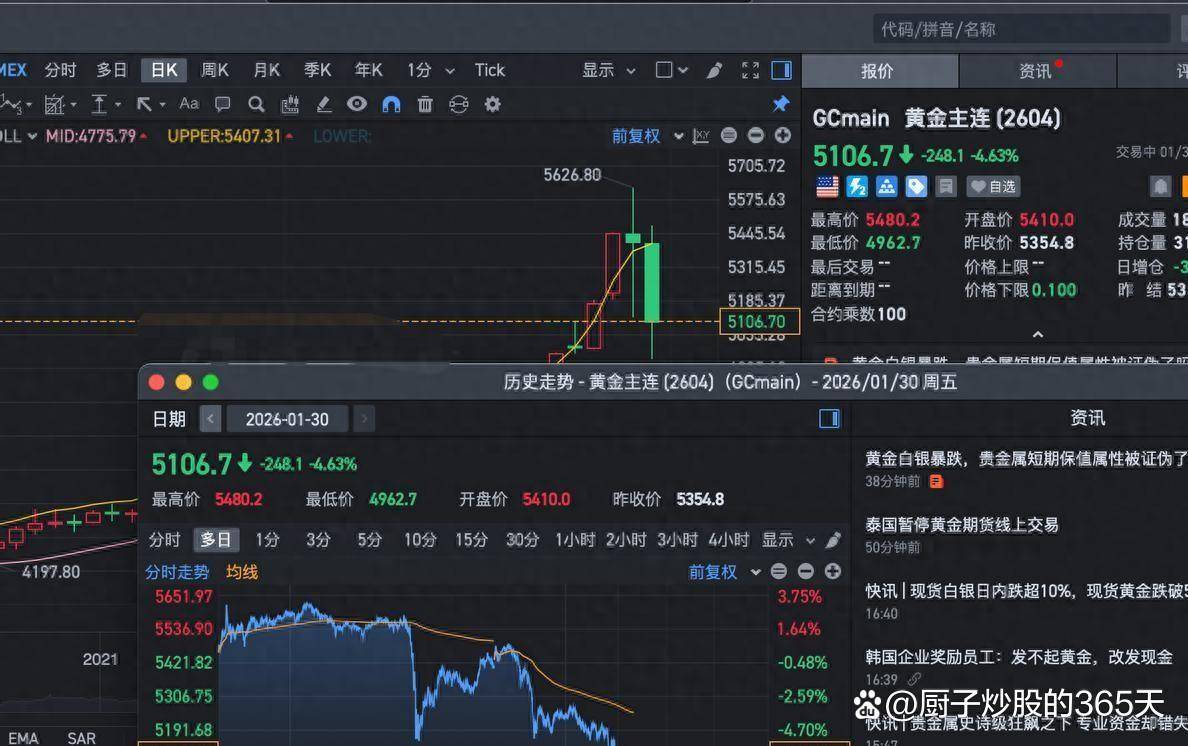
Core Viewpoint - The global precious metals market experienced a dramatic crash on January 30, 2026, with gold prices plummeting over $600 within 24 hours, while silver saw a 20% drop, highlighting extreme volatility and market reactions to Federal Reserve signals [1][3]. Group 1: Market Reactions - Gold prices fell from a historical high of $5627 to below $5000, while silver prices dropped from $122 to $95 [1]. - The Federal Reserve's decision to maintain interest rates and comments on inflation led to a surge in the dollar index by 1.2% and a rise in 10-year Treasury yields above 4.23%, increasing the holding costs of non-yielding assets like gold [3]. - The Chicago Mercantile Exchange raised silver futures margin requirements, pushing high-leverage long positions to the brink of liquidation, exacerbating the market crash [3]. Group 2: Technical Indicators - Technical indicators showed that the Relative Strength Index (RSI) for gold surpassed 90, and silver's year-to-date increase approached 60%, indicating market euphoria [4]. - The gold-to-silver ratio dropped to a 14-year low of 46.39, with a high long-to-short position ratio of 10:1 in gold futures, suggesting extreme market sentiment [4]. Group 3: Political and Economic Factors - Political developments, including Trump's potential nomination of hawkish candidate Kevin Warsh as Fed Chair, raised concerns about sustained high interest rates, further pressuring precious metals [5]. - The market estimated that the recent sell-off resulted in a nominal value loss of $3.4 trillion, equivalent to the total market capitalization of cryptocurrencies [5]. Group 4: Investor Behavior and Market Dynamics - High-leverage accounts faced severe losses due to margin increases, while investors holding physical gold or low-leverage gold ETFs experienced floating losses but were not forced out of the market [6]. - Institutional investors have been withdrawing from the market, with significant sell-offs in gold-related stocks, indicating a shift in market dynamics [6]. - The decline in geopolitical risk premiums, as evidenced by Trump's willingness to negotiate with Iran and easing tensions in Europe, contributed to the sell-off in precious metals [8]. Group 5: Structural Market Issues - The crash revealed structural weaknesses in the precious metals market, with silver's industrial properties failing to provide price support amid financial speculation [8]. - The liquidity crisis highlighted the historical pattern that extreme market conditions often lead to a brutal reckoning of irrational speculation [8].
杠杆屠刀落下!比特币跌破10万刀,美国两党用民众饥饿做赌注
Sou Hu Cai Jing· 2025-11-09 19:21
Group 1: Bitcoin Market Dynamics - Bitcoin price fell below the psychological threshold of $100,000, reaching a low of $99,075.89 before a brief recovery to $104,070, indicating a significant market panic [1] - The recent crash is attributed to a "death spiral" caused by market sentiment cooling and leveraged liquidations, with 76% of liquidations being long positions [3] - Long-term holders sold 405,000 Bitcoins worth over $4 billion in the past 30 days, contributing to downward pressure on prices [3] Group 2: U.S. Government Shutdown Impact - The U.S. government shutdown has entered its 36th day, causing significant disruptions in various sectors, including air travel, with thousands of flights delayed or canceled [5] - The Congressional Budget Office estimates that the shutdown could reduce the annualized GDP growth rate by 1-2 percentage points per week, potentially leading to a $14 billion economic loss in Q4 [6] - The political deadlock is rooted in sharp divisions over the Affordable Care Act, reflecting broader political polarization in the U.S. [6] Group 3: Federal Reserve and Economic Concerns - The Federal Reserve's recent interest rate cut of 25 basis points to a range of 3.75% has not alleviated market anxiety, with concerns about inflation persisting [8] - The independence of the Federal Reserve is under unprecedented pressure, with political interventions complicating monetary policy decisions [8] - A crisis in stablecoins has emerged, with significant liquidity risks highlighted by the collapse of xUSD, which could lead to a broader liquidity crisis in the cryptocurrency market [8] Group 4: Broader Market Reactions - The Nasdaq index fell by 2% in a single day, with significant losses in tech stocks like Nvidia, reflecting a broader downturn in risk assets [10] - Consumer confidence has dropped to its lowest level since June 2022, indicating a potential slowdown in consumer spending [10] - Analysts predict that if Bitcoin fails to hold above $100,000, it may target a low of $74,000, highlighting the extreme uncertainty in the market [10]