
核心+卫星

Search documents
一家公司、一只基金、近二十年深耕,1250%的累计回报,这位基金经理的长期主义实践
Xin Lang Cai Jing· 2026-01-27 12:12
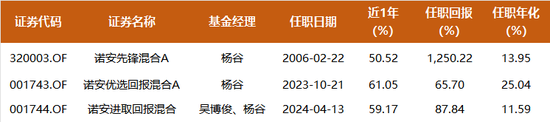
Core Insights - The article highlights the exceptional performance of fund manager Yang Gu, who has managed the Nuon Vanguard Fund for nearly 20 years, achieving an annualized return of approximately 13.3% and a total return of 1153.15% as of December 31, 2025, significantly outperforming the benchmark [3][50][51]. Group 1: Long-term Investment Strategy - Yang Gu exemplifies long-term investment principles, maintaining a consistent focus on quality stocks and demonstrating remarkable discipline in his investment choices [6][53]. - The Nuon Vanguard Fund has received multiple awards for its outstanding long-term performance, including the Golden Bull Fund Award for various time frames [52]. Group 2: Portfolio Management - As of the end of 2025, Yang Gu's managed funds totaled 5.6 billion yuan, allowing for a focused investment strategy [8]. - The fund's portfolio has shown a significant increase in concentration, with the top ten holdings accounting for 51.78% of the fund's assets by the fourth quarter of 2025 [11][58]. Group 3: Stock Selection and Market Positioning - Yang Gu avoids following market trends blindly, focusing instead on independent stock selection, particularly in small and mid-cap growth stocks, which can offer higher growth potential [14][61]. - The top holdings include companies like Jindiaoer and Jin Feng Technology, which have shown substantial price increases, indicating effective stock selection [19][66]. Group 4: Earnings-Driven Growth - The fund's success is attributed to long-term holdings in companies that have significantly increased their market capitalization and earnings, such as Sailun Tire, which saw its stock price rise by approximately 400% since its initial investment [30][70]. - Yang Gu emphasizes that the fund's returns are primarily driven by earnings growth rather than valuation changes [31][72]. Group 5: Diversification Strategy - The Nuon Vanguard Fund employs a diversified approach across various industries, with the top three sectors being semiconductors, specialized equipment, and wind power equipment [35][74]. - This diversification helps manage risk while maintaining a stable net asset value over time, demonstrating the importance of avoiding significant losses in the long run [78]. Group 6: Future Outlook - Yang Gu anticipates that innovation will remain a key theme in 2026, focusing on advancements in manufacturing, AI, and digital economy sectors [84]. - The fund is expected to continue adapting its strategy to capture emerging opportunities while maintaining its long-term investment philosophy [80][86].

康曼德资本董事长丁楹:A股将进入“盈利驱动+政策引导”双轮驱动新阶段
Mei Ri Jing Ji Xin Wen· 2025-12-25 15:00
Core Viewpoint - The A-share market is expected to enter a new phase driven by "profitability and policy guidance" in 2026, transitioning from a liquidity-driven market in 2025, with a focus on both growth and stability in investment strategies [2][5]. Investment Opportunities - The two main investment lines for the next 3-5 years are: 1. "Growth Steed" representing technology innovation fields such as domestic computing power, AI applications, robotics, and energy storage 2. "Steady Horse" representing traditional industry upgrades and value reassessment, including high-end manufacturing, resource security, and financial openness [3][4]. - Institutional funds are expected to continue focusing on AI and computing power, but with a more balanced allocation towards traditional industries like finance and resource optimization [2][3]. Market Characteristics - The 2026 market is characterized by a shift from liquidity-driven dynamics to profitability-driven dynamics, which may increase volatility but still present structural opportunities [5]. - The "15th Five-Year Plan" emphasizes "technological self-reliance" as a core strategy for high-quality development, which is anticipated to reshape the valuation system of A-shares, particularly benefiting technology growth stocks [4]. Valuation and Pricing Logic - The "technological self-reliance" policy is expected to enhance the visibility of earnings and policy certainty for technology growth stocks, thereby reducing risk premiums and raising valuation benchmarks [4]. - The pricing logic for technology stocks will shift from being purely thematic-driven to a three-dimensional assessment based on "technical barriers, market space, and policy support" [4]. Investment Strategy for Ordinary Investors - Ordinary investors are advised to adopt a "core + satellite" allocation framework, focusing on long-term growth sectors while dynamically adjusting satellite positions based on market conditions and policy catalysts [3][5]. - In 2026, it is recommended to initially lean towards "Growth Steed" sectors in the first half of the year, and gradually increase exposure to "Steady Horse" sectors in the latter half to manage potential market fluctuations [5].
市场回暖,提前结募、“日光基”频现
Zheng Quan Shi Bao· 2025-09-11 00:01
Core Insights - The equity fund issuance market is experiencing a significant rebound, with many funds choosing to end their fundraising early due to increased investor confidence and demand for equity products since the market's notable rebound in 2024 [1][4]. Fund Issuance Trends - In September, 10 equity funds have announced early closures of their fundraising, contributing to a total of 13 funds that have done so this month [2][3]. - The new fund issuance market has shown warmth, with 54 new funds established in September, of which 47 are equity funds, accounting for nearly 90% of total issuances [6]. Fund Performance and Demand - The total issuance scale for stock and mixed funds since September has reached approximately 35.2 billion, with 15 newly established mixed funds raising a total of 14.02 billion, marking a monthly record high for average issuance scale in nearly two years [6]. - Notably, the "Zhaoshang Balanced Preferred Mixed Fund" achieved a subscription scale exceeding 8 billion on its launch day, ultimately reaching a final scale of 4.955 billion, making it the largest actively managed equity fund established this year [6]. Market Environment and Investor Sentiment - Analysts attribute the rapid fundraising closures to a combination of market conditions, investor demand, and proactive adjustments by fund companies to seize market opportunities [4]. - The current market environment reflects a recovery in investor confidence, with a shift towards a "structural slow bull" market characterized by a focus on both safety and returns through balanced asset allocation strategies [8][9]. Investment Strategies - Fund managers recommend a balanced asset allocation approach, utilizing strategies such as "core + satellite" or barbell strategies to manage risk and enhance returns [8][9]. - There is an emphasis on investing in undervalued large-cap growth assets and emerging technology assets expected to perform well in the next 1-2 quarters, alongside opportunities in cyclical commodities benefiting from improved liquidity [9][10].
公募FOF选基策略揭晓 多元资产框架下动态配置
Zheng Quan Ri Bao· 2025-07-21 17:17
Group 1 - The core viewpoint of the articles highlights that over 90% of public FOFs achieved net value growth in Q2 2025, with a focus on diversified asset allocation and structural opportunities in the equity market [1][4]. - Different fund managers have varying investment strategies, with some emphasizing structural opportunities in new productivity sectors such as new consumption, new technology, and new manufacturing [2][4]. - Specific funds like Penghua Yixuan and Chuangjin Hexin have reported significant net value growth rates of 6.95% and 6.06% respectively, showcasing their unique asset allocation strategies [2][3]. Group 2 - Fund managers are increasingly focusing on high-dividend assets and technology sectors, with funds like Chuangjin Hexin adjusting their allocations to emphasize value stocks and technology growth [3][4]. - The outlook for the second half of 2025 suggests a potentially better performance in the stock market due to external factors such as the Federal Reserve's interest rate cuts and domestic inventory replenishment cycles [5]. - Managers express optimism about structural investment opportunities in the capital market, particularly in the context of a low-interest-rate environment and the potential for risk appetite recovery [4][5].