AI产业趋势

Search documents
“HALO”交易是否能带来价值红利回归:美日欧篇
Changjiang Securities· 2026-03-18 11:25
Group 1: Global Market Overview - In 2025, global capital markets experienced significant differentiation and restructuring, driven by macroeconomic narratives and strong profitability in the AI industry[4] - The "HALO" trading strategy emerged, indicating a return to value amidst strong growth expectations in certain regions[4] Group 2: European Market Performance - In Europe, the dividend value style outperformed growth style for 11 out of 12 months in 2025, with a notable absolute return in the dividend index exceeding double digits[7] - The MSCI Europe high dividend index recorded a remarkable increase of 35.91%, significantly outperforming the MSCI Europe growth index[25] - The European Central Bank implemented eight interest rate cuts from mid-2024 to mid-2025, reducing the deposit facility rate from 4.00% to 2.00%, alleviating pressure on high-leverage traditional enterprises[8] Group 3: Japanese Market Dynamics - Japan's stock market reached historical highs in 2025, with the Nikkei 225 index rising by 26.18% and the MSCI Japan high dividend index increasing by 23.79%[22] - The Japanese market exhibited a balanced performance between growth and dividend styles, with both achieving double-digit increases[22] - Significant share buybacks in Japan reached approximately 12 trillion yen in the first five months of 2025, marking a 20% increase year-on-year[22] Group 4: U.S. Market Insights - In the U.S., despite the long-term effectiveness of dividend aristocrat strategies, growth expectations driven by major tech companies posed challenges for dividend value strategies[23] - The "HALO" assets, including sectors like energy and utilities, saw a substantial increase in relative returns, particularly in early 2026[23] - The S&P 500 growth index rose by 22.18%, driven by strong earnings from the "Magnificent 7" tech giants, contributing significantly to the overall market gains[25]





2月美国CPI点评与市场观察
Tebon Securities· 2026-03-12 08:30
Inflation Data - February CPI in the U.S. increased by 2.4% year-on-year and 0.3% month-on-month, aligning with market expectations and previous values[1] - Core CPI rose by 2.5% year-on-year and 0.2% month-on-month, also meeting expectations[1] Market Impact - Overall inflation data is relatively mild, with limited market impact due to geopolitical tensions in the Middle East[3] - Energy prices showed a significant increase in March, which may heighten concerns for future inflation data[3] Geopolitical Concerns - The situation in the Middle East remains a primary concern, with market expectations fluctuating based on developments involving Iran and Israel[3] - The G7 finance ministers announced readiness to release strategic oil reserves, leading to significant adjustments in oil prices[3] Oil Reserve Release - The U.S. plans to release 172 million barrels of strategic oil reserves over approximately 120 days to stabilize market expectations and oil prices[3] - Historical data indicates that releasing oil reserves can temporarily lower energy prices, as seen during the Russia-Ukraine conflict[3] Stock Market Dynamics - The U.S. stock market is experiencing a dichotomy between geopolitical risks and strong support from AI industry trends[3] - The Nasdaq index's performance near support levels is crucial, with liquidity concerns reflected in precious metals trends[3] Risk Factors - Potential escalation in U.S.-China tensions could lead to significant impacts on foreign trade and financial markets[8] - Further geopolitical crises, such as conflicts in the Middle East, could heighten global risk aversion and market volatility[8] - A downturn in the U.S. economy could increase downward pressure on the global economy, affecting trade and financial markets[8]
策略周报:短期震荡,等待下一个“战略级”布局点-20260308
Bank of China Securities· 2026-03-08 08:07
Core Insights - The report indicates a short-term market fluctuation with a transition into a consolidation phase, while maintaining a structural slow bull market outlook for A-shares in the medium term. It emphasizes the need to closely monitor the next "strategic" entry point [2][3]. Group 1: Market Dynamics - The primary observation metric for the impact of the recent military conflict on equity markets is oil prices, which are influenced by geopolitical risks leading to cost shocks. The blockage of the Strait of Hormuz has created a "hard supply gap" for crude oil, shifting price determination from demand to risk premiums and transportation disruptions [3][11]. - The report outlines a three-stage liquidity feedback loop: 1. Cost shocks from geopolitical risks affecting oil supply [11]. 2. Resilience of inflation disrupting the "rate cut logic," with rising oil prices pushing CPI expectations higher, leading to a delay in anticipated interest rate cuts by the Federal Reserve [11][12]. 3. Liquidity shocks in emerging markets, including A-shares, as strong dollar conditions prompt capital withdrawal from high-elasticity emerging markets back to safe-haven assets [12][17]. Group 2: Strategic Investment Points - The report highlights the need to identify the next "strategic" investment point, noting that previous strategic buy points since 2025 were triggered by trade friction and liquidity expectations. The current phase is characterized by a stable domestic economic structure and ongoing trends in the AI industry, which remain unaffected by military conflicts [18][19]. - The A-share index is approximately 4% away from its equity risk premium's upper bound, indicating potential for upward movement despite valuation and regulatory pressures. The report anticipates a slow bull market throughout the year [18][19]. - The structural focus remains on "technology" and "cyclical resources," with the potential for renewed catalysts in the cyclical resource market due to rising overseas uncertainties. The technology sector is expected to face short-term pressures from tightening overseas liquidity, but long-term investment logic remains intact [18][19].
【广发宏观郭磊】从PMI和BCI数据看当前内需特征
郭磊宏观茶座· 2026-03-04 07:00
Core Viewpoint - The February manufacturing PMI data aligns with seasonal trends, showing a slight decline due to the impact of the Spring Festival holiday, with a decrease of 0.3 points, which is in line with expectations [6][7]. Group 1: Manufacturing Sector - The February manufacturing PMI is reported at 49.0, down from 49.3 in January, indicating a contraction in manufacturing activity [7]. - The BCI data shows a slight decline but remains at a relatively high level, suggesting a small positive start for the economy in early 2026, with estimated actual GDP growth of 4.86% for January and February [8][6]. - Key structural features of the February PMI include a larger decline in production indicators compared to orders, a significant decrease in finished goods inventory, and better performance of large enterprises compared to small and medium-sized enterprises [10][12]. Group 2: Price Indicators - The raw material purchase price index decreased compared to January but remains higher than December of the previous year, while the factory price index remained stable [15][14]. - The BCI indicates a decline in intermediate goods price expectations, while consumer goods price expectations continue to rise, suggesting a mixed but overall recovery trend in prices [14][16]. Group 3: Construction Sector - The construction sector experienced a decline in business activity index due to the Spring Festival holiday, but the business activity expectation index rose by 1.1 points, indicating positive expectations for the upcoming construction season [17]. Group 4: Service Sector - The service sector PMI increased by 0.2 points to 49.7, indicating a slight improvement, but overall activity remains below the neutral level [18]. - The holiday effect significantly boosted service consumption, particularly in accommodation, catering, and cultural sectors, with indices in these areas exceeding 60 [18]. Group 5: Economic Outlook - Overall, February is characterized as a low season, with the holiday effect impacting soft indicators. However, positive signals include rising business activity expectations in manufacturing and construction, suggesting potential for investment recovery in March [18][20]. - The geopolitical situation in the Middle East is affecting global trade and shipping, leading to rising oil prices and expectations of tighter monetary policy in the US and Europe, which may impact various asset classes [20].


缺电逻辑下的投资机会梳理
2026-03-01 17:22
Summary of Key Points from Conference Call Records Industry Overview - The discussion revolves around the **electricity sector** and the **AI industry**, particularly focusing on the implications of the "electricity shortage" narrative and the emerging opportunities from **Token exports** [1][2][5]. Core Insights and Arguments - **Electricity Shortage Dynamics**: The recent narrative on electricity shortages has evolved, with three key changes: 1. **Token Utilization Trends**: China's Token utilization has surpassed that of the U.S., indicating a sustained industrial boom [2]. 2. **AI Application Pricing**: Increased pricing in AI applications has reinforced market expectations for the AI industry, despite potential extreme pricing phases [2]. 3. **U.S. Policy and Supply Constraints**: U.S. policies delaying coal power retirements and reports of significant shortages in India have heightened global supply concerns [2][3]. - **Investment Opportunities**: The electricity sector is expected to see clearer advantages for domestic operators by 2027-2028, with companies trading at a price-to-book (PB) ratio below 1 being considered for investment [1][6]. - **Token Export Impact**: The export of Tokens provides a new pathway for domestic electricity operators to leverage low-cost electricity, enhancing their valuation and investment logic [5][6]. - **North American Market Dynamics**: The demand for gas turbines and related equipment is anticipated to rise significantly due to the electricity shortage in North America, benefiting domestic companies with flexible marginal capacity [1][7]. Notable Company Developments - **Jereh Group**: Achieved significant breakthroughs in the North American data center generator market, securing four large orders totaling nearly $500 million, with expectations for this segment to grow to approximately 5 billion yuan in revenue over the next 3-5 years [1][7][8]. - **Yingliu Technology**: Made substantial advancements in heavy-duty gas turbine blade production, with rapid order growth expected starting in 2024, establishing a competitive edge in the industry [9]. - **Haomai Technology**: Established a strong customer base in heavy-duty gas turbine casting, with expectations for revenue from this segment to increase significantly [10]. - **Chongqing Machinery**: Holds significant stakes in key energy-related companies, with projected profit contributions from these investments expected to double by 2026 [13][14]. Additional Important Insights - **Investment Strategy**: The focus should be on optimizing investment structures within two categories: companies supplying to overseas giants and those exporting their own equipment [2][14]. - **Market Valuation Trends**: The valuation of North American electricity stocks is projected to reach around 40 times earnings by 2024-2025, while domestic stocks are constrained by cyclical and pricing pressures [6][24]. - **Transformer Market Outlook**: The transformer segment is expected to see prolonged demand due to supply constraints, with delivery timelines extending to 2-3 years, indicating a strong market outlook through 2028 [24][25]. - **Key Risks and Variables**: Attention should be paid to capital expenditure trends and tariff policies, which could influence market dynamics and investment strategies [26]. This summary encapsulates the critical insights and developments discussed in the conference call, providing a comprehensive overview of the current state and future outlook of the electricity and AI sectors.
港股复盘|恒生科技指数跌超2% 重要成分股全线下挫 港交所公布财报后逆市飘红
Mei Ri Jing Ji Xin Wen· 2026-02-26 09:54
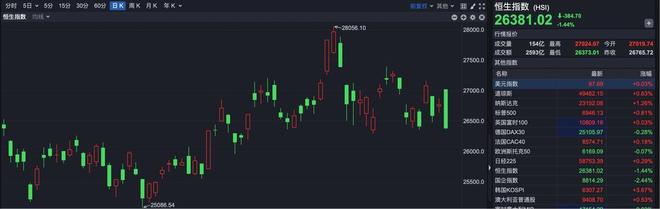
Market Performance - The Hong Kong stock market opened high but closed significantly lower, with the Hang Seng Index ending at 26,381.02 points, down 384.70 points, a decline of 1.44% [1] - The Hang Seng Tech Index also opened high but closed at 5,109.33 points, down 151.17 points, marking a drop of 2.87%, reaching its lowest level since June 24 of the previous year [3] Stock Movements - Among the constituents of the Hang Seng Tech Index, Xpeng Motors (HK09868) fell over 5%, while Huahong Semiconductor, Bilibili, Li Auto, Baidu, Kuaishou, and Horizon Robotics dropped over 4%. Major stocks like SMIC, BYD, and Alibaba declined over 3%, and Tencent fell over 2% [5] - In contrast, wind power stocks surged, with Dongfang Electric rising by 15%, while the building materials and cement sector faced collective weakness, with Anhui Conch Cement dropping over 6% [8] Hong Kong Stock Exchange Performance - The Hong Kong Stock Exchange (HK00388) reported a revenue and other income of HKD 29.161 billion for 2025, a 30% increase from 2024, and a shareholder profit of HKD 17.754 billion, up 36% from 2024. The stock market saw a particularly active new stock financing activity, leading the global new stock market with a total financing amount of HKD 286.9 billion, more than three times that of 2024, with 119 new listings [7] Capital Flow - There was a significant net sell-off by southbound funds, with over HKD 7.3 billion in net sales of Hong Kong stocks by the end of the trading day [9] Market Outlook - According to GF Securities, as the Hang Seng Tech Index continues to decline, it reflects that the emotional suppression factors have largely been released. If positive catalysts emerge, the Hong Kong stock market may see a restoration of sentiment and a return of funds. Suggested investment opportunities include technology leaders benefiting from the AI industry trend [11]

蘑菇街股价上涨,受AI视频生成主题市场情绪带动
Jing Ji Guan Cha Wang· 2026-02-16 00:08
Group 1 - The core viewpoint of the article indicates that the rise of Mogu (MOGU.N) on February 13, 2026, is likely linked to the increased market attention towards AI video generation and related technology themes [1] Group 2 - On that day, the release of ByteDance's AI video generation model Seedance 2.0 served as a key catalyst for the market, positively impacting AI multimodal applications and upstream hardware infrastructure, which in turn boosted market sentiment towards related technology stocks, including Mogu [2] Group 3 - It is noted that Mogu did not release any significant announcements on February 13 that could directly affect its stock price, suggesting that the stock price fluctuations were more likely driven by the overall investment atmosphere in the market [3]
南向资金7天“扫货”超630亿港元 港股底部之争再升温
2 1 Shi Ji Jing Ji Bao Dao· 2026-02-09 12:35
Core Viewpoint - The recent influx of southbound capital into the Hong Kong stock market, particularly in the technology sector, indicates a potential bottoming out despite ongoing market adjustments [1][5]. Group 1: Capital Inflow Trends - Southbound capital has seen a significant net inflow of 637 billion HKD over seven trading days, with notable daily net purchases exceeding 100 billion HKD [1][2]. - The primary sectors attracting this capital include information technology (71.24 billion HKD), financial services (60.84 billion HKD), non-essential consumer goods (51.41 billion HKD), and real estate (41.46 billion HKD) [2]. - Major stocks receiving substantial inflows include Tencent Holdings and Xiaomi Group, with net purchases of 60.77 billion HKD and 31.05 billion HKD, respectively [2]. Group 2: Market Sentiment and Valuation - Analysts suggest that the current valuation of the Hang Seng Technology Index is approximately 22.13 times earnings, which is at a historical low of 24.31% [6]. - Despite the influx of southbound capital, there remains a prevailing cautious sentiment in the market, as evidenced by a net outflow of 18.87 billion HKD on February 9 [5][6]. - The overall market is perceived to be in a deep value zone, with some analysts indicating that the market requires additional conditions to confirm a bottom [6][7]. Group 3: Investment Strategies - Investment strategies are focusing on a balanced approach, emphasizing both growth and value sectors, particularly in technology and high-dividend assets [7][8]. - Analysts recommend a selective investment strategy, highlighting opportunities in AI-related sectors, high-quality dividend stocks, and innovative pharmaceuticals [8]. - The importance of stock selection is increasing, with suggestions to adopt a phased investment approach while monitoring policy changes and global liquidity [8].
市场缩量调整,聚焦攻防均衡丨周度量化观察
申万宏源证券上海北京西路营业部· 2026-02-09 02:10
Market Overview - This week, the A-share market experienced a comprehensive pullback, with the Shanghai Composite Index down by 1.27%, the CSI 300 down by 1.33%, and the ChiNext Index down by 3.28%. The average daily trading volume in the Shanghai and Shenzhen markets significantly decreased to around 2.3 trillion yuan [2][11][15]. - In the bond market, the overall performance was strong, supported by a stable funding environment maintained by the central bank. The January PMI data fell below the growth line, which is favorable for the bond market [3][31]. Equity Market - The decline in A-shares was primarily driven by a shift in expectations regarding the Federal Reserve's policy, which triggered a significant pullback in precious metals and led to profit-taking in popular sectors ahead of the Spring Festival. The nomination of hawkish candidate Waller as Fed Chair strengthened the dollar, suppressing risk appetite and dragging down cyclical stocks [6][9]. - The investment strategy emphasizes a balanced approach, advocating for low buying and avoiding high chasing. Long-term trends in sectors such as defense, resources, finance, and supply chains are highlighted as areas of potential growth [6][9]. Bond Market - The market is expected to remain volatile in the short term, with favorable factors including the central bank's support for the funding environment. However, the anticipated supply of government bonds poses a challenge. The recommendation is to focus on medium to short-term bond strategies rather than excessive speculation on long-term bonds [7][31]. Commodity Market - The gold market experienced significant volatility, with COMEX gold prices dropping sharply by 8.92% due to a combination of factors, including hawkish expectations from the Fed, profit-taking by bulls, and a sharp decline in silver prices [4][36]. - The short-term outlook for gold suggests potential fluctuations within the current range, with a focus on upcoming U.S. non-farm payroll data and Fed officials' statements. Long-term gold investment remains solid as a core asset [8][40]. Overseas Market - The U.S. economy remains strong, with favorable credit cycle expectations. However, the market is at a relatively high level, and factors such as unclear policy outlooks and declining risk appetite may lead to increased volatility. The AI industry trend is still ongoing, and traditional cycles are expected to recover [9][39].

【申万宏源策略 | 一周回顾展望】震荡区间下限逐步探明
申万宏源研究· 2026-02-09 01:32
Core Viewpoint - The market is currently experiencing a small wave adjustment, with overall profitability effects and growth relative value profitability effects retreating to historically high levels. A rebound is possible, but further confirmation of the lower boundary of the fluctuation range may still be needed [2][3]. Short-term Market Analysis - The short-term low cost-effectiveness is no longer extreme, and the rapid adjustment phase may have passed. However, the rebound power based on market forces remains limited. Effective rebounds will require new catalysts and highlights to open up upward space in the market [2][3]. - The overall PE valuation of A-shares is also at historical high levels, indicating a potential transition from an upward phase to a consolidation phase as valuations reach historical peaks [3]. Medium-term Market Positioning - The current market is still in the first phase of an upward trend, with expectations for a "two-stage upward market" where the second stage will be initiated after confirming the lower boundary of the fluctuation range. This phase is characterized by waiting for further industrial trends and easing cost-effectiveness issues [4][5]. - The market has shown alternating structural main lines since September 2025, with several sectors reaching historical high valuations, leading to a horizontal consolidation phase [3]. Investment Opportunities - Four high-certainty judgments for medium-term opportunities include: 1. The primary market venture capital financing has bottomed out and is recovering, indicating a potential trend [5]. 2. The AI industry trend has clear space for growth, with ongoing advancements in AI applications validating the trend [6]. 3. Short-term cyclical Alpha logic is concentrated, but there are still significant discrepancies in cyclical Beta expectations domestically and internationally [6]. 4. The impact of the U.S. "devirtualization" and "broad credit" policies may lead to improved external demand expectations [7]. Sector Performance Indicators - The profitability effect indicators show a contraction in several sectors, including oil and petrochemicals (83% down 7%), basic chemicals (77% down 3%), and non-ferrous metals (71% down 12%). However, sectors like light industry manufacturing (69% up 5%) and electric power equipment (67% up 7%) are continuing to expand [10]. - The overall A-share market shows a profitability effect of 59%, indicating a comprehensive contraction, while sectors like food and beverage (52% up 13%) and household appliances (48% up 9%) are experiencing expansion [10]. ETF Market Insights - Various ETFs are showing different performance metrics, with the Huatai Baichuan Zhongzheng Photovoltaic Industry ETF at 99.83 million shares, reflecting a 0.8% change, while the Fuguo Zhongzheng Innovative Drug Industry ETF has 144.40 million shares, with a 0.9% change [11].