
楼市修复

Search documents
地产行业周报:优质港房财报现积极信号,打开股价上行空间-20260301
Ping An Securities· 2026-03-01 09:49
Investment Rating - The industry investment rating is "Outperform the Market" (maintained) [2] Core Insights - The report highlights positive signals from quality Hong Kong property companies, with New World Development showing revenue growth of 32% year-on-year and a net profit increase of 36.2% for the first half of the 2026 fiscal year. The core net profit, excluding fair value changes of investment properties, grew by 16.7% [3] - The report emphasizes that Hong Kong's real estate market is recovering, with a decrease in impairment provisions and a reduction in the fair value change of investment properties, indicating a positive trend in the market [3] - The report suggests that there is still room for price appreciation in Hong Kong property stocks, particularly for companies like New World Development, which has a price-to-book (PB) ratio of 0.68, lower than its peers [3] Summary by Sections Company Performance - New World Development's interim dividend increased by 3% to HKD 0.98 per share, reflecting a strong financial position [3] - The company has successfully acquired multiple land parcels, positioning itself to benefit from the recovery in the Hong Kong property market [3] Investment Recommendations - The report recommends focusing on three main lines: 1. Companies with light historical burdens and strong land acquisition capabilities, such as China Resources Land and China Overseas Development [3] 2. Hong Kong property companies benefiting from market stabilization, including New World Development and Henderson Land [3] 3. Companies with stable cash flow and dividends, such as China Resources Mixc Lifestyle and Poly Property [3] Market Monitoring - The report notes a significant increase in new home transactions in key cities, with a 428.8% week-on-week rise in new home sales [3] - Inventory levels have decreased slightly, with a current de-stocking cycle of 20.9 months, indicating a potential improvement in market conditions [3] Capital Market Monitoring - The real estate sector saw a 0.6% increase in stock prices, underperforming the broader market [3] - The current price-to-earnings (PE) ratio for the real estate sector is 65.75, significantly higher than the broader market's 14.13, indicating a high valuation relative to historical levels [3]





1月二线城市新房价格环比跌幅收窄,二手房价现企稳信号
Feng Huang Wang· 2026-02-13 08:36
Core Viewpoint - The new housing market in second-tier cities shows signs of price stabilization, with a narrowing decline in sales prices in January 2026 compared to previous months, indicating a potential recovery phase in the real estate market [1][2]. Group 1: New Housing Market Trends - In January 2026, first-tier cities saw a 0.3% month-on-month decline in new residential sales prices, while second-tier cities experienced a 0.3% decline, narrowing by 0.1 percentage points [1]. - Year-on-year, first-tier cities' new housing prices fell by 2.1%, with the decline expanding by 0.4 percentage points compared to the previous month; second and third-tier cities saw declines of 2.9% and 3.9%, respectively, with both declines also widening [1]. - The easing of price declines in second-tier cities reflects a gradual stabilization, supported by existing housing demand and improved market expectations [1]. Group 2: Second-Hand Housing Market Insights - The second-hand housing market shows a notable narrowing of price declines, with first-tier cities experiencing a 0.5% month-on-month decrease, a reduction of 0.4 percentage points from the previous month [3]. - The 70-city second-hand housing price index fell by 0.5% in January, marking the lowest decline since August of the previous year, indicating a potential stabilization in the market [3]. - Core cities are witnessing a shift in landlord attitudes, with a decrease in listing volumes and improved transaction efficiency, suggesting a healthier market dynamic [3][4]. Group 3: Market Outlook and Policy Implications - The overall real estate policy direction is expected to remain focused on stabilizing the market and expectations, with a continued emphasis on targeted measures based on local conditions [4]. - The first quarter of 2026 is seen as a critical period for market trends, with expectations that new housing prices in first-tier cities may gradually stabilize and year-on-year declines may continue to narrow [4][5]. - Despite a rebound in transaction volumes, the stability of the market remains uncertain, with the sustainability of policy effects post-Spring Festival being a key factor for future demand [5].
淡季不淡,一线城市二手房率先回暖
Sou Hu Cai Jing· 2026-02-04 15:18
Core Viewpoint - The second-hand housing market in first-tier cities in China is showing signs of recovery, indicating a potential market repair after a prolonged adjustment period [2][3]. Group 1: Market Performance - In January, second-hand housing transaction volumes in Beijing, Shanghai, Guangzhou, and Shenzhen collectively increased, with Beijing exceeding 15,000 units, Shanghai surpassing 22,000 units, Shenzhen reaching 6,802 units, and Guangzhou at 8,881 units [2]. - The transaction recovery in January is seen as an important signal of market repair, with the second-hand market entering a bottoming phase after four and a half years of adjustment [3]. Group 2: Supply and Demand Dynamics - As transaction volumes rise, the number of listings is decreasing, indicating an improvement in supply-demand dynamics. In January, Beijing's listings dropped significantly, while Shanghai's listings have decreased for nine consecutive months, with a cumulative decline of over 20% from peak levels [3]. - The market is experiencing a shift in seller mentality, with many homeowners opting to withdraw listings or convert to rental properties, particularly for well-located older homes [3]. Group 3: Policy Impact - Policy measures, such as the new real estate support policies in Beijing set to launch by the end of 2025, are stimulating previously suppressed demand by relaxing purchasing conditions and lowering down payment and loan costs [3]. Group 4: Future Outlook - Multiple institutions have reported improved expectations for transaction volumes in first-tier cities for 2026, with a bullish or stable outlook becoming mainstream [4]. - Despite the positive signs, the market is still in a "bottoming repair" phase, and it may take time to stabilize fully. The overall listing scale remains high, and there is still pressure to digest inventory [4].

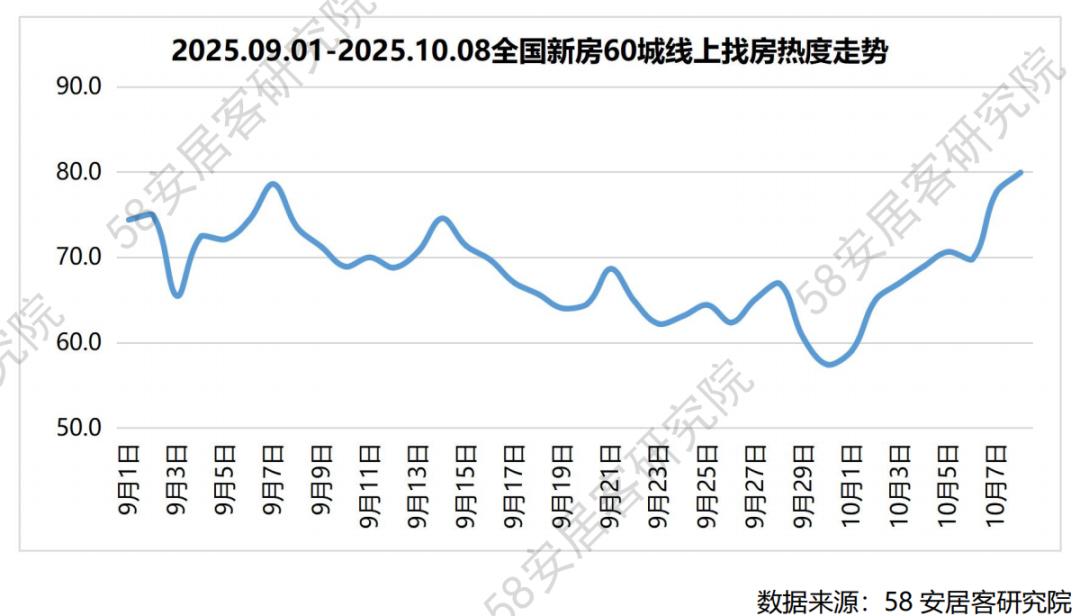
十一新房短暂下降后修复上升,环比上涨11.2%
3 6 Ke· 2025-10-10 03:16
Overall Market Trend - The sales of new residential properties in China from January to August 2025 decreased by 7.3% year-on-year, with the decline rate increasing by 0.8 percentage points compared to July [1] - During the National Day holiday, over 300 million people traveled across regions, leading to a temporary diversion of home-buying demand, with a notable drop in online property search heat in major cities [1] - Post-holiday, there is an expectation for a market rebound due to resilient home-buying intentions and supportive policies [1] Year-on-Year Comparison - The average daily online property search heat for the National Day holiday in 2023, 2024, and 2025 for 60 key cities was 138.2, 124.9, and 69.8 respectively, indicating a significant year-on-year decline of 44.1% in 2025 compared to 2024 [3] - Despite the introduction of various supportive policies in the second half of the year, the substantial drop in online search heat reflects a slow recovery in buyer confidence and demand release [3] City Tier Analysis - The average daily online property search heat during the holiday for first-tier, new first-tier, second-tier, and third/fourth-tier cities was 77.0, 67.8, 70.4, and 68.5 respectively, showing a clear tiered differentiation [5] - All city tiers experienced significant year-on-year declines, with second-tier cities seeing the largest drop of 46.3% [5] Month-on-Month Changes - The month-on-month increase in online property search heat during the holiday ranged from 7% to 14% across different city tiers, with third/fourth-tier cities showing the highest increase of 13.9% [7] - This indicates ongoing market recovery, although long-term confidence remains insufficient [7] First-Tier Cities Performance - In first-tier cities, the online property search heat during the National Day holiday in 2025 was led by Shanghai (99.0), followed by Shenzhen (91.5), Guangzhou (70.9), and Beijing (46.7), all showing significant declines compared to previous years [9] - The recent policy changes in first-tier cities have not yet restored online search heat to previous levels, indicating a more rational decision-making process among buyers [9]
“金九”成色初显
HUAXI Securities· 2025-09-27 13:09
1. Report Industry Investment Rating No relevant content provided. 2. Core Viewpoints of the Report - The property market continued a mild recovery this week, with second - hand housing outperforming new housing. However, the recovery momentum weakened on a weekly basis, and there was a significant divergence in transaction heat among cities at different tiers [1][3]. - The "Golden September" effect was initially shown at the aggregate level, but the policy focus may shift to second - tier cities to boost market confidence [3]. 3. Summary by Relevant Catalogs 3.1 Market Overview - This week (September 19 - 25), the second - hand housing market in 15 cities had a transaction area of 2.18 million square meters, a 1% week - on - week decline but with six consecutive weeks of year - on - year growth. The new housing market in 38 cities had a transaction area of 2.56 million square meters, a 7% week - on - week increase, but only one week of year - on - year growth in the past 16 weeks [1]. - From September 1 - 25, the second - hand housing transactions in 15 cities increased by 26% year - on - year, and the new housing transactions in 38 cities increased by 9% year - on - year, reversing the decline in August [3]. 3.2 Market Performance by City Tiers Second - hand housing market - First - tier cities had stable growth overall, with Beijing and Shanghai performing well (7% and 5% week - on - week growth, 15% and 29% year - on - year growth respectively), while Shenzhen showed a decline (31% week - on - week and 6% year - on - year) [2]. - Second - tier cities had a 3% week - on - week and 15% year - on - year growth, but the sustainability of the recovery needed further observation [2]. - Third - tier cities experienced a significant cooling, with a 21% week - on - week decline and a year - on - year change from 14% to - 8% [2]. New housing market - First - tier cities were the only ones with year - on - year growth, with a 23% year - on - year increase this week. Shanghai and Beijing were strong performers (74% and 26% year - on - year growth respectively) [2]. - Second - and third - tier cities faced significant year - on - year declines, 13% and 31% respectively [2]. 3.3 Key City Observations First - tier cities - For second - hand housing from September 19 - 25, Beijing and Shanghai increased by 7% and 5% week - on - week, while Shenzhen decreased by 31%. Year - on - year, Shanghai and Beijing increased by 29% and 15%, while Shenzhen decreased by 6% [20]. - For new housing from September 19 - 25, Shanghai, Beijing, and Shenzhen increased by 17%, 10%, and 5% week - on - week respectively, while Guangzhou decreased by 21%. Year - on - year, Shanghai and Beijing increased by 74% and 26%, while Shenzhen and Guangzhou decreased by 26% and 22% respectively [21]. Other key cities - In Hangzhou, second - hand housing increased by 8% and new housing decreased by 1% week - on - week, equivalent to 45% and 22% of the annual high respectively [21]. - In Chengdu, second - hand housing increased by 22% and new housing increased by 5% week - on - week, equivalent to 86% and 60% of the annual high respectively [21]. 3.4 Housing Price Observation - From September 15 - 21, the weekly listed prices of second - hand housing in Shanghai, Beijing, and Shenzhen decreased by 0.33%, 0.03%, and 0.61% week - on - week respectively. Compared with the week before the "924" policy last year, they still decreased by 2.1%, 8.5%, and 8.0% respectively [46].
地产行业周报:持续看好库存优、拿地及产品力强房企,现金流及分红稳定物企配置价值凸显-20250622
Ping An Securities· 2025-06-22 12:02
Investment Rating - The industry investment rating is "Outperform the Market" (maintained) [2][29] Core Viewpoints - The short-term performance of the sector may remain volatile, with a weekly decline of 1.69%, underperforming the CSI 300 index which fell by 0.45%. The current divergence in the market is attributed to the mainstream A-share real estate stocks nearing their September 2024 lows, combined with a weakening housing market in April and May, and rising policy expectations following recent government meetings. There is a potential trading opportunity in the mid-term despite the lack of confidence in market stabilization due to weak income and housing price expectations [3] - The report emphasizes the importance of focusing on real estate companies with strong inventory structures, land acquisition capabilities, and product strength. It is believed that despite fluctuations in the housing market recovery, the trend of "core areas and good properties" stabilizing first remains unchanged. Companies with favorable inventory structures and strong product capabilities are expected to benefit from the stabilization of the segmented market [3] - The value of property management companies with stable cash flow and dividends is becoming increasingly prominent. Despite ongoing adjustments in the real estate sector, mainstream property management companies are showing strong cash flow and profit performance. The projected net profit growth for five major property management companies in 2024 is 17.8%, with an average dividend yield of 3.8%, making them attractive in a low-interest-rate environment [3] Summary by Sections Market Performance Monitoring - New home transactions in 50 key cities reached 19,000 units, a week-on-week increase of 6.7%. However, the average daily transaction volume for new homes in June (up to the 20th) decreased by 31.1% year-on-year and 3.9% month-on-month [7] - The inventory of 16 cities slightly increased, with a depletion cycle of 18.5 months. As of June 20, the inventory was 91.66 million square meters, reflecting a 0.03% increase [11] Capital Market Monitoring - The real estate sector saw a weekly decline of 1.69%, underperforming the CSI 300 index. The current price-to-earnings ratio (TTM) for the real estate sector is 38.43 times, which is at the 93.67 percentile of the past five years [20][22] - The issuance of real estate bonds this week was 5.59 billion yuan, with a net financing amount of -3.77 billion yuan, indicating a decrease in net financing [17] Policy Environment Monitoring - Xi'an has released measures to promote the stable and healthy development of the real estate market, while Changsha has implemented detailed policies for housing provident fund loans for families with two or three children [5]
地产行业周报:年中冲刺临近,成交环比有望延续回升-20250603
Ping An Securities· 2025-06-03 11:11
Investment Rating - Industry investment rating: Stronger than the market (maintained) [2] Core Viewpoints - As the mid-year sprint approaches, transaction volume is expected to continue its month-on-month recovery. In May, the number of new homes sold in 50 key cities decreased by 5.3% year-on-year but increased by 9.1% month-on-month. The top 100 real estate companies managed a total of 294.58 billion yuan, reflecting a month-on-month growth of 3.5% [3] - The report emphasizes that "good products" and "core areas in first and second-tier cities" are likely to stabilize first. Although the real estate market in some cities has slightly cooled down in Q2 2025, there is no need for excessive concern. Factors such as sufficient adjustment time in the market and recent interest rate cuts are expected to ease home-buying pressure [3] - Short-term market fluctuations are anticipated, but investors are advised to focus on medium-term positioning. The trend of stabilization in "good products" and "core areas" remains unchanged, with some hot cities expected to recover in Q4 2024 [3] Market Monitoring - New home transactions in key cities showed a month-on-month increase, with 22,000 new homes sold in the week of May 24-30, up 5.8% from the previous week. However, second-hand home transactions in 20 key cities decreased by 9.4% [9] - Inventory slightly decreased, with a total of 91.32 million square meters in 16 cities, reflecting a month-on-month decline of 0.1% and a de-stocking cycle of 18.4 months [12] Capital Market Monitoring - The real estate sector saw a 0.95% increase last week, outperforming the CSI 300 index, which fell by 1.08%. The current price-to-earnings ratio (TTM) for the real estate sector is 39.43 times, placing it in the 95.64th percentile over the past five years [18] - The issuance of domestic real estate bonds increased to 4.91 billion yuan last week, with a net financing amount that also rose [15] Individual Stock Recommendations - Companies to watch include those with lighter historical burdens and strong product capabilities, such as China Overseas Development, China Resources Land, and Poly Development. Additionally, companies like New Town Holdings and Vanke A are recommended for valuation recovery [3][24]
地产行业周报:年中冲刺临近,成交环比有望延续回升
Ping An Securities· 2025-06-03 10:20
Investment Rating - Industry investment rating: Stronger than the market (maintained) [2][28] Core Viewpoints - As the mid-year sprint approaches, transaction volume is expected to continue its month-on-month recovery. In May, the number of new homes sold in 50 key cities decreased by 5.3% year-on-year but increased by 9.1% month-on-month. The operating amount of the top 100 real estate companies was 294.58 billion yuan, a month-on-month increase of 3.5% [3] - The report emphasizes that "good products" and "core areas in first and second-tier cities" are likely to stabilize first. The adjustment period for the real estate market has been sufficient, and recent interest rate cuts have eased home-buying pressure. Core city supply is entering a "window period," which may support market stabilization [3] - Short-term market fluctuations are expected, but investors are advised to focus on medium-term positioning. The trend of stabilization in "good products" and "core areas" remains unchanged, with some hot cities showing early signs of recovery [3] Market Monitoring - New home transactions in key cities showed a month-on-month increase of 5.8%, while second-hand home transactions decreased by 9.4%. The average daily transaction volume for new homes in May was down 5.3% year-on-year but up 9.1% month-on-month [9] - Inventory slightly decreased, with a de-stocking cycle of 18.4 months. The inventory in 16 cities was 91.32 million square meters, a month-on-month decrease of 0.1% [13] - The real estate sector saw a 0.95% increase in stock prices, outperforming the Shanghai and Shenzhen 300 index, which fell by 1.08%. The current PE ratio for the real estate sector is 39.43 times, at the 95.64% percentile of the past five years [18] Policy Environment Monitoring - Multiple regions have introduced policies to stabilize the real estate market, including Shenzhen's guidelines for the allocation of affordable housing [4][6]
核心城市一手房市场持续修复,新规产品全面站上“C位”
Di Yi Cai Jing· 2025-06-03 09:14
Group 1 - The overall performance of the real estate market during the Dragon Boat Festival was flat, with a total transaction area of 266,000 square meters in 30 major cities, showing a year-on-year decline [1] - First and second-tier cities performed well, with first-tier cities seeing a 4.5% increase and second-tier cities a 3.3% increase in transaction area compared to last year [1] - In May, core cities maintained a recovery trend, with various developers using discounts and new product launches to attract buyers, supported by rapid implementation of market support policies [1][2] Group 2 - In Shanghai, the new housing transaction area during the Dragon Boat Festival reached 4.61 million square meters, a year-on-year increase of 87.4% [2] - The overall transaction volume of new homes in Guangzhou reached 708,300 square meters in May, setting a record for the highest monthly volume this year [3] - The Shanghai market saw a significant increase in new supply, with 40 projects launched in May, leading to a transaction area exceeding 600,000 square meters, a year-on-year increase of 23.7% [3][4] Group 3 - High-quality new projects have become a key factor influencing short-term sales in cities and among real estate companies, with many core area projects achieving over 80% sales rates [3][5] - The demand for "good houses" is rising, with projects that meet basic living needs and offer comfort becoming increasingly popular among buyers [6] - In Shenzhen, a new project achieved a sales rate of approximately 40% on its opening day, indicating strong market interest in well-priced and well-designed properties [6][8] Group 4 - The introduction of new product types, such as low-density houses and high-end improvement products, has shown better sales performance compared to ordinary properties [7] - In May, the average price of new homes in first-tier cities increased by 0.90%, with Shanghai experiencing the largest increase at 1.47% due to the launch of improvement projects [9] - The market is expected to see increased promotional efforts and a faster pace of new project launches as the mid-year sales period approaches, which may support new home sales in core cities [9]
地产行业周报四月楼市平稳收官,关注高价项目去化表现
Ping An Securities· 2025-05-06 01:35
Group 1 - Industry investment rating: Real estate sector rated as "Outperform" [2][33] - Core viewpoint: In April, the average daily transaction volume of new homes in 50 key cities decreased by 27.3% year-on-year, with a decline of 8.7% in the operating amount of the top 100 real estate companies [3][6] - The land auction market is heating up, and concerns about the gross profit margins and sales performance of quality real estate projects are rising. High-priced projects in cities like Shanghai are expected to enter the market in May, which may boost market confidence if they achieve high sales and profit margins [3][6] Group 2 - Market performance: The average daily transaction volume of new homes in April for 50 key cities was 0.5 million units, a decrease of 69.7% week-on-week, while the average daily transaction volume for second-hand homes in 20 key cities was 0.9 million units, down 59.3% week-on-week [3][6] - Inventory status: The inventory in 16 cities remained stable at 9,164 million square meters, with a de-stocking period of 20.7 months [10][6] - Capital market monitoring: The real estate sector saw a decline of 3.04% last week, underperforming the CSI 300 index, which fell by 0.43%. The current PE ratio for the real estate sector is 39.93 times, placing it in the 96.96 percentile over the past five years [21][6] Group 3 - Individual stock recommendations: Focus on companies with lighter historical burdens and strong product capabilities, such as China Resources Land, China Overseas Development, and Greentown China. Also, consider companies with valuation recovery potential like New Town Holdings and Vanke A [3][6] - Policy environment: Multiple regions have announced new housing policies, including increased housing provident fund loan limits [5][6] - Company performance: Poly Development reported a 9% increase in revenue to 54.272 billion yuan in Q1 2025, while other companies like New Town Holdings and Vanke A saw declines in revenue [29][6]