四代宅

Search documents
长三角&珠三角区域楼市观察
中指研究院· 2026-03-15 02:07
Investment Rating - The report indicates a stable outlook for the real estate market in the Yangtze River Delta and Pearl River Delta regions, with a focus on "stabilizing expectations and shortening adjustment time" [3] Core Insights - The real estate market in China is entering its sixth year of adjustment, with clear signals from policy levels aimed at stabilizing market expectations and boosting confidence [3] - In Shanghai, the market is expected to show a "structural recovery" with improved buyer sentiment and a gradual increase in transaction volumes, particularly in the second-hand housing market [4][8] - Hangzhou's market is shifting from a phase of panic buying to a more rational approach focused on improvement needs, with a significant increase in demand for larger units [10][11] - Ningbo's market is characterized by the introduction of "fourth-generation houses," which are driving sales and improving market dynamics [15][16] - In Wenzhou, the market is experiencing a seasonal boost due to promotional activities and returning home buyers, although structural challenges remain [18][20] - Nanjing's new housing policies are effectively lowering entry barriers for homebuyers, particularly for young talents, leading to increased demand for high-quality projects [22][24] - Shenzhen is seeing a rise in interest from Hong Kong buyers, supported by cross-border transportation improvements, contributing to a potential "small spring" in the market [25][26] - Guangzhou's market is stabilizing with a focus on quality housing, driven by a shift in buyer preferences towards better living conditions [28][30] Summary by Sections Shanghai - The market is showing signs of recovery with policies supporting demand and a notable increase in second-hand housing transactions [4][6] - The introduction of new policies has led to a more active market, particularly in the outer districts where affordable housing options are in demand [7][8] Hangzhou - The market is transitioning to a phase dominated by improvement needs, with a significant increase in the demand for larger units [10][11] - The high-end market is becoming more distinct, with luxury properties seeing a surge in transactions [11][12] Ningbo - The introduction of "fourth-generation houses" is driving market activity, with significant sales recorded during the holiday period [15][16] - The market is seeing a structural increase in average prices due to the popularity of these new housing types [16] Wenzhou - The market is benefiting from promotional activities and a surge in returning buyers, although structural issues persist [18][20] - The demand for high-quality properties is evident, particularly in core urban areas [19] Nanjing - New policies aimed at young professionals are effectively lowering barriers to homeownership, leading to increased interest in high-quality projects [22][24] - The market is characterized by a focus on larger, well-equipped homes that meet modern living standards [23] Shenzhen - The market is experiencing increased interest from Hong Kong buyers, supported by improved transportation links [25][26] - Promotional activities during the holiday season are expected to lead to a temporary boost in sales [26] Guangzhou - The market is stabilizing with a focus on quality housing, driven by a shift in buyer preferences towards better living conditions [28][30] - The demand for larger, high-quality homes is increasing, reflecting a broader trend towards improved living standards [29][31] Fujian Fuzhou - The market is showing signs of rational recovery, with promotional activities boosting demand, particularly in core areas [32][33] - The overall sentiment is cautious, with expectations for continued support from policies aimed at stabilizing the market [33]
四代宅,在青岛的分歧!
Sou Hu Cai Jing· 2026-02-03 19:31
Core Viewpoint - The emergence of "four-generation housing" is reshaping the real estate landscape in Qingdao, reflecting a shift towards higher living standards and a desire for integration with nature, although the implementation remains cautious and complex [1][6][20]. Group 1: Market Trends - In 2025, new developments in Xi'an predominantly feature designs like "every unit with a terrace" and "100% usable area" [2]. - Qingdao's housing market is characterized by a cautious approach to "four-generation housing," with no large-scale policy support or rapid market adoption observed [8][21]. - The local real estate companies exhibit a diverse response to "four-generation housing," ranging from proactive experimentation to maintaining existing product lines [8][19]. Group 2: Consumer Preferences - Qingdao residents have a high demand for living quality, favoring designs that connect with nature, such as terraces and gardens [6]. - The concept of "four-generation housing," which includes features like independent terraces and spacious living areas, resonates with the expectations of many potential buyers [8][20]. - However, traditional metrics like usable area, layout efficiency, and school district proximity remain the primary concerns for most buyers, limiting the acceptance of innovative housing concepts [15][19]. Group 3: Project Examples - Notable projects like "Yunshan Villa" and "Jinshui Yunlu" are early attempts at "four-generation housing," showcasing features like large living spaces and terraces, but have faced challenges in sales performance [11][12]. - Upcoming projects such as "Shangjunfu" and "Jinmao Puyishi Garden" are expected to represent true "four-generation housing" in Qingdao, with unique designs and high usable area [12][13]. - Despite these developments, the overall market remains dominated by traditional residential projects, with "four-generation housing" not yet achieving significant market presence [17][21]. Group 4: Challenges and Future Outlook - The lack of widespread adoption of "four-generation housing" in Qingdao is attributed to high construction density, which compromises privacy and usability of terraces [14][20]. - Maintenance challenges due to the coastal climate and the high costs associated with innovative designs pose additional barriers to market acceptance [14][15]. - The future of "four-generation housing" in Qingdao is likely to remain limited to niche markets, with broader acceptance requiring a shift in consumer priorities and market conditions [21].

观楼|昆明南市区四代宅带动价格上涨3成,北市区第二个四代宅落地
Xin Lang Cai Jing· 2026-02-03 10:24
Core Insights - The real estate market in Kunming experienced a significant increase in both transaction volume and prices last week, with a notable rise in the price of improved housing projects in the South City District by nearly 30% [1] - The latest data from CRIC indicates that there were no new residential project approvals in Kunming's main urban area, while transaction volume reached approximately 53,800 square meters, reflecting a slight week-on-week increase of 2% [1] - The average transaction price rose to approximately 13,293 yuan per square meter, marking a 29% increase compared to the previous week [1] Transaction Highlights - The projects "Bontai Guanyun" and "Poly Tianjun Phase II" saw significant sales, with sales of approximately 102 million yuan and 30 million yuan respectively, achieving transaction averages of about 19,937 yuan per square meter and 17,898 yuan per square meter [1] - The "China Resources Center" project implemented price reductions, resulting in sales of approximately 28 million yuan with an average transaction price of about 14,535 yuan per square meter [4] New Project Developments - Bontai's new project, "Bontai Zhenyue Garden," is set to be developed in the North City District, with plans for low-density residential buildings [9] - The project will consist of 17 buildings with 15-17 floors, covering a total land area of approximately 32,065.95 square meters and a total construction area of 95,622 square meters [9] - Bontai has established itself as the developer with the most four-generation residential projects in Kunming, with previous successful launches in the South City District and Chenggong core area [11] Market Supply and Demand - The main urban area of Kunming continues to show no new land supply or transactions, indicating a stagnant supply situation [5] - Only two projects, "China Overseas Huide Li" and "Zhongtong Lian Dashushan," were launched, with no new project openings reported [6] - "China Overseas Huide Li" launched 29 high-rise units with a transaction average of approximately 16,200 yuan per square meter, achieving a sales rate of 48% [7] - "Zhongtong Lian Dashushan" launched 48 units of four-generation houses, achieving a transaction average of approximately 11,000 yuan per square meter, with a sales rate of 44% [8]
百强房企争相涌入代建市场 不打“价格战”锚定“好房子”
Zheng Quan Shi Bao· 2026-01-15 18:19
Core Insights - The real estate industry is rapidly exploring new development models, with top 100 real estate companies showing strong enthusiasm for the construction agency market, leading to further industry growth and a new competitive landscape [1] - The focus has shifted from a "scale race" to a "value revolution," with companies engaging in differentiated competition, emphasizing quality over price [1] Group 1: Market Trends - In 2025, the new scale of construction agency reversed the slowdown seen in 2024, with the top 20 companies signing contracts for 22,007 million square meters, a year-on-year increase of 16%, and a growth rate improvement of 6 percentage points compared to 2024 [2] - The competitive structure of the construction agency market has fundamentally changed, showing an "olive-shaped" competition structure typical of a mature industry with high concentration [2] - Over 100 companies have entered the construction agency business, primarily from the top real estate sales companies, indicating a highly competitive environment [3] Group 2: Competitive Dynamics - Despite high market concentration among leading companies, the competitive landscape is still evolving, with ongoing reshuffling among top-tier and mid-tier companies [3] - The construction agency sector is characterized by light assets, high profit margins, and resistance to economic cycles, making it attractive for real estate companies amid significant market pressures [3] Group 3: Pricing and Value Competition - The management fee rates for construction agency projects have decreased from an early average of 3% to a range of 1%-3%, with 81.7% of projects falling within this range [4] - Industry leaders are advocating for a shift from price competition to value competition, emphasizing the importance of value creation over low pricing [4][5] - Many companies are consciously maintaining price floors and focusing on quality service rather than engaging in price wars [5] Group 4: Differentiated Competition Strategies - Companies are actively enhancing their capabilities and creating value through various means, including focusing on "good housing," urban renewal, and revitalizing existing assets [6] - Successful examples include projects that integrate comprehensive management and cost control, such as the Chengdu Xijingtai project, which achieved over 90% sales in a previously stalled development [7] - The industry is recognizing the need for higher service standards and a healthier evaluation system to guide companies towards enhancing their professional capabilities [5][6] Group 5: Future Outlook - The construction agency market still holds potential for residential and affordable housing, as well as opportunities in urban renewal and village renovations [8] - Future strategies suggest that leading companies should focus on improving service capabilities and management efficiency, while smaller firms should deepen their expertise in niche areas to build competitive advantages [8]
地产行业依然在经历次生灾害
3 6 Ke· 2025-12-30 02:50
Core Viewpoint - The real estate market is experiencing a secondary disaster, where the initial shock has passed, but ongoing challenges and capacity shortfalls are emerging within the industry [1] Group 1: Industry Challenges - The importance of product quality has significantly increased, leading to a demand for better marketing strategies that focus on product core concepts rather than just storytelling [2] - The supply chain lacks capable third-party providers who understand product needs, as existing firms struggle to adapt from a fast turnover model [3][4] - The transition from a finance-driven model to a manufacturing-oriented approach has created a talent gap, with many firms unable to retain skilled personnel [5][9] Group 2: Market Dynamics - The industry is witnessing a shift in policy focus from financial regulation to product-oriented regulations, indicating a change in how the real estate sector is perceived [7][8] - The current market environment has led to a decline in the quality of customer research, with a lack of understanding of diverse customer preferences and needs [6] - The real estate sector is facing a generational talent crisis, with many professionals leaving the industry due to pessimism about its future [9][10] Group 3: Opportunities Amidst Challenges - Despite the challenges, there are emerging opportunities for new entrants and innovative approaches within the real estate development sector, as traditional players overlook potential [10] - The focus is shifting towards creating emotional resonance with customers through product value communication, moving away from self-serving narratives [8]
宁波2026宅地市场布局图,四大价值板块结构性机会凸显
Sou Hu Cai Jing· 2025-12-15 10:08
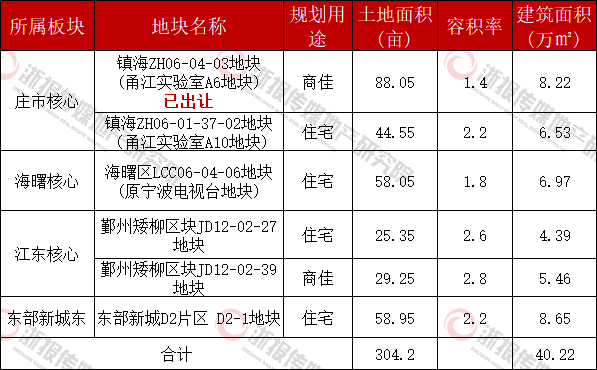
Core Insights - Ningbo is focusing on high-quality land supply, particularly in residential areas, to enhance urban development and create a benchmark for quality living [1][14] - The market response has been positive, with several high-quality residential projects achieving significant sales rates in the second half of the year [1] Group 1: Land Supply and Development Strategy - Ningbo's land supply for residential use is tightening, with a clear shift towards high-quality pilot plots known as "fourth-generation residences" [1] - The city aims to transform its development model through precise land supply regulation, enhancing the quality of living environments [1][14] - In 2026, the focus will be on five premium land plots in key urban areas, including Zhenhai, Haishu, Yinzhou, and the Eastern New City [2] Group 2: Market Performance and Sales Data - Several fourth-generation residential projects launched in the second half of the year reported impressive sales, such as the Green Town project achieving an 88% sales rate and the Baoyi project exceeding 300 million yuan in sales [1] - The successful sales of these projects validate the value of innovative and improved residential products in the market [1] Group 3: Upcoming Land Plots and Characteristics - The upcoming land supply includes five quality plots, with a total area of 304.2 acres, strategically located in high-value urban areas [3][4] - Specific plots include residential land in the Zhenhai core area and the Haishu core area, with varying building capacities and plot ratios [3][7][9][11] - The land plots are designed to meet diverse improvement needs, reflecting the city's commitment to urban renewal and enhanced living standards [7][14]
「附赠率」不该也不能成为主旋律
3 6 Ke· 2025-11-25 02:45
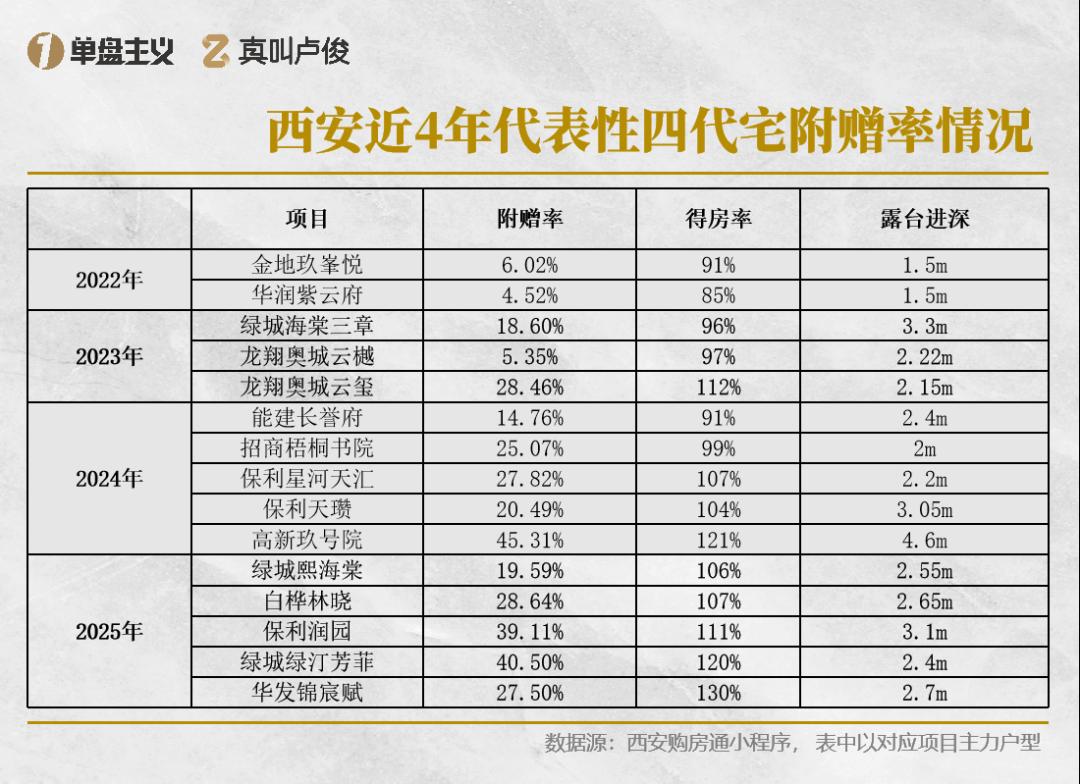
Core Viewpoint - The real estate market in 2025 is witnessing a competitive trend among developers to offer additional usable space, with many projects exceeding a 100% usable area ratio, indicating a shift in sales strategies and product offerings [1][5]. Group 1: Market Trends - Developers are increasingly engaging in a competition to provide additional space, with some projects offering up to 40% more area than the original size, reflecting a significant change in market dynamics [1][5]. - The concept of "Fourth Generation Housing" has gained traction, with developers focusing on maximizing usable space through design innovations such as larger balconies and terraces [1][5]. - In cities like Xi'an, the additional area ratios for Fourth Generation Housing have consistently increased over the past three years, with many projects achieving usable area ratios above 100% [1][3]. Group 2: Financial Implications - The increase in additional area offerings is seen as a way to enhance product appeal and address local government budget constraints, as higher land sale prices can alleviate financial pressures [5][9]. - The national land market has experienced a significant contraction, with a 25% decrease in the area of commercial land sold and a 33% drop in transaction value year-on-year as of October 2025 [7]. - The strategy of increasing usable space without lowering land prices is viewed as a method to enhance land value and market attractiveness [9][11]. Group 3: Consumer Impact - The trend of offering more usable space is perceived as beneficial for consumers, allowing them to receive greater value for their investment, effectively reducing the impact of shared areas [10][11]. - New regulations have led to a notable increase in the absorption rates of new projects, with some cities reporting absorption rates of up to 75% for Fourth Generation Housing compared to only 20% for traditional housing [10][11]. - However, despite the apparent benefits, the long-term sustainability of this trend raises questions about its impact on overall market demand and consumer purchasing power [11][12]. Group 4: Design and Quality Concerns - The focus on maximizing additional space has led to concerns about the quality of living environments, with some designs compromising essential aspects such as natural light and ventilation [16][19]. - Issues related to the structural integrity and safety of large balconies and terraces have been highlighted, raising questions about the long-term maintenance and safety of these designs [18][21]. - The industry's emphasis on additional area offerings may detract from other critical innovations in residential design, potentially leading to a homogenization of products [19][22]. Group 5: Regulatory Environment - Regulatory tightening is anticipated as cities like Guangzhou and Chengdu prepare to implement new rules to curb excessive area offerings, indicating a shift towards more sustainable development practices [25][26]. - The real estate sector is transitioning from a phase of rapid expansion to one focused on quality improvement and sustainable development, aligning with broader urbanization trends [25][26].
住房“附赠率”,不该成为主旋律
虎嗅APP· 2025-11-24 09:58
Core Viewpoint - The article discusses the rising trend of "附赠率" (additional area) in the real estate market, particularly focusing on the concept of "四代宅" (fourth-generation housing), which has become a competitive strategy among developers to attract buyers by offering more usable space than the actual purchase area [5][10][12]. Group 1: Market Trends - In 2025, many housing projects are expected to offer additional areas, with some achieving effective rates exceeding 100% [6][10]. - The competition among developers has led to significant increases in附赠率, with some projects in cities like Xi'an showing rates as high as 45.31% [8][10]. - The trend of offering additional area is seen as a response to a cooling land market, where developers are incentivized to enhance the perceived value of their properties without lowering land prices [15][22]. Group 2: Impact on Buyers and Developers - The increase in附赠率 is perceived as beneficial for buyers, allowing them to receive more usable space for the same price, effectively reducing the impact of shared areas [24][25]. - Developers are encouraged to adopt this strategy as it improves sales rates and accelerates cash flow, with some new regulations positively impacting market dynamics [23][24]. - However, the article raises concerns about the sustainability of this trend, questioning whether continuously increasing附赠率 can genuinely stimulate long-term market demand [12][29]. Group 3: Challenges and Risks - The article highlights potential risks associated with the high附赠率, including design compromises that may affect living comfort and safety [33][36]. - There are concerns about the long-term maintenance and safety of these properties, particularly regarding structural integrity and the management of additional features like large balconies [39][40]. - The focus on increasing附赠率 may detract from other essential aspects of housing design, leading to a lack of innovation in the industry [44][46]. Group 4: Future Directions - The article suggests that the industry should consider alternative strategies beyond the附赠率 competition, such as differentiating land use and focusing on genuine living quality [46][52]. - It emphasizes the need for regulatory measures to curb excessive附赠率 practices, indicating a shift towards quality over quantity in housing development [56].

热销项目 | 10月“好房子”去化居前但加速分化
克而瑞地产研究· 2025-11-11 09:10
Core Viewpoint - The real estate market in October showed a general decline in transaction volume and supply, with a notable drop in the average sales rate across 30 key cities, indicating a cooling market trend [2][4]. Market Performance - The average sales rate for new homes in 30 key cities fell to 34% in October, down 6 percentage points month-on-month and 4 percentage points year-on-year [4]. - Major cities like Beijing, Shanghai, Guangzhou, and Shenzhen experienced a steady decline in market heat, with Guangzhou's sales rate dropping to 10% in October [4][5]. - Cities such as Suzhou, Hefei, and Nanjing showed signs of weak recovery, with month-on-month increases in sales rates, while cities like Fuzhou and Qingdao remained sluggish with sales rates below 20% [4]. Project Characteristics - High-quality projects with strong product features, particularly those aligned with government initiatives for safe and comfortable housing, have been performing well [8]. - In Wuhan, new projects accounted for 90% of the launches in October, achieving a first-day sales rate of 32%, compared to just 6% for older projects [8]. - Notable high-performing projects include Tianjin Longyao City Fengming and Chengdu Dongcheng Jinmao Xiaomao, both achieving 100% sales rates [9]. Market Segmentation - There is increasing differentiation among projects, with some achieving high sales rates while others struggle. For example, in Guangzhou, new projects saw a drop in sales rates from 25% in September to 10% in October [11]. - Specific projects in the same district can have vastly different sales performances, highlighting the importance of timing and marketing strategies [13]. Impact of Amenities - Strong supporting facilities, particularly educational resources, have become crucial in driving sales, with school district properties seeing significant demand [17][21]. - Projects like Tianjin Jiantou Aoti and Changsha Zhongjian Boci have leveraged their prime locations and amenities to achieve high sales rates [21]. Pricing Strategies - In weaker markets, some projects have resorted to price reductions and promotional strategies to boost sales. For instance, in Xi'an, discounts were increased to stimulate demand [22]. - In Suzhou, many top-selling projects were driven by high cost-performance ratios or aggressive pricing strategies [22]. Future Outlook - The expectation for November indicates continued low transaction volumes, with potential further declines in sales rates due to high comparative bases from last year [26]. - Differentiation among cities and projects is expected to persist, with core cities facing downward pressure while some second-tier cities may continue to show signs of recovery [26].

代建双周报 | 旭辉建管三季度新拓项目17个,绿城管理三季度交付十余个项目(2025.10.11-10.24)
克而瑞地产研究· 2025-10-25 01:25
Company Developments - CIFI Construction Management expanded its projects by 17 in Q3 2025 [1] - New Town Construction Management signed contracts for over 5.7 million square meters in Q3 2025 [1] - CIFI Construction Management won the bid for the "Fourth Generation Residential" project in Foshan [1] - Longfor's Longzhizao signed a contract with Yiyun Group to set a new benchmark for luxury housing in the Bay Area [1] - Greentown Management delivered over ten projects in Q3, including Wuhan Liuchan Chunxiao [1][6] Industry Trends - Greentown Management's new project management fees reached approximately 5 billion yuan in the first half of the year [14] - CIFI Construction Management initiated its first "Fourth Generation Residential" project in Dalian [14] - The first comprehensive capability evaluation standard for construction management companies was released [14] - Jindi Management published the "Client Service White Paper 2.0" [14] - Yuanyang Construction Management's Dalian Huannan Hui project saw strong sales [14]