
汽车行业价格规范

Search documents
央行开展万亿逆回购操作,国产大模型节前集体上新 | 财经日日评
吴晓波频道· 2026-02-14 00:39
Monetary Policy - The People's Bank of China conducted a 1 trillion yuan buyout reverse repurchase operation with a 6-month term, marking a net liquidity injection of 600 billion yuan for February, which is an increase of 300 billion yuan compared to the previous month [2][3] - The central bank's continued use of quantity-based tools indicates a reduced likelihood of interest rate cuts or reserve requirement ratio reductions in the short term [2][3] Real Estate Market - In January, new home prices in first-tier cities fell by 0.3% month-on-month, while second-tier cities saw a smaller decline of 0.2%, indicating a narrowing of price drops in these areas [4][5] - The overall trend shows an increase in cities with declining new home prices compared to late 2022, with the year-on-year decline in first-tier cities expanding to 2.1% [4][5] Automotive Industry - The State Administration for Market Regulation released guidelines to clarify legal risks in the automotive industry, aiming to promote healthy competition and compliance among manufacturers [6][7] - The guidelines address various pricing behaviors that could lead to legal issues, emphasizing the need for a clear competitive framework in the automotive sector [6][7] AI Industry - Anthropic raised $30 billion in its latest funding round, achieving a valuation of $380 billion, which is double its previous valuation [10][11] - The competition in the AI sector is intensifying, with major players like OpenAI and Anthropic attracting significant investments, indicating a growing interest in AI commercialization [10][11] Commodity Funds - Recent fluctuations in international oil prices have led to strict purchase limits on commodity funds, with some funds allowing purchases as low as 1 yuan [12] - The volatility in commodity markets has prompted fund companies to implement tighter risk control measures, reflecting a heightened speculative atmosphere [12] Stock Market - The A-share market experienced a decline, with the Shanghai Composite Index falling by 1.26% and trading volume decreasing by 161.8 billion yuan compared to the previous day [13][14] - The market is transitioning from an overheated phase to a more rational state, with the index seeking a new consolidation platform above 4000 points [14]


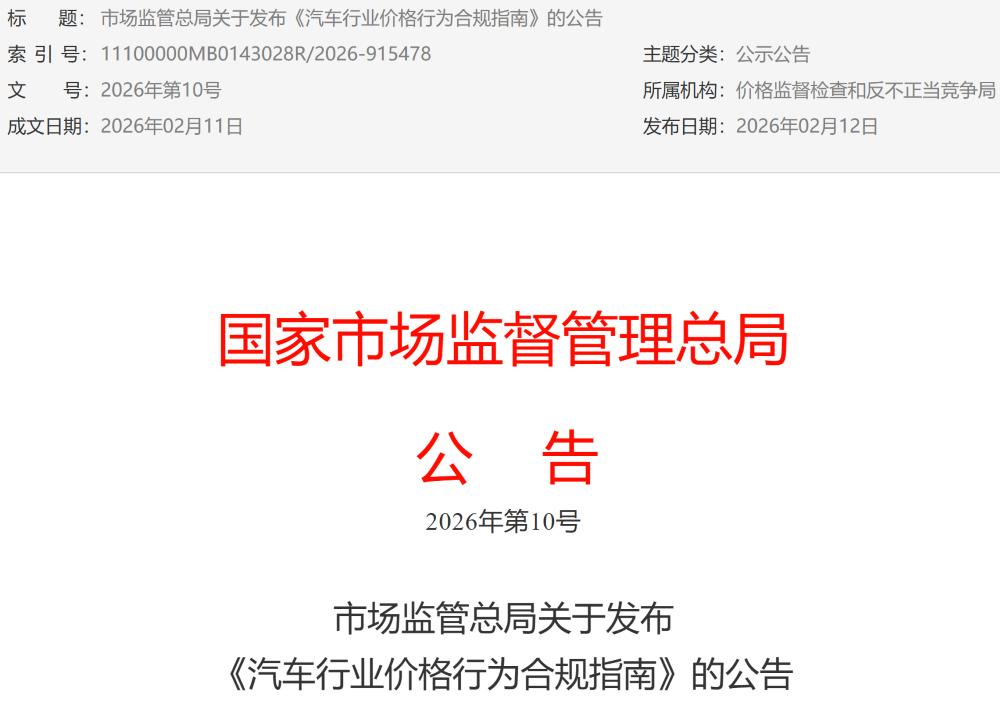
不得价外加价 汽车行业将告别“价格套路”
Bei Jing Shang Bao· 2026-02-12 16:06
Core Viewpoint - The automotive industry is shifting from price competition to value competition, driven by the newly released "Guidelines for Compliance with Pricing Behavior in the Automotive Industry" by the National Market Supervision Administration, which aims to regulate pricing behaviors and promote healthy market development [1][2]. Group 1: Pricing Behavior Guidelines - The "Guidelines" consist of five chapters and 28 articles, detailing pricing behavior norms for automotive production and sales enterprises [1]. - It emphasizes full-process price management, fair pricing constraints, and strict regulation of improper pricing behaviors across all stages from vehicle production to sales [1][2]. Group 2: Legal Risks and Compliance - Automotive production enterprises face significant legal risks if they engage in pricing behaviors aimed at eliminating competition or monopolizing the market, such as selling below production costs or using deceptive pricing strategies [2]. - The guidelines require automotive dealers to clearly display vehicle information, sales prices, and service fees, prohibiting hidden charges and false promotions [2]. Group 3: Impact on Industry and Consumers - The guidelines are expected to alleviate operational pressures on dealers, enhance profit margins, and protect consumer rights, thereby boosting consumer confidence [3]. - The automotive industry is urged to adopt differentiated pricing strategies rather than relying solely on low prices to capture market share, while also improving after-sales services to enhance consumer experience [3].
禁止亏本卖车,车圈反内卷新规出炉,价格战乱象大整治
3 6 Ke· 2026-02-12 11:25
Core Viewpoint - The release of the "Guidelines for Compliance with Pricing Behavior in the Automotive Industry" by the State Administration for Market Regulation aims to standardize pricing behavior in the automotive sector, ensuring fair competition and protecting consumer rights while promoting high-quality industry development [3][24]. Group 1: Pricing Guidelines for Automotive Manufacturers - Automotive manufacturers must base pricing on production costs and market demand, prohibiting loss-leading sales aimed at eliminating competitors or monopolizing the market [5][6]. - Manufacturers are not allowed to significantly raise prices without justifiable reasons, even when there is a severe supply-demand imbalance in the automotive supply chain [6]. - The guidelines require manufacturers to clearly inform consumers about the terms and costs associated with "pay-to-unlock" features, including any free trial periods [6][13]. Group 2: Pricing Guidelines for Automotive Dealers - Automotive dealers are required to display clear pricing, including vehicle name, price, unit of measurement, model, manufacturer, and key specifications [13][18]. - Dealers must publicly disclose promotional rules, activity duration, and applicable scope, ensuring transparency in discounts and promotional offers [13][18]. - Similar to manufacturers, dealers are prohibited from loss-leading sales except during inventory clearance [14][18]. Group 3: Supplier Payment Terms and Industry Practices - A survey by the China Automotive Industry Association indicates that most of the 17 key automotive companies have reduced payment terms to within 60 days, with an average of 54 days, which is a reduction of about 10 days compared to the previous year [20][21]. - 15 companies have adopted cash or bank acceptance bills for payments, with some companies allowing early payment requests for cash-strapped small and medium enterprises [20][21]. - The guidelines are part of a broader effort to ensure compliance with the revised "Regulations on Payment of Funds to Small and Medium Enterprises" by the State Council, promoting timely payments to suppliers [21][24].
香港汽车ETF(520720)回调超2.7%,政策与行业规范或重塑消费预期,关注回调布局机会
Mei Ri Jing Ji Xin Wen· 2025-12-16 06:47
Group 1 - The core viewpoint is that the "Guidelines for Compliance with Pricing Behavior in the Automotive Industry (Draft for Comments)" is expected to further promote the "anti-involution" process, regulating price competition in the domestic automotive industry, which may slow down the price war and improve profit margins for manufacturers and dealers [1] - Dealers, who have seen a significant decline in profitability in recent years, are expected to experience a more substantial improvement in their profit margins due to the new guidelines [1] - The guidelines require companies to adopt pricing strategies based on production costs and market supply and demand, ensuring price behavior is regulated across the entire chain, including vehicle sales and financial services [1] Group 2 - The Hong Kong Automotive ETF (520720) tracks the Hong Kong Stock Connect Automotive Index (931239), which selects listed companies involved in vehicle manufacturing, components, and emerging fields like smart driving to reflect the overall performance of automotive-related securities [2] - The index has a high research and development investment and growth characteristics, with the vehicle manufacturing sector accounting for over 60% of its weight, demonstrating strong market elasticity and international features [2] - The Hong Kong Automotive ETF (520720) can be traded directly through A-share accounts without the need for a Hong Kong Stock Connect permission, addressing the pain point of ordinary investors lacking investment tools [2]
国家出手:卖车须明码标价,比亚迪、小鹏、北汽积极响应
2 1 Shi Ji Jing Ji Bao Dao· 2025-12-13 02:05
Core Viewpoint - The National Market Supervision Administration has drafted the "Guidelines for Compliance with Pricing Behavior in the Automotive Industry" to standardize pricing practices in the automotive sector [1] Group 1: Regulatory Changes - The draft emphasizes that automotive sales companies must clearly mark prices for goods and services, including details on optional accessories such as name, price, specifications, and origin [1] - Companies are required to inform customers of delivery times if vehicles cannot be delivered on-site [1] Group 2: Industry Response - BYD, Xpeng Motors, and BAIC Group have expressed support for the guidelines, committing to adhere to the regulations on pricing competition [1] - These companies have pledged to eliminate practices such as selling below cost and false advertising, ensuring transparent pricing to protect consumer rights [1]


