传统燃油汽车

Search documents
【月度分析】2026年2月份全国乘用车市场分析
乘联分会· 2026-03-12 08:09
Core Insights - The overall retail market for passenger vehicles in February 2026 saw a significant decline, with retail sales reaching 1.034 million units, a year-on-year decrease of 25.4% and a month-on-month decrease of 33.1% [13][14]. - The production of passenger vehicles in February 2026 was 1.373 million units, reflecting a year-on-year decline of 21.0% and a month-on-month decline of 31.5% [17]. - The export of passenger vehicles in February 2026 reached 555,000 units, marking a year-on-year increase of 56.0% [16]. Overall Market Analysis - Retail sales for the year-to-date reached 2.578 million units, down 18.9% year-on-year [13]. - The February retail performance is characterized by significant fluctuations due to seasonal factors, particularly the Spring Festival [13]. - The market is currently experiencing a recovery phase following the expiration of the new energy vehicle purchase tax exemption policy, which has led to some consumer behavior adjustments [13][14]. New Energy Market Insights - In February 2026, the retail sales of new energy vehicles (NEVs) totaled 464,000 units, down 32.0% year-on-year [18]. - The production of NEVs in February was 645,000 units, a year-on-year decrease of 21.3% [18]. - NEVs accounted for 44.9% of the total retail market penetration in February, indicating a slight decline compared to the previous year [21]. Export Performance - The export of new energy vehicles reached 269,000 units in February, representing a year-on-year increase of 124.7% [22]. - NEVs constituted 48.5% of total vehicle exports, showing a significant increase from the previous year [22]. - Major exporters included BYD, Geely, and Chery, with substantial growth in overseas markets, particularly in Europe and Southeast Asia [22][23]. Manufacturer Performance - In February, domestic brands sold 630,000 units, down 30% year-on-year, with a market share of 61.2% [16]. - The luxury vehicle segment saw retail sales of 130,000 units, down 12% year-on-year, but with a market share increase [16]. - The competitive landscape is shifting, with traditional manufacturers like Geely and Changan showing improved performance in the new energy segment [16][24]. Future Outlook - March 2026 is expected to see a rebound in sales due to the resumption of normal operations post-Spring Festival and the introduction of new models [26]. - The government’s consumption promotion policies are anticipated to stimulate demand, particularly in the new energy vehicle sector [26][27]. - The automotive industry is projected to play a crucial role in driving economic growth, with significant contributions to manufacturing and employment [27][28].



乘联分会:1月全国乘用车市场零售154.4万辆 新能源车渗透率为38.6%
智通财经网· 2026-02-12 06:41
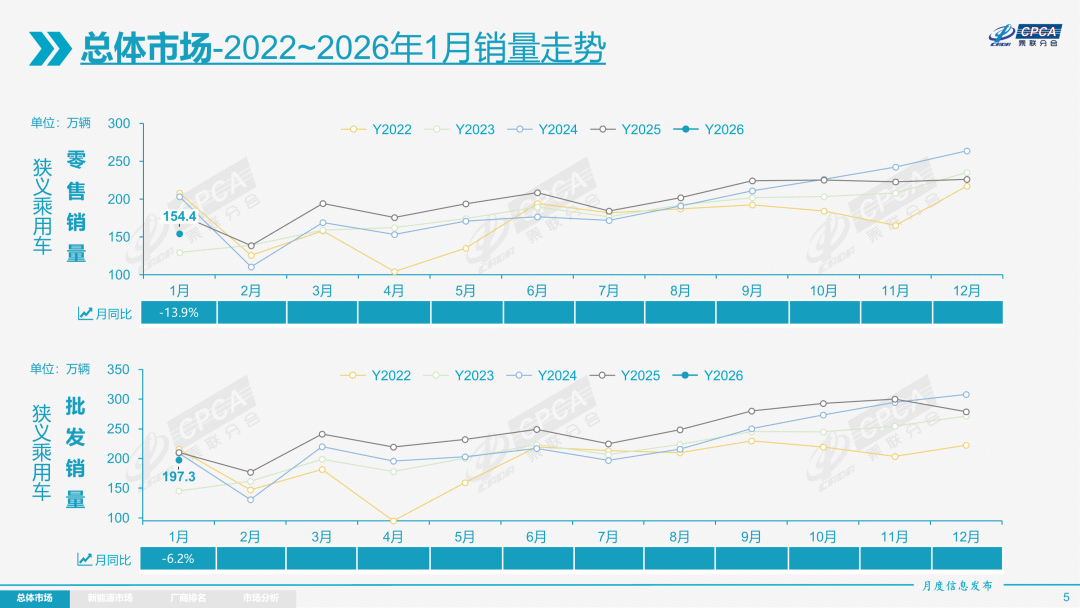
Core Insights - The overall retail sales of passenger cars in January decreased by 13.9% year-on-year, with a total of 1.544 million units sold. The retail sales of new energy vehicles (NEVs) reached 596,000 units, representing a penetration rate of 38.6%, down 3 percentage points from the previous year [1][11]. Retail Market Overview - In January, the retail sales of self-owned fuel passenger cars were 250,000 units, up 17% year-on-year, while self-owned NEVs sold 226,000 units, marking a significant increase of 115%. NEVs accounted for 47.5% of self-owned exports, indicating growing international influence [2]. - The retail sales of self-owned brands totaled 890,000 units, down 18% year-on-year, with a domestic market share of 57.5%, a decrease of 3.5 percentage points [2]. - Mainstream joint venture brands sold 470,000 units, down 4% year-on-year, with German brands increasing their market share to 19.8%, up 1.4 percentage points [2]. Production and Wholesale Analysis - In January, the production of passenger cars was 2.003 million units, down 4.4% year-on-year. The wholesale volume was 1.973 million units, a decrease of 6.2% year-on-year [4]. - The wholesale of self-owned brands was 1.326 million units, down 8%, while luxury car wholesale increased by 4% to 228,000 units [4]. - The overall wholesale landscape is changing, with some mid-tier companies showing strong performance, such as SAIC-GM-Wuling and NIO [4]. New Energy Vehicle Insights - The production of NEVs reached 938,000 units, a slight decrease of 0.6% year-on-year, while wholesale sales were 864,000 units, down 3.3% [5][6]. - NEV retail sales were 596,000 units, down 20% year-on-year, with conventional fuel vehicles selling 948,000 units, down 10% [7]. - NEV exports reached 286,000 units, a remarkable increase of 103.6%, accounting for 49.6% of total passenger car exports [11][12]. Market Trends and Future Outlook - The new energy vehicle market is expected to face challenges in February due to the impact of the Spring Festival, which may lead to lower sales volumes [16]. - The transition from merely selling cars to exporting entire industrial chains is anticipated, indicating a shift towards quality growth in the automotive export sector [17].




中国汽车行业展望
Zhong Cheng Xin Guo Ji· 2026-02-06 09:32
Investment Rating - The report maintains a stable investment rating for the Chinese automotive industry, indicating that the overall credit quality of the industry is not expected to change significantly in the next 12 to 18 months [5][7]. Core Insights - The automotive industry in China is projected to continue high production and sales levels in 2026, supported by policies such as vehicle trade-in programs and the extension of subsidies for new energy vehicles (NEVs). However, challenges such as the reduction of NEV purchase tax incentives and geopolitical uncertainties may exert pressure on growth [5][7]. - The report highlights a divergence in financial performance among automakers, with domestic brands and traditional fuel vehicle companies that are accelerating their transformation expected to perform better financially [7][21]. - The competitive landscape is shifting, with domestic brands increasing their market share in the passenger vehicle segment, while joint venture brands face transformation challenges [7][21]. Summary by Sections Analysis Approach - The automotive manufacturing industry is cyclical, influenced by macroeconomic conditions and consumer sentiment. The report assesses credit fundamentals by analyzing production and sales trends across passenger and commercial vehicles, as well as the impact of policies on market dynamics [8]. Industry Fundamentals - Since 2025, China's automotive market has shown stable economic performance, with significant policy support driving demand. In 2025, vehicle production and sales grew by 10.4% and 9.4%, respectively, reaching 34.53 million and 34.40 million units. The industry is characterized by rapid growth in NEVs and strong export performance [9][17]. Financial Performance - The report notes that while the industry has seen revenue growth, profit margins are under pressure due to price wars. Some automakers are experiencing cash flow issues and high debt levels, leading to signs of market consolidation [7][9]. Conclusion - The report concludes that while the automotive industry is expected to maintain growth, the pace may slow due to various factors, including policy changes and market saturation. The focus will shift towards enhancing service consumption and improving market order [20][30]. Tables and Figures - The report includes various tables and figures illustrating trends in vehicle sales, production, and market dynamics, providing a visual representation of the industry's performance [10][13][44].
2025年度中国汽车产业盘点——销量篇 车企竞争进入深水区
Zhong Guo Zhi Liang Xin Wen Wang· 2026-02-04 06:51
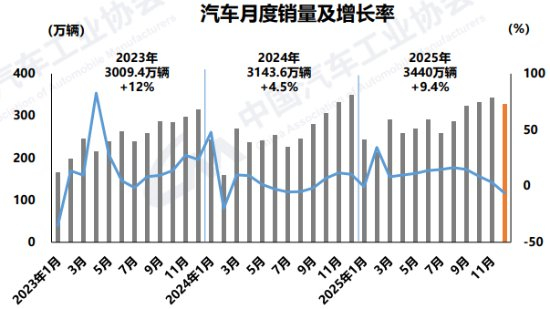
Overall Market - In 2025, China's automotive industry achieved record production and sales, with 34.53 million vehicles produced and 34.40 million sold, marking year-on-year growth of 10.4% and 9.4% respectively, driven by policy support and market dynamics [1][5] - The market demonstrated strong resilience against global trade protectionism, supply chain restructuring, and intensified competition [1] Market Dynamics - The "Two New" policy expanded consumer goods categories and support for equipment upgrades, stimulating vehicle replacement demand, particularly in lower-tier cities [5] - The transition to electric vehicles (EVs) was facilitated by stable tax policies and improved charging infrastructure, lowering barriers for potential EV buyers [5] - Consumer preferences are shifting towards intelligent features and green travel, pushing the market towards higher quality development [5] Segmented Market - In 2025, new energy vehicles (NEVs) became the dominant growth segment, with production and sales reaching 16.63 million and 16.49 million respectively, reflecting year-on-year growth of 29% and 28.2% [6] - NEVs accounted for 47.9% of total new vehicle sales, a 7 percentage point increase from the previous year [6] - The traditional fuel vehicle market is undergoing structural adjustments, with demand for high-displacement, high-fuel-consumption models declining, while smaller, hybrid models remain popular [10] Market Structure - Domestic brands solidified their leading position, with their market share exceeding 60% for the first time, driven by strong performances from companies like BYD, Geely, and Changan [13][15] - BYD led the market with over 4.6 million units sold, benefiting from its technological advancements in NEVs [15] - Joint venture brands faced significant pressure, with declining market shares due to slow adaptation to the NEV market and product homogenization [16] Export Market - In 2025, China's automotive exports exceeded 7 million units, achieving a year-on-year growth of 21.1%, maintaining its position as the world's largest automotive exporter for three consecutive years [18] - Emerging markets in Southeast Asia, the Middle East, and South America remain key destinations for Chinese automotive exports, with NEVs becoming a significant export category [18] Sales Rankings - The top ten automotive brands in 2025 showcased a strong performance from domestic brands, with five spots occupied by them, and a combined market share of 37.3% [21] - BYD, Geely, and Changan maintained their positions through a dual strategy of fuel and NEV offerings [21] - Traditional joint venture brands like FAW-Volkswagen and SAIC Volkswagen continued to experience declines, unable to offset losses from fuel vehicle sales with NEV growth [21] Emerging Brands - New entrants like Leap Motor and Hongmeng Zhixing showed remarkable growth, with Leap Motor doubling its sales through self-developed technology and competitive pricing [23] - Traditional automakers' NEV sub-brands also performed well, rapidly capturing market share through targeted strategies [23] Consumer Trends - Successful models in 2025 aligned with market trends, focusing on price adaptability, user needs, and technological highlights [24] - Family and young consumers emerged as core target groups, with vehicles designed for spaciousness and smart features gaining popularity [26] - The integration of new energy and intelligent technologies became essential for popular models, addressing consumer concerns about range and charging [26] Future Outlook - The strong rise of NEVs indicates China's automotive industry is positioned advantageously in the global transformation of the sector [28] - Continued policy support for NEVs and smart vehicles is expected, alongside growing consumer demand for high-quality, intelligent products [28] - The industry is likely to see further integration across the supply chain, enhancing competitiveness [28]


比亚迪1月30日获融资买入2.54亿元,融资余额129.93亿元
Xin Lang Cai Jing· 2026-02-02 01:28
Group 1 - BYD's stock price decreased by 1.54% on January 30, with a trading volume of 3 billion CNY [1] - The financing buy amount for BYD on the same day was 254 million CNY, while the financing repayment was 309 million CNY, resulting in a net financing outflow of 55.02 million CNY [1] - As of January 30, the total financing and securities lending balance for BYD was 13.048 billion CNY, with the financing balance at 12.993 billion CNY, accounting for 2.63% of the circulating market value, which is below the 50th percentile level over the past year [1] Group 2 - As of September 30, BYD had 642,600 shareholders, an increase of 98.37% compared to the previous period, with an average of 5,427 circulating shares per person, up by 51.21% [2] - For the period from January to September 2025, BYD reported operating revenue of 566.266 billion CNY, a year-on-year increase of 12.75%, while the net profit attributable to shareholders decreased by 7.55% to 23.333 billion CNY [2] Group 3 - BYD has distributed a total of 27.859 billion CNY in dividends since its A-share listing, with 24.414 billion CNY distributed in the last three years [3] - As of September 30, 2025, Hong Kong Central Clearing Limited was the fourth largest circulating shareholder of BYD, holding 263 million shares, an increase of 137 million shares from the previous period [3] - Huatai-PB CSI 300 ETF ranked as the eighth largest circulating shareholder with 46.304 million shares, an increase of 30.2458 million shares from the previous period [3]
2025年乌兹别克斯坦进口乘用车总量达7.98万辆
Shang Wu Bu Wang Zhan· 2026-01-30 15:02
Core Insights - Uzbekistan's total passenger car imports are projected to reach 79,822 units in 2025, reflecting a 7.1% increase from 74,505 units in 2024 [1] - The total value of passenger car imports is expected to be $1.17 billion, a decrease of 8.1% from $1.28 billion in 2024 [1] Electric Vehicles - Electric vehicles continue to dominate imports, with a volume of 56,832 units, doubling year-on-year, and an import value of $701 million, a significant increase of 212% from $224.7 million in 2024 [1] Traditional Fuel Vehicles - The import volume of traditional fuel vehicles has significantly contracted, with 19,871 units imported, representing a nearly 40% decline, and the import value dropping from $706.8 million in 2024 to $387.9 million [1] Hybrid Vehicles - Hybrid vehicle imports have seen the most drastic decline, with only 3,017 units imported in 2025, an 83% decrease from 17,480 units in 2024, and the import value plummeting from $339.3 million to $80.9 million [1] Diesel Vehicles - Diesel passenger car imports increased from 22 units in 2024 to 102 units in 2025, but the import value decreased from $5.08 million to $2.65 million [1]
去年中国车市销量2093.6万辆创新高,TOP5车企拿下半个市场
21世纪经济报道· 2026-01-16 08:24
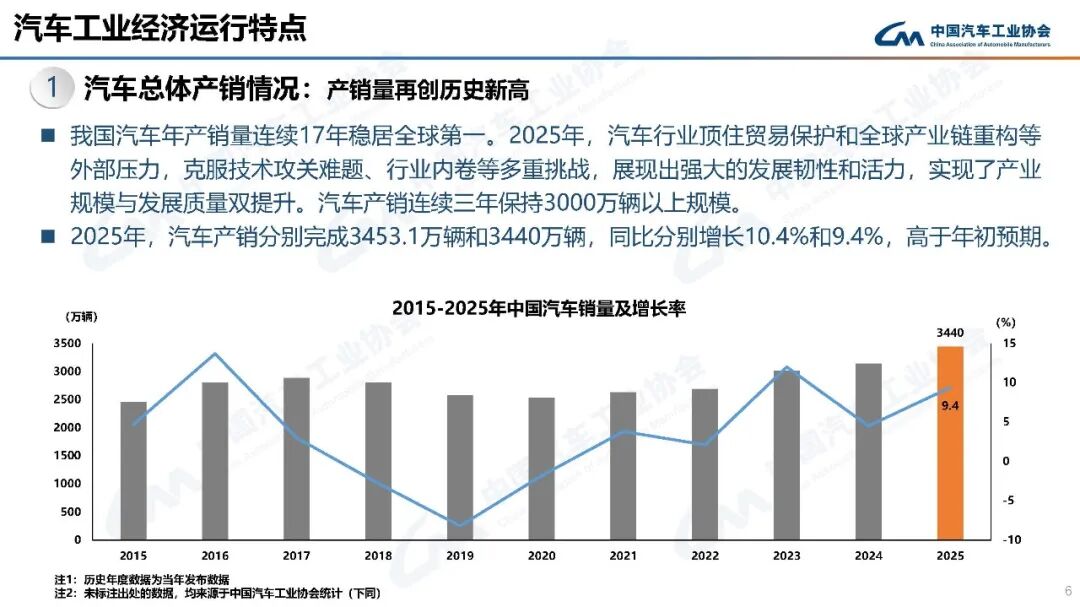
Core Viewpoint - In 2025, China's automotive market is expected to achieve structural growth, with production and sales reaching 34.53 million and 34.40 million units respectively, marking a year-on-year increase of 10.4% and 9.4%, maintaining its position as the world's largest market for 17 consecutive years [1][2]. Group 1: Market Performance - The significant growth in the automotive sector is driven by the rise of new energy vehicles (NEVs), with domestic sales projected to reach 13.88 million units in 2025, a year-on-year increase of 19.8%, resulting in a penetration rate of 54% for new energy passenger cars [1][2]. - Chinese brands are a core engine of growth, with sales of domestic passenger cars expected to reach 20.94 million units, a 16.5% increase, raising market share to 69.5%, the highest since 2018 [1][2]. Group 2: Market Dynamics - The automotive industry has shifted away from aggressive price wars, with only 156 new models seeing price reductions in the first ten months of 2025, indicating a more rational market order [2]. - Growth is primarily fueled by government policies such as "trade-in" programs that effectively stimulate demand for vehicle upgrades [2]. Group 3: Profitability and Competition - Despite the expansion in sales, the automotive industry's profitability remains under pressure, with revenues exceeding 10 trillion yuan and profits reaching 440.3 billion yuan, a 7.5% increase, but with a profit margin of 4.4%, below the average of 6% for downstream industrial enterprises [2]. - The competition landscape is increasingly concentrated, with the top three companies—BYD, SAIC, and Geely—accounting for 36.6% of the market share, while the top 15 companies collectively hold 92.3% of total sales [10][12]. Group 4: New Energy Vehicle Trends - In 2025, the sales of new energy passenger vehicles are projected to reach 13.01 million units, a 17.7% increase, while traditional fuel vehicles are expected to decline to 11.06 million units, a decrease of 4.3% [4][6]. - The mainstream market for new energy vehicles is concentrated in the price range of 100,000 to 200,000 yuan, with sales in this segment expected to reach 6.94 million units, a 24% increase, representing half of the total new energy vehicle sales [4][6]. Group 5: Brand Strategies - BYD continues to dominate the 100,000 to 200,000 yuan market segment, with significant sales from its Dynasty and Ocean series, while Geely's Galaxy brand has seen a 150% increase in sales, enhancing its market penetration [6][13]. - New entrants like Leap Motor and Xpeng are also making significant strides, with Leap Motor achieving a 104.7% year-on-year growth, focusing on cost control and technology [14][19]. Group 6: Future Outlook - For 2026, the automotive market is expected to see a modest growth of 1%, with total sales projected at 34.75 million units, while new energy vehicles are anticipated to grow by 15.2% to 1.9 million units [16][17]. - The competitive landscape is expected to intensify, with traditional automakers setting ambitious sales targets, while new entrants aim for aggressive growth, indicating a fierce battle for market share [19].


崔东树:2025年全国汽车市场总体走势较强 卡车和客车市场回暖明显
智通财经网· 2026-01-15 07:29
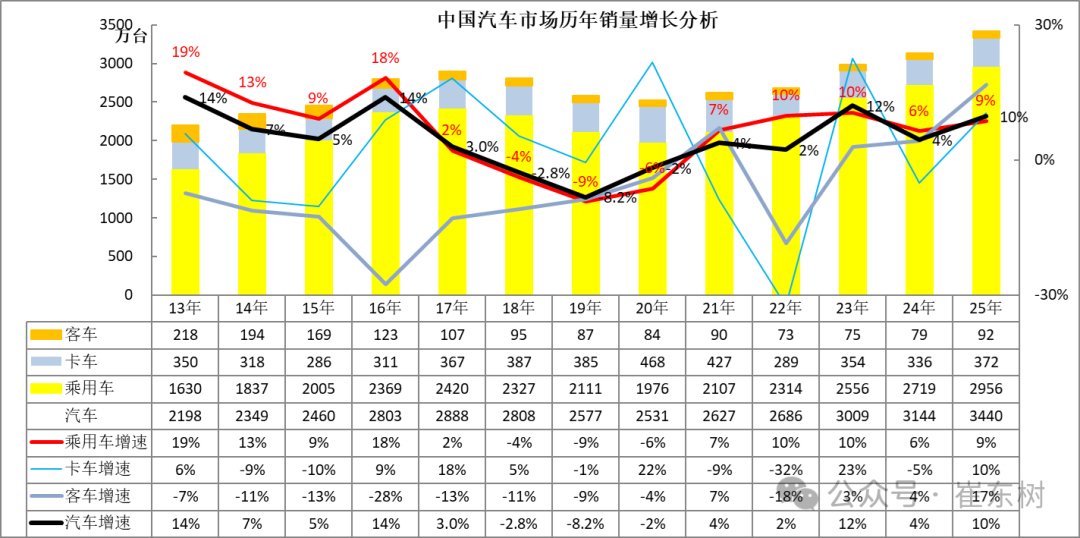
Group 1 - The core viewpoint of the articles indicates a strong growth trajectory for the automotive market in 2025, driven by macroeconomic factors and promotional policies, with a notable recovery in both truck and bus markets [1] - The differentiation between passenger and commercial vehicles is becoming more pronounced, with passenger vehicle growth projected at 9% due to policy support, while commercial vehicles are experiencing structural growth driven by electrification [3][5] - The total automotive sales for 2025 are expected to reach 34.4 million units, with a cumulative growth rate of 9%, although December sales showed a decline of 8% year-on-year [5][34] Group 2 - The performance of major automotive groups is showing significant divergence, with leading companies like BYD and Chery performing well, while some state-owned enterprises are lagging [7][10] - The competitive landscape for electric vehicles is stabilizing, with leading manufacturers experiencing rapid growth, while second-tier manufacturers are gradually catching up [24] - The sales of traditional fuel vehicles are projected to decline, with a 10% drop expected in 2024 and a further 9% decline in 2025, indicating ongoing pressure from the rise of electric vehicles [26] Group 3 - The passenger vehicle market is seeing a strong performance from domestic brands, with BYD leading, followed by Geely and Chery, while joint venture brands are experiencing weaker sales [17][19] - The December sales for passenger vehicles showed a significant decline, with a 9% drop year-on-year, highlighting the challenges faced by many manufacturers [15][19] - The commercial vehicle market is benefiting from strong demand for logistics and electric vehicles, with a notable increase in sales for light trucks and microbuses [32][36]
2025年汽车产销超3400万辆,10家车企集团稳居“百万俱乐部”
Zhong Guo Jing Ji Wang· 2026-01-15 06:41
Group 1 - The core viewpoint of the article highlights the robust growth of China's automotive industry in 2025, achieving a total vehicle sales target of approximately 32.3 million units, with a notable increase in new energy vehicle (NEV) sales reaching around 15.5 million units, reflecting a year-on-year growth of about 20% [1][10] - The China Association of Automobile Manufacturers (CAAM) reported that in 2025, the production and sales of automobiles reached 34.5 million and 34.4 million units respectively, marking a year-on-year increase of 10.4% and 9.4%, maintaining China's position as the world's largest automotive market for 17 consecutive years [1][3] - NEV production and sales in 2025 were 16.6 million and 16.5 million units respectively, with year-on-year growth of 29% and 28.2%, indicating that NEVs accounted for over 50% of the domestic market, solidifying their dominance [1][10] Group 2 - In 2025, the automotive industry faced external pressures such as trade protectionism and global supply chain restructuring, yet it demonstrated resilience and vitality, achieving both scale and quality improvements in production and sales [3] - The export of automobiles reached 7.1 million units in 2025, with a year-on-year increase of 21.1%, becoming a key driver for positive growth in the Chinese automotive market [3][10] - The passenger vehicle market saw a significant surge, with production and sales surpassing 30 million units for the first time, achieving 30.3 million and 30.1 million units respectively, reflecting year-on-year growth of 10.2% and 9.2% [3][4] Group 3 - Ten automotive groups achieved sales exceeding one million units in 2025, collectively accounting for 83.9% of total automotive sales, with notable players including BYD, SAIC, and Geely [4] - The market share of domestic brands in the passenger vehicle segment increased, with a market share of 68.8% in December 2025, up 2.7 percentage points from the previous year [4][5] - The sales of traditional fuel vehicles continued to decline, with 13.4 million units sold in 2025, a decrease of 4% year-on-year, highlighting a shift towards electric vehicles [5][10] Group 4 - The article emphasizes the importance of the transition to electric vehicles, noting that while NEVs have not yet achieved a majority in overall sales, they have surpassed 50% in domestic sales [8][10] - The automotive market is transitioning from a growth phase to a more mature phase, with consumer behavior influenced by various factors including policy changes and income expectations [12] - Looking ahead to 2026, the forecast predicts total automotive sales of 34.75 million units, with NEV sales expected to reach 19 million units, reflecting a year-on-year growth of 15.2% [12]
崔东树:2025年全国汽车市场总体走势较强 新能源商用车景气度走高
智通财经网· 2025-12-14 09:49
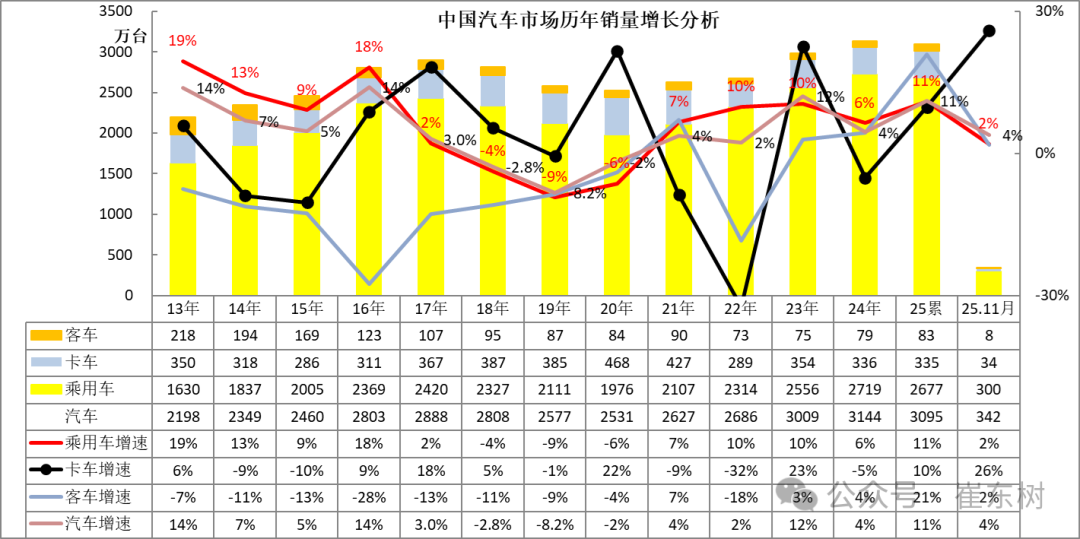
Core Viewpoint - The automotive market in China is expected to maintain strong growth in 2025, driven by government policies promoting consumption, with passenger vehicle growth projected at 11% and significant recovery in both truck and bus markets [1][2]. Group 1: Market Trends - The automotive market is experiencing a clear differentiation between passenger and commercial vehicles, with passenger vehicle consumption improving while commercial vehicle sales are weaker [4][6]. - In the first 11 months of 2025, total automotive sales reached 30.94 million units, with a cumulative growth rate of 11% [6]. - November 2025 saw total automotive sales of 3.42 million units, reflecting a year-on-year growth of 3% [6]. Group 2: Company Performance - There is significant performance differentiation among major automotive groups, with some state-owned enterprises lagging behind while companies like BYD and Chery show strong performance [9][12]. - The competitive landscape is shifting, with private enterprises like Geely, BYD, and Chery becoming the main players in the industry, indicating a sustainable trend [12][13]. Group 3: Passenger Vehicle Dynamics - Cumulative sales of narrow passenger vehicles reached 26.75 million units in the first 11 months of 2025, with an 11% growth rate [17]. - In November 2025, narrow passenger vehicle sales totaled 3 million units, showing a year-on-year increase of 2% [17][19]. - The retail sales of narrow passenger vehicles maintained a year-on-year growth of 5% since 2023, although a downward trend was observed from September 2025 [21]. Group 4: New Energy Vehicle Trends - In November 2025, sales of new energy passenger vehicles reached 1.71 million units, marking a year-on-year increase of 19% [24]. - Cumulative wholesale sales of new energy passenger vehicles from January to November 2025 reached 13.77 million units, reflecting a year-on-year growth of 28% [24][26]. Group 5: Commercial Vehicle Insights - The commercial vehicle market is characterized by structural growth driven by equipment renewal subsidies, with high subsidies accelerating the electrification of logistics and transportation [1][4]. - In the first 11 months of 2025, cumulative truck sales reached 3.35 million units, with a growth rate of 10% [37]. - November 2025 saw truck sales of 340,000 units, representing a year-on-year increase of 26% [37][39].