注销式回购

Search documents
永升服务:已注销596.2万股回购股份
Zhong Zheng Wang· 2026-02-25 12:43
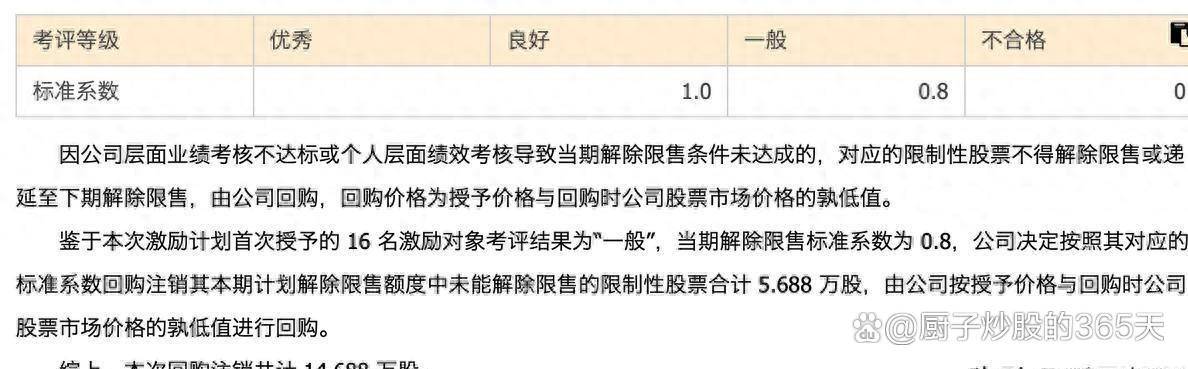
Core Viewpoint - Yongsheng Service announced the cancellation of 5.962 million shares, representing approximately 0.34% of the company's total share capital, which is expected to enhance net asset value per share and earnings per share, aligning with the overall interests of the company and its shareholders [1] Group 1 - The share cancellation was completed on February 25, following a buyback period from December 15, 2025, to January 28, 2026, during which the company repurchased a total of 5.962 million shares [1] - The company previously announced its intention to initiate share buybacks based on market conditions, which began on December 15, 2025, and lasted for 30 consecutive trading days [1] - According to a report by CITIC Securities, the nature of share cancellation buybacks is similar to dividends, as they can enhance shareholder value by increasing ownership percentage at a lower cost when the company's market value is below its intrinsic value [1]
A股深夜突发利好!九大行业龙头集体行动,全部用于注销
Sou Hu Cai Jing· 2025-12-20 20:23
Core Viewpoint - A significant trend in the A-share market is the increase in share buybacks and subsequent cancellations by leading companies, which is seen as a positive signal for investors [3][5][10]. Group 1: Company Actions - Nine leading companies, including Yintai Group, Chengde Lululemon, and Zhangyu A, announced share buybacks and cancellations on December 19, 2025, with Yintai Group canceling 146,900 shares, Chengde Lululemon 1.14 million shares, and Zhangyu A 2.15 million shares [3]. - Midea Group completed a buyback plan of 10 billion yuan, with over 70% allocated for cancellation, while Kweichow Moutai announced a new buyback plan of 1.5 to 3 billion yuan, also aimed at cancellation [5][10]. - As of December 2025, the total buyback amount in the A-share market exceeded 150 billion yuan, with over 40% of the funds explicitly designated for cancellation [3][13]. Group 2: Market Implications - The trend of buyback and cancellation is viewed as a method to enhance shareholder value by reducing share capital and increasing earnings per share (EPS) and return on equity (ROE) [7][10]. - The increase in buybacks reflects a shift in corporate strategy from expansion to enhancing shareholder returns, especially when companies have excess cash but lack profitable investment opportunities [10][12]. - The overall buyback and cancellation activity is expected to reduce the supply of shares in the market, potentially supporting stock prices during periods of low market sentiment [12]. Group 3: Policy and Market Sentiment - The new "National Nine Articles" policy encourages listed companies to buy back shares and cancel them, integrating the buyback amounts into dividend payout calculations [8][10]. - The growing number of companies opting for buyback cancellations indicates a rising recognition of their own value and a shift towards value investing in the capital market [13][16]. - Analysts suggest that the willingness to engage in buyback cancellations serves as a new benchmark for assessing a company's intrinsic quality and governance standards [16].


今日视点:期待A股涌现更多注销式回购
Xin Lang Cai Jing· 2025-12-11 23:12
Core Viewpoint - Midea Group has completed a share buyback of 10 billion yuan, with over 70% of the repurchased shares intended for cancellation, reflecting a positive response from investors and indicating a trend towards cancellation-style buybacks in the A-share market [1][7]. Group 1 - The cancellation-style buyback provides a new benchmark for assessing the value of listed companies, enhancing earnings per share and return on equity without changing net profit [2][8]. - More companies are adopting cancellation-style buybacks, which serve as a measure of a company's internal quality and governance, guiding investments towards assets with genuine value creation capabilities [2][8]. Group 2 - Cancellation-style buybacks represent a new paradigm for companies to utilize capital effectively, shifting from scale pursuit to efficiency enhancement in the context of high-quality economic development [3][9]. - When companies have ample cash flow but lack investment projects that exceed their capital costs, using funds for buybacks is a rational and efficient choice [3][9]. Group 3 - Cancellation-style buybacks help create a more coordinated investment and financing ecosystem, reducing stock supply and supporting share prices [4][10]. - This mechanism acts as an "internal stabilizer" for the market, providing liquidity support and favoring long-term investors while pressuring companies to improve governance [4][10]. Group 4 - The rise of cancellation-style buybacks fosters a mature "shareholder culture," similar to practices in developed markets, where companies regularly return excess cash to shareholders [5][11]. - As more A-share companies adopt this practice, it encourages a focus on real profitability and free cash flow, enhancing market efficiency and creating a stable environment for long-term investments [5][11]. Group 5 - The increasing number of cancellation-style buyback cases in the A-share market indicates significant potential for growth, with expectations for more companies to adopt this approach to strengthen shareholder return awareness and optimize capital allocation [12].
期待A股涌现更多注销式回购
Zheng Quan Ri Bao· 2025-12-11 16:14
Core Viewpoint - The announcement by Midea Group regarding a 10 billion yuan share buyback, with over 70% of the repurchased shares intended for cancellation, reflects a positive trend in the A-share market towards share buybacks that enhance shareholder value and optimize capital structure [1] Group 1 - The implementation of share buybacks for cancellation provides a new benchmark for assessing the value of listed companies, enhancing earnings per share and return on equity without altering net profit [1] - More companies are adopting cancellation-based buybacks, indicating a shift in market dynamics towards valuing companies that prioritize shareholder returns [1] Group 2 - Cancellation-based buybacks serve as a new paradigm for companies to utilize capital effectively, especially when cash flow is abundant but investment opportunities are limited [2] - This approach aligns with the transition of the economy towards high-quality development, emphasizing efficiency over mere scale [2] Group 3 - Cancellation-based buybacks contribute to a more coordinated investment and financing ecosystem, reducing stock supply and supporting share prices, thus acting as a stabilizing mechanism in the market [3] - This mechanism encourages companies to enhance governance and focus on long-term value, as only financially healthy firms can afford to implement genuine cancellation-based buybacks [3] Group 4 - The rise of cancellation-based buybacks fosters a mature "shareholder culture" in the A-share market, similar to practices in developed markets, where returning excess cash to shareholders is standard [4] - As more companies engage in cancellation-based buybacks, investor focus will shift towards genuine profitability and free cash flow, promoting capital allocation towards high-quality firms [4]
每经热评丨回购100亿元至少注销70亿元 美的集团回报股东的“作业”值得抄
Sou Hu Cai Jing· 2025-12-09 14:45
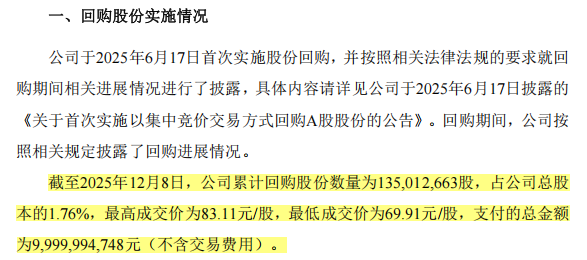
Group 1 - The core viewpoint of the article highlights Midea Group's successful completion of a share buyback program amounting to 10 billion yuan, which involved repurchasing 135 million shares, with 95 million shares set to be canceled, reducing the registered capital by 1.24% of the total share capital [1] - Midea Group's buyback represents a significant portion of the total buyback amount in the A-share market this year, which has seen over 1,400 companies engage in buybacks totaling 140.6 billion yuan, with Midea accounting for 11.545 billion yuan [1] - The article emphasizes that share buybacks can enhance shareholder returns and improve market liquidity, while also reflecting the company's confidence in its future development [1] Group 2 - The article notes that while share buybacks temporarily reduce the number of freely tradable shares, the intrinsic value per share does not change until shares are canceled, which subsequently increases metrics like net asset value and earnings per share [2] - It points out that most share buybacks are not for cancellation but for purposes like equity incentives or market value management, which may not create long-term value for shareholders [2] - The article advocates for companies to adopt cancellation-style buybacks when financially feasible, rather than engaging in market speculation [2] Group 3 - The article suggests that companies should focus on timely and proactive buybacks rather than waiting for optimal market conditions, as demonstrated by Midea Group's efficient execution of its buyback plan within six months [3] - It highlights that despite 1,465 companies announcing buyback plans this year, many have executed minimal buybacks, indicating potential issues with capital allocation or market timing perceptions [3] - The article stresses that genuine performance and cash flow are essential for companies to engage in cancellation-style buybacks, which can enhance overall operational quality [3]

回购100亿元至少注销70亿元 美的集团回报股东的“作业”值得抄
Mei Ri Jing Ji Xin Wen· 2025-12-09 14:41
Core Viewpoint - Midea Group has successfully completed a share buyback of 10 billion yuan, acquiring 135 million A-shares, with 95 million shares to be canceled, representing 1.24% of the total share capital before cancellation [1] Group 1: Share Buyback Details - The buyback amount of 10 billion yuan corresponds to 135 million shares, with 95 million shares set for cancellation [1] - Midea Group's buyback accounted for 115.45 billion yuan of the total 1,406 billion yuan spent on buybacks by over 1,400 A-share listed companies this year [1] - The company's stock price reached a new high since February 19, 2021, on December 4, indicating the effectiveness of the buyback in enhancing shareholder value [1] Group 2: Characteristics of Share Buybacks - Share buybacks are characterized by companies exchanging cash for shares, reducing the number of circulating shares, which has a direct and rapid impact on stock prices [1] - The funds from buybacks flow from the company to the capital market, improving overall market liquidity and signaling confidence in future growth [1] - The effectiveness of buybacks is maximized by the company's sincerity, with Midea Group's 10 billion yuan buyback serving as a reference for other companies [1] Group 3: Long-term Value Creation - The intrinsic value of shares does not change with buybacks; only after cancellation do metrics like net asset per share and earnings per share increase, enhancing share value [2] - Most buybacks are not for cancellation but for purposes like equity incentives or market management, with some companies later selling repurchased shares at a profit [2] - Companies should focus on cancellation-style buybacks to genuinely create long-term value for shareholders, avoiding short-term speculative strategies [2] Group 4: Implementation of Buyback Plans - Companies should adopt a proactive approach to buybacks, completing them within the committed timeframe, as demonstrated by Midea Group's swift execution of its buyback plan [3] - The buyback price ranged from 69.91 yuan to 80.62 yuan per share, indicating a high-price buyback strategy [3] - A significant number of companies have announced buyback plans, but many have executed minimal buybacks, suggesting a reluctance to act until stock prices reach perceived "buy points" [3]
宋城演艺:拟回购注销增强投资回报 彰显长期发展信心
Zheng Quan Shi Bao Wang· 2025-12-09 14:01
Group 1 - The core announcement from Songcheng Performance is the plan to repurchase shares using its own funds, with a total amount between 100 million and 200 million yuan, aimed at canceling the repurchased shares and reducing registered capital [1] - The maximum repurchase price is set at 12.00 yuan per share, which is 150% of the average trading price over the previous 30 trading days, estimating the repurchase quantity to be between 8.33 million and 16.67 million shares, representing 0.32% to 0.63% of the current total share capital [1] - The company emphasizes its recognition of intrinsic value and confidence in future development, highlighting stable operations and good financial health, with total assets of 10.149 billion yuan and net assets of 8.371 billion yuan as of September 30, 2025 [1] Group 2 - The repurchase initiative aligns with the regulatory call from the China Securities Regulatory Commission to enhance investor returns and promote share buybacks as a means of rewarding investors [2] - The company aims to convey a positive signal to the market through this share repurchase, which is expected to enhance earnings per share and shareholder returns, thereby boosting market confidence and laying a solid foundation for long-term high-quality development [2]

超1500亿元 四成以上为注销!A股年内回购大数据,出炉→
Zheng Quan Shi Bao· 2025-12-09 12:32
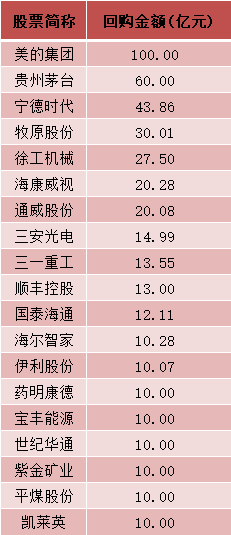
Group 1 - The core viewpoint of the articles highlights the increasing trend of stock buybacks among A-share listed companies, driven by policy guidance, valuation recovery needs, and shareholder return optimization [1][4] - Over 40% of stock buyback plans announced this year are aimed at complete or partial cancellation, indicating a rise from 38.33% in 2024 [1][4] - The total amount of stock buybacks in A-shares has exceeded 150 billion yuan, with leading companies actively participating in these buybacks [2][4] Group 2 - Midea Group has completed a significant buyback of approximately 1.35 million shares, totaling around 10 billion yuan, marking it as the only "billion-level" buyback in A-shares this year [2][4] - Other notable companies include Kweichow Moutai and CATL, which have also engaged in substantial buybacks of 6 billion yuan and 4.386 billion yuan, respectively [2][3] - The trend of buyback cancellations is seen as a response to policies like the "New Nine Articles," which encourage companies to optimize their capital structures and enhance shareholder value [4][5] Group 3 - The buyback and cancellation strategy is viewed as a means to improve earnings per share (EPS) and attract long-term capital inflow, thereby enhancing company competitiveness [5][6] - Companies are advised to balance shareholder returns with maintaining a robust capital structure to avoid excessive cash flow pressure [6] - The overall sentiment is that buyback cancellations can stabilize the market and promote healthy development within the capital market [6]



年内A股回购总额突破1400亿元
Shen Zhen Shang Bao· 2025-12-09 11:37
Core Viewpoint - The A-share market is experiencing a significant increase in stock buybacks, driven by leading companies and supported by favorable policies, with a total buyback amount exceeding 140 billion yuan as of December 8, 2023 [2][3]. Group 1: Buyback Trends - A total of 1,464 A-share listed companies have initiated stock buybacks this year, with a cumulative buyback amount surpassing 140 billion yuan [2]. - Key industries such as power equipment, electronics, home appliances, and machinery have each seen buyback amounts exceeding 10 billion yuan [2]. - The People's Bank of China and financial regulators have introduced policies to support stock buybacks, including a loan program with an initial quota of 300 billion yuan, increasing to 800 billion yuan by May 2025 [2]. Group 2: Loan Support for Buybacks - Over 770 listed companies have disclosed receiving loan support for buybacks, with a total loan ceiling exceeding 157.19 billion yuan, including 98.50 billion yuan specifically for buybacks [3]. - Notable companies receiving significant loan amounts include China Three Gorges Renewables, Kweichow Moutai, and Haier Smart Home, with loan ceilings exceeding 10 billion yuan [3]. Group 3: Leading Companies in Buybacks - Nineteen companies have repurchased over 100 million shares this year, with the top five being BOE Technology Group, Innovation Materials, XCMG, China State Construction, and Liao Port, repurchasing 428 million, 362 million, 358 million, 290 million, and 279 million shares respectively [3]. - The top three companies by buyback amount are Midea Group, Kweichow Moutai, and CATL, with buyback amounts of 11.01 billion yuan, 6 billion yuan, and 4.39 billion yuan respectively [3]. Group 4: Impact of Buybacks - The current buyback trend is characterized by a significant increase in cancellation-type buybacks, with nearly 20% of companies explicitly stating their buybacks will be used for capital cancellation, a 3% increase from the previous year [5]. - Kweichow Moutai has completed a 6 billion yuan buyback for cancellation and announced a new buyback plan of 1.5 billion to 3 billion yuan, all intended for capital cancellation [5]. - The trend of leading companies engaging in buybacks is seen as a natural outcome of market resources concentrating towards top firms, which typically have stronger cash flow and risk resilience [4].
回购100亿元注销70亿元 美的回报股东的“作业”值得抄
Mei Ri Jing Ji Xin Wen· 2025-12-09 10:32
Core Viewpoint - Midea Group has completed a share buyback of 10 billion yuan, acquiring 135 million A-shares, with 95 million shares to be canceled, reducing registered capital by 1.24% [1][3]. Group 1: Buyback Details - The total amount of share buybacks in the A-share market this year exceeded 140.6 billion yuan, with Midea Group accounting for approximately 11.545 billion yuan [3]. - Midea's share buyback was approved on May 30 and completed in less than six months, with buyback prices ranging from 69.91 yuan to 80.62 yuan [4]. Group 2: Impact on Shareholder Value - Share buybacks can enhance shareholder value by reducing the number of circulating shares, which can lead to an increase in metrics such as net asset value and earnings per share once shares are canceled [4]. - Midea's buyback has been effective, with its stock price reaching a new high since February 19, 2021, just a few percentage points away from its historical peak [3]. Group 3: Market Context and Trends - A total of 1,465 companies have disclosed buyback plans this year, but 515 companies have repurchased less than 10 million yuan, indicating potential issues with capital allocation or market timing [5]. - The trend towards "cancellation-style buybacks" is encouraged, as it reflects a company's genuine performance and commitment to returning value to shareholders [5].