
消费公平

Search documents
春节出行住宿更安心,亚朵官方渠道上线“降价退、买贵赔”双重价格保障
Sou Hu Wang· 2026-02-04 05:26
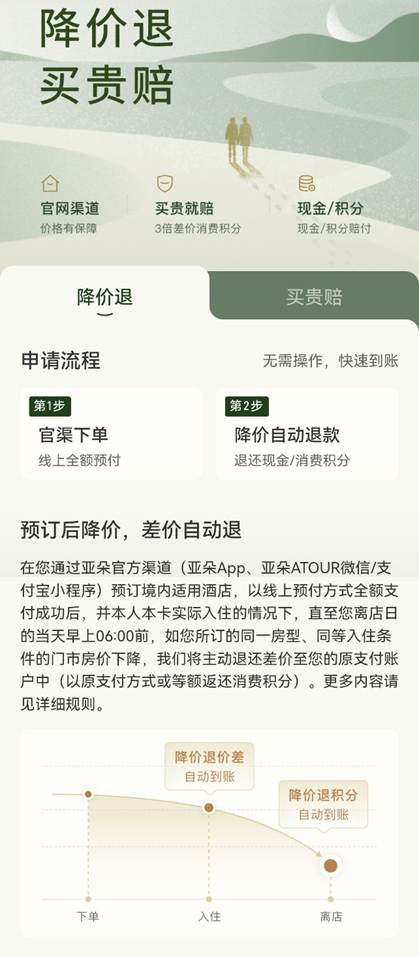
Core Viewpoint - Atour Group has launched a new "Price Drop Refund and Price Guarantee" membership protection mechanism to enhance consumer confidence and simplify hotel booking during the peak travel season around the Spring Festival [1][4]. Group 1: Membership Protection Mechanism - The new protection applies to all Atour hotel brands nationwide, requiring full payment through official channels like the Atour APP, WeChat, or Alipay [4]. - The "Price Drop Refund" feature automatically refunds members if the room price drops before 6 PM on the day of check-out, ensuring a hassle-free experience [4]. - If members find a lower price on other OTA platforms after booking, they can claim a refund of three times the price difference in Atour consumption points within seven days after check-out [4]. Group 2: Consumer Experience and Market Impact - The new policy aims to alleviate consumer anxiety over price fluctuations and restore trust in the accommodation industry [5][8]. - As of September 30, 2025, Atour has over 108 million members, indicating a strong customer base [8]. - The company plans to enhance service offerings during the Spring Festival, including various unique services and partnerships to improve overall travel experiences [8].


高额退订费成消费“隐形陷阱”
Xin Lang Cai Jing· 2025-12-23 20:12
Core Viewpoint - The article highlights the challenges consumers face regarding refund policies in the online service industry, particularly in travel, entertainment, and hospitality sectors, where strict no-refund policies and high penalties for cancellations are prevalent [1] Group 1: Consumer Experiences - A consumer named Chen faced a non-refundable policy for a tour package, despite the cancellation not affecting the travel agency's ability to regroup [1] - Another consumer, Guo, encountered difficulties in obtaining a refund for movie tickets, with the platform initially refusing to process the request based on its own rules, which were later contradicted by the cinema [1] - Wang, who had to cancel a hotel reservation due to a medical emergency, was initially denied a full refund by the platform but succeeded after directly contacting the hotel [1] Group 2: Legal and Regulatory Insights - A court case in Haidian District ruled against a strict no-refund policy, emphasizing that businesses should not impose excessive penalties when consumers cannot fulfill their contracts due to unforeseen circumstances [1] - Legal experts argue that consumer protection laws prohibit unfair terms that limit consumer rights, suggesting that clauses stating "no cancellations under any circumstances" are invalid [1] - Recommendations include the establishment of tiered refund policies by industry associations or regulatory bodies to balance consumer rights and business costs, promoting fair practices in the industry [1]
时报观察|破除定价“黑箱” 保障消费公平
证券时报· 2025-12-22 23:50
Core Viewpoint - The article discusses the recent implementation of the "Internet Platform Pricing Behavior Rules" by various regulatory bodies in China, aimed at addressing consumer grievances related to pricing practices on digital platforms, ensuring consumer rights protection and fair consumption [1][2]. Group 1: Pricing Behavior Regulations - The new rules consist of 29 detailed requirements that define the red lines for pricing behavior on platforms and operators, aiming to protect consumer rights and ensure fair consumption [1]. - The rules extend the principle of "clear pricing" to digital transactions, mandating platforms to clearly display prices, pricing units, and shipping costs, as well as to transparently indicate dynamic pricing and additional services [1][2]. Group 2: Consumer Protection Measures - The regulations specifically address the controversial practice of "automatic renewal," requiring platforms to present related options prominently and provide easy cancellation methods [2]. - The rules prohibit platforms from using data and algorithms to set differentiated prices for the same product or service without consumer awareness, tackling the issue of "big data price discrimination" [2]. Group 3: Regulatory Approach - The new regulations do not adopt a purely prohibitive stance but instead aim to balance market order regulation with the need for innovation in the platform economy, encouraging technological advancements and business model upgrades to enhance service quality [2]. - The effectiveness of these rules will depend on subsequent regulatory enforcement, which is essential for creating a fair and trustworthy market environment conducive to sustainable development in the platform economy [2].

时报观察|破除定价“黑箱” 保障消费公平
Zheng Quan Shi Bao· 2025-12-22 23:47
Core Viewpoint - The introduction of the "Internet Platform Pricing Behavior Rules" aims to address various pricing irregularities in the digital marketplace, enhancing consumer protection and ensuring fair consumption practices [1][2]. Group 1: Pricing Irregularities - Consumers are often charged more for the same services, with long-time users paying an average of 3 yuan more than new users [1]. - Issues such as automatic subscription renewals without prior notice and bundled sales of insurance or service packages with tickets have been highlighted as significant consumer pain points [1]. Group 2: Regulatory Framework - The new rules consist of 29 detailed requirements that set clear boundaries for pricing behaviors of platforms and operators, extending the principle of "clear pricing" to digital transactions [1]. - Platforms are mandated to clearly display pricing, unit costs, and shipping fees, as well as to transparently indicate dynamic pricing and additional services [1]. Group 3: Consumer Rights - The rules emphasize the protection of consumer rights by ensuring that consumers are informed about pricing processes and have the right to make choices without being misled [1][2]. - The regulation specifically prohibits platforms from using data and algorithms to set differential pricing for the same goods or services without consumer awareness [2]. Group 4: Market Environment - The new regulations aim to balance market order with the need for innovation in the platform economy, encouraging technological advancements and business model upgrades to enhance service quality [2]. - The regulatory approach combines oversight with the promotion of sustainable development in the platform economy, ensuring a competitive market environment [2]. Group 5: Implementation and Enforcement - The effectiveness of the new rules will depend on robust enforcement and regulatory follow-up to ensure that consumers benefit from the changes [2]. - A fair and trustworthy market transaction environment is essential for the sustainable development of the platform economy [2].
时报观察 破除定价“黑箱” 保障消费公平
Zheng Quan Shi Bao Wang· 2025-12-22 23:16
Core Viewpoint - The introduction of the "Internet Platform Pricing Behavior Rules" aims to address consumer grievances related to pricing practices on digital platforms, ensuring transparency and fairness in pricing [1][2] Group 1: Pricing Behavior Regulations - The new rules consist of 29 detailed requirements that define pricing behavior boundaries for platforms and operators, establishing a regulatory framework for consumer rights protection [1] - The rules extend the principle of "clear pricing" to digital transactions, mandating platforms to clearly display prices, units of measurement, and shipping costs, while also requiring transparency in dynamic pricing and additional services [1][2] Group 2: Consumer Protection Measures - The regulations specifically target problematic practices such as automatic renewals, requiring platforms to present options for automatic payments and renewals prominently, along with easy cancellation methods [2] - The rules prohibit platforms from using data and algorithms to set differential pricing for the same product or service without consumer awareness, addressing the issue of "big data price discrimination" [2] Group 3: Balancing Regulation and Innovation - The "Behavior Rules" do not adopt a purely prohibitive regulatory approach but instead encourage platforms to innovate and upgrade their business models to enhance service quality for consumers [2] - This regulatory framework aims to purify the market competition environment while allowing sufficient space for the sustainable development of the platform economy [2] Group 4: Implementation and Enforcement - The effectiveness of the new rules relies on robust enforcement and regulatory follow-up to ensure that consumers benefit from the changes [2] - Establishing a fair and trustworthy market transaction environment is crucial for the sustainable development of the platform economy [2]
金融护航消费公平——中信银行铜锣湾支行合规宣传赋能南昌商业活力
Zhong Guo Jin Rong Xin Xi Wang· 2025-12-08 13:10
Core Viewpoint - The article emphasizes the importance of the Renminbi as a legal currency in ensuring fair consumption and maintaining convenience for the public, particularly for vulnerable groups like the elderly. It highlights a campaign by CITIC Bank to promote cash acceptance and protect payment rights in the Nanchang area [1][2]. Group 1: Campaign Overview - CITIC Bank's Tongluowan branch launched a campaign titled "Rectifying Cash Refusal, Protecting Payment Rights" in the Nanchang Tongluowan business district and the Dongfang Heidelberg community [1]. - The campaign involved face-to-face interactions with local merchants to explain legal responsibilities regarding cash acceptance and encourage them to sign a "No Cash Refusal Commitment" [1][2]. - The bank provided small denomination bills and coin exchange services on-site to address the common issue of making change for merchants [1]. Group 2: Community Impact - In the Dongfang Heidelberg community, the campaign fostered a sense of community welfare, enhancing the warmth of local shops [2]. - Bank staff educated shop owners on diverse payment regulations and assisted elderly residents in recognizing counterfeit money and understanding their rights [2]. - The initiative has made cash payment channels more accessible in community shops, improving the overall consumer experience [2]. Group 3: Future Plans - CITIC Bank's Tongluowan branch plans to incorporate cash acceptance promotion into its regular operations, aiming to provide better cash services and more detailed compliance guidance [3].

恭城瑶族自治县计量检定测试所“送检上门”!免费检定计量器具 筑牢消费公平防线
Zhong Guo Shi Pin Wang· 2025-09-24 09:40
Core Points - The county's measurement authority has initiated a free inspection campaign for measuring instruments in local markets to ensure fair trade and protect consumer rights [1][2] - The campaign has covered 37 local markets and convenience stores across 9 townships, focusing on commonly used electronic scales [1] - A total of 658 measuring instruments have been inspected, with 65 non-compliant instruments rectified on-site [2] Group 1 - The campaign aims to maintain order in local markets and safeguard consumer rights by providing free inspections of measuring instruments [1] - Consumers have expressed increased confidence in the accuracy of scales after witnessing the inspection process and learning about compliance marks [1] - Educational materials on measurement standards and consumer rights have been distributed, reaching over 1,000 individuals [1] Group 2 - The inspection process includes visual checks, error testing, and stability verification of measuring instruments [1] - Compliant instruments receive a certification mark with a specified validity period, while non-compliant ones are either repaired or replaced [1][2] - The measurement authority plans to incorporate these inspections into regular operations to ensure ongoing consumer protection and market stability [2]