消费贡献率

Search documents
去年GDP同比增5%:消费贡献率53%,房地产投资下降
Nan Fang Du Shi Bao· 2026-01-19 04:55
Economic Overview - In 2025, the GDP reached 14,018.79 billion yuan, reflecting a year-on-year growth of 5.0% at constant prices [1] - Quarterly GDP growth rates were 5.4% in Q1, 5.2% in Q2, 4.8% in Q3, and 4.5% in Q4, with a quarter-on-quarter growth of 1.2% in Q4 [1] Contribution to Economic Growth - In 2025, the contribution rates to economic growth from final consumption expenditure, gross capital formation, and net exports of goods and services were 52.0%, 15.3%, and 32.7% respectively [3] - In Q4, the contribution rates were 52.9% from final consumption expenditure, 16.0% from gross capital formation, and 31.1% from net exports of goods and services [3] Investment Trends - Total fixed asset investment (excluding rural households) was 485.186 billion yuan, showing a decline of 3.8% compared to the previous year [3] - Excluding real estate development investment, total fixed asset investment decreased by 0.5% [3] - By sector, infrastructure investment fell by 2.2%, while manufacturing investment increased by 0.6%, and real estate development investment saw a significant decline of 17.2% [3]


李迅雷:期望“十五五”期间出台一批超预期超常规刺激政策
Di Yi Cai Jing· 2025-11-26 03:06
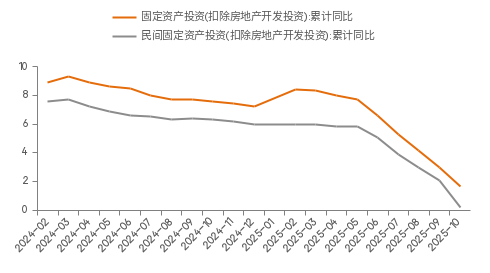
Real Estate Cycle - The long-term upward phase of the real estate market from 2000 to 2020 led to a widespread belief that housing prices would not decline, despite contrary predictions from analysts like Professor Zhu Ning [1][2] - The average rental yield in core cities of China is around 2%, indicating a price-to-earnings ratio of 50 times, while Shanghai's rental yield is even lower, suggesting a need for adjustment to around 3% [2] - Real estate investment has seen a significant decline, with a 14.7% year-on-year drop in the first ten months, raising concerns about a consensus bearish outlook [2][3] Economic Impact - The real estate sector influences numerous industries, and its downturn is expected to affect economic growth through 2026, with private investment growth already showing a significant decline [2][3] - The need for a real estate stability fund has been suggested, as urbanization continues and many new citizens have yet to purchase homes, indicating potential structural shortages in first- and second-tier cities [3] Export and Trade - China's exports have shown resilience, with a 5.3% increase in the first ten months, despite concerns over a potential downturn in external demand in the coming year [4][5] - The ongoing trade tensions and tariff wars, particularly with the U.S., are expected to impact trade volumes negatively, with a forecasted reduction in trade with major economies [5] Consumption and GDP Contribution - Consumption is projected to become a more significant contributor to GDP growth, especially as investment contributions decline [8] - The current economic environment shows a trend of high consumer debt levels, which may hinder future consumption growth unless addressed through fiscal measures [9] Fiscal and Monetary Policy - The fiscal policy for 2026 is expected to be more aggressive, with an anticipated increase in the broad deficit to around 13.2 trillion yuan, reflecting the need for stimulus amid economic pressures [15][19] - Interest rates may be lowered to stimulate demand, although this poses challenges for banks' net interest margins [18] Stock Market Dynamics - The stock market is currently facing resistance, with the need for corporate profit growth to drive a sustainable bull market, as recent gains have been primarily due to valuation increases rather than earnings growth [22][23] - Structural bull markets are anticipated, particularly in the context of the ongoing AI revolution, which may provide opportunities for growth in specific sectors [24]
李迅雷:对当前经济热点的一点思考 | 立方大家谈
Sou Hu Cai Jing· 2025-11-25 14:11
Group 1: Real Estate Cycle - The long-term upward cycle of real estate from 2000 to 2020 led to a widespread belief that housing prices would not decline, despite contrary predictions from analysts like Professor Zhu Ning [2][3] - The average rental yield in core cities of China is estimated to be around 2%, indicating a high price-to-earnings ratio of 50 times, suggesting that a rental yield of 3% is necessary for a price bottom [3][6] - Real estate development investment in China decreased by 14.7% year-on-year in the first ten months of the year, indicating a potential acceleration in the downward trend [3][6] Group 2: Economic Impact - The decline in the real estate sector is expected to continue affecting China's economy through 2026, with significant impacts on related industries and financial sectors [3][6] - The slowdown in urbanization, aging population, and declining total population are identified as pressures on the real estate market post-2021 [6] - The contribution of real estate to GDP and employment is significant, and its decline could hinder overall economic growth [6][12] Group 3: Export Trends - China's exports grew by 5.3% in the first ten months of the year, contrary to initial fears of negative growth, with a notable increase in capital and technology-intensive products [7][8] - However, the growth in exports is expected to slow down in the coming year due to the diminishing "import grabbing" effect from the U.S. and high base effects from previous years [11][12] - The ongoing trade tensions and tariff wars between major economies are likely to impact future export performance negatively [11][12] Group 4: Consumer Spending - Consumer spending is projected to become a more significant contributor to GDP growth, especially as export growth declines [12][16] - The consumption growth has shown a pattern of being higher in the first half of the year, with expectations of a slowdown in the latter half due to high base effects from previous years [15][16] - Long-term improvements in consumption will depend on rising household incomes and increased marginal propensity to consume, which are currently challenged by the real estate downturn [16][19] Group 5: Fiscal and Monetary Policy - The fiscal policy for 2026 is expected to be more aggressive, with a projected increase in the general deficit from approximately 11.9 trillion yuan to 13.2 trillion yuan [28][31] - Interest rates may be lowered by 10-20 basis points in 2026 to stimulate demand, although this poses challenges for banks' net interest margins [35][36] - Coordination between fiscal and monetary policies is deemed essential to address the economic challenges and support growth [40][41] Group 6: Stock Market Outlook - The stock market has faced resistance around the 4000-point mark, with the need for corporate profit growth to outpace GDP growth for a sustained bull market [41][43] - The current economic environment suggests that corporate profitability must improve significantly to support stock market performance [41][43] - Structural bull markets are anticipated, particularly in the context of the AI revolution, which may provide new growth opportunities for companies [47][48]