
混合AI模型策略

Search documents
米奥会展(300795.SZ):暂未使用阿里巴巴的千问模型
Ge Long Hui· 2025-11-21 07:20
Core Viewpoint - The company is currently utilizing a hybrid AI model strategy to enhance communication efficiency in foreign trade scenarios, rather than employing Alibaba's Q&A model [1] Group 1: Technology Strategy - The company has not yet implemented Alibaba's Q&A model in its multi-agent trade social network chat function [1] - The technology selection focuses on the core needs of overseas users, employing various models to improve communication accuracy, particularly in less common languages [1] - The combination of specific models for natural language understanding and leading international models for content generation aims to provide more precise and efficient services to global trade customers [1]

从 Snowflake 到 Sierra,每家企业软件公司都在销售同样的 AI 代理
Hua Er Jie Jian Wen· 2025-11-13 00:44
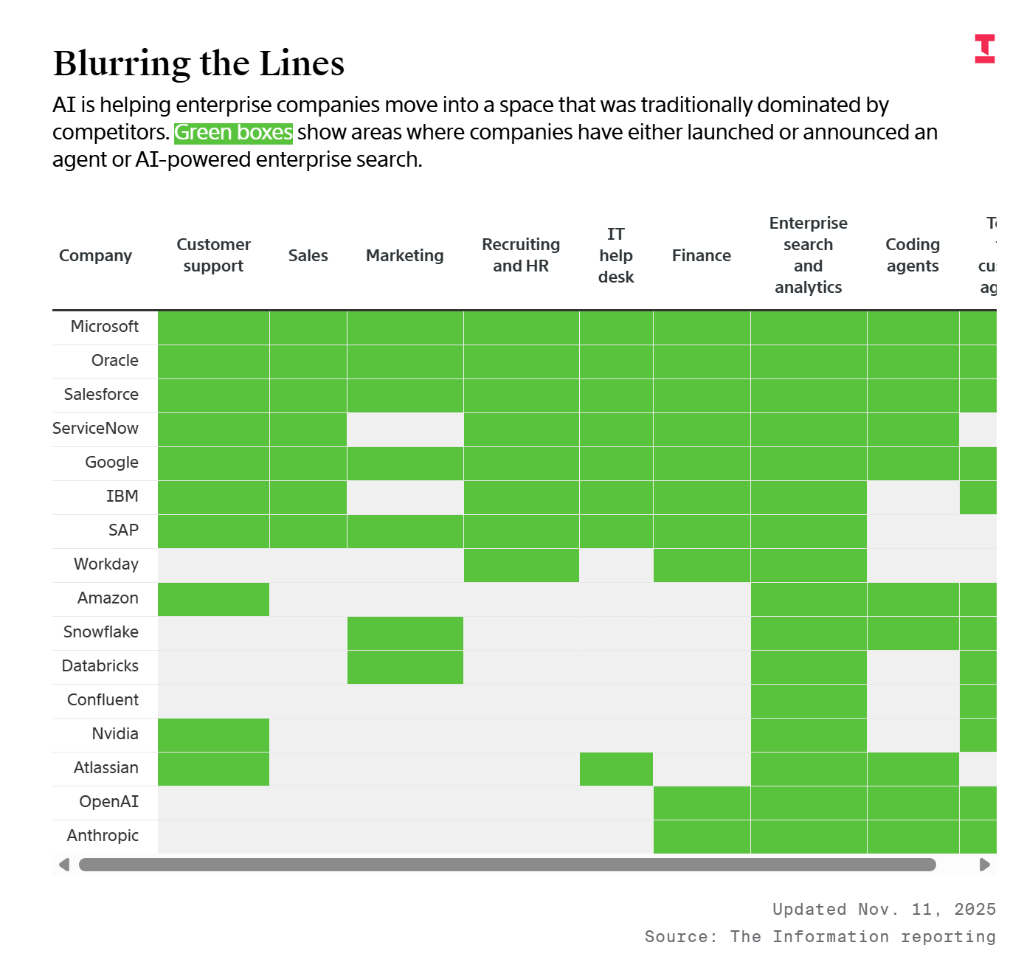
Core Insights - The enterprise software industry is experiencing unprecedented competition as traditional market boundaries are disrupted by artificial intelligence (AI) [1] - Major tech companies are launching similar AI agents, leading to confusion among enterprise buyers and delaying purchasing decisions [1][2] - The rise of AI agents is blurring the lines between different software markets, with at least seven major tech companies competing in eight functional areas [3] Market Dynamics - The competition is characterized by a high degree of product overlap, as many companies rely on foundational AI models from firms like OpenAI and Anthropic [6] - Established database and data streaming companies are now competing with emerging AI application startups in areas like sales and customer support [7] - Existing software giants leverage their vast customer bases and data to create a competitive advantage, making it easier for clients to use AI agents that integrate with their core software [8] Buyer Behavior - Enterprise buyers are facing challenges in selecting AI products due to significant feature overlap, leading to a complicated decision-making process [8][9] - Convenience is a key factor in decision-making, with companies preferring AI solutions that integrate seamlessly with their existing data systems [9] Strategic Approaches - Software giants are adopting a hybrid AI model strategy, combining proprietary data-driven models with external advanced language models to create a robust ecosystem [12] - The critical nature of enterprise software creates natural barriers to entry, as companies are cautious about migrating core business processes to new AI solutions [12] Adoption Challenges - Despite the potential of AI agents, their commercialization has not significantly boosted revenue for major companies like Salesforce and ServiceNow [13] - Slow adoption is attributed to the need for extensive manual support during configuration and concerns over the maturity of vendor-provided AI solutions [14] - As the number of AI agents within enterprises increases, the focus may shift to managing and coordinating these agents across different software platforms [14]


“软件已死,AI当立”?
Hua Er Jie Jian Wen· 2025-08-19 02:59
Core Insights - The AI wave is reshaping the tech industry, leading to intense debates about the future of traditional software businesses, particularly following the release of OpenAI's GPT-5, which caused significant market sell-offs and concerns about AI replacing traditional software [1][2] Group 1: Market Sentiment and Predictions - The software industry sentiment has turned bearish, with SAP's stock dropping 7.1%, resulting in a market cap loss of nearly €22 billion, marking the largest single-day decline since late 2020 [1] - Goldman Sachs analysts believe that fears regarding AI as a disruptive force are overstated, suggesting that AI could act as a "force multiplier" for leading suppliers rather than a replacement [1][2] - The report anticipates that as enterprise software renewal pressures ease by 2026, AI will contribute positively to key metrics like Net Revenue Retention (NRR), paving the way for sustained growth in the software market [2] Group 2: Competitive Landscape - The debate centers on whether AI-native companies can offer products that are "meaningfully better and cheaper" than traditional SaaS offerings [3] - SaaS giants have established high competitive barriers, making it difficult for AI-native companies to disrupt them, especially in pricing strategies where AI-native firms may threaten traditional seat-based pricing models [3][4] - SaaS leaders are innovating through both organic growth and acquisitions, with notable examples including Salesforce's Agentforce and ServiceNow's acquisitions [3] Group 3: AI Integration Strategies - Major software companies are adopting hybrid AI model strategies, combining proprietary data-driven models with external large language models (LLMs) to enhance their offerings [5][6] - This strategy helps mitigate the risk of being undermined by AI-native newcomers, as it locks customers into familiar and integrated ecosystems [7] - The complexity and critical nature of enterprise software create significant barriers to entry, making it challenging for AI-native products to gain trust and adoption quickly [8] Group 4: Future Indicators to Watch - Key indicators for investors include the stability of NRR, the contribution of AI to revenue growth, customer feedback on SaaS innovations, and the momentum of AI-native companies [10] - For instance, Adobe expects its AI products to contribute $250 million in annual recurring revenue by the end of 2025, which will serve as a critical validation signal for the market [10]