现实世界AI

Search documents
特斯拉三季度净利同比下滑近四成,马斯克在AI领域“留后手”
Sou Hu Cai Jing· 2025-10-23 14:15
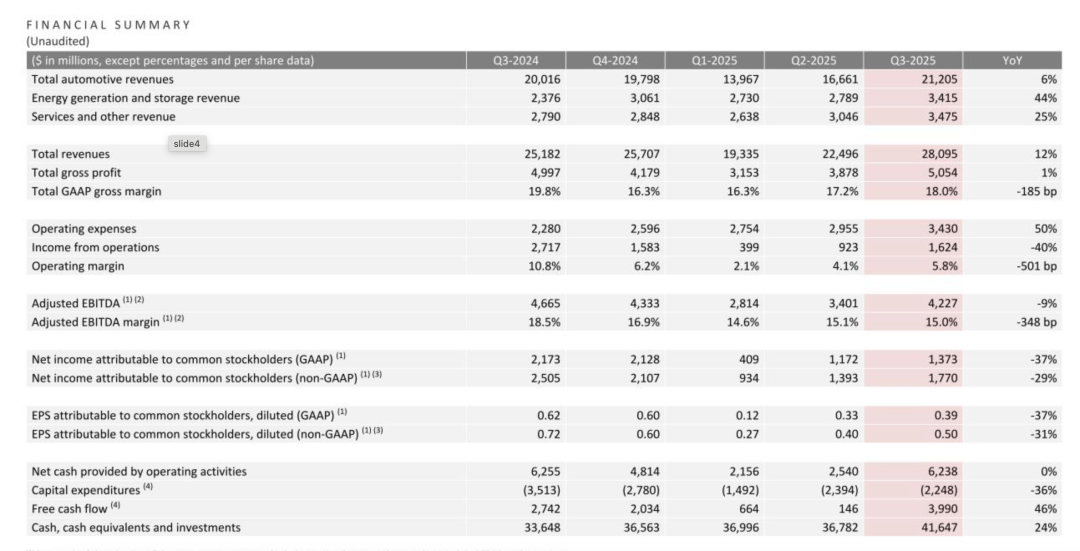
Core Viewpoint - Tesla reported a record high total revenue of $28.095 billion for Q3 2025, marking a 12% year-over-year increase, driven by higher vehicle deliveries and growth in energy and service revenues [1][2] Financial Performance - Total automotive revenues reached $21.205 billion, a 6% increase year-over-year [2] - Energy generation and storage revenue grew by 44% to $3.415 billion [2] - Services and other revenue increased by 25% to $3.475 billion [2] - Total gross profit was $5.054 billion, with a gross margin of 18.0%, down from 19.8% in Q3 2024 [2] - Net income attributable to common stockholders (GAAP) decreased by 37% to $1.373 billion [2] - Free cash flow increased by 46% to $3.990 billion [2] Vehicle Deliveries - Tesla delivered a total of 497,000 vehicles globally in Q3 2025, a 7.4% increase year-over-year, setting a new quarterly delivery record [1] - Significant growth in deliveries was noted in the Greater China region (33% increase) and the Asia-Pacific region (29% increase) [1] Strategic Focus - The company is shifting its strategic focus towards AI and new business areas, with R&D spending increasing by 56.9% to $1.630 billion, the highest in five quarters [3] - CEO Elon Musk emphasized the importance of "real-world AI" as a core strategy moving forward [3] AI Developments - Tesla's next-generation AI chip, AI5, is reported to be 40 times more powerful than AI4, with significant improvements in efficiency and cost-effectiveness [4] - The Optimus V3 humanoid robot prototype is expected to debut in Q1 2026, with plans for a production line by the end of 2026 [4] - The paid usage rate of the Full Self-Driving (FSD) feature has reached 12%, with the latest version, FSD V14, rolled out to all U.S. users [4] Robotaxi Expansion - Tesla's Robotaxi service is operational in Austin, Texas, and the San Francisco Bay Area, with plans to expand to additional U.S. metropolitan areas by the end of 2025 [5] - The company aims to eliminate safety drivers in certain areas of Austin by the end of 2025, contingent on regulatory approvals [5] Market Reaction - Following the earnings report, Tesla's stock price fell over 3%, with a market capitalization of approximately $1.46 trillion as of the report date [5]


特斯拉业绩电话会,马斯克带给机器人产业链的惊喜与担忧
Ge Long Hui· 2025-10-23 10:26
Core Viewpoint - Tesla's Q3 earnings report has elicited mixed reactions from analysts, with Morgan Stanley expressing a generally acceptable view while Goldman Sachs conveyed disappointment, particularly regarding key performance indicators and delays in the Optimus robot timeline [1][2]. Financial Performance - Tesla's Q3 results were close to market expectations, with a strong free cash flow and a reduction in inventory levels to just 10 days of supply [1]. - Automotive business revenue accounted for 75% of total income, while service/other and energy businesses saw year-over-year growth of 25% and 44%, respectively, indicating a diversification of revenue sources [1]. AI and Robotics Strategy - Elon Musk dedicated 80% of the earnings call to discussing AI and robotics, signaling a strategic shift towards building a "real-world AI" ecosystem [2]. - Tesla's robot strategy is structured in three phases: short-term reliance on automotive revenue, mid-term synergy between FSD and Optimus technology, and long-term subscription models for "robots as a service" [2]. Technical Challenges - The development of the Optimus robot faces significant engineering challenges, particularly in achieving human-like dexterity and AI capabilities [3]. - The V3 version of Optimus has made progress, with the number of hand actuators increasing from 28 to 31, but still requires substantial advancements in AI training data and energy efficiency [3]. Production Timeline - Tesla has provided a clear production roadmap for the Optimus robot, with the GEN3 version expected to be showcased in Q1 2026 and mass production of one million units targeted by the end of 2026 [5]. - The credibility of this timeline is supported by Tesla's active factory audits and supply chain development in multiple countries [5]. Industry Impact - The announcement of mass production has triggered significant reactions within the supply chain, benefiting precision transmission companies and torque sensor manufacturers while pressuring traditional industrial robot firms [6]. - Tesla's potential vertical integration strategy could disrupt existing supply chains, as the company may develop core components in-house, leading to uncertainty for smaller suppliers [6]. Future Outlook - The market is divided on Tesla's long-term valuation, with optimistic projections suggesting a significant market for humanoid robots, while cautious analysts highlight risks related to technology and regulatory challenges [7][8]. - Key milestones to watch include the unveiling of the V3 prototype in early 2026 and the ramp-up of production capacity by 2030, alongside monitoring of tariff impacts and developments in the domestic robotics sector [9].

特斯拉业绩电话会,马斯克带给机器人产业链的惊喜与担忧
格隆汇APP· 2025-10-23 09:36
Core Viewpoint - Tesla's Q3 earnings report has elicited mixed reactions from the market, with Morgan Stanley viewing the results as acceptable while Goldman Sachs expresses disappointment due to key indicators falling short of expectations [2][4]. Financial Performance - Tesla's Q3 results were close enough to market expectations to maintain consensus, with a strong free cash flow and inventory levels reduced to just 10 days of supply [2]. - Revenue from automotive business accounted for 75%, while service/other businesses and energy business saw year-on-year growth of 25% and 44%, respectively, indicating a diversification of revenue sources [2]. AI and Robotics Strategy - Elon Musk spent 80% of the earnings call discussing AI and robotics, indicating a strategic shift towards building a "real-world AI" ecosystem with FSD algorithms, Dojo supercomputing, and Optimus robots [4]. - The robot strategy is structured in three phases: short-term reliance on automotive business, mid-term synergy between FSD and Optimus, and long-term subscription model for "robots as a service" [4]. Technical Challenges - The development of the Optimus robot faces significant engineering challenges, particularly in achieving human-like dexterity and AI capabilities [5][6]. - The V3 version of Optimus has made progress, with the number of hand actuators increasing from 28 to 31, but still requires substantial advancements in AI training data and energy efficiency [6]. Production Timeline - Tesla has provided a clear production roadmap for the Optimus robot, with plans to showcase the GEN3 version in Q1 2026 and achieve a production capacity of one million units by the end of 2026 [8]. - The credibility of this timeline is supported by Tesla's active factory audits and supply chain development in multiple countries [8]. Industry Impact - The announcement of a million-unit production capacity is expected to significantly impact the supply chain, benefiting precision transmission companies and torque sensor manufacturers while pressuring traditional industrial robot manufacturers [9]. - Tesla's potential vertical integration strategy may disrupt existing supply chains, as the company aims to self-source key components like motors and reducers [9]. Future Outlook - The market is divided on Tesla's long-term valuation, with optimistic projections suggesting a $500 billion market for humanoid robots by 2028, while cautious analysts highlight risks related to technology and policy [12]. - Key challenges include validating demand, reducing production costs from $50,000 to below $20,000, and establishing an ecosystem similar to Apple's App Store for developers and applications [12].
电话会让市场失望,马斯克称“特斯拉处于关键时刻”
华尔街见闻· 2025-10-23 08:18
Core Viewpoint - Tesla is shifting its narrative from being solely an electric vehicle manufacturer to becoming a leader in artificial intelligence (AI) and robotics, emphasizing its commitment to "real-world AI" and the potential of its Robotaxi and Optimus projects [1][4]. Strategic Shift - CEO Elon Musk stated that Tesla is at a "critical inflection point" in bringing AI into the real world, with a focus on "real-world AI" as the core of its future strategy, moving beyond just electric vehicles [3][4]. - The company aims to create a world without poverty through full self-driving and the Optimus robot, which Musk believes will have a significant impact [5][18]. Optimus and Robotaxi Developments - The production timeline for the Optimus robot has been pushed back to late 2026, with the latest version, Optimus V3, expected to debut in early 2026 [2][6]. - The Cybercab, designed for full autonomy without a steering wheel or pedals, is set to begin production in Q2 2026, representing a major expansion in Tesla's production capabilities [3][6]. - Musk has expressed concerns about maintaining control over the company as it develops its "robot army," linking this to upcoming shareholder votes on his compensation and influence [9][10]. Autonomous Driving and Robotaxi Expansion - Tesla plans to remove safety drivers from Robotaxis in Austin by the end of 2025 and expand the service to 8-10 metropolitan areas, a significant reduction from previous goals of covering 50% of the U.S. population [2][7][8]. - The latest version of the Full Self-Driving (FSD) software has been released to all U.S. owners, with future updates expected to enhance the vehicle's reasoning capabilities [3][7]. Financial Performance - Tesla reported record revenue, deliveries, and free cash flow of approximately $4 billion in Q3, with automotive revenue increasing by 29% quarter-over-quarter [12][19]. - The automotive gross margin slightly increased from 15% to 15.4%, attributed to lower material costs and economies of scale, despite facing over $400 million in tariff impacts [12][21]. - The energy storage business continues to show strong demand, with the upcoming Megapack 4 expected to simplify deployment processes [11][25]. AI and Chip Development - Tesla is investing heavily in AI chip development, with the AI5 chip expected to be 40 times more powerful than its predecessor, AI4, and designed for efficiency and cost-effectiveness [11][32]. - The company aims to achieve an "AI chip surplus" to support its automotive and robotics ambitions, with production planned in collaboration with Samsung and TSMC [11][31]. Shareholder Engagement - Tesla executives urged shareholders to support Musk's compensation plan and board member re-elections in the upcoming vote to ensure the company's stability and future growth [3][12].