
电力市场体系建设

Search documents
AI猛“吞电”!电网设备掀涨停潮,万亿赛道彻底爆了
Ge Long Hui· 2026-02-12 06:43
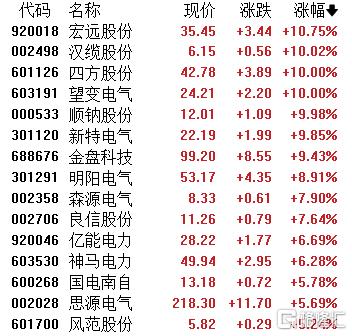
Core Viewpoint - The A-share electric grid equipment and smart grid sectors have experienced a significant surge, driven by favorable policies and substantial investments in the electric power market. Group 1: Market Performance - As of February 12, several stocks in the electric grid sector, including Hanlan Co., Sifang Co., and Wangbian Electric, reached their daily limit up, indicating strong market interest [1] - Notable stock performances include Hanlan Co. with a 10.02% increase, Sifang Co. up by 10%, and Wangbian Electric also rising by 10% [2] Group 2: Policy Developments - Recent policies from the State Council aim to establish a unified national electricity market by 2030, with a target for market-based transactions to account for approximately 70% of total electricity consumption [3] - The policies also emphasize the need for a shift from separate pricing and trading to unified pricing and joint trading across different market levels [3] Group 3: Investment Plans - The State Grid has announced a massive investment plan of 4 trillion yuan from 2026 to 2030, averaging over 800 billion yuan annually, marking a 40% increase compared to the previous five-year plan [4] - This investment will focus on the construction of new electric power systems, creating significant market opportunities for related electric equipment companies [4] Group 4: AI and Power Demand - The explosive growth in AI computing power is making electricity a strategic resource, with predictions that AI chip consumption will account for 1.5% of global electricity usage in the next five years [5] - Estimates suggest that AI electricity demand will surge from 8 TWh in 2024 to 652 TWh by 2030, representing an increase of 8050% [6] Group 5: Company Performance - Recent financial reports indicate strong performance among electric equipment companies, with Siyuan Electric reporting a revenue of 21.205 billion yuan, a 37.18% year-on-year increase, and a net profit growth of 54.35% [6] - Other companies like Xinlian Electronics and Shuangjie Electric are also expected to report significant profit increases, with projections showing growth rates of up to 147.40% [6] Group 6: Industry Outlook - The electric power sector is entering a high-growth phase, driven by urgent demand for AI computing infrastructure and global data center construction [7] - The investment in global electric grid infrastructure is expected to exceed $500 billion from 2026 to 2030, benefiting electric equipment and scheduling system companies [7]


两部门部署完善发电侧容量电价机制 推动抽水蓄能、新型储能公平参与电力市场
Zhong Guo Zheng Quan Bao· 2026-01-30 23:19
Core Viewpoint - The National Development and Reform Commission (NDRC) and the National Energy Administration (NEA) have jointly issued a notice to improve the capacity pricing mechanism for power generation, aiming to ensure the stable operation of the power system and support the green and low-carbon transformation of energy [1][2]. Group 1: Capacity Pricing Mechanism - The notice proposes to enhance the capacity pricing standards for coal power based on local conditions and to establish a similar mechanism for gas power [1]. - For newly constructed pumped storage power stations, a unified capacity price will be set based on the principle of compensating average costs [1]. - An independent capacity pricing mechanism for new energy storage will be established, taking into account factors such as discharge duration and peak contribution [1]. Group 2: Market Compensation Mechanism - A reliable capacity compensation mechanism will be gradually established for various types of power generation units based on their peak capacity contributions [2]. - The notice emphasizes the need for local authorities to organize the implementation of these policies effectively and to guide enterprises in enhancing management practices [2]. - The policy aims to ensure that the adjustments in capacity pricing do not significantly impact electricity costs for residential and agricultural users, while having a limited effect on industrial and commercial users [2]. Group 3: Benefits of the New Mechanism - The improved capacity pricing mechanism is expected to enhance the security and reliability of power supply, stimulate the construction of adjustable power sources, and better support the integration of renewable energy [3]. - It will promote the healthy development of adjustable power sources, guiding enterprises to optimize their operations and innovate technologies for a more efficient new power system [3].
习近平主持召开中央全面深化改革委员会第二十二次会议
Xin Hua Wang· 2025-06-06 03:16
Group 1: Technology System Reform - The purpose of the technology system reform is to enhance technological innovation and emergency response capabilities through institutional mechanisms, focusing on target orientation and problem-solving [2][3] - The meeting emphasized the need to strengthen national strategic technological capabilities and establish an efficient organizational system for tackling key core technologies [4] Group 2: Electricity Market Development - The construction of the electricity market has been steadily advancing, with a significant increase in the proportion of market-based electricity transactions [5] - The meeting called for the establishment of a multi-level unified electricity market system to promote coordinated operation and development across various levels of electricity markets [5] Group 3: Education System Leadership - The meeting highlighted the importance of strengthening the Party's comprehensive leadership over education, particularly in establishing a principal responsibility system led by Party organizations in primary and secondary schools [6] - It emphasized the need for political standards and requirements to be integrated into all aspects of education and school management [6] Group 4: Cultural Heritage and Innovation - The meeting noted significant advancements in the protection and utilization of cultural heritage since the 18th National Congress, calling for improved overall planning for cultural heritage protection [7] - It stressed the importance of enhancing the international influence of Chinese culture through innovative services and expanding platforms for cultural exchange [7] Group 5: Innovation Demonstration Zone - Support for the Zhongguancun National Independent Innovation Demonstration Zone to conduct high-level self-reliance and self-improvement reforms was emphasized, targeting breakthroughs in innovation mechanisms and resource aggregation [7]
公用事业行业跟踪周报:《2025年能源工作指导意见》印发,蒙西电力现货市场转正
Soochow Securities· 2025-03-03 08:23
Investment Rating - The report maintains an "Overweight" rating for the utility sector [1] Core Insights - The "2025 Energy Work Guidance" has been issued, indicating a steady increase in national energy production capacity, with coal and natural gas output growing significantly. The total installed power generation capacity has reached over 3.6 billion kilowatts, with new renewable energy installations exceeding 200 million kilowatts [4][5] - The green and low-carbon transition is progressing, with non-fossil energy generation capacity accounting for approximately 60% of total installed capacity and non-fossil energy consumption reaching 20% of total energy consumption. Policies for renewable energy consumption and regulation are being improved [4] - The official launch of the Mengxi electricity spot market marks a significant development, becoming the fifth electricity spot market in China [4] Industry Data Tracking Electricity Prices - In March 2025, the average grid purchase price of electricity was 398 RMB/MWh, a year-on-year decrease of 4% and unchanged from the previous month [32] Coal Prices - As of February 28, 2025, the price of thermal coal (Q5500) at Qinhuangdao port was 690 RMB/ton, down 25.16% year-on-year and down 4.03% week-on-week [39] Water Conditions - As of February 28, 2025, the water level at the Three Gorges Reservoir was 162.99 meters, with inflow and outflow rates of 7700 cubic meters/second and 7620 cubic meters/second, respectively, showing increases of 28.33% and 11.89% year-on-year [48] Electricity Consumption - In 2024, the total electricity consumption was 985.21 billion kWh, a year-on-year increase of 6.8%. The growth rates for the primary, secondary, and tertiary industries, as well as urban and rural residential consumption, were 6.3%, 5.1%, 9.9%, and 10.6%, respectively [14] Power Generation - The cumulative power generation in 2024 was 942.1 billion kWh, reflecting a year-on-year increase of 4.6%. The growth rates for different energy sources were as follows: thermal power +1.5%, hydropower +10.7%, nuclear power +2.7%, wind power +11.1%, and solar power +28.2% [21] Installed Capacity - By the end of 2024, the cumulative installed capacity of thermal power reached 1.44 billion kilowatts, an increase of 3.8% year-on-year. The new installed capacity for thermal power in 2024 was 47.44 million kilowatts, up 1.9% year-on-year [43]