
发电侧容量电价机制

Search documents
南网科技接待57家机构调研,包括淡水泉、中信证券、财通证券、中金证券等
Jin Rong Jie· 2026-03-17 10:27
Core Viewpoint - The company, Nanfang Technology, reported a revenue of 3.688 billion yuan for 2025, representing a year-on-year growth of 22.40%, and a net profit of 421 million yuan, with a growth of 15.42%. The company aims to drive innovation, deepen its main business, and actively explore new markets to achieve stable growth in revenue and profit [1][3]. Group 1: Financial Performance - In 2025, the company achieved a revenue of 3.688 billion yuan, a year-on-year increase of 22.40% [1][3]. - The net profit attributable to shareholders was 421 million yuan, reflecting a year-on-year growth of 15.42% [1][3]. Group 2: Market and Policy Impact - The National Development and Reform Commission and the Energy Administration proposed a new pricing mechanism for energy storage, which is expected to enhance investment expectations and returns for energy storage projects [1][3]. - The company, as a new energy storage EPC and equipment integration service provider, is expected to benefit from this policy change [1][3]. Group 3: Business Expansion - The company is expanding its energy storage market beyond the Southern Power Grid to include the State Grid and other regions, covering power generation, grid, and user-side projects [1][4]. - The establishment of the National New Energy Storage Innovation Center and partnerships with local energy groups will support the company's market expansion and technology application [1][4][5]. Group 4: Technological Development - The company is involved in energy optimization management and intelligent load scheduling, developing integrated solutions for energy storage and power supply [2][5][6]. - The company has developed a series of power electronic products, achieving over 300 million yuan in revenue contracts, with orders covering multiple provinces [2][7]. Group 5: International Business Strategy - The company is increasing its international market presence, focusing on regions such as South America, Southeast Asia, the Middle East, and Africa, using technology consulting to drive equipment exports [2][8]. Group 6: Corporate Structure and Strategy - The company is progressing with the transfer of state-owned shares and the establishment of Nanfang Technology Industry Company, which is expected to enhance resource optimization and technological integration [2][9].

“发展新型储能”再次被提及
第一财经· 2026-03-06 08:55
Core Viewpoint - The article emphasizes the importance of developing new energy storage technologies in China, highlighting their role in supporting the new power system dominated by renewable energy sources, as reiterated in the government work reports for three consecutive years [3]. Summary by Sections New Energy Storage Development - New energy storage, excluding pumped hydro storage, is crucial for enhancing the flexibility and safety of the power grid, especially as wind and solar energy generation scales up [3]. - By the end of 2025, the installed capacity of new energy storage in China is expected to reach 136 million kilowatts, a more than 40-fold increase compared to the end of the 13th Five-Year Plan [3]. Utilization and Capacity - In 2025, the equivalent utilization hours of new energy storage are projected to be 1,195 hours, an increase of nearly 300 hours from 2024 [4]. - New energy storage is expected to free up 42.1 billion kilowatt-hours of consumption space for renewable energy, with a peak capacity exceeding 30 million kilowatts in summer [4]. Market Challenges and Policy Changes - Despite rapid growth, new energy storage faces profitability challenges due to factors like slow electricity market development and limited auxiliary service varieties, leading to a significant drop in rental income for independent storage projects [5]. - The cancellation of "policy-based storage" has resulted in a reduction of 50% to 70% in rental income, with internal rates of return dropping to 2.2% to 3.5% [5]. Policy Support and Economic Viability - Recent policy changes have integrated independent storage into the capacity price mechanism, establishing a three-tier revenue structure that includes energy market, auxiliary service market, and capacity pricing [5][6]. - This policy shift is expected to enhance the economic viability of new energy storage projects by providing a dual revenue model of guaranteed capacity pricing and market-based income [6]. Industry Trends - The number of independent storage project filings has surged, with 79 projects approved in Guangdong by March 6, 2026, nearing half of the total for 2025 and significantly higher than previous years [6]. - The industry is anticipated to enter a phase of true market development during the 14th Five-Year Plan, characterized by steady growth, diverse technology pathways, and an upgraded role as a core resource for system regulation [6].

青海发电侧容量补偿落地:2026年按165元/千瓦·年执行
2 1 Shi Ji Jing Ji Bao Dao· 2026-02-26 12:51
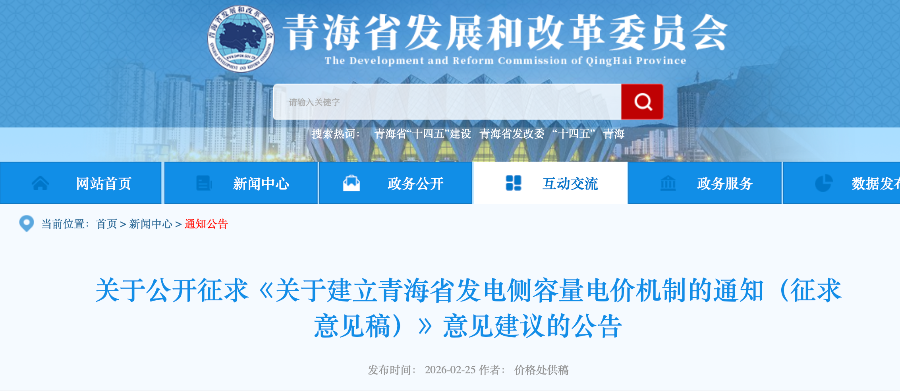
Core Viewpoint - The new pricing mechanism for power generation capacity in China, particularly for coal, gas, and pumped storage power, is being implemented to establish a reliable capacity compensation system, with specific standards set for different regions, starting with Qinghai Province in 2026 [1][3]. Group 1: Pricing Mechanism - The capacity compensation standard in Qinghai is set at 165 yuan per kilowatt per year, based on initial guidelines from the national policy [3]. - The compensation will not be a straightforward calculation of installed capacity multiplied by the standard rate; it will also consider effective capacity, supply-demand coefficients, and the specific characteristics of different power sources [3][4]. - The pricing aims to balance investment encouragement with the overall cost burden on society, reflecting a consensus among stakeholders [4]. Group 2: Regional Implementation - Qinghai is among the first provinces to respond to national policy by establishing a specific implementation plan for the capacity pricing mechanism [5]. - Other regions, such as Gansu and Ningxia, have also introduced similar policies, indicating a broader trend of regional adaptation to national guidelines [5]. - The local policies are designed to align with the central framework, ensuring that regional adaptations contribute to the overall goals of the national energy strategy [6]. Group 3: Effective Capacity Assessment - The effective capacity of power generation units will be assessed based on various factors, including output stability and peak capacity, which will influence the final compensation received [3][4]. - The mechanism aims to provide a more accurate reflection of each power source's contribution to system reliability, promoting the development of high-availability and peak-capable resources [4]. - The establishment of a reliable capacity assessment system is crucial for the future refinement and market-oriented reforms of the pricing mechanism [6].
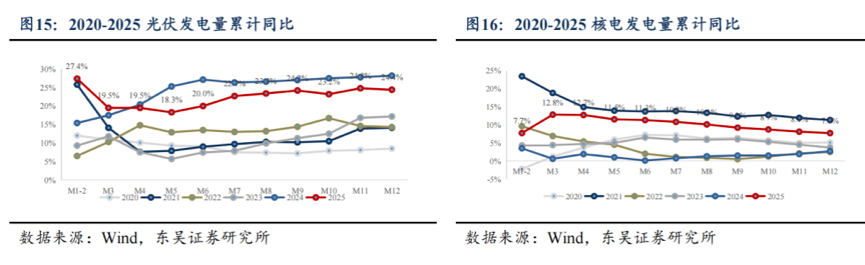
2025年全国风光发电量同比增长25%,风光装机增速分化
Huan Qiu Wang· 2026-02-14 01:04
Core Insights - The National Energy Administration projects that by 2025, the national wind and solar power generation will increase by 25% year-on-year, accounting for 22% of total power generation, significantly boosting the share of renewable energy to nearly 40% [1] - New installed capacity for renewable energy in China is expected to reach 452 million kilowatts by 2025, representing a year-on-year growth of 21% [1] Group 1: Wind and Solar Power Growth - By 2025, new installed capacity for wind power and solar energy is forecasted to be 119.33 GW and 315.07 GW respectively, with year-on-year growth rates of 50.4% and 13.7% [1] - The disparity in growth rates between wind and solar installations is attributed to the pressure on electricity prices and demand caused by the full market entry of new energy sources, with wind power being less affected due to its dispersed output [1] Group 2: Investment and Infrastructure - During the 14th Five-Year Plan period, the State Grid's fixed asset investment is expected to reach 4 trillion yuan, a 40% increase compared to the previous period, focusing on green transformation [1] - The State Grid aims to support an annual increase of approximately 20 million kilowatts in wind and solar energy installations, targeting a non-fossil energy consumption share of 25% and an electricity share in terminal energy consumption of 35% [1] Group 3: Market Mechanisms and Development - The National Development and Reform Commission and the National Energy Administration have introduced a new pricing mechanism for power generation, which includes independent new-type energy storage in the compensation framework [2] - East Wu Securities notes that the three main constraints on the full market entry of new energy—consumption, pricing, and subsidies—are gradually easing, paving the way for high-quality development of renewable energy [2]
碳酸锂 将止跌回升
Qi Huo Ri Bao· 2026-02-10 06:06
Core Viewpoint - The lithium carbonate price has experienced a significant decline of 34% since late January, nearly reversing its gains for the year, primarily due to the nomination of Kevin Walsh as the next Federal Reserve Chairman, which led to a strong rise in the US dollar index and a sharp drop in global risk appetite [1] Supply Side Summary - Lithium ore supply and demand are robust, with prices for Australian spodumene and domestic lithium mica rising by 26% this year. However, lithium salt plants are currently undergoing maintenance, and production in the Yichun area has decreased due to certification changes [2] - In January, China's lithium carbonate production fell by 1% month-on-month to 97,900 tons, with February production expected to drop to 81,900 tons, indicating a downward trend in domestic production [2] - Chile's lithium salt exports in January reached 39,300 tons LCE, a 76% increase month-on-month and a 38.7% year-on-year rise, primarily due to early shipments ahead of the Chinese New Year [2] Demand Side Summary - As the Chinese New Year approaches, production at cathode manufacturers has slowed, but demand from power battery companies has rebounded due to "export rush" strategies. Weekly production of ternary materials has decreased by 11% from last year's peak, while lithium iron phosphate production has dropped by 8.6% [3] - Power battery production, which had been declining for eight consecutive weeks, saw a slight increase of 0.3 GWh last week, reaching 26.7 GWh, driven by manufacturers stocking up ahead of a reduction in export tax rates for lithium batteries [3] - The domestic energy storage market showed strong performance in January, with a 13.7% increase in energy scale to 13.9 GWh, indicating sustained high demand in the energy storage sector [4] Inventory Perspective - As of February 5, domestic social inventory of lithium carbonate was 105,463 tons, with a weekly reduction of 2,019 tons. The inventory structure shows that 41% is concentrated in downstream sectors, indicating strong actual demand [5] - The overall supply pressure for lithium carbonate is gradually easing, with expectations for demand recovery post-holiday, which may lead to further declines in inventory levels [5] - The lithium carbonate market is entering a new phase dominated by supply and demand fundamentals, with short-term price support solidifying as production decreases and import windows close, reducing future overseas supply [5]
电改迈出关键一步
中国能源报· 2026-02-09 01:43
Core Viewpoint - The issuance of the "Notice on Improving the Capacity Price Mechanism for Power Generation" is seen as a crucial step in China's electricity reform, addressing key issues related to the stability of the power system and the retention of backup power sources [1][9]. Group 1: Current Issues with Capacity Price Mechanism - The existing capacity price mechanism faces new challenges, including a rapid decline in operating hours for coal power in some regions, leading to insufficient support from current capacity price levels [3]. - The current pricing mechanism for pumped storage lacks adequate cost constraints, hindering the rational layout and efficient development of pumped storage projects [3]. - There is a lack of uniform principles for capacity pricing of gas power and new energy storage across different regions, which undermines a fair competitive market environment [3]. Group 2: Reliable Capacity and Compensation Mechanism - Reliable capacity refers to the ability of power generation units to provide stable power during peak demand periods, serving as a benchmark for measuring peak capacity [3]. - The establishment of a reliable capacity compensation mechanism will allow for fair compensation based on the reliable capacity of different types of units, promoting fair competition among various technologies [3][4]. Group 3: Two-Step Approach of the Notice - The Notice outlines a two-step approach: the first phase involves categorically improving capacity pricing rules for different power sources, while the second phase will establish a reliable capacity compensation mechanism that does not differentiate between power source types [4]. Group 4: Independent Storage Capacity Pricing - The Notice marks the first time that a national-level capacity pricing mechanism for independent new energy storage has been established, allowing local governments to set capacity prices for grid-side independent storage [6]. - This new mechanism aims to enhance the profitability of independent storage projects, which previously relied on mandatory storage policies and lacked a revenue model linked to capacity [6]. Group 5: Market Dynamics and Future Outlook - The introduction of the capacity price mechanism is expected to create a complete revenue structure for independent new energy storage, integrating energy sales, auxiliary services, and capacity pricing [7]. - The Notice encourages flexible pricing contracts and promotes a floating price mechanism, which is anticipated to stabilize overall electricity prices for users despite the increase in capacity fees [8]. - The overall aim is to ensure sufficient peak power sources are available during times of low renewable energy generation, effectively providing a form of "insurance" for the power system [9].
容量电价迎新规,电力系统“兜底能力”有价可循
Bei Ke Cai Jing· 2026-02-06 06:36
Core Viewpoint - The introduction of the capacity pricing mechanism for power generation marks a significant policy shift in China's energy sector, aiming to enhance the stability and reliability of the power supply while supporting the green energy transition [1][2][3]. Group 1: Policy Overview - The National Development and Reform Commission and the National Energy Administration issued the "Notice on Improving the Capacity Pricing Mechanism for Power Generation," which categorizes and improves the pricing mechanisms for coal, natural gas, pumped storage, and new energy storage [1]. - The policy integrates natural gas power generation and grid-side independent new energy storage into a unified capacity pricing framework, creating a comprehensive system for various regulatory power sources [1][2]. - The initiative aims to establish a reliable capacity compensation market that ensures "equal pay for equal work" among different energy sources, thereby enhancing the security of power supply [1][3]. Group 2: Capacity Pricing Mechanism - The capacity pricing mechanism is designed to pay for the available generation capacity of power sources rather than just the actual electricity generated, focusing on the ability to provide power during peak demand [2][4]. - The current challenges faced by the existing capacity pricing mechanism include inconsistencies in pricing principles across regions, which hinder fair competition in the market [2][3]. - The new policy aims to adapt to the requirements of a new power system and market structure, ensuring better stability and safety in power supply while facilitating a low-carbon energy transition [2][3]. Group 3: Impact on New Energy Storage - The 114 document fills the policy gap for new energy storage in the capacity mechanism, allowing it to compete on equal footing with coal and pumped storage in the electricity market [3][6]. - The capacity pricing level for independent new energy storage will be determined based on local coal power capacity pricing standards, adjusted according to peak capacity contributions [4][5]. - The introduction of a dual-driven model combining capacity pricing and market revenue is expected to stabilize the revenue structure for new energy storage projects [5][6]. Group 4: Regional Variations and Implementation - The implementation of the capacity pricing mechanism may vary across provinces, influenced by local renewable energy ratios, load characteristics, and transmission conditions [5][6]. - Differences in pricing logic, assessment standards, and cost-sharing mechanisms across regions will affect the feasibility and effectiveness of the capacity pricing policy [5][6]. - Local governments are encouraged to plan and manage various regulatory resources effectively, ensuring that the benefits of the policy are directed towards reliable and high-quality storage projects [7].
福能股份:公司将平衡保底收益与市场弹性,保障项目回报与可持续发展
Zheng Quan Ri Bao Wang· 2026-02-05 13:43
Group 1 - The core viewpoint of the article is that Funiu Co., Ltd. (600483) believes that the reliable capacity price for pumped storage power stations can enhance return certainty and that market-oriented operations can expand revenue opportunities [1] - The company aims to balance guaranteed returns with market flexibility to ensure project returns and sustainable development [1] - The company also highlights that the implementation progress of specific policy details, provincial capacity price determinations, changes in market rules, and fluctuations in auxiliary service prices may introduce uncertainties affecting project revenues [1]

动力煤:印尼减产消息刺激进口市场,国内煤价节前仍以稳为主
Guo Tai Jun An Qi Huo· 2026-02-05 01:47
Report Industry Investment Rating - Not provided Core Viewpoints - The domestic coal price before the Spring Festival remains stable, and the market will show a pattern of weak supply and demand in the short term, with prices expected to adjust slightly within a narrow range [1][2] - The news of Indonesia's production cut has stimulated the imported coal market, and the prices of Indonesian coal and Australian coal have risen, but the actual production cut scale in Indonesia remains to be finally approved [2] - The implementation of the "Notice on Improving the Capacity Tariff Mechanism on the Power Generation Side" will have an impact on the coal - power industry, including capacity tariff adjustment and optimization of the lower limit of medium - and long - term market transaction prices [3] Summary by Directory 1. Fundamental Tracking - **Coal Prices**: The prices of various types of coal in different regions have different changes. For example, the price of Shanxi Datong 5500 is 568.0 yuan/ton, unchanged from the previous period and 42.0 yuan/ton lower than the same period last year; the price of Indonesian FOB Q3800 is 51.5 US dollars/ton, up 1.0 US dollars/ton from the previous period and 2.5 US dollars/ton higher than the same period last year [1][2] 2. Macro and Industry News - **Market Situation**: On February 4, the market sentiment in the northern ports was slightly strong, with upstream quotes firm and downstream mostly on the sidelines. The market transaction was cold. The market will show a pattern of weak supply and demand, and prices are expected to adjust slightly within a narrow range in the short term [2] - **Indonesia's Production Cut**: There is news that some Indonesian coal mines may reduce production by 20% - 60%, but no official document has been issued. If the information is confirmed, it will have a strong supporting and price - driving effect on low - calorie Indonesian coal [2] - **Policy**: The "Notice on Improving the Capacity Tariff Mechanism on the Power Generation Side" was issued, which includes coal - power capacity tariff adjustment and optimization of the lower limit of medium - and long - term market transaction prices [3] - **Indonesia's Industry Situation**: The Indonesian Coal Mining Association said that the government's significant reduction in production quotas may lead to the shutdown of some coal mines, and the association called on the government to re - evaluate the quota reduction plan [3]
加快构建新型电力系统 煤电、气电将提高“保底工资”
Zhong Guo Jing Ying Bao· 2026-02-03 17:35
Core Viewpoint - The recent policy changes aim to enhance the capacity pricing mechanism for coal, gas, pumped storage, and new energy storage to ensure the stability and safety of the power system while promoting a green and low-carbon energy transition [2][4]. Group 1: Policy Changes and Mechanisms - The National Development and Reform Commission (NDRC) and the National Energy Administration (NEA) have issued a notification to improve the capacity pricing mechanism for various energy sources, including coal and gas [2]. - The notification emphasizes the need to adapt the pricing mechanisms to the requirements of the new power system and market structure, ensuring a fair competitive environment [2][3]. - It proposes to increase the coal power capacity price standard in various regions and establish a similar pricing mechanism for gas power [2]. Group 2: Financial Implications - The notification requires that the proportion of fixed costs recovered through capacity pricing for coal power plants be raised to no less than 50%, equating to 165 yuan per kilowatt annually [4]. - For new pumped storage projects, a unified capacity price will be set based on average cost recovery principles [2][4]. - The establishment of an independent capacity pricing mechanism for new energy storage will consider factors such as discharge duration and peak contribution [2][4]. Group 3: Impact on Electricity Pricing - The policy is designed not to affect residential electricity prices, maintaining the current pricing policy for residential and agricultural users [4]. - For industrial and commercial users, the adjustments in capacity pricing are expected to balance out, with costs for regulatory power sources decreasing while capacity pricing increases, resulting in minimal impact on overall electricity costs [4].