
疫苗行业转型

Search documents
28亿元项目黄了!康泰生物终止与阿斯利康合资设立疫苗企业
第一财经· 2026-02-08 05:44
Core Viewpoint - The joint venture plan between Kangtai Biological (300601.SZ) and AstraZeneca has been terminated due to significant market changes and high investment risks in the vaccine industry [3][4]. Group 1: Joint Venture Details - Kangtai Biological and AstraZeneca planned to establish a joint venture in Beijing with a registered capital of approximately 345 million RMB (about 50 million USD) and a total investment of around 400 million USD (approximately 2.76 billion RMB) [3]. - The joint venture was intended to develop, register, and commercialize innovative vaccines, including AstraZeneca's RSV and hMPV combination vaccine in China [3]. Group 2: Reasons for Termination - The termination was attributed to severe market environment changes and significant downward pressure on the industry, making new investments in the vaccine sector highly risky [4]. - Currently, there are no approved vaccines for RSV and hMPV in the Chinese market, and many domestic vaccine companies focus on traditional products, leading to increased market homogenization [4]. Group 3: Financial Outlook - Kangtai Biological expects a net profit attributable to shareholders of 49 million to 73 million RMB for 2025, representing a year-on-year decline of 63.80% to 75.70% [4]. - Recent data from the China Chamber of Commerce for Import and Export of Medicines and Health Products indicates a decline in the batch issuance and import volume of vaccines in 2025, primarily due to multinational companies reducing or pausing imports to consume existing inventory [4]. Group 4: AstraZeneca's Investment Plans - Despite the termination of the joint venture, AstraZeneca plans to invest over 100 billion RMB (approximately 15 billion USD) in China by 2030 to expand its pharmaceutical production and R&D footprint [5].



28亿元项目黄了!康泰生物终止与阿斯利康合资设立疫苗企业
Di Yi Cai Jing· 2026-02-08 04:14
Group 1 - The joint venture plan between Kangtai Biological and AstraZeneca has been terminated due to significant changes in the market environment and high risks associated with new investments in the vaccine industry [1][3] - The joint venture was initially planned to have a registered capital of 345 million RMB (approximately 50 million USD) and a total investment of around 400 million USD (about 2.76 billion RMB) [1] - The joint venture aimed to develop and commercialize innovative vaccines, including AstraZeneca's RSV and hMPV combination vaccine, in China [1] Group 2 - Kangtai Biological cited substantial downward pressure in the industry and a lack of approved vaccines for RSV and hMPV as reasons for the termination [3] - The domestic vaccine market is facing increasing homogenization due to many companies focusing on traditional products with lower market risks, leading to a slowdown in demand for children's vaccines and an underdeveloped adult vaccination market [3] - Kangtai Biological expects a significant decline in net profit for 2025, projecting a profit of 49 million to 73 million RMB, representing a year-on-year decrease of 63.80% to 75.70% [3] Group 3 - Despite the termination of the joint venture, AstraZeneca plans to invest over 100 billion RMB (approximately 15 billion USD) in China by 2030 to expand its pharmaceutical production and R&D [4]

价格战持续 疫苗行业2025年业绩分化加剧
2 1 Shi Ji Jing Ji Bao Dao· 2026-02-03 23:13
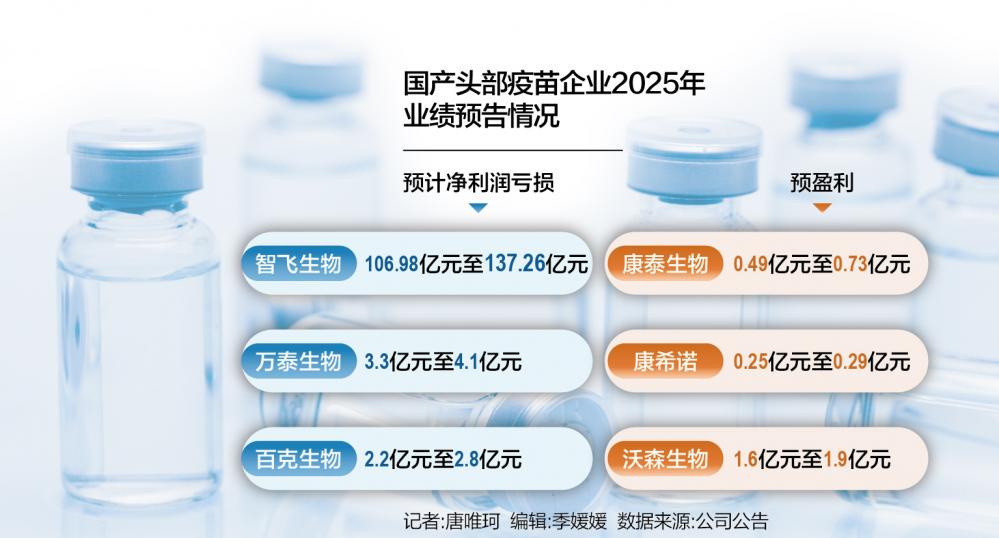
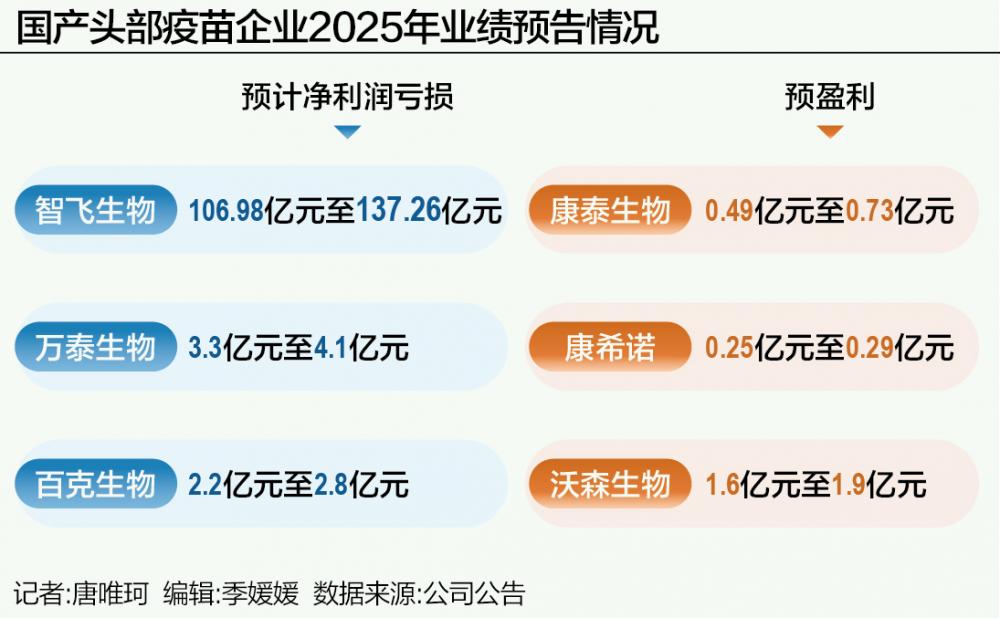
Core Viewpoint - The performance forecasts for A-share vaccine companies in 2025 reveal significant industry adjustments, with major players like Zhifei Biological, Wantai Biological, and Baike Biological reporting losses, while companies like CanSino and Watson Biologics achieve growth through innovative products and overseas market expansion [1][2]. Industry Overview - The vaccine industry is facing multiple pressures, including price wars, shrinking demand, and product homogenization, which are forcing companies to shift from channel-driven to innovation-driven strategies [1][4]. - The overall profitability of the industry has sharply declined, with Zhifei Biological expecting its first annual loss since its listing, projecting a net loss of 10.698 billion to 13.726 billion yuan, a year-on-year decline of 630% to 780% [1][2]. Company Performance - Zhifei Biological, Wantai Biological, and Baike Biological have all transitioned from profit to loss due to various factors, including price cuts and inventory issues [1][2]. - CanSino has turned a profit in 2025, with a projected net profit of 24.5 million to 29 million yuan, benefiting from the strong sales of its four-valent meningococcal vaccine, which accounts for 90% of its revenue [2][6]. - Watson Biologics has seen a 35% year-on-year increase in overseas vaccine exports, achieving a net profit of 16 million to 19 million yuan, reflecting its ability to counter domestic declines [2][7]. Market Dynamics - The ongoing price war is compressing profit margins, with significant price drops observed in various vaccine categories, such as the HPV vaccine and flu vaccine, leading to reduced gross margins for companies [4][8]. - Demand for vaccines is declining due to a falling birth rate and low vaccination rates among adults, exacerbating the industry's growth challenges [4][5]. Strategic Shifts - Companies are increasingly focusing on innovation and overseas expansion as key strategies to navigate the current market challenges [5][9]. - The inclusion of the HPV vaccine in the national immunization program is expected to stabilize market demand but will also pressure companies to reduce costs and innovate further [8][9]. Future Outlook - 2025 is seen as a pivotal year for the vaccine industry in China, with a shift towards high-quality development and a focus on core competencies and innovation [9]. - The industry is expected to gradually recover as innovative products are launched, overseas markets are expanded, and public awareness of vaccination increases [9].


疫苗行业2025年业绩分化加剧
2 1 Shi Ji Jing Ji Bao Dao· 2026-02-03 23:08
Core Insights - The performance forecasts for A-share vaccine companies in 2025 reveal significant industry adjustments, with major players like Zhifei Biological, Wantai Biological, and Baike Biological reporting losses, while companies like CanSino and Watson Biologics achieve growth through innovative products and overseas market expansion [1][2][5] Industry Overview - The vaccine industry is facing multiple pressures, including price wars and shrinking demand, leading to a significant contraction in profitability [5][6] - The continuous price competition has compressed profit margins, with HPV vaccines and flu vaccines reaching historical lows in pricing, impacting overall industry profitability [5][6] - The decline in birth rates has reduced the core vaccination population for children's vaccines, while adult vaccine uptake remains low due to vaccine hesitancy [5][6] Company Performance - Zhifei Biological is expected to report its first annual loss since its listing, with a projected net loss of 10.698 billion to 13.726 billion yuan, a year-on-year decline of 630% to 780% [1] - Wantai Biological and Baike Biological also shift from profit to loss, with projected net losses of 330 million to 410 million yuan and 220 million to 280 million yuan, respectively [1] - CanSino is projected to turn a profit with a net income of 24.5 million to 29 million yuan, benefiting from the strong sales of its quadrivalent meningococcal vaccine [2] - Watson Biologics expects a net profit of 160 million to 190 million yuan, driven by a 35% increase in overseas vaccine exports [2] Market Dynamics - The industry is experiencing severe product homogeneity, leading to intensified competition among companies in popular vaccine segments like HPV and shingles [6] - Companies overly reliant on agency models are facing challenges, as seen with Zhifei Biological, which has a high dependency on agency products [6] - Inventory and cash flow pressures are evident, with companies like Zhifei Biological and Wantai Biological facing significant inventory write-downs [6] Innovation and Opportunities - Companies with unique innovative products are achieving performance rebounds, with CanSino's quadrivalent vaccine capturing over 90% market share [7] - The overseas market is becoming a crucial growth point, with Watson Biologics exporting to 24 countries and CanSino's inhaled vaccine gaining market share in Southeast Asia and Latin America [8] - The inclusion of the bivalent HPV vaccine in the national immunization program is expected to stabilize market demand while also compressing profit margins for companies [9] Future Outlook - 2025 is seen as a pivotal year for the vaccine industry to transition towards high-quality development, with a focus on innovation and overseas market expansion [10] - The industry is expected to gradually emerge from the adjustment period as innovative products are launched and vaccination awareness increases among residents [10] - The China Vaccine Industry Association has initiated measures to curb irrational price competition, aiming for a more rational pricing environment in the future [10]
疫苗龙头集体亏损,412亿巨头净利预亏780%
21世纪经济报道· 2026-02-03 13:23
Core Viewpoint - The vaccine industry in A-shares is experiencing significant performance declines in 2025, with major companies like Zhifei Biological, Wantai Biological, and Baike Biological reporting losses, while companies like CanSino and Watson Biologics are achieving growth through innovative products and overseas market expansion [1][4]. Group 1: Industry Performance - Zhifei Biological is expected to report its first annual loss since its listing, with a projected net loss of CNY 10.698 billion to CNY 13.726 billion, a year-on-year decline of 630% to 780% [1]. - Wantai Biological and Baike Biological have also shifted from profit to loss, with Wantai's net loss projected at CNY 330 million to CNY 410 million due to inventory write-downs and pricing pressures [1][3]. - CanSino is projected to turn a profit with a net income of CNY 24.5 million to CNY 29 million, benefiting from the strong sales of its innovative vaccine [4]. Group 2: Market Challenges - The industry is facing multiple pressures, including price wars and reduced demand, leading to significant profit margin compression [6]. - The birth rate decline is reducing the core vaccination population, with the proportion of children aged 0-6 years expected to drop from 64.6% in 2020 to 43.7% in 2024 [6]. - The phenomenon of "vaccine hesitancy" is also impacting adult vaccination rates, with annual flu vaccination rates below 4% [6]. Group 3: Strategic Shifts - Companies are being forced to transition from channel-driven models to innovation-driven strategies due to competitive pressures [6][10]. - The inclusion of the HPV vaccine in the national immunization program is expected to stabilize market demand but will also compress profit margins, pushing companies to innovate and reduce costs [9]. - The industry is witnessing a shift towards overseas markets, with Watson Biologics reporting a 35% increase in vaccine exports, highlighting the potential for growth outside domestic markets [4][8]. Group 4: Future Outlook - The vaccine industry is anticipated to undergo a transformation towards high-quality development in 2025, with a focus on innovation and overseas expansion [9][10]. - The Chinese Vaccine Industry Association has called for a ban on bidding below cost to combat price wars, indicating a move towards more rational competition [10]. - Companies that can innovate and adapt to new market conditions are expected to emerge stronger from the current industry adjustments [10].

行业调整的战略重构:智飞生物亏损背后的转型阵痛与突围路径
Jin Rong Jie· 2026-01-15 08:27
Core Viewpoint - The vaccine industry is undergoing a deep adjustment period, with a significant decline in public willingness to receive vaccinations, leading to substantial losses for leading companies like Zhifei Biological. The company anticipates a loss of 10.698 billion to 13.726 billion yuan in 2025, with a net profit decline of 630% to 780% year-on-year [1][2]. Group 1: Industry Challenges - The direct cause of the massive loss is not due to a depletion of operating cash flow but rather large-scale asset impairment provisions made on a cautious basis. This includes inventory write-downs due to lower-than-expected sales and market demand changes [2]. - The global increase in "vaccine hesitancy" following public health events has exacerbated demand shrinkage across the entire vaccine industry, creating severe challenges [2][6]. - Policy adjustments and market environment changes have disrupted the demand rhythm for certain vaccine products, leading to increased inventory pressure for companies [2]. Group 2: Company Response Strategies - Zhifei Biological has initiated several measures to address short-term operational pressures, including negotiating procurement plans with partners and optimizing product promotion strategies to improve inventory turnover efficiency [2][3]. - The company has secured a syndicated loan of up to 10.2 billion yuan from Agricultural Bank of China to alleviate debt pressure and optimize its debt structure [3]. - Zhifei Biological is also issuing technology innovation bonds to further enhance its financial stability and reduce financial risks [3]. Group 3: Long-term Development and Innovation - Despite short-term pressures, Zhifei Biological continues to invest in R&D and international expansion, with 34 preventive biological pipeline projects under development, including several in clinical trial stages [4][5]. - The company has achieved significant milestones in its product pipeline, including the approval of new vaccines that will diversify its product offerings and support future revenue growth [5]. - Zhifei Biological's internationalization efforts include clinical trials for vaccines in foreign markets, which are expected to enhance its global presence and revenue streams [5][6]. Group 4: Policy Support and Market Opportunities - The inclusion of HPV vaccines in the national immunization program is a significant policy change that is expected to boost public vaccination awareness and gradually revive market demand [6][7]. - The government's push for high-level openness and support for Chinese vaccines in global public health governance presents new opportunities for companies with strong technical capabilities [7]. - 2026 is seen as a critical year for Zhifei Biological to validate its transformation efforts, with plans to accelerate product launches and optimize business strategies for sustainable development [7].
智飞生物2025年短期业绩承压 期待创新管线与国际化增长新空间
Zheng Quan Shi Bao Wang· 2026-01-14 03:19
Core Viewpoint - The company, Zhifei Biological, is facing significant financial losses in 2025, with projected losses between 10.698 billion to 13.726 billion yuan, representing a year-on-year decline of 630% to 780% due to the deep adjustment period in the vaccine industry [1][2] Industry Adjustment and Financial Challenges - The vaccine industry is undergoing a deep adjustment due to decreased public vaccination willingness, increased vaccine hesitancy, and policy changes [2] - Zhifei Biological's losses are attributed to underperformance in product sales, inventory impairment due to market demand changes, and credit loss provisions for accounts receivable [2] Strategic Responses and Innovations - The company is actively optimizing its operational strategies by adjusting procurement plans, enhancing product promotion strategies, accelerating the launch of self-developed products, and restructuring debt [2][3] - Zhifei Biological is focusing on research and development, with 34 projects in the pipeline, including 24 in clinical trials, which are expected to improve revenue structure upon approval [4] Market Opportunities and Product Expansion - The inclusion of the HPV vaccine in the national immunization program is expected to enhance public awareness and open up market opportunities for related vaccine products [3] - The company has successfully expanded the indications for its HPV vaccines and shingles vaccine, targeting high-risk populations and potentially increasing revenue streams [5] Internationalization and Clinical Trials - Zhifei Biological is pursuing an internationalization strategy with a focus on clinical trials, including a dual-valent vaccine for dysentery in Bangladesh and a 26-valent pneumococcal vaccine in Australia [6] - The company is also engaging in partnerships for therapeutic products, which will likely increase its overseas revenue share [6] Future Outlook and Commitment - Despite the current losses, the company expresses commitment to improving operations and aims to launch more self-developed products while optimizing commercial collaborations [7] - Industry experts believe that with the upcoming product launches and market expansion, Zhifei Biological is positioned to reshape its growth trajectory and enhance its core competitiveness in the biopharmaceutical sector [7]
智飞生物102亿贷款"解渴":200亿疫苗库存压顶
2 1 Shi Ji Jing Ji Bao Dao· 2026-01-09 02:25
Core Viewpoint - The announcement by Zhifei Biological (300122) regarding a loan application of up to 10.2 billion yuan highlights the urgent need to address a significant inventory pressure of approximately 20 billion yuan in the context of a 1.2 billion yuan loss in Q3 2025, reflecting the challenges faced by the Chinese vaccine industry amid supply-demand imbalances and price wars [1][4]. Group 1: Financial Situation - As of Q3 2025, Zhifei Biological reported a staggering inventory balance of 20.246 billion yuan, a 125% increase from 8.986 billion yuan at the beginning of 2024, with accounts receivable reaching 12.814 billion yuan, resulting in a total of 33 billion yuan, which is over four times the revenue for that period [4]. - The company's revenue for 2024 is projected to decline by over 50% to 26.07 billion yuan, with net profit plummeting nearly 75%, and by Q3 2025, the cumulative loss has expanded to 1.2 billion yuan [4]. - The proposed 10.2 billion yuan loan will increase the company's debt ratio from 36.18% to approximately 48%, nearing historical peaks, indicating severe financial strain [4]. Group 2: Market Dynamics - The HPV vaccine market, once a profit engine, has shifted from a supply shortage to overcapacity, with sales declining since 2024, leading to a situation where Zhifei Biological is compelled to purchase vaccines it cannot sell due to prior high-volume procurement agreements [5]. - The competitive landscape has intensified with the introduction of domestic HPV vaccines at significantly lower prices, such as the 1,500 yuan full-course price of Wantai Biological's product, alongside drastic price reductions in other vaccine categories due to centralized procurement policies [6]. - The vaccine industry is undergoing a deep restructuring, with only 6 out of 17 listed vaccine companies remaining profitable in the first half of 2025, while many others face revenue declines exceeding 50% [5][6]. Group 3: Strategic Responses - In response to the crisis, Zhifei Biological has prioritized inventory reduction, cash recovery, and debt reduction, launching vaccination initiatives across various regions, although challenges remain due to the industry-wide supply-demand imbalance [7]. - The company is accelerating the launch of its own products, aiming to increase the proportion of self-developed products in its revenue mix over the next three to five years, with significant products already in the application stage [7]. - The industry is witnessing a divergence in strategies, with many companies exploring overseas markets for growth, while experts emphasize the need for innovation and higher-tier vaccine development to survive the ongoing market reshuffle [8].

湘财证券:疫苗行业依然承压 四季度旺季有望迎来结构性机会
智通财经网· 2025-11-05 07:06
Core Insights - The vaccine industry is experiencing significant pressure on both revenue and profit, with profit declines outpacing revenue declines, indicating substantial strain on profitability [1] - Despite the challenges, the industry maintains high R&D expenditure, which has increased year-on-year, reflecting ongoing efforts to seek new pipeline transformations amid homogeneous competition [1] Industry Performance - The performance of vaccine companies is showing a divergence, with only a few companies, namely Olin Biological, CanSino, and Kanglao Weishi, reporting positive growth in both revenue and profit for the first three quarters of 2025 [2] - Companies like Kanghua Biological and Wantai Biological have shown signs of recovery in revenue growth, while others like Watson Bio and CanSino have demonstrated significant improvements in net profit margins [2] Investment Recommendations - The fourth quarter is expected to present structural opportunities for the vaccine industry due to seasonal increases in respiratory infections and heightened public awareness of vaccination [3] - Two main investment themes are suggested: innovation-driven companies with strong technological advantages and event-driven opportunities related to seasonal demand for vaccines like influenza and pneumonia [3] - Companies with high technical barriers and differentiated pipeline layouts are expected to outperform, with a focus on CanSino as a key player [3]