白酒估值

Search documents
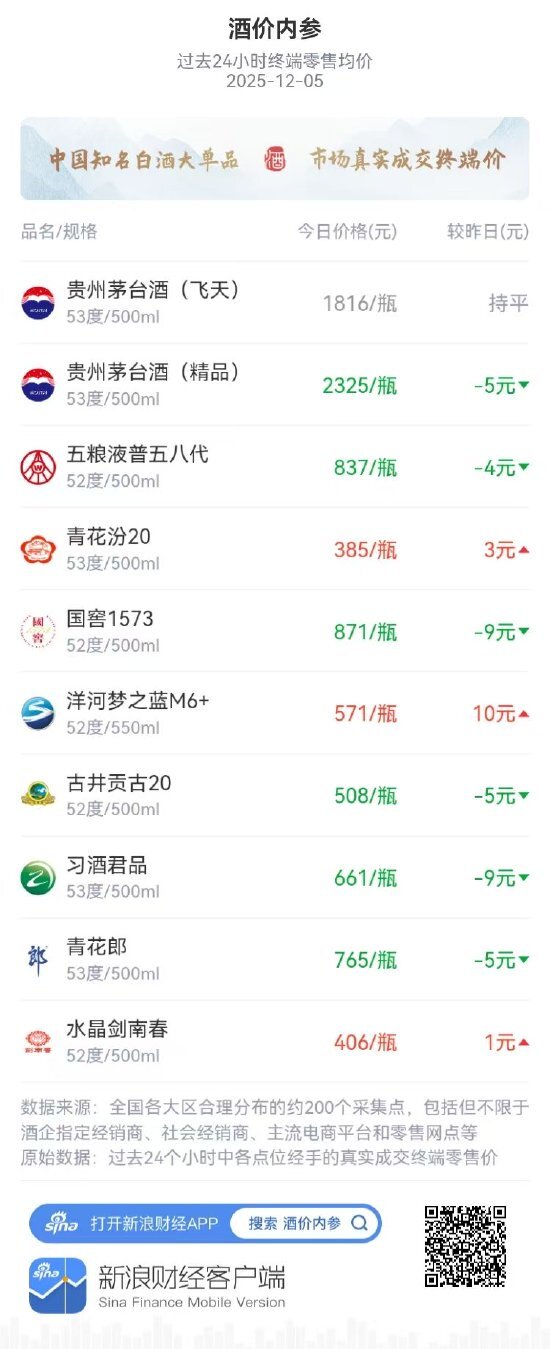
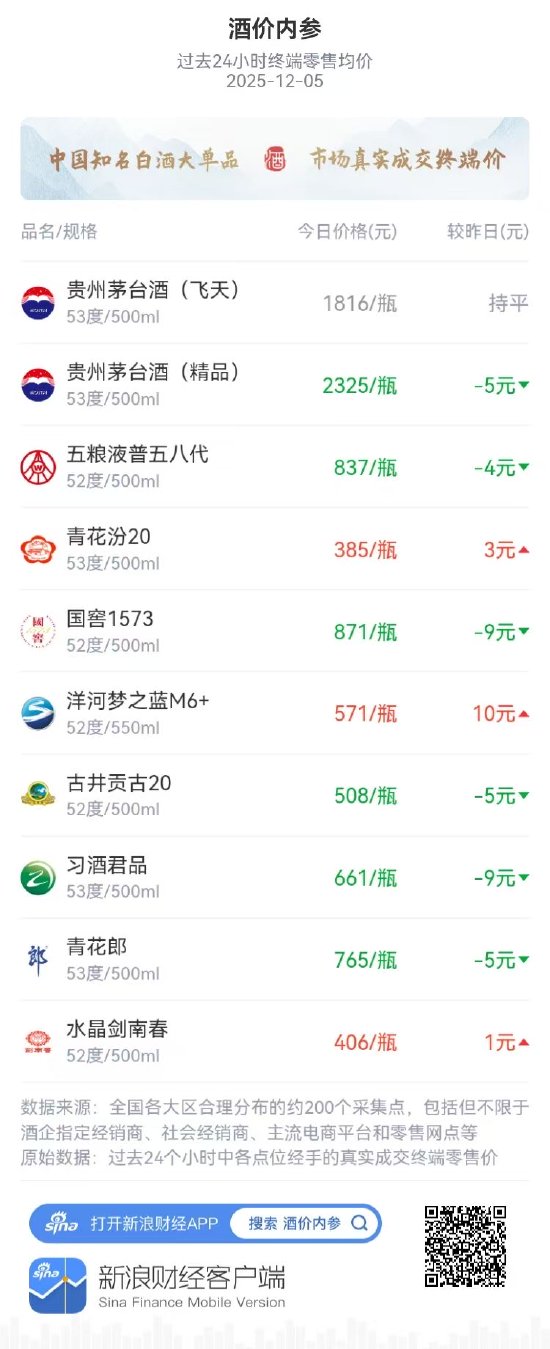
酒价内参12月5日价格发布 青花郎下跌5元
Xin Lang Cai Jing· 2025-12-05 01:36
Core Viewpoint - The white liquor market is experiencing a downward trend in retail prices, with the average price of the top ten products decreasing for the second consecutive day, indicating a weak adjustment in the market [1]. Price Trends - The total price for a package of the top ten white liquor products is 9,145 yuan, down 23 yuan from the previous day [1]. - Most products are primarily declining, but some have stabilized or increased in price, such as Yanghe Dream Blue M6+, which rose by 10 yuan per bottle [1]. - Other notable price changes include Qinghua Fen 20 increasing by 3 yuan, and Crystal Jian Nan Chun rising by 1 yuan, while Xijiu Junpin and Guojiao 1573 both fell by 9 yuan [1][3]. Market Analysis - The valuation of Moutai is a central topic of debate, with its current price-to-earnings (PE) ratio at approximately 20 times, which is below its five-year average of 36.35 times [1]. - Historical data shows that Moutai's lowest PE in the past five years was 19.69 times, indicating that the current valuation is relatively low [1]. - Some analysts argue that the fundamental changes in the white liquor industry's business model may have led to a downward adjustment in Moutai's valuation center, despite its high brand value and pricing power [1].


酒价内参12月5日价格发布 习酒君品下跌9元
Xin Lang Cai Jing· 2025-12-05 01:36
Core Viewpoint - The white liquor market is experiencing a downward trend in retail prices, with the average price of the top ten products decreasing for the second consecutive day, indicating a weak adjustment in the market [1]. Price Trends - The total retail price for a package of the top ten white liquor products is 9,145 yuan, down 23 yuan from the previous day [1]. - Most products are primarily experiencing price declines, although some have stabilized or increased slightly [1]. - Notable price movements include: - Yanghe Dream Blue M6+ increased by 10 yuan per bottle - Qinghua Fen 20 rose by 3 yuan per bottle - Crystal Jian Nan Chun saw a minor increase of 1 yuan per bottle - Prices for Xijiu Junpin and Guojiao 1573 fell by 9 yuan per bottle each - Qinghua Lang decreased by 5 yuan per bottle - Gujing Gong Gu 20 and Premium Moutai both dropped by 5 yuan per bottle - Wuliangye Pu 58 generation decreased by 4 yuan per bottle [1][3]. Valuation Analysis - The current price-to-earnings (PE) ratio for Moutai is approximately 20 times, which is below its five-year average of 36.35 times and its ten-year average of over 33 times, indicating a relatively low valuation [1]. - Some analysts argue that the fundamental changes in the white liquor industry's business model may have led to a downward shift in Moutai's valuation center, despite its current PE being higher than historical lows of around 10 times [1]. - Conversely, many believe that Moutai, as a high-end consumer brand, should maintain a valuation premium due to its brand strength and pricing power [1].
酒价内参12月5日价格发布 青花汾20价格回升3元
Xin Lang Cai Jing· 2025-12-05 01:12
Core Viewpoint - The white liquor market is experiencing a downward trend in retail prices, with the average price of the top ten products decreasing for the second consecutive day, indicating a weak adjustment in the market [1][4]. Price Trends - The total price for a package of the top ten products is 9145 yuan, down 23 yuan from the previous day [1][4]. - Most products are seeing price declines, but some have stabilized or increased, such as: - Yanghe Dream Blue M6+ increased by 10 yuan per bottle - Qinghua Fen 20 rose by 3 yuan per bottle - Shuijing Jian Nan Chun increased by 1 yuan per bottle - Feitian Moutai remained unchanged [1][5]. - Declining products include: - Xijiu Junpin and Guojiao 1573, each down by 9 yuan per bottle - Qinghua Lang down by 5 yuan per bottle - Gujing Gonggu 20 and Jingpin Moutai down by 5 yuan per bottle - Wuliangye Pu 58 down by 4 yuan per bottle [1][5]. Market Analysis - The current valuation of Moutai is approximately 20 times its earnings, which is below its five-year average of 36.35 times and its ten-year average of over 33 times, indicating a relatively low valuation [2][5]. - Some analysts argue that Moutai's valuation may have shifted downward due to fundamental changes in the white liquor industry's business model, despite its high brand equity and pricing power justifying a premium valuation [2][5].





头部酒品零售价整体上扬,行业估值仍处在相对低位
Xuan Gu Bao· 2025-11-16 23:30
Group 1 - The overall retail price of major Chinese liquor brands has increased, with leading products like Moutai and Yanghe experiencing significant price hikes of 5 CNY and 8 CNY per bottle respectively [1] - The valuation of the liquor sector is currently at a relatively low level, with the food and beverage index at the 17th percentile and the liquor index at the 23rd percentile since 2005 [1] - The combined dividend yield of liquor stocks has reached 3.74%, outperforming the 2.54% and 2.21% yields of the CSI 300 and Shanghai Composite Index respectively [1] Group 2 - The second quarter of 2026 is expected to stabilize, with a potential turning point in the third quarter as inventory clears and demand recovers, leading to a rebound in wholesale prices [2] - Yanghe Co. is recognized as a major national liquor producer, owning two famous Chinese liquor brands, Yanghe and Shuangguo [3] - Shui Jing Fang is noted as a well-known high-end liquor brand in China, representing a typical example of strong aroma liquor [4]
基金经理减仓白酒?不,其实是加仓
Sou Hu Cai Jing· 2025-11-05 10:51
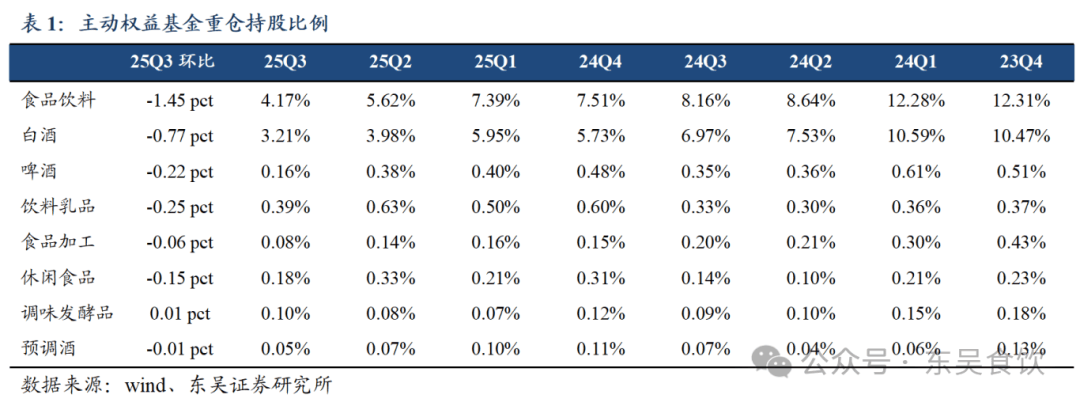
Core Viewpoint - The active funds have continued to reduce their holdings in the liquor sector during the third quarter, influenced by the underperformance of liquor stocks compared to broader indices, leading to a passive decline in their proportion within public fund holdings [2][4]. Group 1: Fund Holdings and Changes - In the third quarter, the number of liquor stocks held by active funds slightly increased from 325 million shares to 328 million shares, indicating no large-scale sell-off [4][6]. - The total number of liquor stocks held by active funds decreased significantly from 501 million shares to 325 million shares in the second quarter, a reduction of 35% [4]. - The total market value of liquor stocks held by active funds in the third quarter was approximately 6.90 billion yuan, with a slight increase in holdings compared to the previous quarter [7]. Group 2: Performance of Liquor Stocks - The China Securities Liquor Index rose by 7.75% in the third quarter, underperforming the CSI 300 Index by 10 percentage points and the "Equity Mixed Fund Index" by 18 percentage points [2]. - The proportion of liquor stocks in the public fund holdings decreased due to their underperformance relative to other sectors [2]. Group 3: Fund Managers' Strategies - Fund manager He Shuai significantly increased his positions in Kweichow Moutai and Luzhou Laojiao, which became part of the top ten holdings in his fund, accounting for a total of 11.4% [9]. - Fund manager Li Xiaoxing also increased his holdings in Luzhou Laojiao and Wuliangye, citing the attractive dividend yield and potential for recovery in consumer stocks [11]. - Fund manager Nie Shilin increased his holdings in Kweichow Moutai by 77% and in Shanxi Fenjiu by 96%, indicating a strong bullish stance on high-end liquor [13]. Group 4: Market Sentiment and Future Outlook - Some fund managers expressed a cautious outlook, suggesting that the domestic consumption and real estate sectors remain under pressure, with a focus on observing policy changes affecting consumer demand [14]. - Fund managers like Zhang Feng have shifted their focus to higher dividend yield sectors, indicating a strategic pivot towards food and beverage stocks, including liquor, due to their potential for recovery [19]. Group 5: Redemption and Fund Flows - The consumer-focused active funds experienced significant redemptions, with total shares dropping from 74.5 billion to 65.5 billion, reflecting a net redemption of 12% [25]. - In contrast, the total shares of ordinary stock and mixed funds saw only a 5% net redemption, highlighting the challenges faced by consumer-focused funds [26].