社保合规

Search documents
筑牢守法底线、恪守诚信经营--致经营性人力资源服务机构的一封信
Sou Hu Cai Jing· 2025-11-13 21:08
Core Viewpoint - The importance of integrity and legal compliance in the human resources service industry is emphasized, urging companies to adhere to laws and regulations to maintain market order and social responsibility [1][6][7]. Group 1: Legal Compliance - Human resources service institutions must enhance their legal awareness and strictly comply with relevant laws such as the Labor Law, Labor Contract Law, Social Insurance Law, and interim regulations on the human resources market [1][6]. - It is prohibited to operate without the necessary licenses or to exceed the scope of business, ensuring all activities are legal and compliant [1][6]. Group 2: Integrity in Operations - Companies are warned against engaging in fraudulent social insurance practices, such as fictitious labor relationships for social insurance payments, which can lead to significant risks including financial loss and damage to reputation [3][6]. - There is a strict prohibition on promoting or organizing individuals to participate in social insurance fraud, including altering personal records or improperly facilitating early retirement [6][7]. Group 3: Industry Responsibility - Human resources service institutions are encouraged to improve the legal knowledge of their staff and to actively standardize their operations to avoid illegal practices, thereby enhancing the industry's image [7]. - The social harm and legal consequences of fraudulent practices are highlighted, reinforcing the need for companies to operate ethically and responsibly [7].


定西高强申报IPO前更换评级更低的投行辅导 近百人未足项缴纳社保“五险”变“四险”却称没有违规
Xin Lang Zheng Quan· 2025-11-05 13:41
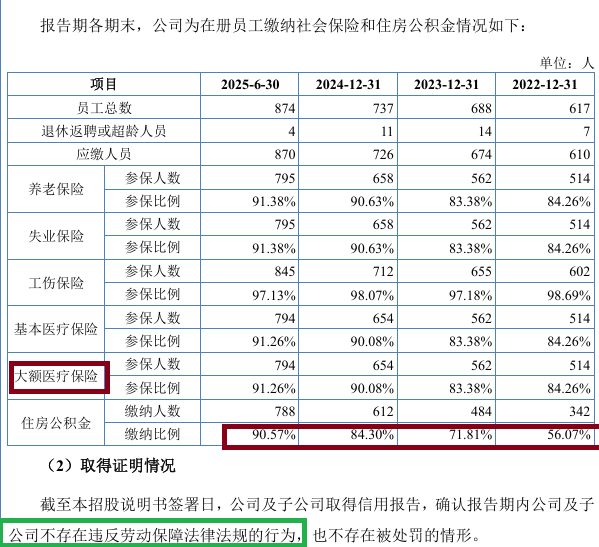
Core Viewpoint - The IPO application of Dingxi High Strength Fasteners Co., Ltd. has been accepted by the Beijing Stock Exchange, but the path to listing has become complicated due to the recent investigation of its underwriter, First Capital Securities, by the China Securities Regulatory Commission for alleged negligence in continuous supervision [2][3]. Group 1: Company Background - Dingxi High Strength was established on August 15, 1997, and was transformed from a state-owned enterprise. It was listed on the New Third Board on October 9, 2023, with Dongfang Securities as its initial underwriter [3][4]. Group 2: Underwriter Change - Before applying for the IPO, Dingxi High Strength changed its underwriter from Dongfang Securities to First Capital Securities, citing "strategic development needs." This change is puzzling given that Dongfang Securities had been advising the company for nearly five years and had a higher classification rating for 2024 compared to First Capital Securities [2][4][5]. Group 3: Compliance Issues - Dingxi High Strength has significant compliance issues, particularly regarding the failure to fully pay social insurance for nearly 100 employees. The company reported that it did not provide maternity insurance, which is a legal requirement, while claiming no violations of labor laws in its prospectus [5][7][9]. - The number of employees not receiving full social insurance has decreased from 268 in 2022 to 82 in mid-2025, but the company still has a substantial number of employees without proper coverage [6][7]. Group 4: Legal Obligations - According to the Social Insurance Law of the People's Republic of China, employers are required to participate in and pay social insurance for their employees. Dingxi High Strength's claim that many employees voluntarily waived their rights to social insurance does not exempt the company from its legal obligations [8][9][10]. - The company's prospectus misleadingly states that it provides "five insurances," but it effectively only offers "four insurances" as it does not include maternity insurance, which is a violation of legal requirements [9][10].
《中国企业社保白皮书2025》:三成企业遇到社保纠纷,社保基数合规比例提升幅度亮眼
Jing Ji Guan Cha Bao· 2025-08-29 12:23
Core Insights - The report indicates that 34.1% of companies have fully compliant social security bases, an increase of 5.7 percentage points from 2024, highlighting initial progress in compliance efforts [1] - 29.3% of companies encountered employee disputes related to social security in the past year, indicating that social security disputes are becoming a real challenge for businesses [2] - The report emphasizes the need for companies to proactively embrace social security compliance amid rising labor rights awareness and increasing labor disputes [3] Compliance and Challenges - The increase in fully compliant social security bases reflects a significant achievement, yet many companies still face challenges in compliance [1][2] - 22.7% of companies pay social security at the minimum level, down 5.5 percentage points from last year, while 24.6% pay based on fixed salary excluding bonuses, down 2.6 percentage points [1] - The report suggests that social security compliance is a long-term endeavor requiring careful planning and consideration of historical and current factors [2] Employee Disputes and Legal Context - The Supreme People's Court's recent ruling allows employees to leave and claim compensation if their employer fails to pay social security, which may increase disputes [2] - In the first half of 2025, labor dispute cases accepted by courts rose to 436,000, a year-on-year increase of 40.17% [2] Employment Practices - The report notes a trend towards diversified employment practices, with 61.0% of companies employing interns, 44.6% using outsourced workers, 30.9% hiring part-time employees, and 12.6% re-employing retirees [3] - The survey covered 6,689 companies, with 90.9% of respondents being human resources professionals, indicating a broad representation of the industry [3]
不同集团IPO潜在风险迷雾: 社保问题,合规之路上的绊脚石
Sou Hu Cai Jing· 2025-08-29 01:25
Core Viewpoint - BUTONG GROUP is planning to issue up to 16,188,600 overseas listed ordinary shares and list on the Hong Kong Stock Exchange, despite underlying operational compliance issues that could pose risks to its market performance [1][5]. Group 1: Company Overview - BUTONG GROUP, a brand known for high-end parenting products, ranks first in the market for durable parenting products based on 2024 GMV [1]. - The company was previously known as BUTONG Technology, and its relationship with Guangzhou Ronghui raises potential concerns regarding related party transactions [3]. Group 2: Related Party Transactions - Between April 2020 and March 2021, BUTONG Technology paid Guangzhou Ronghui 1.5 million yuan for consulting services, settled through a transfer of 75,000 yuan in registered capital, raising questions about the fairness of the service fee [3]. - Following a Series A financing round in November 2020, BUTONG Technology was valued at approximately 300 million yuan, suggesting a significant discrepancy between the service fee and the value of the equity transferred [3]. - In May 2020, a 2.5% unissued share was transferred to Guangzhou Ronghui at no cost, which was later sold back to the original owner for 14.42 million yuan, indicating potential profit from related party transactions [3]. Group 3: Social Insurance Compliance - The company admitted in its prospectus that it has not fully paid social insurance and housing fund contributions, with total shortfalls of 5.9 million yuan, 7.7 million yuan, 9.4 million yuan, and 5.4 million yuan for the years 2022, 2023, 2024, and the first half of 2025, respectively [4]. - Non-compliance with social insurance laws could lead to penalties, including late fees and fines, which may impose financial pressure on the company and affect its reputation [4]. Group 4: Future Considerations - The company needs to address the concerns regarding related party transactions by providing evidence of fairness and necessity, as well as improving disclosure procedures to alleviate investor concerns [4]. - Timely payment of outstanding social insurance contributions and establishing a compliant payment system are crucial to mitigating future risks [4]. - The ability of BUTONG GROUP to resolve these issues before its IPO will be critical for maintaining investor confidence and meeting regulatory scrutiny [5].

最高法明确不缴社保约定无效,京东提出外卖全职骑手100%签劳动合同、
Zhong Jin Zai Xian· 2025-08-19 07:24
Core Viewpoint - The new judicial interpretation effective from September 1 mandates all employers to legally pay social insurance, rendering any agreements to not pay invalid, which could significantly impact millions of new employment groups, including delivery riders [1] Group 1: Social Insurance Implementation - All full-time delivery riders at JD have signed formal labor contracts and the company covers all social insurance costs, benefiting over 150,000 riders [2][3] - Riders experience an additional monthly income of approximately 2,000 yuan from social insurance, enhancing their overall financial security and quality of life [2] - The introduction of social insurance has provided riders with essential protections, such as medical coverage, maternity leave, and other employee benefits, transforming their work into a more stable and respected profession [3] Group 2: Industry Impact and Compliance - The new social insurance regulations represent a significant shift for delivery riders, transitioning their status from "algorithm prisoners" to recognized professionals, with compliance becoming a legal obligation rather than a moral choice [4] - JD's proactive approach in implementing social insurance sets a precedent for the industry, urging other platforms to follow suit and ensure compliance with labor laws [4][5] - The industry faces a compliance challenge, as platforms that fail to provide social insurance may encounter increased costs and competitive disadvantages, potentially affecting over a million workers [6]

全员交社保了,奶茶店会不会迎来大面积倒闭潮?
36氪· 2025-08-06 09:50
Core Viewpoint - The recent judicial interpretation by the Supreme People's Court mandates that all agreements regarding "not paying social insurance" are invalid, which has significant implications for the beverage industry, particularly tea and coffee shops [4][17]. Group 1: Industry Practices - The practice of "not paying social insurance" has become a common norm in the tea beverage industry, with many shop owners opting out due to high employee turnover and short-term employment characteristics [9][10]. - The high turnover rate in tea shops makes it impractical for owners to pay social insurance, as many employees do not stay long enough to justify the costs [11][12]. - The franchise system creates a "grey area" where compliance with social insurance regulations varies, with some individual store owners substituting subsidies for social insurance or having employees sign waivers [14]. Group 2: Impact of New Policy - The new policy, effective September 1, raises concerns about the survival of small shops, as mandatory social insurance payments could lead to increased operational costs [17][19]. - Many small franchise stores, which already operate on thin margins, may struggle to remain profitable if they are required to pay for social insurance, potentially leading to a wave of closures [18][26]. - The policy could disproportionately affect individual operators and small franchise stores, while larger brands with established management systems may benefit from the regulatory changes [20][22]. Group 3: Economic Implications - The requirement to pay social insurance represents a significant shift in the cost structure for small tea shops, which may lead to losses for those that previously operated on minimal profit margins [24][26]. - The industry may undergo a "cleaning" process, pushing out businesses that have relied on circumventing regulations [27]. - The transition from a flexible to a mandatory compliance environment will likely result in a profound transformation of the industry ecosystem, with a focus on operational compliance rather than product or marketing competition [29][30].