
科技巨头

Search documents
美银Hartnett:小盘股比科技股更值得押注 科技巨头不再是赢家
Xin Lang Cai Jing· 2026-02-08 09:18
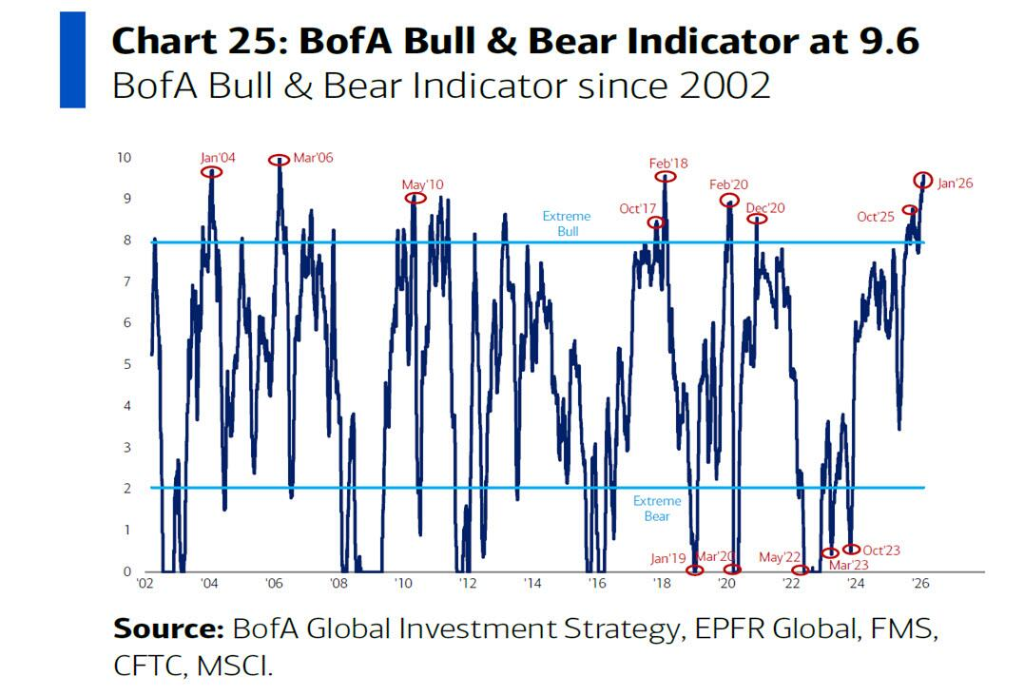
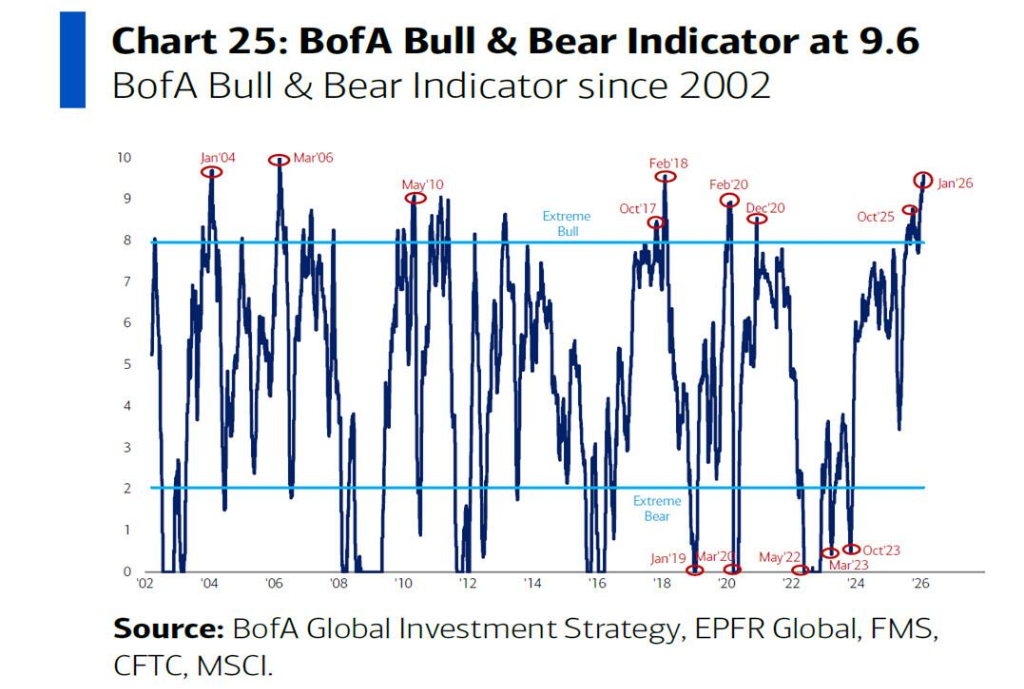
Core Insights - The Bull & Bear Indicator has reached its highest level since 2006, signaling a "sell" recommendation from Bank of America strategist Michael Hartnett, with a current reading of 9.6, indicating extreme market conditions [1] - Hartnett suggests a shift in asset allocation for 2026, advocating for a strategy of "long Main St, short Wall St," which involves moving funds from crowded tech giants and cryptocurrencies to small-cap stocks and international markets [3] Market Dynamics - The recent market downturn aligns with Hartnett's warnings, marked by a sudden crash in software stocks and significant declines in silver and Bitcoin prices, exacerbated by political factors [4] - The cryptocurrency market has lost $2 trillion in value since October 2025, equivalent to 10% of U.S. consumer spending, which Hartnett warns will have a substantial economic impact [4] Technology Sector Analysis - Tech giants are facing a "capital expenditure trap," with projected AI-related capital expenditures for 2026 reaching $670 billion, which is 96% of their combined cash reserves, compared to 40% in 2023 [5] - This shift from a "light asset" to a "heavy asset" model threatens the market leadership of tech stocks in the 2020s [5] Economic Policy Implications - Hartnett believes that the Trump administration will intervene in various sectors to lower inflation, which, combined with AI's impact on the labor market, could lead to unexpected declines in inflation by 2026, benefiting small and mid-cap stocks [6] - Since the new government took office, small-cap stocks have outperformed billionaire concept stocks, with small caps rising 13% compared to a mere 6% increase for the latter [7] Capital Flow Trends - Recent EPFR data indicates a significant style shift in the market, with outflows from safe-haven assets like gold and cryptocurrencies, while undervalued markets are seeing substantial inflows [10] - Investment-grade bonds have experienced 41 consecutive weeks of net inflows, indicating a preference for safer assets amid market volatility [11] Future Outlook - Hartnett posits that the years 2025-2026 will mark the end of "American exceptionalism" and the beginning of "global rebalancing," with emerging markets and commodities becoming the new winners [15] - The current market decline is viewed as a "healthy and overdue bubble deflation," unless a systemic event occurs [13]

美银Hartnett:小盘股比科技股更值得押注,科技巨头不再是赢家
Hua Er Jie Jian Wen· 2026-02-08 07:59
Group 1 - The Bull & Bear Indicator has reached its highest level since 2006, currently at 9.6, signaling a "sell" recommendation from Bank of America's chief investment strategist Michael Hartnett [1] - Hartnett attributes this extreme reading to a combination of "position peak, liquidity peak, and inequality peak" [1] - The recent market downturn aligns with Hartnett's warnings, including significant drops in software stocks and cryptocurrencies, leading to a broader panic in the market [4] Group 2 - Hartnett suggests a strategic shift for 2026: "long Main St, short Wall St," indicating a move away from crowded tech giants and cryptocurrencies towards small-cap stocks and international markets [3] - The anticipated capital expenditures for tech giants in AI for 2026 are projected to reach $670 billion, which is 96% of their combined cash reserves, compared to only 40% in 2023 [5] - This shift from a "light asset" to a "heavy asset" model poses a significant threat to the market leadership of tech stocks in the 2020s [5] Group 3 - Hartnett believes that the Trump administration will intervene in various sectors to lower inflation, which, combined with AI's cooling effect on the labor market, will benefit small and mid-cap stocks in 2026 [7] - Since the new government took office, small-cap stocks have risen by 13%, while billionaire concept stocks like NVDA and META have only increased by 6% [7] - There is a significant style shift in the market, with key "bubble support levels" identified for tech ETFs, Bitcoin, and gold [10] Group 4 - Recent data shows a net outflow from safe-haven assets, with gold funds experiencing their first weekly net outflow since November 2025, and cryptocurrency funds seeing a $1.5 billion outflow [14] - Conversely, there has been a massive inflow into undervalued markets, with the Korean stock market recording a historic $5.2 billion weekly inflow [14] - Hartnett views the current period as a historical turning point, marking the end of "American exceptionalism" and the beginning of "global rebalancing," with a focus on international stocks and emerging market commodities [15]


美股市场速览:盘带头回撤,资金加速流出
Guoxin Securities· 2026-02-01 09:13
Market Performance - S&P 500 increased by 0.3% while Nasdaq decreased by 0.2% this week[1] - Small-cap stocks led the decline with Russell 2000 value down by 1.0% and Russell 2000 growth down by 3.1%[1] - 13 sectors saw gains, while 10 sectors experienced losses, with telecommunications leading at +9.0%[1] Fund Flows - Estimated fund flow for S&P 500 components was -$84.1 million this week, down from +$5.6 million last week[2] - Major inflows were seen in technology hardware (+$40.3 million) and media & entertainment (+$39.5 million)[2] - Significant outflows occurred in software & services (-$106.0 million) and healthcare equipment & services (-$57.7 million)[2] Earnings Forecast - S&P 500's forward 12-month EPS expectation increased by 0.8% this week, up from 0.2% last week[3] - 21 sectors had upward revisions, with technology hardware & equipment seeing the largest increase at +5.6%[3] - Energy sector saw a downward revision of -2.7%[3] Risks - Economic fundamentals, international political situations, U.S. fiscal policies, and Federal Reserve monetary policies present uncertainties[3]




美股市场速览:整体市场平静,能源变数较大
Guoxin Securities· 2026-01-24 15:19
Market Performance - The S&P 500 decreased by 0.4% this week, while the Nasdaq fell by 0.1%[1] - Small-cap value (Russell 2000 Value) outperformed with a gain of 0.2%, compared to large-cap value (Russell 1000 Value) which declined by 0.2%[1] - The energy sector saw a notable increase of 3.1%, while the banking sector experienced a decline of 2.8%[1] Fund Flows - Estimated fund flow for S&P 500 constituents was +$5.6 billion this week, up from -$1.7 billion last week[2] - Key sectors with inflows included automotive and auto parts (+$9.2 million) and semiconductor products (+$9.2 million)[2] - Significant outflows were observed in the financial sector, particularly in diversified financials (-$13.6 million) and capital goods (-$7.4 million)[2] Earnings Forecast - The forward 12-month EPS expectation for S&P 500 constituents increased by 0.2% this week, slightly down from 0.3% last week[3] - Notable upward revisions were seen in real estate (+2.0%) and semiconductor products (+0.7%), while the energy sector was revised down by 2.0%[3] - Risks include uncertainties in economic fundamentals, international political situations, U.S. fiscal policies, and Federal Reserve monetary policies[3]



美股市场速览:金涌入科技巨头,小盘消费开始发力
Guoxin Securities· 2026-01-10 11:18
Investment Rating - The report maintains a rating of "Underperform" for the U.S. stock market [4] Core Insights - The overall market is showing a recovery, with small-cap and consumer sectors gaining momentum. The S&P 500 increased by 1.6% and the Nasdaq by 1.9% this week. Small-cap growth stocks outperformed with a 4.7% increase, while small-cap value stocks rose by 4.5% [1] - 21 out of 24 sectors experienced gains, with notable increases in retail (+8.4%), durable goods and apparel (+5.2%), and materials (+4.9%). Conversely, technology hardware and equipment saw a decline of 3.2% [1] - There is a significant inflow of funds into technology giants, with the estimated fund flow for S&P 500 components at +$130.2 billion this week, compared to -$30.2 billion the previous week [2] Summary by Sections 2.1 Investment Returns - The weighted average price return for various sectors shows significant performance, with retail at +8.4%, durable goods and apparel at +5.2%, and materials at +4.9%. In contrast, technology hardware and equipment reported a decline of -3.2% [13] 2.2 Fund Flows - Fund flows indicate a strong interest in semiconductor products and equipment (+$2.756 billion), technology hardware and equipment (+$1.724 billion), and retail (+$1.686 billion). However, sectors like telecommunications experienced outflows of -$0.090 billion [15] 2.3 Earnings Forecast - The earnings forecast for the S&P 500 components shows a slight increase of +0.3% this week, with 17 sectors experiencing upward revisions. Notable increases were seen in semiconductor products and equipment (+0.9%) and materials (+0.6%) [16] 2.4 Valuation Levels - Valuation levels across sectors reflect varying performance, with the semiconductor sector showing a significant increase in earnings expectations, while sectors like telecommunications and durable goods and apparel faced downward adjustments [18]

美股市场速览:大盘趋势淡化,资金持续流入半导体
Guoxin Securities· 2026-01-03 13:09
Investment Rating - The report maintains a "weaker than the market" rating for the U.S. stock market [4] Core Insights - The overall market trend is fading, with continued capital inflow into the semiconductor sector [2] - The S&P 500 index decreased by 1.0% this week, while the Nasdaq fell by 1.5% [1] - Energy sector showed the best performance with a gain of 3.3%, while the automotive sector saw the largest decline at -7.0% [1] Summary by Sections 2.1 Investment Returns - Energy sector recorded a weekly return of 3.3%, while the automotive sector experienced a decline of 7.0% [13] - The capital goods sector increased by 1.1%, and the semiconductor products and equipment sector had a slight gain of 0.2% [13] 2.2 Capital Flows - The estimated net capital inflow for the semiconductor products and equipment sector was $2.061 billion this week [15] - The automotive sector faced significant outflows, with a net capital outflow of $2.562 billion [15] - The capital goods sector saw a net inflow of $394 million [15] 2.3 Earnings Forecast - The earnings per share (EPS) forecast for the semiconductor products and equipment sector was adjusted upward by 0.5% this week [16] - The automotive sector's EPS forecast was increased by 0.7% [16] - Overall, the EPS expectations for all 24 sectors have risen [3] 2.4 Valuation Levels - The report does not provide specific valuation levels in the provided content [18]
美股市场速览:半导体业绩上修带动市场回升
Guoxin Securities· 2025-12-20 13:44
Investment Rating - The report maintains a "weaker than market" rating for the U.S. stock market [4] Core Views - The semiconductor sector has driven a significant upward revision in market performance, with the S&P 500's estimated future 12-month EPS expectations raised by 0.8% this week [3] - The overall market saw a slight recovery, with the S&P 500 increasing by 0.1% and the Nasdaq by 0.5% [1] Summary by Sections 1. Market Performance - The S&P 500 rose by 0.1% and the Nasdaq by 0.5% this week, with the Russell 1000 Growth outperforming the Russell 1000 Value [1] - Nine sectors experienced gains, while fifteen sectors saw declines, with notable increases in the automotive sector (+4.3%) and semiconductor products (+1.3%) [1] 2. Fund Flows - The estimated fund flow for S&P 500 constituents was +67.4 billion USD this week, a recovery from the previous week's outflow of -72.0 billion USD [2] - Significant inflows were observed in the semiconductor sector (+42.8 million USD) and automotive sector (+23.6 million USD) [2] 3. Earnings Forecast - The earnings expectations for the semiconductor sector were revised upward by 6.0%, contributing to the overall increase in the S&P 500's EPS forecast [3] - Fourteen sectors saw upward revisions in earnings expectations, while four sectors experienced downward adjustments [3] 4. Valuation Levels - The report includes various valuation metrics, indicating a mixed performance across sectors, with the semiconductor sector showing strong growth in valuation [18]
美股市场速览:格快速修复,业绩预期平稳
Guoxin Securities· 2025-11-30 11:34
Market Performance - The S&P 500 index closed at 6,849, reflecting a weekly increase of 3.7% and a year-to-date increase of 16.4%[6] - The Nasdaq 100 index reached 25,435, with a weekly rise of 4.9% and a year-to-date increase of 21.0%[6] - The Dow Jones Industrial Average increased by 3.2% this week, with a year-to-date growth of 12.2%[6] Sector Analysis - The automotive and auto parts sector saw a significant weekly increase of 9.3% and a year-to-date increase of 9.9%[9] - The information technology sector reported a weekly rise of 4.6% and a year-to-date increase of 32.8%[9] - The healthcare sector experienced a weekly increase of 1.9% and a year-to-date increase of 21.0%[9] Fund Flows - The energy sector recorded a net inflow of $48 million this week, with a total of $572 million over the past 52 weeks[11] - The materials sector faced a net outflow of $290 million this week, totaling a negative $3.344 billion over the past 52 weeks[11] - The financial sector had a net inflow of $2.106 billion this week, with a total outflow of $6.723 billion over the past 52 weeks[11] Earnings Forecast - The overall EPS adjustment for the energy sector was 0.3% this week, with a year-to-date adjustment of -7.4%[14] - The materials sector saw an EPS adjustment of 0.6% this week, with a year-to-date adjustment of 4.9%[14] - The information technology sector's EPS adjustment was 0.6% this week, with a year-to-date adjustment of 28.0%[14]
美股市场速览:贸易冲突再起,全风格恐慌下跌
Guoxin Securities· 2025-10-12 05:14
Investment Rating - The report maintains a "Weaker than Market" rating for the U.S. stock market [1] Core Insights - The report highlights a significant market downturn due to renewed trade conflicts, with the S&P 500 dropping by 2.4% and the Nasdaq by 2.5% [3] - Only three sectors experienced gains, while 21 sectors saw declines, indicating widespread market fear [3] - The semiconductor sector attracted substantial capital inflows, contrasting with the overall outflow from the market [4] Summary by Sections Price Trends - The S&P 500 fell by 2.4%, and the Nasdaq decreased by 2.5% due to trade tensions [3] - The performance of sectors varied, with the Food, Beverage & Tobacco sector increasing by 1.7%, while Durable Goods & Apparel dropped by 8.4% [3] Capital Flows - The estimated capital flow for S&P 500 components was -$40.6 billion, indicating a significant outflow compared to the previous week [4] - The semiconductor products and equipment sector saw a capital inflow of $83.2 million, while the automotive sector experienced a $25.7 million outflow [4] Earnings Forecast - The report indicates a 0.3% upward adjustment in the earnings per share (EPS) forecast for S&P 500 components, with 21 sectors seeing an increase in earnings expectations [5] - The materials sector led the upward revisions with a 1.0% increase, while the energy sector faced a downward adjustment of 0.5% [5]

美股市场速览:市场窄幅震荡,多数行业下跌
Guoxin Securities· 2025-07-13 03:29
Investment Rating - The report maintains a "Weaker than Market" investment rating for the U.S. stock market [1] Core Insights - The U.S. stock market experienced narrow fluctuations with most sectors declining, as the S&P 500 fell by 0.3% and the Nasdaq by 0.1% [3] - There were 8 sectors that increased while 16 sectors decreased, with notable gains in Energy (+2.6%), Semiconductor Products and Equipment (+2.4%), and Transportation (+1.2%) [3] - Conversely, sectors that saw significant declines included Telecommunications (-4.8%), Insurance (-2.6%), and Banks (-2.5%) [3] Summary by Sections Market Overview - The S&P 500's estimated fund flow was -$5.7 billion this week, a decrease from the previous week's +$23.4 billion, with a total of +$216.4 billion over the last 13 weeks [4] - Fund inflows were observed in 11 sectors, with Semiconductor Products and Equipment leading at +$17.2 billion, followed by Transportation (+$6.0 billion) and Energy (+$4.1 billion) [4] - Sectors experiencing fund outflows included Software and Services (-$15.9 billion) and Automotive and Parts (-$8.2 billion) [4] Earnings Forecast - The dynamic F12M EPS forecast for S&P 500 constituents was adjusted upward by 0.3%, following a 0.2% increase the previous week [5] - Earnings expectations were raised for 21 sectors, with the highest adjustments in Integrated Finance (+0.8%), Automotive and Parts (+0.8%), and Semiconductor Products and Equipment (+0.8%) [5] - Three sectors saw downward revisions, notably Healthcare Equipment and Services (-1.0%) and Telecommunications (-0.2%) [5] Price Performance - The Energy sector recorded a price return of +2.6% this week, while the Telecommunications sector saw a decline of -4.8% [15] - Over the past 52 weeks, the Energy sector has increased by 5.1%, while the Telecommunications sector has decreased by 4.0% [15] - The Semiconductor Products and Equipment sector has shown a remarkable increase of +48.0% over the past 13 weeks [15] Fund Flow Analysis - The Industrial sector led with a net fund inflow of $781 million this week, followed by Energy with $409 million [19] - The Semiconductor Products and Equipment sector also saw significant inflows of $1.716 billion, indicating strong investor interest [19] - In contrast, the Software and Services sector experienced the largest outflow of -$1.594 billion [19]
