移动的第三空间

Search documents
万亿美元赛道浮现,萝卜快跑稳居全球Robotaxi榜首
3 6 Ke· 2025-11-13 11:36
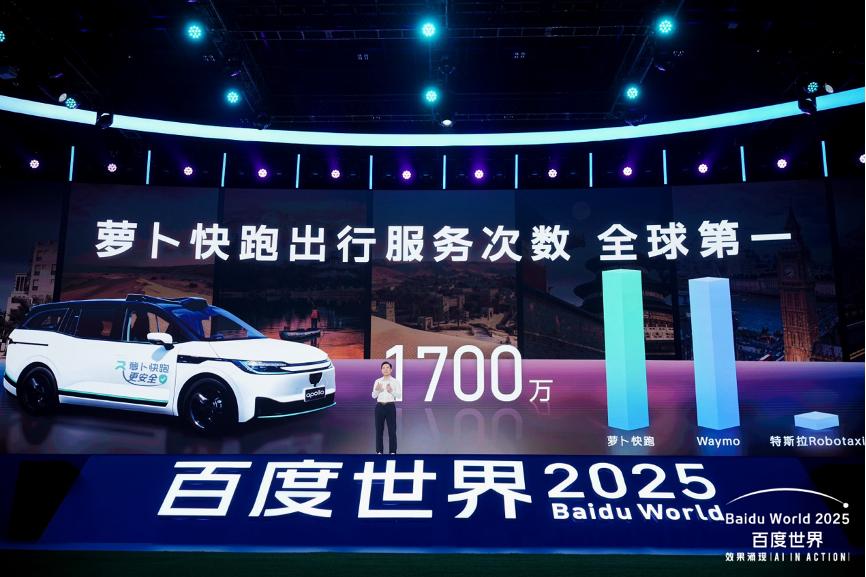
Core Insights - The integration of AI large models with the real world is exemplified by the emergence of Robotaxi services, which are reshaping urban transportation [1][2] - Baidu's Robotaxi service, "LuoBo Kuaipao," has become a global leader in commercializing Robotaxi, achieving over 250,000 weekly orders and a cumulative total of 17 million orders by the end of October [1][3] Group 1: Robotaxi Market Position - LuoBo Kuaipao leads the global Robotaxi order rankings, with a significant presence in 22 cities including Beijing, Shanghai, and Dubai, and all orders being fully autonomous [3][5] - The service has accumulated over 17 million orders, surpassing Google's Waymo, which has 10 million orders, establishing itself as the world's foremost Robotaxi service [3][5] Group 2: Technological and Societal Impact - The acceleration of Robotaxi adoption signifies the feasibility of autonomous driving technology, which is expected to profoundly influence urban planning and transportation systems [2][6] - Baidu's founder, Li Yanhong, emphasizes the transition of AI from "intelligent emergence" to "effect emergence," highlighting the potential of AI large models when integrated with real-world applications [2][6] Group 3: Economic Potential - The global market for autonomous vehicles is projected to reach $10 trillion by 2030, with the number of autonomous vehicles expected to reach approximately 50 million [10][12] - The average cost of autonomous rides is anticipated to decrease from $1.1 per mile to $0.25, potentially increasing ride-hailing demand by 5 to 7 times [10][11] Group 4: Urban Transformation - The introduction of Robotaxi services is expected to reduce the need for parking spaces in densely populated areas, thereby freeing up space for commercial and residential development [7][8] - As commuting time becomes more productive through the use of Robotaxis, the traditional urban structure may shift from a single-center model to a multi-center model, enhancing land value in suburban areas [8][10] Group 5: Global Recognition and Expansion - LuoBo Kuaipao is recognized as a significant player in the global autonomous driving landscape, competing primarily with U.S. companies like Waymo [12][13] - The service has expanded internationally, with recent launches in Dubai and Abu Dhabi, and partnerships with local transportation operators to enhance its service offerings [13][14]


新能源走向全球,用中国语言造世界产品
晚点LatePost· 2025-10-16 12:30
Core Viewpoint - The advancement of China's new energy vehicles (NEVs) on the global stage relies on mastering core technologies, excellent product design, and cultural connotations [4][13]. Group 1: Technological Leadership and Market Position - DJI broke the narrative of low-value processing in China's hardware industry by achieving industry-leading technology in all drone modules, capturing over 70% of the global consumer drone market [4]. - China's NEV industry is leading globally in electrification and intelligence technologies, which positions it well for global expansion [4][12]. - The shift from being a technology follower to a leader is evident, with China now being viewed as a global innovation engine rather than just a technology input market [6][13]. Group 2: Redefining Luxury and Design - Chinese NEVs need to redefine "luxury" by integrating advanced electric and intelligent experiences with Chinese aesthetics and values [5][10]. - The fusion of Eastern aesthetics and intelligent technology is a key strategy for Chinese brands to reshape the perception of automotive luxury [5][10]. - Lantu Automotive exemplifies this approach, having established a unified family design language that reflects Chinese cultural elements [7][19]. Group 3: Evolving Consumer Preferences - There is a notable shift in consumer preferences towards brands that resonate with Chinese cultural identity, moving away from a reliance on joint venture brands [9][23]. - The concept of vehicles as "third spaces" reflects a deeper emotional connection, where cars serve not just as transportation but also as spaces for relaxation and work [9][12]. - The rise of cultural confidence among Chinese consumers is driving the demand for vehicles that embody Eastern aesthetics and cultural narratives [9][25]. Group 4: Market Performance and Future Outlook - Lantu's sales have surged, with a cumulative sales increase of 85% year-on-year in the first nine months of the year, indicating strong market acceptance of its design philosophy [7][23]. - The integration of Eastern aesthetics into vehicle design is becoming a competitive advantage, as seen in the growing emphasis on cultural narratives and design language among various brands [10][25]. - China's NEV exports reached 1.06 million units in the first half of the year, marking a 75.2% increase, highlighting the rapid growth of Chinese NEVs in international markets [23].
这场央地合作,何以提升了对“移动的第三空间”的想象?|文博会观察
Sou Hu Cai Jing· 2025-05-23 09:07
Core Insights - The article discusses the emergence of a "third space" beyond work and home, particularly in the context of the automotive industry, where vehicles are evolving into mobile entertainment spaces due to advancements in technology such as AI, 5G, and autonomous driving [5][6]. Group 1: Industry Trends - The automotive industry is transitioning from simple transportation to a multifunctional entertainment space, driven by technological advancements [5]. - The demand for in-car entertainment systems is increasing as consumers seek immersive experiences, such as attending virtual concerts or enjoying high-quality audio-visual content [5][6]. Group 2: Technological Innovations - The GAC Group, in collaboration with Huawei and the Central Radio and Television Station, launched the "M8 Qiankun" series, which integrates advanced technologies to enhance user experience [5][6]. - The M8 Qiankun features the latest Huawei technology, including the Harmony cockpit and intelligent driving capabilities, aiming to create a seamless connection with home ecosystems [6]. Group 3: Collaborative Ecosystem - The collaboration among GAC, Huawei, and the Central Radio and Television Station exemplifies a synergistic approach to meet diverse user needs and drive industry innovation [7]. - The establishment of new audio standards for in-car entertainment is expected to elevate the quality of audio programming and vehicle sound systems, enhancing the overall user experience [6][7].