
税收调整

Search documents
2026年税收调整将对美国经济产生重大影响
Xin Lang Cai Jing· 2025-12-29 11:41
Core Viewpoint - Economists believe that the tax reduction policies introduced by the Trump administration's "Great American Plan" will become the core driving force of economic activity for individuals and businesses in the U.S. by 2026 [1][4]. Individual Tax Reduction Policies - Adjustments to personal tax rates and tax deductions will enhance household financial reserves in early 2026 through increased tax refund amounts during tax season and revised withholding tax standards, leading to higher disposable income [2][5]. - The plan aims to make the low tax rates for personal and corporate income taxes from the 2017 Tax Cuts and Jobs Act permanent, extend the standard deduction policy, and increase the estate tax exemption from $14 million to $15 million [6][8]. - By 2029, tax exemptions will apply to tips up to $25,000 and overtime pay up to $12,500, with gradual phase-out for individuals earning over $150,000 [6][8]. - A new tax deduction policy will provide up to $6,000 for individuals aged 65 and older by 2029, and a maximum of $10,000 tax deduction for interest on auto loans for domestically assembled vehicles [6][8]. - The state and local tax (SALT) deduction cap will be raised from $10,000 to $40,000, benefiting wealthy homeowners in high-tax states like New York and New Jersey [6][8]. Corporate Tax Incentives - The core objective of corporate tax adjustments is to stimulate business investment by extending low tax rate policies and increasing the tax-deductible proportion of capital expenditures and R&D expenses [3][7]. - The plan allows full tax deductions for specific equipment purchases, which was set to phase out by 2027, and permits full tax deductions for domestic R&D costs, with small businesses able to retroactively deduct R&D expenses incurred since 2022 [6][8]. - Interest expense deduction limits will be relaxed, reverting to a calculation that includes amortization costs, which could enhance corporate cash flow [6][8]. - The plan extends and increases tax relief for "pass-through" business owners, allowing them to deduct up to 20% of their income, although experts express skepticism about its effectiveness in driving economic growth [6][8].
债市日报:8月11日
Xin Hua Cai Jing· 2025-08-11 08:22
Core Viewpoint - The bond market experienced a comprehensive pullback on August 11, with expectations of a moderate rise in yield costs following the cooling of tax adjustment disturbances, leading to a collective decline in government bond futures and a general increase in interbank bond yields by approximately 2 basis points [1]. Market Performance - Government bond futures closed lower across the board, with the 30-year main contract down 0.55% at 118.6, the 10-year main contract down 0.11% at 108.495, and the 5-year main contract down 0.08% at 105.735 [2]. - The interbank major rate bond yields saw an increase, with the 30-year government bond yield rising by 3.1 basis points to 1.9520% and the 10-year government development bond yield increasing by 3.2 basis points to 1.8220% [2]. Overseas Bond Market - In North America, U.S. Treasury yields rose collectively on August 8, with the 2-year yield up 3.45 basis points to 3.762% and the 10-year yield up 3.49 basis points to 4.287% [3]. - In the Eurozone, the 10-year French bond yield increased by 5.3 basis points to 3.347%, while the 10-year German bond yield rose by 5.9 basis points to 2.687% [3]. Primary Market - The Ministry of Finance reported weighted average winning yields for 28-day and 182-day government bonds at 1.1220% and 1.3243%, respectively, with bid-to-cover ratios of 3.95 and 2.67 [4]. - Agricultural Development Bank's 91-day, 3-year, and 5-year financial bonds had winning yields of 1.3731%, 1.6322%, and 1.7046%, with bid-to-cover ratios of 3.05, 2.6, and 3.2 [4]. Funding Conditions - The central bank conducted a 7-day reverse repurchase operation of 1120 billion yuan at a rate of 1.40%, resulting in a net withdrawal of 4328 billion yuan for the day [5]. - Shibor rates showed mixed performance, with the overnight rate rising by 0.06 basis points to 1.315% and the 14-day rate declining by 1.39 basis points to 1.455%, marking a new low since January 2023 [5]. Economic Indicators - In July, the CPI rose by 0.4% month-on-month, while the PPI fell by 0.2% month-on-month, with the year-on-year PPI decline remaining at 3.6% [7]. - The core CPI showed a year-on-year increase of 0.8%, indicating a continuous expansion over three months [7]. Institutional Perspectives - CICC predicts that the PPI may rebound to around -2.8% year-on-year in August, while the CPI may drop to approximately -0.4% year-on-year due to high base effects from last year [8]. - Huatai Fixed Income suggests that the bond market is in a phase of expected improvement, with the 10-year government bond yield expected to remain between 1.6% and 1.8% [9].
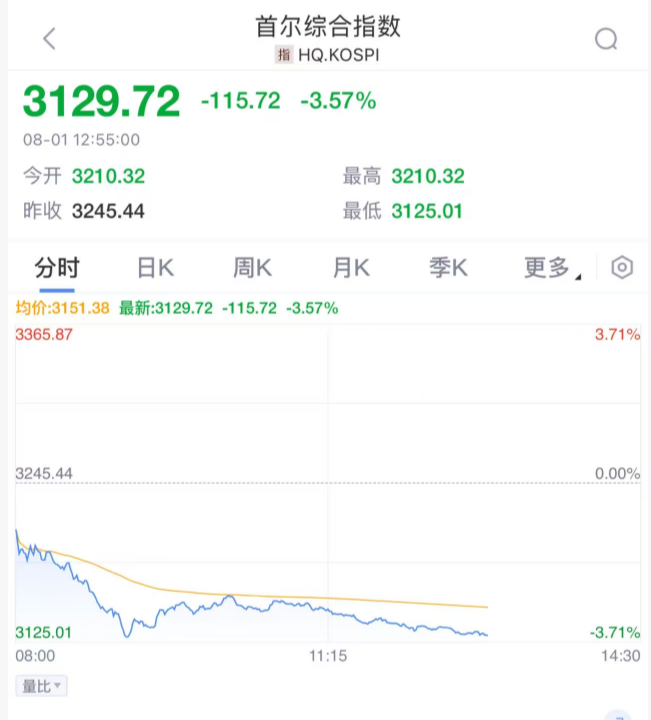
突发!韩国,“崩了”!
Zhong Guo Ji Jin Bao· 2025-08-01 06:31
Market Overview - On August 1, the South Korean stock market experienced a sudden drop, with the Seoul Composite Index falling nearly 4%, marking the largest decline since early April [2] - The decline was attributed to government plans to increase taxes on businesses and investors, leading to cautious sentiment in one of the hottest stock markets globally [2] Tax Policy Changes - The South Korean Ministry of Finance proposed to lower the capital gains tax threshold from 5 billion KRW (approximately 714,250 USD) to 1 billion KRW, while also increasing transaction taxes [4] - The corporate income tax rate is set to rise from 24% to 25%, reversing previous tax reduction policies [4] Investor Sentiment - The proposed tax changes have sparked strong backlash among retail investors, with a nationwide petition for immediate withdrawal gaining traction and public support [5] - Despite the recent downturn, the Seoul Composite Index has risen over 30% this year, benefiting from optimistic sentiment surrounding corporate governance reforms initiated by the new government [5] Economic Context - President Lee Jae-myung, who took office in June, aims to boost government revenue to increase subsidies and stimulate consumption amid slowing economic growth [6] - The proposed tax increases may weaken support from the active retail investor community and raise concerns among foreign institutional investors who had recently regained confidence in the market [6] Market Performance - Samsung Electronics, South Korea's largest market-cap stock, has seen consecutive declines due to disappointing earnings reports that did not meet analyst expectations [6] - The market's focus is shifting towards government policy reforms, with recent tax proposals being perceived as negative news that could undermine investor confidence [8] Future Outlook - If market momentum is lost, achieving President Lee's ambitious goal of pushing the stock market above 5,000 points, which is over 50% higher than current levels, will become more challenging [8] - The proposed increase in stock transaction tax from 0.15% to 0.2% and the new tax rates on dividend income are unexpected negative developments for the market [8]

巴西政府推多项增税措施以增加财政收入
news flash· 2025-07-22 00:36
Group 1 - The core viewpoint of the article highlights the Brazilian government's efforts to achieve fiscal balance through various tax adjustments and new tax measures since Lula's third term began in January 2023 [1] - Over the past three years, the Lula administration has implemented approximately 25 tax adjustments, including increasing existing tax rates, eliminating certain tax incentives, introducing new taxes, and imposing additional taxes on specific goods and services [1] - Notable measures include a special tax on the sports betting industry, the "shirt tax" on international shopping, and the financial transaction tax (IOF) [1] Group 2 - In 2023, the government has undertaken a series of measures to adjust the tax structure, including the restoration of certain tax rate incentives that were suspended during the pandemic, adjusting tax burdens on investment funds, enhancing the powers of tax dispute management agencies, and increasing tax rates related to firearms and ammunition [1]