
稳健

Search documents
2026郎酒全国经销商视频会议召开,“强壮、稳健、挤压增长”成2026关键词
Zhong Guo Jing Ji Wang· 2026-02-09 06:44
Core Insights - In 2025, the Chinese liquor industry underwent significant adjustments, and the company successfully met its production and operational goals while achieving a slight increase in distributor shipment volume compared to 2024 [1] - The company held a national distributor video conference on February 5, 2026, emphasizing a theme of "strong, steady, and squeezed growth," which served as a motivational boost for the industry [1] Group 1 - The company's general manager, Wang Bowei, highlighted the past year as one of resilience and effort, stating that the company and its distributor partners bravely persevered through adversity, achieving a metaphorical "one kilometer forward" [3] - For 2026, the company is committed to a strategic product layout focusing on "high-end sauce aroma, leading mixed aroma, and dual excellence in both aromas" [3] - The company plans to implement a more rigorous commercial model design, emphasizing continuous upgrades in thought, team, product, momentum, and organizational driving forces [3] Group 2 - The company will establish dedicated business teams among its distributors to deepen local market connections and enhance business capabilities [6] - The company aims to expand its "China Lang" channel partnerships and strengthen its membership center, effectively amplifying brand momentum at sales terminals [6] - In January, the company achieved record-high shipments, with a single-day peak of 270 million yuan, marking a strong start to 2026 [6] Group 3 - The "China Lang" New Year channel partner networking events were highly successful, with nearly 500 events held across almost 300 districts and counties, engaging around 200,000 partners and customers [6] - The company acknowledges ongoing challenges but maintains a clear direction for future growth, as articulated by Wang Bowei, who emphasized the importance of continuing to move forward despite difficulties [6]

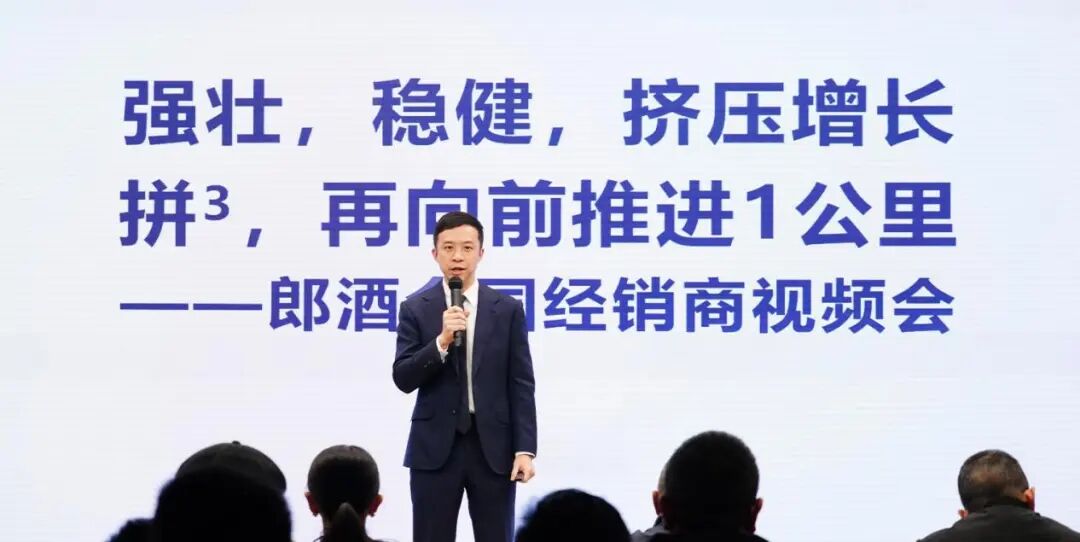
郎酒2026,为何锁定这三个关键词?
Xin Lang Cai Jing· 2026-02-06 05:31
Core Insights - The core viewpoint of the article emphasizes Langjiu's commitment to sustainable growth and strategic resilience in a challenging market environment, focusing on long-term value rather than short-term financial metrics [3][6][26] Group 1: Strategic Vision and Goals - Langjiu aims to advance with the spirit of "拼³" (Pīn sān), indicating a commitment to push forward despite market pressures, with a focus on a healthy and sustainable value chain from production to end consumers [3][26] - The company has set a strategic tone for 2026 characterized by "strong, stable, and squeezed growth," reflecting its approach to navigating industry challenges [5][15] - Langjiu's strategic vision includes a systematic upgrade of its product structure, transitioning from the fourth generation to the fifth generation of its products, which is seen as a significant brand value enhancement [10][12] Group 2: Market Performance and Adjustments - In 2025, Langjiu achieved a slight increase in dealer shipment volume compared to 2024, despite a generally challenging environment characterized by high inventory and slow sales across the industry [6][8] - The company effectively expanded its merchant base to over 3,300 and increased its terminal store alliances by nearly 100,000, leading to a reduction in social channel inventory [8][12] - Langjiu's focus on real consumption scenarios is evident, with significant growth in various product lines, including a 73% increase in the Red Flower Lang banquet segment and a 44% increase in membership for Langjiu's estate [8][14] Group 3: Product and Brand Strategy - Langjiu maintains a strategic focus on "high-end sauce aroma, leading mixed aroma, and dual excellence," ensuring a robust product matrix that supports its market position [12][23] - The company has established a tower structure for its sauce aroma products, ensuring a focus on main brands while avoiding the development of private label products [23][25] - Langjiu's brand value reached 162.065 billion yuan in 2025, maintaining its position among the top three in the industry for 17 consecutive years [14] Group 4: Tactical Implementation for 2026 - For 2026, Langjiu has developed a tactical system that aligns with its strategic goals, focusing on enhancing its sales team and establishing dedicated business teams for local market engagement [23][25] - The company has initiated nearly 500 "China Lang" New Year channel partner events across approximately 300 districts, reinforcing its collaborative ecosystem with partners and customers [25] - Langjiu's commitment to not engaging in price wars and maintaining a focus on quality and brand integrity reflects its strategic determination to navigate through market cycles [12][19]
什么样的人,能在这个时代里活得很好?
Sou Hu Cai Jing· 2025-12-12 21:13
Core Insights - The current era rewards stability and prudence in business practices [2][27] - Companies with strong cash reserves can navigate challenges more effectively [18][27] Group 1: Case Study of Nintendo - Nintendo revolutionized the gaming industry with the launch of Wii, selling over 100 million units and significantly increasing its market value [5][24] - The failure of Wii U led to substantial losses, with stock prices plummeting back to 10,000 yen and market value evaporating by over 85% [9][10] - Despite pressure from the market to cut costs and pivot to software, Nintendo's leadership maintained a conservative financial strategy, preserving cash reserves of over 1 trillion yen [17][18] - This financial stability allowed Nintendo to retain talent, invest in R&D, and explore innovative ideas without immediate pressure for profitability [20][21][22] - The successful launch of the Switch in 2017, which sold over 140 million units, marked a significant recovery for Nintendo [24][25] Group 2: Principles of Stability - Companies should maintain a robust cash reserve to ensure operational flexibility during downturns [27][35] - Stability encompasses three key aspects: capability stability, financial stability, and mental resilience [33][34][35] - The ability to adapt and learn new skills is crucial for long-term success in a changing market [34] - Financial stability provides the freedom to make choices without immediate economic pressure [35] - Mental resilience allows individuals and companies to navigate challenges while maintaining a clear strategic vision [36]

中泰期货成功举办“五要五不”专题文化宣讲会议
Qi Huo Ri Bao Wang· 2025-11-17 02:05
Core Viewpoint - The meeting emphasized the importance of cultural construction in enhancing the company's high-quality development and the implementation of the "Five Musts and Five Must Nots" initiative [1][2] Group 1: Cultural Significance - The value of Chinese financial culture is highlighted through five essential requirements: political and people-oriented financial work, quality financial services for the real economy, effective risk prevention and financial system stability, addressing deep-rooted issues in the financial sector, and promoting high-quality financial development [1] - The meeting called for the cultivation of a futures industry culture characterized by compliance, integrity, professionalism, stability, and responsibility, aligning with the cultural philosophy of Zhongtai Securities [1] Group 2: Cultural Construction Approach - Cultural construction is a long-term process that requires continuous accumulation and should not be seen as a mere superficial effort [2] - Culture must be a shared consensus and goal among all employees, necessitating their commitment and effort [2] - The culture should have depth, reflected in attitudes towards people, matters, clients, and shareholders, and must be visibly promoted through branding efforts [2] Group 3: Focus on High-Quality Development - The meeting urged a focus on high-quality development during the critical fourth quarter, emphasizing the need to prioritize cultural construction in overall work strategies [2] - The implementation of the "Five Musts and Five Must Nots" is seen as a way to inject strong momentum into the company's high-quality development [2]
中信银行行长芦苇:以三大“透过”实现上半年“难中求成”
2 1 Shi Ji Jing Ji Bao Dao· 2025-08-28 03:39
Core Viewpoint - China CITIC Bank emphasizes a "steady, balanced, and sustainable" development approach, achieving positive results in a complex environment during the first half of the year, driven by three main aspects [1] Group 1: Performance Indicators - The bank reported positive growth in net profit, improved revenue margins, effective cost control, stable asset quality, and quality growth in scale [1] Group 2: Capability Insights - The development is supported by the bank's capability in managing volume and price balance, light capital development, comprehensive risk management, and customer operations [1] Group 3: Future Structure - Continuous optimization of asset, liability, and customer structures has led to a balanced revenue structure of 40% from retail, 40% from corporate, and 20% from financial market businesses, enhancing the bank's ability to withstand economic cycles [1]
