
系统性风险防范

Search documents
金融控股集团监管研究① | 集团公司控制权风险与法律监管
清华金融评论· 2026-03-14 03:04
Core Viewpoint - The article discusses the rapid rise of corporate groups in China since the reform and opening-up, highlighting the associated risks in sectors like real estate and finance, and emphasizes the need for regulatory reforms to manage control risks within financial holding companies [2][31]. Group 1: Control Rights and Limited Liability - The vitality of modern companies stems from the combination of shareholder control rights and limited liability, which has led to the rise of corporate groups as a dominant organizational form [4][10]. - The article reviews the legal risks associated with corporate group structures, including improper control, regulatory arbitrage, and risk transfer, necessitating reforms in corporate law and regulations [3][10]. - It emphasizes that regulating control rights aims to enhance prudence rather than negate limited liability, which is crucial for preventing systemic risks [4][10]. Group 2: Corporate Group Structures - Corporate groups consist of a parent company and its subsidiaries, where the parent exercises control over strategic decisions, financial budgets, and major transactions [12][14]. - The article notes that the structure of corporate groups often leads to complex control relationships and responsibility allocations, which can obscure accountability and increase legal risks [14][21]. - It highlights that the global trend shows a significant number of large companies are part of corporate groups, reflecting the advantages of coordinated operations and risk management [9][14]. Group 3: Legal and Regulatory Framework - The article outlines the need for a comprehensive legal framework that addresses the control rights and responsibilities within corporate groups, balancing the interests of shareholders, subsidiaries, and creditors [23][24]. - It discusses two main regulatory approaches: top-down control rights penetration and bottom-up shareholder liability attribution, both aimed at ensuring transparency and accountability within corporate structures [23][24]. - The article emphasizes the importance of legal regulations that prevent the abuse of control rights while maintaining the integrity of corporate legal status and limited liability [24][27]. Group 4: Implications for Financial Stability - The article points out that the misuse of control rights can lead to significant risks, particularly in the financial sector, where improper control can threaten financial stability and public interest [21][31]. - It stresses that the new Company Law, effective from July 1, 2024, introduces joint liability for controlling shareholders, addressing key legal risks associated with corporate groups [31][32]. - The article concludes that effective regulation of control rights is essential for mitigating risks in corporate groups, particularly in the real estate and financial sectors, to ensure sustainable economic growth [31][32].


上金所、中国黄金宣布调整!
Jin Rong Jie· 2026-02-07 09:29
Group 1 - Major gold companies are adjusting their precious metal buyback business rules, with China Gold announcing changes effective February 7, 2026, including the suspension of buyback services on non-trading days and the implementation of limit management on buyback transactions [1] - The buyback limit management will include daily cumulative buyback limits for individual customers and total limits for single transactions, with adjustments based on market conditions [1] - Another leading gold retailer, Caibai Jewelry, has also announced similar adjustments to its buyback business, effective February 6, 2026, including the same limitations and dynamic settings [1] Group 2 - Precious metal prices have experienced significant volatility due to multiple factors, including a decline in the US dollar index and investor buying on dips, with gold prices rising by 1.85% to $4979.80 per ounce and silver prices increasing by 0.24% to $76.895 per ounce on February 6 [2] - For the week, gold prices increased by 4.95%, while silver prices decreased by 2.08% [2] - The Shanghai Gold Exchange announced adjustments to margin levels and price fluctuation limits for certain contracts, effective February 9, 2026, with gold contract margins increasing from 17% to 18% and silver contract margins from 23% to 24% [2] Group 3 - Experts indicate that adjusting margin and price fluctuation limits is a common risk management tool in financial markets, aimed at conducting counter-cyclical adjustments to prevent systemic risks from significant market fluctuations [3]


镍、氧化铝、铅、锌、不锈钢 上期所调整多个期货合约风控参数
Sou Hu Cai Jing· 2026-01-23 11:40
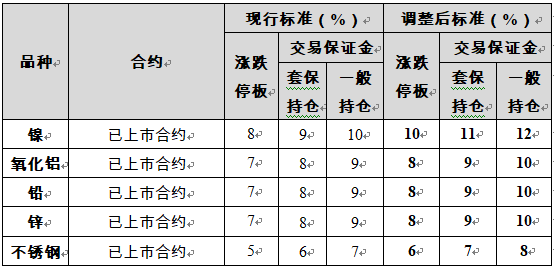
Core Viewpoint - The Shanghai Futures Exchange announced adjustments to the price limits and margin ratios for nickel, alumina, lead, zinc, and stainless steel futures contracts, effective from January 27, 2026, to enhance market regulation and prevent systemic risks [1][2][4]. Summary by Category Price Limit Adjustments - Nickel futures price limit will be adjusted to 10%, with a hedging margin ratio of 11% and a general margin ratio of 12% [1][2]. - Alumina, lead, and zinc futures price limits will be set at 8%, with a hedging margin ratio of 9% and a general margin ratio of 10% [1][2]. - Stainless steel futures price limit will be adjusted to 6%, with a hedging margin ratio of 7% and a general margin ratio of 8% [1][2]. Margin Ratio Adjustments - The margin ratios for nickel futures will be 11% for hedging and 12% for general positions [1][2]. - For alumina, lead, and zinc futures, the ratios will be 9% for hedging and 10% for general positions [1][2]. - Stainless steel futures will have a hedging margin ratio of 7% and a general margin ratio of 8% [1][2]. Market Context - The adjustments are a response to heightened volatility in international metal prices and are aimed at regulating market speculation, especially during the sensitive period leading up to the Chinese New Year [1][4]. - Factors such as international geopolitical tensions, uncertainty in major economies' monetary policies, and competition over key minerals have contributed to rising prices of various commodities, particularly strategic resources [1][4].
长城基金:市场震荡上行趋势有望延续
Xin Lang Cai Jing· 2026-01-20 08:00
Core Insights - The A-share market has seen a significant increase in financing transaction activity, with the financing balance reaching 2.68 trillion yuan, a new historical record, and financing transaction volume accounting for 11.3% of total market transactions as of January 14 [1][4]. Financing Margin Adjustment - On January 14, the Shanghai and Shenzhen Stock Exchanges announced an adjustment to the financing margin ratio, increasing the minimum margin requirement for investors from 80% to 100% when buying securities on margin [1][4]. - This adjustment is a key tool for regulatory authorities to conduct counter-cyclical adjustments, aimed at preventing excessive accumulation of systemic risks [2][5]. - Historical adjustments include a previous increase from 50% to 100% in November 2015 to curb rapid financing growth and a decrease from 100% to 80% in August 2023 to enhance market liquidity [1][2][4]. Impact on Market Dynamics - The core objective of raising the margin requirement is to maintain stable capital market operations and prevent excessive concentration of leveraged trading risks, reducing the leverage from 1.25 times to 1 time for new financing contracts [2][5]. - The policy will only apply to new financing contracts, while existing contracts will continue under the previous rules, reflecting a cautious regulatory approach to mitigate market impact and systemic risks [2][5]. Market Outlook - Short-term regulatory measures may not alter the upward trend of the market, with underlying support for continued market growth expected amidst fluctuations [2][5]. - Investment focus should be on policy initiatives and industry prosperity, particularly in technology growth sectors such as semiconductors, internet, electronics, media, and computing, as well as globally competitive sectors like power and machinery [2][5]. - Non-bank financial sectors are likely to benefit from increased demand for wealth management and capital market reforms, while cyclical sectors like tourism, hospitality, and consumer goods may present marginal improvement opportunities due to expanding domestic demand policies [2][5].
增强市场主体获得感 以制度和规则守底线
Sou Hu Cai Jing· 2025-12-27 22:37
Core Viewpoint - The article emphasizes the importance of balancing "letting go" and "managing well" as a crucial economic policy requirement and governance wisdom, particularly during the critical phase of economic transformation and upgrading [1][9]. Group 1: Economic Policy Principles - The Central Economic Work Conference proposed five musts, including the necessity to fully tap economic potential and the importance of both "letting go" and "managing well" to stimulate market vitality and enhance risk prevention capabilities [2]. - Achieving a balance between stimulating vitality and regulating order is identified as a key issue for promoting high-quality development in the context of increasingly complex internal and external environments [2][3]. Group 2: Market Dynamics - "Letting go" refers to reducing unnecessary administrative intervention to allow the market to play a decisive role in resource allocation, thereby lowering transaction costs and enhancing innovation and competition among enterprises and individuals [2][3]. - "Managing well" involves the government fulfilling its responsibilities in areas of market failure through institutional supply, rule-making, and effective regulation to maintain fair competition and macroeconomic stability [2][3]. Group 3: Enhancing Market Participants' Experience - The vitality of business entities directly impacts employment stability and economic quality, with 13.278 million new business entities established in the first half of 2025, including 4.62 million new enterprises and 8.629 million new individual businesses [4]. - The key to "letting go" lies in continuously enhancing the sense of gain for business entities, which includes reducing institutional costs and ensuring fair, transparent rules and stable policies [4][5]. Group 4: Governance and Regulation - "Managing well" is not about suppressing market vitality but rather establishing clear boundaries for market operations through rules and regulations to ensure sustainable development [6][7]. - The emphasis on "managing well" reflects the need for the government to shift from pre-approval management to rule-based supervision, enhancing governance effectiveness while reducing undue interference in microeconomic activities [7][8]. Group 5: Risk Prevention - Effective risk prevention requires institutionalized, transparent, and predictable policy arrangements to guide areas such as local government debt risks and financial market stability [8]. - The article highlights that "managing well" is about using rules rather than arbitrary interventions to govern the market, ensuring that market vitality can be continuously released and economic development can be stable and sustainable [8].
省人大常委会组成人员对省政府关于辽宁省2024年财政决算报告的审议意见
Liao Ning Ri Bao· 2025-08-01 01:12
Group 1 - The core viewpoint of the article emphasizes the commitment of the provincial government to implement the central government's decisions and the provincial party's requirements, focusing on effective fiscal policies and management to support the goals of comprehensive revitalization [1] - The provincial government aims to enhance fiscal resource coordination and improve fiscal management levels while preventing risks in key areas, thereby providing solid fiscal support for the year of tackling challenges [1] Group 2 - Suggestions include strengthening budget and final accounts management by improving the budget draft system and enhancing the management of surplus funds [2] - There is a focus on increasing the efficiency of fiscal fund usage through performance evaluations and optimizing budget allocations [2] - The establishment of a comprehensive risk monitoring and early warning system is recommended to prevent systemic financial risks, including hidden debts [2] - The article advocates for advancing fiscal and tax system reforms, including implementing zero-based budgeting to enhance the scientific and effective nature of budget preparation [2]