
经济意外指数

Search documents
宏观与大宗商品周报:冠通期货研究报告-20251117
Guan Tong Qi Huo· 2025-11-17 11:48
1. Report Industry Investment Rating No relevant content provided. 2. Core Viewpoints of the Report - Recently, after the U.S. government ended its shutdown, market sentiment varied, and asset trends diverged. The controversy over AI bubble resurfaced, and the high - level decline of safe - haven assets such as gold and Bitcoin raised market concerns, resulting in a decline in investors' risk appetite and a slight increase in the VIX volatility index. Global major stock markets showed mixed performance, with A - shares leading the decline after reaching a high, while the Hang Seng Index had a relatively large increase. The BDI index rose, U.S. bond yields increased, the U.S. dollar index slightly declined, and most non - U.S. currencies strengthened. Most commodities rose [4][8]. - In the domestic market, the bond market mostly closed down with short - term weakness and long - term strength, and most stock indices declined. The commodity sectors showed mixed performance but generally closed up, with the Wind Commodity Index having a weekly change of 3.92%. Among the 10 commodity sub - sector indices, 6 closed up and 4 closed down. Commodity futures generally maintained the pattern of strong agricultural products and weak industrial products [4][13]. - The probability of the Fed cutting interest rates by 25bp to 3.5 - 3.75% in December decreased to 39.8%, significantly lower than last week's 61.9%, while the probability of keeping the interest rate unchanged at 3.75 - 4% increased significantly [5][68]. 3. Summary by Relevant Catalogs Market Overview - Global asset trends: Global major stock markets showed mixed performance, A - shares led the decline after reaching a high, the Hang Seng Index rose, the BDI index increased, U.S. bond yields went up, the U.S. dollar index slightly declined, and most non - U.S. currencies strengthened. Most commodities rose, with precious metals stabilizing, rebounding, and then fluctuating at a high level, and copper and oil prices slightly rebounding [4][8]. - Domestic market performance: The domestic bond market mostly closed down with short - term weakness and long - term strength, and most stock indices declined. The commodity sectors showed mixed performance but generally closed up. The Wind Commodity Index had a weekly change of 3.92%. Commodity futures maintained the pattern of strong agricultural products and weak industrial products, with precious metals leading the rise, followed by significant increases in the agricultural products, grains, and oilseeds sectors. The non - ferrous and chemical sectors slightly closed up, while other sectors all closed down, with the coal, coking, steel, and mining and energy sectors having the largest declines [4][13]. - Futures market capital flow: The overall capital in the commodity futures market slightly flowed in. The precious metals, non - metallic building materials, oilseeds, and non - ferrous sectors had obvious capital inflows, while the soft commodities, coal, coking, steel, and mining, and chemical sectors had obvious capital outflows [4][15]. - Commodity volatility: The volatility of the international CRB Commodity Index significantly increased, while the volatility of the domestic Wind Commodity Index and Nanhua Commodity Index showed a divergent performance of one rising and one falling. Most of the commodity futures sub - sector volatilities declined, with the oilseeds, non - ferrous, soft commodities, and coal, coking, steel, and mining sectors having the largest decline in volatility, and the energy sector having the most obvious increase in volatility [5][22]. Variety Performance - The domestic major commodity futures showed mixed performance in the recent week. The top - rising commodity futures varieties were Shanghai silver, lithium carbonate, and apples, while the top - falling varieties were glass, coke, and red dates [18][21]. Data Tracking - International commodities: International major commodities generally closed up, the BDI slightly increased, the CRB was flat, soybeans and corn rose, and copper, oil, gold, and silver all closed up, with the silver price rising more and the gold - silver ratio significantly declining [26]. - Domestic data: Asphalt production rate continued to decline, real - estate sales were weakly bottom - seeking, freight rates rebounded with differentiation, and short - term capital interest rates fluctuated downward [41]. Macro Logic - Stock market: The domestic four major stock indices fluctuated and declined last week. In terms of style, value stocks were obviously more resistant to decline, while growth - style stock indices were relatively weaker. The valuation of stock indices declined, and the equity risk premium (ERP) changed little [30][31]. - Commodities: The commodity price index fluctuated and rebounded, and the inflation expectation was under downward pressure [34]. - U.S. bonds: U.S. bond yields rebounded, the term structure steepened bearishly, the term spread changed little, the real interest rate rebounded, and the gold price rebounded and then declined [49]. - U.S. economic indicators: The U.S. high - frequency "recession indicator" weakened, the Citi Economic Surprise Index showed differentiation, and the 10Y - 3M U.S. bond spread fluctuated in positive territory [60]. Fed Interest Rate Expectation The probability of the Fed cutting interest rates by 25bp to 3.5 - 3.75% in December decreased to 39.8%, significantly lower than last week's 61.9%, while the probability of keeping the interest rate unchanged at 3.75 - 4% increased significantly [5][68]. This Week's Focus - Monday (November 17): Canada's October CPI monthly rate, U.S. November New York Fed Manufacturing Index [73]. - Tuesday (November 18): U.S. October Import Price Index monthly rate, U.S. October Industrial Production monthly rate, U.S. November NAHB Housing Market Index, Minneapolis Fed President Kashkari hosts a fireside chat, Reserve Bank of Australia releases November Monetary Policy Meeting Minutes, Saudi Crown Prince Mohammed visits the White House and meets with U.S. President Trump [73]. - Wednesday (November 19): U.S. API crude oil inventory for the week ending November 14, UK October CPI monthly rate, Eurozone October CPI annual rate final value, U.S. October New Housing Starts annualized, U.S. EIA crude oil inventory for the week ending November 14, U.S. EIA crude oil inventory in Cushing, Oklahoma for the week ending November 14 [73]. - Thursday (November 20): China's October Swift RMB share in global payments, China's one - year loan prime rate as of November 20, Germany's October PPI monthly rate, Switzerland's October trade balance, U.S. initial jobless claims for the week ending November 15, U.S. November Philadelphia Fed Manufacturing Index, Eurozone November Consumer Confidence Index preliminary value, U.S. October Existing Home Sales annualized, U.S. October Conference Board Leading Index monthly rate, U.S. EIA natural gas inventory for the week ending November 14, Fed releases Monetary Policy Meeting Minutes, New York Fed President Williams gives a speech, September non - farm payroll data [73]. - Friday (November 21): Japan's October core CPI annual rate, UK November Gfk Consumer Confidence Index, UK November Manufacturing PMI preliminary value, Canada's September retail sales monthly rate, U.S. November S&P Global Manufacturing PMI preliminary value, U.S. November University of Michigan Consumer Confidence Index final value, U.S. November one - year inflation rate expectation final value, Chicago Fed President Goolsbee gives a speech, Philadelphia Fed President Patrick Harker gives a speech on the economic outlook, European Central Bank President Lagarde gives a speech, New York Fed President Williams gives a speech [73].
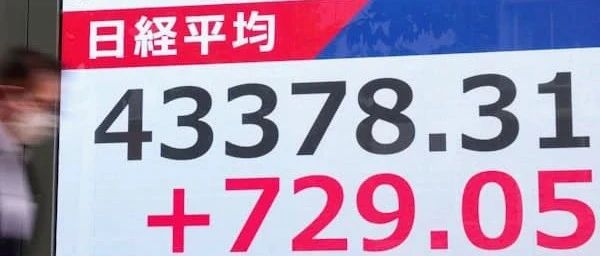
日经平均股指再次刷新历史最高纪录
日经中文网· 2025-08-15 07:07
Core Viewpoint - The Japanese stock market is experiencing significant inflows of overseas capital, driven by positive economic indicators and corporate performance, leading to record highs in the Nikkei index [2][5][7]. Economic Performance - The GDP growth for Japan in the April to June quarter of 2025 was reported at 0.3% quarter-on-quarter, translating to an annualized growth rate of 1.0%, marking five consecutive quarters of positive growth [2]. - The economic surprise index for Japan stands at 26.7, significantly higher than the global average of 12.0, indicating a robust recovery trend [5][6]. Market Trends - The Nikkei index closed at 43,378 points on August 15, 2023, up 729 points (1.71%) from the previous trading day, reflecting renewed investor confidence [2]. - The banking sector saw a notable increase, with Mitsubishi UFJ Financial Group reaching new highs, and the banking industry index rising by 3.14% [5]. Investor Sentiment - There is a growing interest from overseas investors, particularly from Europe, in the Japanese stock market, driven by structural economic factors and the potential for stable returns [6]. - Short-term speculative funds are also increasing their positions in the Japanese market, with expectations that the Nikkei index could reach around 44,000 points in the near term [7]. Corporate Earnings Outlook - Despite a projected 8.6% decrease in regular profits for major companies in the fiscal year 2025, a rebound of 13.0% is expected in fiscal year 2026, indicating a shift in investor focus towards future earnings [5].


海外周报:非农后,如何看待当前美国经济状况?-20250803
Soochow Securities· 2025-08-03 13:20
Economic Overview - The U.S. economy is currently in a soft landing phase despite short-term recession concerns, as indicated by recent economic data[1] - The U.S. GDP growth rate for Q2 2025 is reported at +3.0%, surpassing Bloomberg's consensus estimate of +2.6%[1] - The core GDP, which excludes net exports and inventory changes, shows a growth of only +1.2%, indicating reliance on external factors rather than domestic growth[1] Labor Market Insights - In July 2025, the U.S. added 73,000 non-farm jobs, significantly below the expected 104,000, with prior months' data revised down by 258,000, marking the largest downward revision since June 2020[1] - The unemployment rate rose to 4.248%, higher than the expected 4.2% and the previous 4.117%, the highest level since November 2021[1] Market Reactions - The disappointing non-farm payroll data has reignited recession fears, leading to declines in U.S. stock markets and a drop in bond yields[1] - The 10-year U.S. Treasury yield fell by 17.2 basis points to 4.216%, while the 2-year yield decreased by 24.2 basis points to 3.682%[1] Monetary Policy Outlook - The July FOMC meeting resulted in a 9-2 vote to maintain the policy rate at 4.25-4.5%, with some members advocating for a rate cut[1] - The Federal Reserve's stance indicates a balancing act between managing inflation and supporting the labor market amid rising unemployment[1] Trade and Tariff Developments - The U.S. has introduced "Tariff 2.0," which lowers tariffs compared to the previous version, but uncertainty remains regarding potential increases in tariffs to expedite trade agreements[1] - The new tariff rates will take effect on August 7, 2025, impacting 69 trade partners, with significant rates set for the EU (15%) and Japan (15%)[1]