网络化协同

Search documents
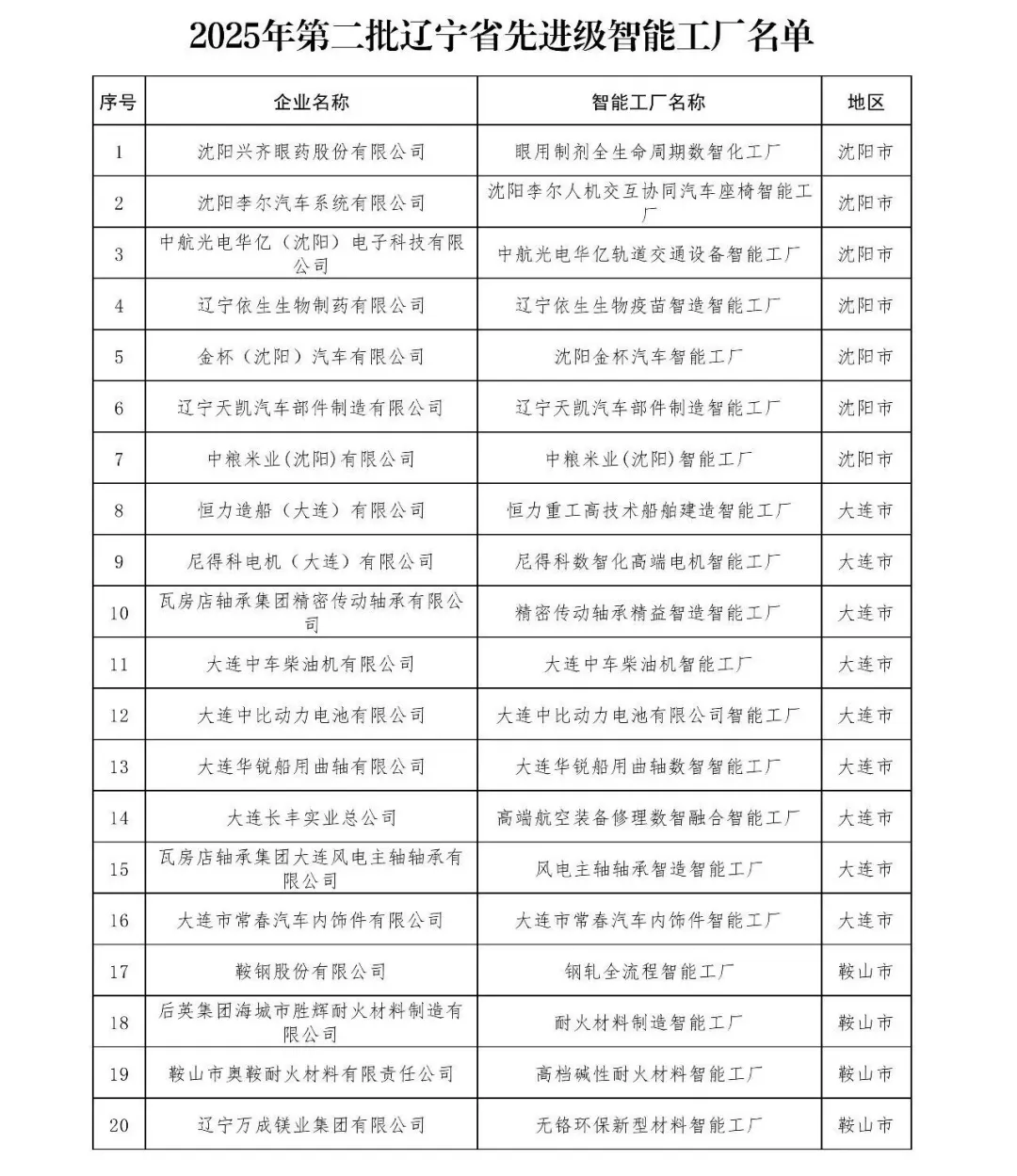
2025年第二批辽宁省先进级智能工厂名单公布,35家企业入选
Xin Lang Cai Jing· 2026-01-10 15:26
Core Insights - The Liaoning Provincial Department of Industry and Information Technology has announced the second batch of advanced intelligent factories for 2025, with 35 companies selected, covering various sectors including biomedicine, automotive parts manufacturing, equipment manufacturing, electronic information, and new metallurgical materials [1] - The total number of advanced intelligent factories in the province has reached 273 [1] - Advanced intelligent factories focus on digital transformation and networked collaboration, aiming to establish industry-leading benchmarks [1] Group 1: Intelligent Factory Development - The intelligent factories are categorized into four levels: basic, advanced, excellent, and leading [1] - The Dalian Zhongbi Power Battery Co., Ltd. is highlighted for its intelligent battery production base, achieving significant results in automation and smart management [1] - The production line at Dalian Zhongbi has a 100% automation rate for key processes such as winding, baking, and liquid injection, with a smart control center enabling full process visualization and traceability [1] Group 2: Future Plans - The province plans to implement a gradient construction action for intelligent factories, promoting the upgrade of production processes and the establishment of advanced-level factories [2] - The goal is to add over 80 advanced and above intelligent factories by 2026 [2]



首批15家领航级智能工厂出炉!长三角成智造标杆集聚高地
Guo Ji Jin Rong Bao· 2025-12-03 13:04
Core Insights - The Ministry of Industry and Information Technology, along with five other ministries, has announced the first batch of 15 leading smart factories for 2025, showcasing advancements in key industries such as equipment manufacturing, raw materials, electronic information, and consumer goods [1] - The Yangtze River Delta region, particularly Shanghai, Jiangsu, and Zhejiang, has excelled in this initiative, with Shanghai leading the nation in the number of selected factories [1][3] - The establishment of a tiered cultivation system for smart factories began in 2024, categorizing them into four levels: basic, advanced, excellent, and leading, with the leading level representing the pinnacle of smart manufacturing in China [1][4] Industry Developments - Leading smart factories are demonstrating significant innovation value, with Shanghai Aerospace Equipment Manufacturing Factory achieving a reduction in launch costs through an intelligent full-process chain model [2] - In the raw materials sector, Nanjing Steel has achieved a 98.5% on-time delivery rate for customized steel production using digital twin and AI technologies, while Baosteel has gained a competitive edge through data-driven manufacturing [2] - Hikvision in the electronic information sector has reduced production line changeover time by 50% through self-developed IoT, AI, and big data technologies, providing replicable solutions for the electronics manufacturing industry [2] Regional Performance - Shanghai has cultivated 2 national leading smart factories, 28 national excellent smart factories, and over 300 advanced smart factories, maintaining its position as the top city in China for smart manufacturing [3] - The city plans to focus on a three-pronged development strategy that includes tiered cultivation of smart factories, providing smart manufacturing system solutions, and building a standard framework for smart manufacturing [3] - Leading smart factories serve as demonstration models, promoting innovation and transformation across the supply chain, with modular solutions available for small and medium-sized enterprises to facilitate their own smart upgrades [3] Construction Achievements - As of now, China has established over 35,000 basic smart factories, more than 7,000 advanced smart factories, 230 excellent smart factories, and 15 leading smart factories [4] - Smart factory upgrades have led to an average reduction of 29% in product development cycles, a nearly 22% increase in production efficiency, and a 20% decrease in carbon emissions [4] - Leading smart factories are positioned as integrated platforms for technological innovation, standard output, and industry collaboration, aligning with the core demands of high-quality manufacturing development during the 14th Five-Year Plan [4]

京东物流Q3营收551亿;安克创新拟二次IPO;嘉友国际签MMC大单
Sou Hu Cai Jing· 2025-11-14 08:33
Group 1 - JD Logistics reported Q3 revenue of 55.1 billion yuan, a year-on-year increase of 24.1%, with integrated supply chain revenue surging by 45.8%, indicating a successful transformation from a logistics service provider to a supply chain solution provider [1] - Anker Innovations plans a secondary IPO in Hong Kong, with revenue of 21 billion yuan in the first three quarters, reflecting the accelerated global capital layout of leading cross-border e-commerce companies [1] - Ezhou Huahu Airport has surpassed 10,000 international cargo flights, with 50 routes covering four continents, and its international cargo throughput has doubled year-on-year, showcasing its hub effect of "overnight delivery nationwide, next-day connection to the world" [1] Group 2 - The industry is undergoing three major transformations: cross-border e-commerce is shifting from traffic competition to deep supply chain cultivation, logistics companies are upgrading from transportation services to strategic partners, and regional hubs are moving from single-point breakthroughs to networked collaboration [2] - The simultaneous growth of JD Logistics' supply chain revenue and Ezhou Airport's intercontinental routes indicates that China's logistics globalization capability has entered a new era [2]

今年第二批先进级智能工厂遴选启动
Liao Ning Ri Bao· 2025-10-29 01:27
Core Viewpoint - The province is organizing the selection of the second batch of advanced intelligent factories for 2025, aiming to create an upgraded version of intelligent manufacturing through a tiered cultivation approach with four levels: basic, advanced, excellent, and leading [1] Group 1: Selection Criteria and Levels - Advanced intelligent factories must be registered in the province, have independent legal status or be independent accounting units, and demonstrate good asset, credit, and operational conditions [1] - The main products or technologies of the enterprises must align with national industrial policies and industry policy orientations [1] - Factories must have completed construction and be operational, demonstrating leadership in intelligent manufacturing within their industry in the province, and have been verified as basic intelligent factories by municipal industrial and information authorities [1] Group 2: Focus Areas for Each Level - Basic intelligent factories focus on digital transformation and network connectivity to promote digitalization [1] - Advanced intelligent factories emphasize digital transformation and network collaboration to establish regional industry benchmarks [1] - Excellent intelligent factories concentrate on digital transformation, network collaboration, and intelligent upgrades to create nationally leading benchmarks [1] - Leading intelligent factories focus on digital transformation, network collaboration, and intelligent innovation to explore future manufacturing models and establish globally leading benchmarks [1] Group 3: Progress and Achievements - Since the initiation of the selection process for digital workshops and intelligent factories in 2022, the province has selected 469 digital workshops and 238 intelligent factories [1]
轻工企业数字化研发工具普及率超八成
Ren Min Ri Bao· 2025-09-26 21:45
Core Insights - The digital R&D tool penetration rate among light industry enterprises has increased to 86.2% as of the first half of this year, while the digital management penetration rate reached 82.3%, indicating a solid foundation for intelligent manufacturing in the sector [1] - By 2024, the proportion of networked collaborative enterprises in the light industry is expected to be 47.2%, and the share of personalized customization enterprises is projected to be 18.3%, both exceeding the national average by 2.0 and 2.8 percentage points respectively [1] - Significant advancements in AI technologies such as visual inspection and intelligent sorting are being widely adopted in industries like home appliances, food, and sewing machinery, leading to notable improvements in quality and efficiency [1] - A total of 1,260 5G factories have been established in China, with the light industry accounting for 13%, or 167 factories, showcasing the sector's leading position in intelligent manufacturing [1]
趋势研判!2025年中国路口自动信号装置行业发展历程、产业链、市场规模、重点企业及未来前景展望:市场规模达149亿元,智能化升级推动行业持续增长[图]
Chan Ye Xin Xi Wang· 2025-09-02 01:23
Core Insights - The traditional traffic management methods are facing significant challenges due to the rapid growth of urbanization and vehicle ownership, leading to the widespread adoption of intelligent and automated intersection signal control devices [1][9] - The market size of China's intersection automatic signal device industry is projected to grow from 11 billion yuan in 2019 to 14.9 billion yuan in 2024, with a compound annual growth rate (CAGR) of 6.26% [1][9] - Future developments in the industry will focus on smarter and more networked solutions, driven by technological innovations and the deepening of new urbanization [1][9] Industry Overview - Intersection automatic signal devices are designed to control traffic lights based on real-time traffic flow and road conditions, enhancing traffic efficiency and safety [3] - The devices can be categorized into timed signal machines, semi-sensing signal machines, and fully sensing signal machines [3] Industry Development History - The industry has evolved from manual traffic control by police to mechanical signal lights, and then to electronic signal lights, which are now being replaced by intelligent systems that optimize signal management [3][4] Industry Chain - The upstream of the industry includes raw materials and core components such as sensors and controllers, while the downstream applications are primarily in traffic management and smart city systems [5][6] Sensor Market Growth - The sensor market, crucial for real-time traffic monitoring, is expected to grow from 169.08 billion yuan in 2017 to 406.12 billion yuan in 2024, with a CAGR of 13.34% [7][8] Smart Traffic System - The smart traffic system, a key application area for intersection automatic signal devices, is projected to grow from 151.3 billion yuan in 2019 to 262.82 billion yuan in 2024, with a CAGR of 11.68% [8][9] Competitive Landscape - The industry exhibits a layered competitive structure, with leading companies dominating the high-end market while many small and medium enterprises focus on regional services and price competition [10] - Key players include Hikvision, Sainojie Technology, and several others, each leveraging technology and innovation to gain market share [10][11] Future Trends - The industry is moving towards intelligent upgrades, networked collaboration, and integrated design, enhancing the capabilities of intersection automatic signal devices [12][13][14]