
供应链深耕

Search documents
美团收购叮咚买菜,释放出什么信号?
Bei Ke Cai Jing· 2026-02-06 04:01
Core Viewpoint - Meituan announced the acquisition of Dingdong Maicai's 100% stake in its China business for approximately $717 million, aiming to enhance supply chain efficiency and improve consumer experience through combined strengths in product, technology, and operations [1][2]. Company Summary - Dingdong Maicai confirmed the acquisition, stating its overall value is nearly $1 billion, and assured that its business and team remain stable [1]. - Dingdong Maicai reported a record GMV of 7.27 billion yuan and revenue of 6.66 billion yuan for Q3 2025, with a net profit of 133 million yuan, marking twelve consecutive quarters of profitability under Non-GAAP standards and seven quarters under GAAP standards [2][3]. - Dingdong Maicai's founder, Liang Changlin, emphasized the company's strong supply chain capabilities, with over 85% of fresh produce sourced directly and significant growth in various product categories [3][4]. Industry Summary - The acquisition is seen as a strategic move to enhance Meituan's supply chain capabilities in the competitive instant retail market, which is projected to exceed 1 trillion yuan by 2026 [6][9]. - Dingdong Maicai holds over 30% market share in the East China market, particularly in Shanghai, and has established a robust supply chain system, which will benefit Meituan's operations [5][7]. - The industry is transitioning from price-driven competition to a focus on user experience, necessitating strong supply chain support for sustainable growth [6][9].


eBay林文奎:跨境电商是一场“走得远”的价值远征
Jing Ji Wang· 2026-01-13 10:08
Core Insights - The article discusses the evolution of cross-border e-commerce in China, highlighting its transformation from a nascent industry to a significant growth driver for foreign trade, with eBay playing a pivotal role in this journey [1][2][3]. Historical Development - Cross-border e-commerce in China began in 1999, with early transactions relying on email communication and postal services, leading to long order fulfillment cycles [1]. - eBay's investment in the local C2C platform, eBay's strategic shift towards cross-border trade in 2006, and the digitalization of global trade around 2010 marked significant milestones in the industry's development [2][3]. Supply Chain Activation - The demand for faster delivery from overseas users led eBay to promote the use of overseas warehouses starting in 2014, significantly reducing logistics time from months to 3-5 days [4][5]. - This shift allowed for a broader range of products, including larger items like home goods and auto parts, to be sold internationally [5][6]. Industry Transformation - The activation of local industrial clusters, such as auto parts in Changzhou and furniture in Foshan, has shifted the focus of competition towards supply chain management and inventory turnover [6]. - eBay's data-driven approach has enabled factories to adapt to market demands, transitioning from a production-based model to a market-responsive one [6]. Talent Development - eBay launched the "eYouth" program in 2018 to address the talent gap in the rapidly growing industry, training over 20,000 professionals in cross-border e-commerce [6]. Market Focus and Strategy - The auto parts category has emerged as a key growth engine for Chinese sellers, transitioning from rough operations to refined brand-led strategies [7][9]. - eBay aims to support high-quality enterprises through the "元石·motors" club, providing resources for market analysis, compliance, and incentives [9][10]. Compliance and Challenges - Increasing regulatory barriers in the European market necessitate a focus on compliance as a core competitive advantage for sellers [10]. - eBay has introduced support programs to help sellers navigate these challenges, including compliance tools and operational incentives [10]. Future Outlook - eBay plans to focus on the dual-core markets of Europe and the U.S., emphasizing high-potential categories and leveraging technology to enhance operational efficiency [12][14]. - The integration of AI technology is expected to transform operations and improve buyer-seller interactions, positioning eBay for future growth [12][14].



创始人离场,君乐宝接盘:现制酸奶龙头能否触底反弹?
Guan Cha Zhe Wang· 2025-12-13 04:01
Core Viewpoint - The recent management changes at the fresh yogurt brand "Mo Yogurt" indicate a significant shift from a founder-led model to one dominated by industrial capital, as the company seeks to address challenges and reshape its strategy in the competitive yogurt market [1][3][9]. Company Changes - Founder Zhao Bohua has completely exited from all positions and shareholder status, with co-founder Gu Hao taking over as the legal representative and holding 57.14% of the shares [1]. - Junlebao Group has increased its stake in Mo Yogurt from 30% to 42.86%, becoming one of the two major shareholders alongside Gu Hao [1][8]. Market Position and Challenges - Mo Yogurt, founded in 2014, grew rapidly to over 1,600 stores at its peak, leveraging a health-focused brand image with products like avocado yogurt smoothies [3][6]. - The brand faced significant backlash in 2023 due to high pricing and allegations of using inferior ingredients, leading to a damaged reputation [3][4]. - A food safety crisis in 2024, involving expired ingredients and improper storage practices, further harmed the brand's image and resulted in store closures [4][6]. Strategic Shift - The management transition aims to pivot from aggressive expansion to a focus on supply chain development and product quality, with Junlebao's involvement expected to enhance brand credibility and operational efficiency [7][9]. - Junlebao's investment is seen as a strategic move to secure a stable distribution channel for high-end dairy products, especially in first-tier cities [8]. Future Outlook - The integration of Junlebao's traditional supply chain practices with Mo Yogurt's fast-paced marketing and franchise model presents a management challenge that will need to be navigated carefully [10]. - The success of this strategic shift will be critical in determining whether Mo Yogurt can recover and achieve sustainable growth in a post-consumer investment bubble environment [10].

京东物流Q3营收551亿;安克创新拟二次IPO;嘉友国际签MMC大单
Sou Hu Cai Jing· 2025-11-14 08:33
Group 1 - JD Logistics reported Q3 revenue of 55.1 billion yuan, a year-on-year increase of 24.1%, with integrated supply chain revenue surging by 45.8%, indicating a successful transformation from a logistics service provider to a supply chain solution provider [1] - Anker Innovations plans a secondary IPO in Hong Kong, with revenue of 21 billion yuan in the first three quarters, reflecting the accelerated global capital layout of leading cross-border e-commerce companies [1] - Ezhou Huahu Airport has surpassed 10,000 international cargo flights, with 50 routes covering four continents, and its international cargo throughput has doubled year-on-year, showcasing its hub effect of "overnight delivery nationwide, next-day connection to the world" [1] Group 2 - The industry is undergoing three major transformations: cross-border e-commerce is shifting from traffic competition to deep supply chain cultivation, logistics companies are upgrading from transportation services to strategic partners, and regional hubs are moving from single-point breakthroughs to networked collaboration [2] - The simultaneous growth of JD Logistics' supply chain revenue and Ezhou Airport's intercontinental routes indicates that China's logistics globalization capability has entered a new era [2]

直播间巨变,东方甄选率先「换赛道」
3 6 Ke· 2025-10-29 10:32
Core Insights - The article highlights a strategic transformation at Dongfang Zhenxuan, shifting from a reliance on traffic to a focus on product quality, marking a significant change in the live e-commerce landscape [1][9][20] Financial Performance - Dongfang Zhenxuan's latest financial report indicates a strong performance, with projections suggesting a profit exceeding 100 million yuan for Q1 of the 2026 fiscal year [1] - The annual GMV for self-operated products reached 3.81 billion yuan, contributing to a 30% year-on-year increase in net profit, excluding asset disposal impacts [1][3] Product Strategy - The company has increased its self-operated product SKUs by nearly 50% year-on-year, with self-operated products accounting for 80% of total revenue [3][9] - Dongfang Zhenxuan's focus on product quality has been evident since its inception, with early self-operated products launched even before gaining significant traffic [6][9] Market Positioning - The company is positioning itself similarly to Sam's Club, emphasizing a "product membership system" and aiming to build long-term competitiveness through its own app and live streaming team [8][10] - The shift towards a product-driven model is seen as a necessary evolution in the industry, as competitors also attempt to move away from pure traffic-driven strategies [16][20] Supply Chain and Membership - Dongfang Zhenxuan is investing in its supply chain, with plans to establish 40 warehouses across 10 key cities to enhance product quality and reduce costs [14][15] - The company has launched a paid membership service with 264,300 subscribers, although it still lags behind Sam's Club in terms of membership scale and revenue contribution [15][9] Long-term Vision - The company emphasizes a long-term approach to growth, focusing on product quality and brand trust rather than short-term traffic gains [21][20] - The transition from a traffic-dependent model to a product-centric strategy is seen as a critical step for sustainable development in the live e-commerce sector [20][19]


董宇辉出走1年后,东方甄选股价暴涨超200%,俞敏洪做对了什么?
Zhong Guo Jing Ji Wang· 2025-08-12 07:35
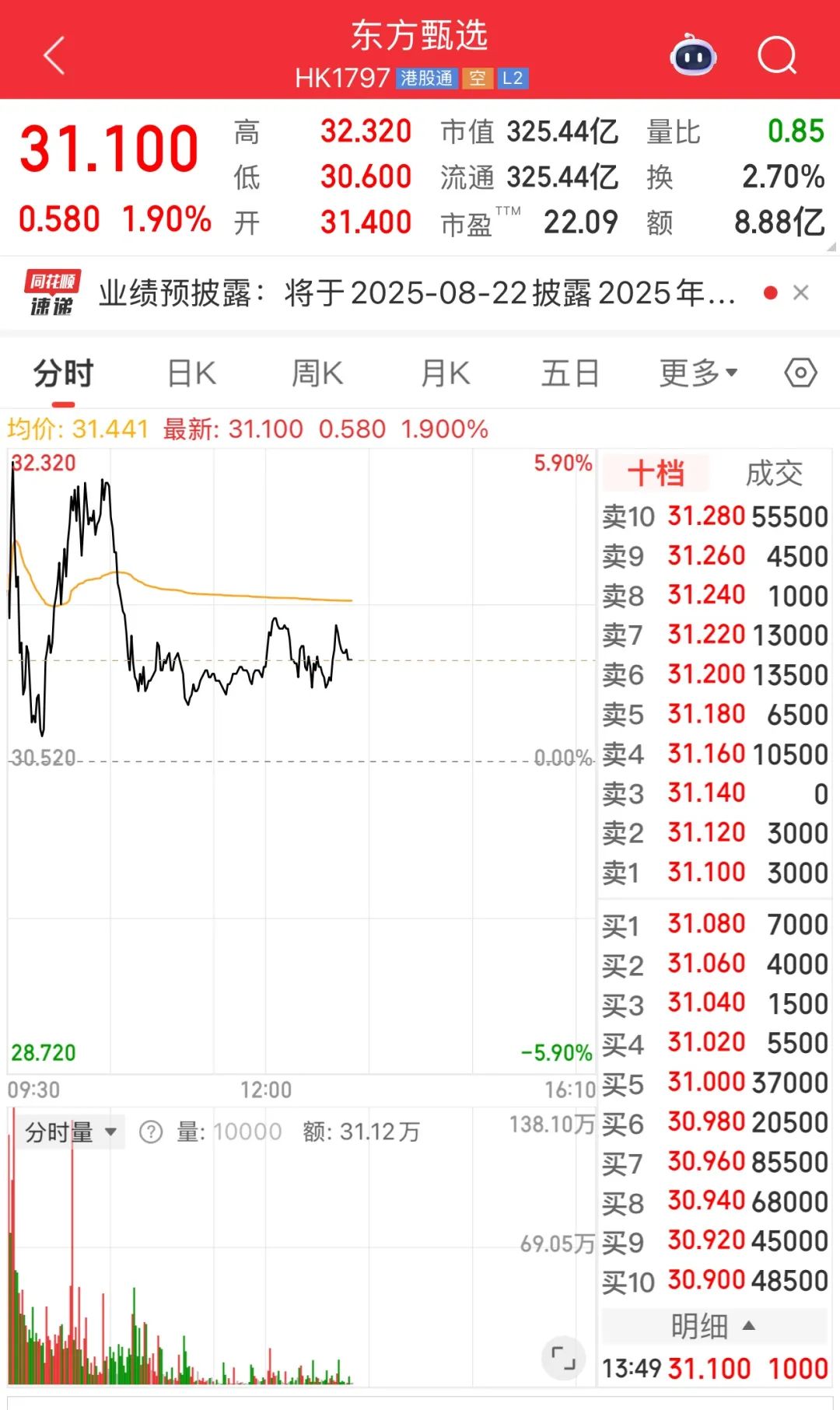
Core Viewpoint - The stock price of Dongfang Zhenxuan has increased significantly, with a rise of over 200% since its lowest point in the year, reflecting a recovery after a substantial drop following the separation from Dong Yuhui [4][10]. Financial Performance - As of November 30, 2024, Dongfang Zhenxuan reported a revenue of 2.186 billion RMB, a year-on-year decrease of 21.8%, and transitioned from a profit of 160 million RMB to a net loss of 96.5 million RMB [9][10]. - The company’s earnings before tax showed a profit of 188.554 million RMB, while the net profit was reported at 141.414 million RMB after a 50% distribution to Dong Yuhui [6][10]. Stock Performance - On August 12, 2025, the stock price was reported at 31.100 HKD, with a market capitalization of 32.544 billion HKD. The stock has seen an increase of approximately 207.31% from its lowest price of 10.12 HKD this year and about 248.65% from the low of 8.92 HKD following the separation from Dong Yuhui [1][10]. Business Strategy - Dongfang Zhenxuan has launched over 400 self-operated products since April 2022, achieving cumulative sales of over 210 million units and a customer base of 30.86 million [11][13]. - In 2024, self-operated products became the core revenue source for the company, accounting for 46% of total sales, indicating a shift towards a more stable profit model [13]. - The company aims to transform into a product technology company centered around self-operated products and a one-stop shopping platform primarily based on a membership system [13]. Product Development - In June 2024, Dongfang Zhenxuan entered the sanitary napkin market, selling 180,000 units within two days of launch, followed by the introduction of a second product [15]. - The company is diversifying its product offerings from agricultural products to household goods and snacks, reducing reliance on top influencers for growth [15].
国联水产战略收缩 从产能竞赛转向供应链深耕
Zheng Quan Ri Bao Wang· 2025-04-18 13:48
Core Viewpoint - Guolian Aquatic Products has decided to terminate certain fundraising projects and permanently supplement working capital, reflecting a strategic shift in the aquaculture processing industry towards efficiency and supply chain management rather than mere capacity expansion [1][2][3] Company Actions - On April 17, 2025, Guolian Aquatic Products announced the termination of the "Guolian (Yiyang) Food Co., Ltd. Aquatic Product Deep Processing Expansion Project" and plans to use the corresponding raised funds to enhance working capital [1] - The company aims to improve fund utilization efficiency and optimize resource allocation by reallocating the remaining raised funds [1][2] Industry Context - The aquaculture processing industry is experiencing a significant shift from scale expansion to efficiency competition, particularly in the context of the prepared food sector entering a "survival of the fittest" phase [2][3] - Recent declines in aquatic product prices, with core raw material prices dropping over 30% year-on-year, have increased inventory impairment pressures on companies, leading to a focus on flexible supply chain management [2] Strategic Focus - Guolian Aquatic Products is prioritizing a "big single product + channel sinking" strategy, establishing a "Channel Sinking Expansion Department" to enhance market penetration [2] - The company is shifting its focus to the domestic market, launching an "export to domestic sales" initiative to offer high-quality aquatic products at competitive prices [2] Future Outlook - According to predictions, aquatic product prices may hit a cyclical bottom in 2024, positioning Guolian Aquatic Products to leverage its supply chain advantages to capture market share as the industry recovers [2]
