老字号企业转型

Search documents
百年五芳斋再闯港股,出海寻解药
虎嗅APP· 2025-10-06 08:57
Core Viewpoint - The company Wufangzhai is preparing for a Hong Kong IPO to accelerate its international strategy and enhance its brand image, despite facing significant growth challenges in its domestic market [3][4]. Financial Performance - Wufangzhai's revenue is projected to decline by 14.57% to 22.51 billion yuan in 2024, with net profit expected to drop by 14.24% to 1.42 billion yuan [4]. - Since its A-share listing in 2022, the company's market value has decreased by nearly 30%, with its market capitalization falling below 3.5 billion yuan on the announcement day of the Hong Kong listing [4]. Product Dependency and Challenges - The company's core product, zongzi (sticky rice dumplings), is facing severe competition, with revenue from this segment expected to decline by 18.64% to 15.79 billion yuan in 2024 [6]. - The company's diversification strategy, "Zong +", has not yielded significant results, as non-zongzi products have also seen revenue declines, except for mooncakes which grew by 3.46% [7][8]. Market Trends - The mooncake market in China is projected to reach 32.5 billion yuan by 2025, with a growth rate of approximately 8% [10]. - Traditional brands, including Wufangzhai, are experiencing a surge in popularity, with sales of old brand mooncakes increasing by up to 14 times [10]. International Expansion - Wufangzhai is actively pursuing international markets, having established subsidiaries in countries like Singapore, Japan, and the UK, with a focus on "exporting zongzi" as a key strategy [11]. - However, overseas revenue remains low, accounting for only 0.7% of total revenue in 2024, despite a year-on-year growth of 8.23% [12]. Regulatory and Compliance Issues - The company faces compliance challenges in international markets, as evidenced by a recent incident where a batch of mooncakes was rejected by South Korean authorities due to regulatory violations [13]. Strategic Considerations - The decision to pursue a Hong Kong listing is seen as a move to enhance market valuation and provide funding for international expansion, especially given the underperformance in the A-share market [15][16].

百年五芳斋再闯港股,出海寻解药
Hu Xiu· 2025-10-06 07:18
Core Viewpoint - The century-old brand Wufangzhai is preparing for a Hong Kong stock listing to accelerate its international strategy and enhance its brand image, despite facing significant growth challenges in its domestic market [1][2]. Group 1: Company Strategy - Wufangzhai has initiated preparations for its H-share listing, aiming to create a dual capital platform with its existing A-share listing [2]. - The company has authorized its management to start the listing process and has appointed new board members with expertise in law, finance, and accounting to support upcoming capital operations [2]. - The decision to list in Hong Kong is seen as a strategic move to address the company's growth difficulties experienced since its A-share debut in 2022, where its market value has decreased by nearly 30% [2]. Group 2: Financial Performance - Wufangzhai's revenue for 2024 is projected to decline by 14.57% to 22.51 billion yuan, with net profit expected to drop by 14.24% to 1.42 billion yuan [2]. - The company's core product, zongzi, is facing severe competition, leading to an 18.64% decline in revenue from this segment, which is projected to be 15.79 billion yuan in 2024 [3]. - The company has struggled to diversify its product offerings, with non-zongzi products showing mixed performance; only the mooncake segment has seen growth, while other categories have declined [3]. Group 3: Market Challenges - The mooncake market is becoming increasingly competitive, with the market size expected to reach 32.5 billion yuan by 2025, growing at approximately 8% [4]. - Wufangzhai is not the only traditional brand competing in the mooncake market, as other century-old brands have also seen significant sales growth [5]. - The company is facing challenges in expanding its overseas market presence, with international revenue accounting for only 0.7% of total income in 2024, despite a year-on-year growth of 8.23% [7]. Group 4: International Expansion - Wufangzhai is pursuing international markets as a new growth strategy, having established subsidiaries in several countries, including Singapore, Japan, and Australia [6]. - However, the acceptance of traditional Chinese foods in foreign markets remains uncertain, and the company has faced regulatory challenges, such as product recalls due to compliance issues [7]. - The company aims to leverage its Hong Kong listing to enhance its international strategy and improve its brand image, potentially providing strong financial support for overseas expansion [6][9].

3亿元跨界投资光通信芯片,火腿巨头涨停,老字号们陷“守”与“变”困局
Mei Ri Jing Ji Xin Wen· 2025-09-23 14:04
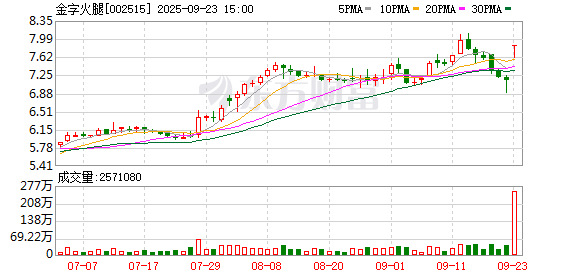
Core Viewpoint - Jinzi Ham plans to acquire up to 20% of Zhongsheng Microelectronics for no more than 300 million yuan, indicating a strategic shift towards cross-industry investment despite previous failures in similar attempts [2][4]. Group 1: Company Strategy and Performance - Jinzi Ham's revenue growth has stagnated since 2011, with a reported revenue of 170 million yuan in the first half of 2025, down 14.73% year-on-year, and a net profit of 22.92 million yuan, down 25.11% year-on-year [5]. - The company has previously attempted cross-industry ventures in sectors like rare earths and healthcare, but most have ended in failure, leading to a return to its core business [5]. - The recent acquisition attempt is seen as a response to the company's long-standing operational difficulties and a need for new growth avenues [5][4]. Group 2: Industry Challenges and Trends - Many time-honored brands, including Zhang Xiaoquan and Quanjude, are facing similar growth challenges and transformation issues, indicating a broader trend among traditional enterprises [6]. - The success of these brands historically relied on traditional craftsmanship, which is now challenged by modern consumer expectations and market dynamics [6][3]. - Experts suggest that these brands must balance preserving their unique cultural heritage while adapting to contemporary relevance to attract younger consumers [8][3]. Group 3: Recommendations for Transformation - Experts recommend that traditional brands focus on deepening their cultural narratives and aligning products with modern lifestyles to maintain relevance [8]. - It is advised that non-core businesses should operate under independent brands and teams to protect the integrity of the main brand [8]. - Successful examples include Zhang Xiaoquan, which has expanded its product lines and achieved a revenue increase of 9.80% in the first half of 2025, contrasting with the struggles of other brands like Quanjude [7][8].