火腿加工

Search documents
讲好“一带一路”故事 共绘美好生活画卷
Ren Min Ri Bao· 2026-02-05 00:46
Group 1: Economic Development and Opportunities - The transformation of Niulian Village in Kunming, Yunnan, showcases the integration of agriculture, culture, and tourism, leading to local employment and entrepreneurship opportunities [1][2] - The Dou Nan Flower Trading Center in Yunnan is the largest in Asia, with a trading volume exceeding 15.4 billion stems and a transaction value of over 13.4 billion yuan in 2025, maintaining its position as the national leader for over 20 years [2] - Yunnan has applied for 1,280 new flower varieties, with over 800 receiving national authorization, both ranking first in the country, indicating a strong focus on high-quality flower industry development [2] Group 2: Cultural Heritage and Tourism - The ecological corridor around Erhai Lake has improved local tourism, with increased visitor engagement and a focus on environmental protection, leading to a better quality of life for residents [4][5] - The Dali region has implemented comprehensive lake management strategies, resulting in a 100% water quality rate for 27 major inflow rivers and significant ecological restoration efforts [6] - The cultural richness of Dehong Prefecture is highlighted through its diverse ethnic heritage, with over 1,000 historical and cultural artifacts displayed in the local museum, promoting cultural tourism [7][8] Group 3: Rural Revitalization and Economic Growth - Yulhu Village in Lijiang has seen a significant increase in collective economic income, projected to reach 3.8 million yuan by 2025, with per capita income rising from 13,000 yuan in 2019 to 35,000 yuan by 2025 [10][11] - The village has embraced tourism through the establishment of a cooperative, offering horseback riding and homestay experiences, which has led to a projected 120 million visitors and 75 million yuan in tourism revenue by 2025 [10] - The integration of traditional culture and modern tourism in Yulhu Village reflects a successful model of rural revitalization, balancing development and preservation [11]
讲好“一带一路”故事 共绘美好生活画卷 ——2025“一带一路”媒体合作论坛联合采访成果扫描
Ren Min Ri Bao· 2026-02-04 22:01
Group 1: Economic Development and Opportunities - The transformation of Niulian Village into a model for rural revitalization through agricultural, cultural, and tourism integration is highlighted, showcasing local entrepreneurship and community engagement [1] - Yunnan's flower industry is a significant contributor to the economy, with the Dou Nan flower trading center projected to exceed 15.4 billion stems and 13.4 billion yuan in transaction value by 2025, maintaining its position as the largest in the country for over 20 years [2] - The development of the Yunnan ham industry, particularly in Xuanwei, is notable, with a projected production of 71,000 tons and a value of 12 billion yuan by 2025, driven by brand building and consumer preference [2] Group 2: Environmental Protection and Tourism - The ecological restoration efforts around Erhai Lake have led to improved water quality and biodiversity, with 100% of major inflow rivers meeting quality standards and significant land restoration initiatives [4] - The establishment of the Erhai Index reflects the ongoing commitment to environmental governance, achieving a score of 92.8 in the first half of 2025, indicating effective management of water resources [5] - The development of tourism in Dali, particularly around Erhai Lake, has been enhanced by the construction of ecological corridors, attracting visitors and boosting local businesses [3][4] Group 3: Cultural Heritage and Community Engagement - The rich cultural heritage of the Dehong region is showcased through its diverse ethnic exhibits, emphasizing the importance of cultural preservation and community identity [6] - The promotion of traditional practices, such as the production of sour tea by the De'ang ethnic group, is linked to economic development and cultural exchange, with plans for expanding tea cultivation supported by local financial institutions [7] - The preservation of the Tunpu culture in Guizhou, with its unique architectural style and historical significance, is being leveraged for cultural tourism, enhancing community engagement and economic opportunities [10][12]
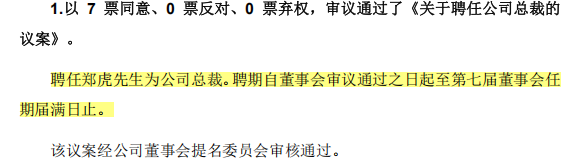
卖超跑7年后,“企二代”到父亲公司当总裁卖火腿!市值超78亿
Mei Ri Jing Ji Xin Wen· 2025-12-15 22:23
Core Viewpoint - Jinzi Ham, known as the "first ham stock," has announced the resignation of its president Guo Bo for personal reasons, appointing Zheng Hu as the new president, marking the second leadership change within the year [1][2]. Group 1: Leadership Changes - This is the second time Jinzi Ham has changed its president in 2023, with Guo Bo serving only five months in the role after replacing Zhou Guohua in July [2]. - Zheng Hu, born in 1991, has been appointed as the new president and has a background in automotive sales, specifically with Aston Martin [2]. - Zheng Hu is the son of Zheng Qingsheng, the controlling shareholder of Jinzi Ham, who holds 145 million shares, representing 11.98% of the company's total shares [2][6]. Group 2: Company Background - Jinzi Ham was established in 1994 and went public on the Shenzhen Stock Exchange in 2010, recognized as a key enterprise in agricultural industrialization in Zhejiang [4]. - The company specializes in various ham products, including Jinhua ham and Parma fermented ham, as well as traditional meat products and innovative items like ham ice cream [4]. Group 3: Financial Performance - For the first three quarters of 2025, Jinzi Ham reported total revenue of 222.3 million yuan, a year-on-year decrease of 13.97%, and a net profit attributable to shareholders of 22 million yuan, down 26.25% [5]. - In the third quarter, the company achieved revenue of 52.6 million yuan, a decline of 11.45%, and a net profit of -905,820 yuan, a decrease of 19.44% [5]. - The company's total assets at the end of the reporting period were approximately 2.67 billion yuan, reflecting a 2.30% decrease from the previous year [5]. Group 4: Recent Developments - Zheng Qingsheng acquired control of Jinzi Ham in June 2023, transferring 145 million shares to himself and gaining significant voting rights [6]. - The company has diversified into the semiconductor industry, establishing two new companies focused on chip technology [6]. Group 5: Market Position - As of December 15, 2023, Jinzi Ham's stock closed at 6.49 yuan per share, with a market capitalization of 7.857 billion yuan [9].

3亿元跨界投资光通信芯片,火腿巨头涨停,老字号们陷“守”与“变”困局
Mei Ri Jing Ji Xin Wen· 2025-09-23 14:04
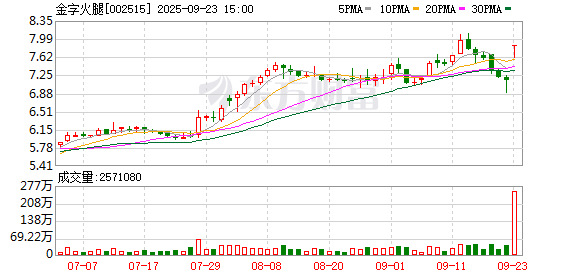
Core Viewpoint - Jinzi Ham plans to acquire up to 20% of Zhongsheng Microelectronics for no more than 300 million yuan, indicating a strategic shift towards cross-industry investment despite previous failures in similar attempts [2][4]. Group 1: Company Strategy and Performance - Jinzi Ham's revenue growth has stagnated since 2011, with a reported revenue of 170 million yuan in the first half of 2025, down 14.73% year-on-year, and a net profit of 22.92 million yuan, down 25.11% year-on-year [5]. - The company has previously attempted cross-industry ventures in sectors like rare earths and healthcare, but most have ended in failure, leading to a return to its core business [5]. - The recent acquisition attempt is seen as a response to the company's long-standing operational difficulties and a need for new growth avenues [5][4]. Group 2: Industry Challenges and Trends - Many time-honored brands, including Zhang Xiaoquan and Quanjude, are facing similar growth challenges and transformation issues, indicating a broader trend among traditional enterprises [6]. - The success of these brands historically relied on traditional craftsmanship, which is now challenged by modern consumer expectations and market dynamics [6][3]. - Experts suggest that these brands must balance preserving their unique cultural heritage while adapting to contemporary relevance to attract younger consumers [8][3]. Group 3: Recommendations for Transformation - Experts recommend that traditional brands focus on deepening their cultural narratives and aligning products with modern lifestyles to maintain relevance [8]. - It is advised that non-core businesses should operate under independent brands and teams to protect the integrity of the main brand [8]. - Successful examples include Zhang Xiaoquan, which has expanded its product lines and achieved a revenue increase of 9.80% in the first half of 2025, contrasting with the struggles of other brands like Quanjude [7][8].

投资光通信芯片企业,金字火腿再谋跨界
Bei Jing Shang Bao· 2025-09-23 12:39
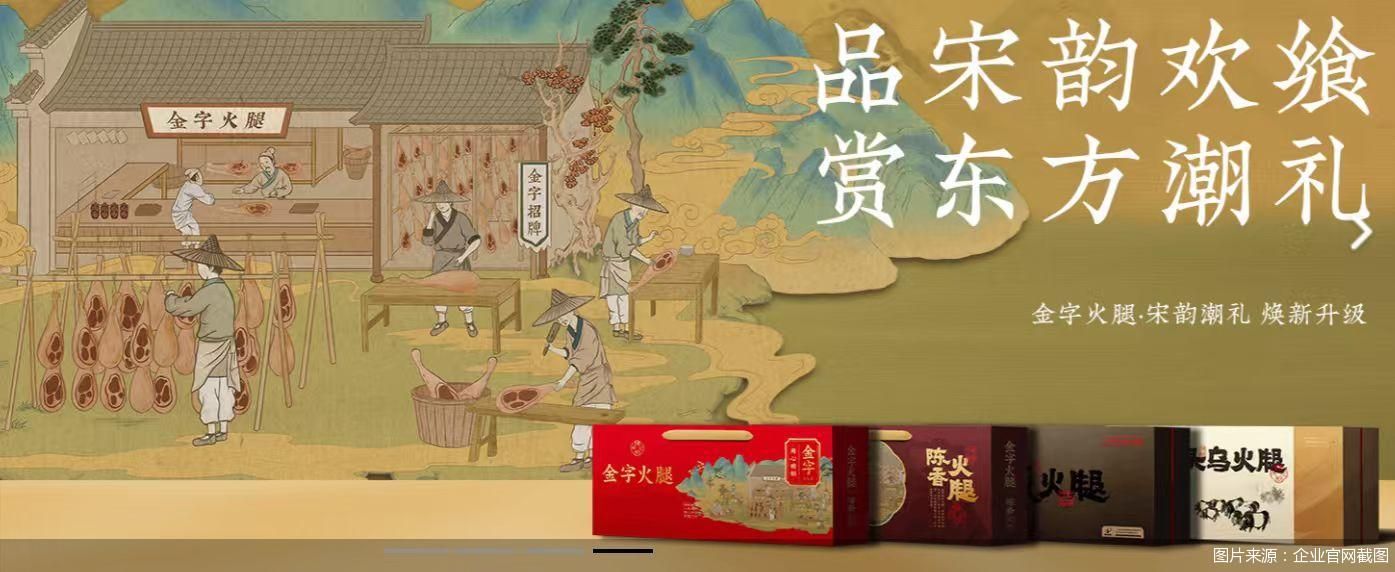
Group 1 - The core point of the article is that Jinzi Ham is diversifying its business by investing in the semiconductor industry, specifically in Zhongsheng Microelectronics, to adapt to market challenges in its main business of meat products [2][3] - Jinzi Ham's investment in Zhongsheng Microelectronics will not exceed 300 million yuan, aiming to acquire up to 20% equity in the company, marking a significant move under the new control of Zheng Qingsheng [2][3] - The investment is a strategic response to the slow growth in Jinzi Ham's main business, which has faced performance declines due to market factors, and aims to enhance long-term sustainable development [3][4] Group 2 - Zhongsheng Microelectronics, founded by key R&D personnel from a U.S. optical communication chip design company, focuses on high-speed optical module core chip development and has been recognized in the "China Future Unicorn TOP 100" list for 2024 and 2025 [3][4] - Currently, Zhongsheng Microelectronics has not yet achieved profitability, reporting revenue of 511,100 yuan and a net loss of 20.37 million yuan for the first seven months of 2025 [4] - The investment will occur in two rounds, with the first round of 100 million yuan based on a pre-investment valuation of Zhongsheng Microelectronics between 1 billion and 1.3 billion yuan, indicating a potential high valuation risk [4][5] Group 3 - Jinzi Ham has previously attempted multiple cross-industry ventures, including investments in rare earths, internet finance, and new energy vehicles, but these efforts have not significantly improved its financial performance [5][6] - Under the previous control of Ren Guilong, Jinzi Ham sought transformation by developing prepared dishes and investing in cloud computing, but these initiatives also faced challenges [6][7] - The recent investment in Zhongsheng Microelectronics is seen as a strategic move to tap into the high-growth potential of the semiconductor industry, which is expected to benefit from the global AI data center construction wave [7]
金字火腿“跨界”造芯背后,隐现福建富商郑庆昇的资本阳谋
Huan Qiu Lao Hu Cai Jing· 2025-09-23 11:52
Core Viewpoint - Jinzi Ham's recent investment in Zhongsheng Microelectronics marks a significant move into the semiconductor industry, reflecting a strategic shift from its traditional food business to high-tech sectors, particularly in optical communication chips [1][2][3] Investment Details - Jinzi Ham plans to invest up to 300 million yuan (approximately 42.5 million USD) to acquire no more than 20% equity in Zhongsheng Microelectronics through a capital increase [1][2] - The investment will occur in two phases: the first phase involves 100 million yuan at a pre-investment valuation of Zhongsheng Microelectronics between 1 billion to 1.3 billion yuan, while the second phase will depend on the successful verification of a specific chip [2][3] Company Background - Zhongsheng Microelectronics was founded in 2019 by key R&D personnel from U.S. optical communication chip design companies and has been recognized as a potential unicorn in China [3] - The company specializes in the R&D and design of high-speed optical module core chips, including TIA and Driver chips, but has yet to achieve profitability, reporting revenues of 20,490 yuan and a net loss of 3,882,610 yuan in 2024 [3] Jinzi Ham's Performance - Jinzi Ham, listed since 2010, has struggled with its core business of Chinese and European-style hams, with revenues of 445 million yuan in 2022, declining to 314 million yuan in 2023, and a slight recovery to 344 million yuan in 2024 [4] - The company reported a net profit of 49.03 million yuan in 2022, which decreased to 40.06 million yuan in 2023, followed by a recovery to 62.17 million yuan in 2024 [4] Leadership and Strategic Shift - The control of Jinzi Ham was transferred to Zheng Qingsheng in April 2023, who has a history of cross-industry ventures, including real estate and education [6][8] - Following the acquisition, Zheng Qingsheng quickly established two semiconductor-related companies, indicating a strong commitment to diversifying Jinzi Ham's business model [7][10] Market Reaction - Following the announcement of the investment, Jinzi Ham's stock surged to a limit-up of 7.85 yuan per share, bringing its market capitalization close to 10 billion yuan [1][2]
火腿第一股跨界造芯片,市值飙升近10亿元
2 1 Shi Ji Jing Ji Bao Dao· 2025-09-23 06:24
Core Viewpoint - Traditional ham producer Jinzi Ham is attempting to enter the rapidly growing semiconductor sector with a 300 million yuan investment, leading to a significant increase in its market value [1][3]. Investment Details - Jinzi Ham's wholly-owned subsidiary, Fujian Jinzi Semiconductor Co., Ltd., plans to acquire up to 20% equity in Zhongsheng Microelectronics (Hangzhou) Co., Ltd. through a capital increase, with a total investment not exceeding 300 million yuan [3]. - The investment will occur in two rounds, with the first round amounting to 100 million yuan based on a pre-investment valuation of Zhongsheng Microelectronics between 1 billion yuan and 1.3 billion yuan [3]. - Zhongsheng Microelectronics specializes in the research and design of high-speed optical module core chips, with applications in AI, cloud computing, and 5G technologies [3]. Company Background - Jinzi Ham, established in 1994 and listed in December 2010, primarily produces various types of ham and meat products [4]. - The company has previously attempted to diversify into sectors such as healthcare and internet finance, but these efforts were largely unsuccessful [4]. Recent Changes in Management - In June 2023, entrepreneur Zheng Qingsheng acquired Jinzi Ham for 870 million yuan, becoming the new actual controller [5]. - Under the new management, Jinzi Ham has initiated its foray into the semiconductor industry, establishing two wholly-owned subsidiaries focused on semiconductor devices and integrated circuit sales [5]. Financial Performance - Jinzi Ham's financial performance has faced significant pressure, with a reported revenue of 170 million yuan in the first half of 2025, a decline of 14.73% year-on-year [6]. - The net profit attributable to shareholders decreased by 25.11% to approximately 22.92 million yuan during the same period [5][6].
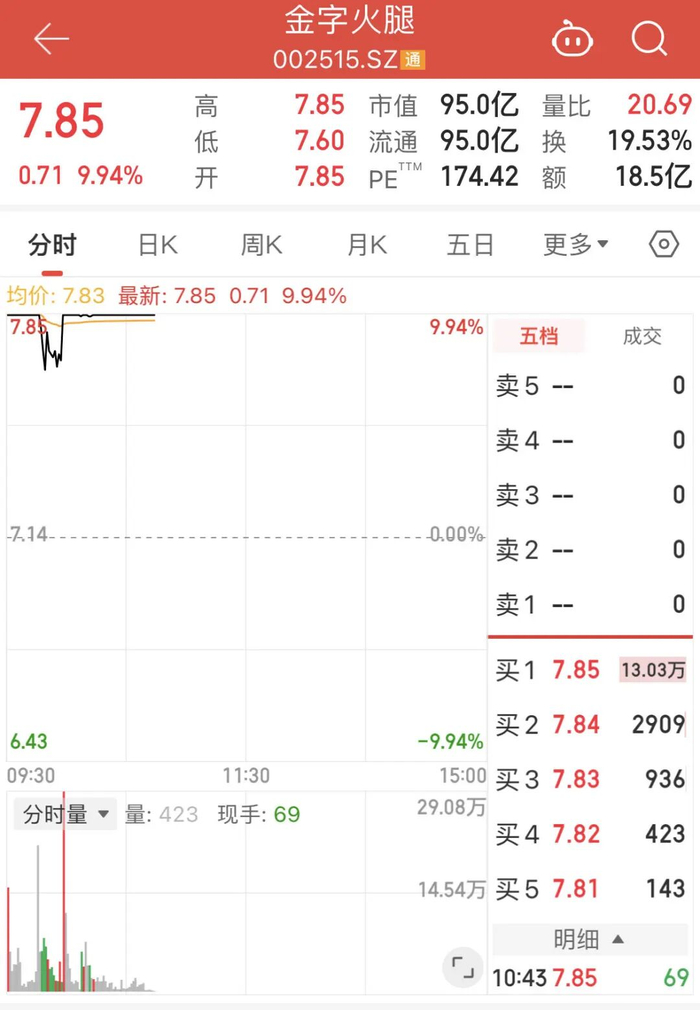
002515,直线涨停!拟跨界投资光通信芯片
中国基金报· 2025-09-23 04:21
Core Viewpoint - Jinzi Ham plans to invest no more than 300 million CNY to acquire up to 20% equity in Zhongsheng Microelectronics, focusing on the promising optical communication chip sector [2][6][8]. Investment Details - The investment will be conducted through capital increase and will be divided into two rounds, with the final amount and shareholding ratio to be determined after due diligence [7][11]. - The first round of investment is estimated at 100 million CNY, based on Zhongsheng Micro's pre-investment valuation of 1 billion to 1.3 billion CNY, indicating a potential appreciation rate of 9710% [11]. Company Background - Zhongsheng Micro was founded in 2019 by core R&D personnel from a US optical communication chip design company and has been recognized as a "future unicorn" in China [7][8]. - The company specializes in the development of high-speed optical module core chips, with products used in AI, cloud computing, and telecommunications [8]. Financial Performance - Zhongsheng Micro has not yet achieved profitability, reporting revenues of 204,900 CNY in 2024 and a net loss of 38.83 million CNY [9][10]. - For the first seven months of 2025, the company generated revenues of 511,100 CNY with a net loss of 20.37 million CNY [9][10]. Strategic Shift - Jinzi Ham's investment is part of a broader strategy to utilize idle funds effectively and align with the trends of the digital economy, aiming to enhance future business opportunities and improve performance [8][12]. - The company has faced challenges in its core business, leading to a decline in revenue from its traditional ham products [14][15][17]. Recent Changes in Control - The investment marks the first major move by the new controlling shareholder, Zheng Qingsheng, who took control of Jinzi Ham in June 2025 [21][22]. - Zheng Qingsheng has a background in real estate and automotive sales, indicating a shift in the company's strategic direction towards the semiconductor industry [22].