股票抄底

Search documents
1 Reason to Buy Robinhood Stock on the Dip
The Motley Fool· 2026-02-16 18:15
Core Viewpoint - The recent dip in Robinhood Markets' stock price presents a buying opportunity due to continued customer asset growth on its platform, despite a slight revenue miss in the fourth quarter [1][2]. Group 1: Financial Performance - Robinhood reported a 27% year-over-year increase in revenue for the fourth quarter, but slightly missed estimates, leading to a sharp sell-off in shares [1]. - Net deposits reached nearly $16 billion in the fourth quarter, reflecting an annualized growth rate of 19% compared to the previous quarter's total platform assets [4]. Group 2: Customer Engagement and Growth - The company has seen net deposits of $7 billion already in the early part of the first quarter of 2026, indicating strong customer engagement and asset inflow [5]. - There was a 57% year-over-year increase in the number of retirement accounts opened last quarter, showcasing Robinhood's ability to build long-term relationships with customers [6]. Group 3: Future Outlook - The growth in customer deposits is expected to create more revenue opportunities through interest- and fee-related products, including the new Robinhood Banking service [5]. - The revenue miss does not fully reflect the underlying growth on Robinhood's platform, suggesting a positive trajectory for the stock in the coming years [6].



Prediction: The e.l.f. Sell-Off Is a Golden Opportunity
The Motley Fool· 2026-02-08 13:15
Core Viewpoint - E.l.f. Beauty's stock experienced a significant reversal despite strong fiscal Q3 results, presenting a potential buying opportunity for investors [1]. Financial Performance - E.l.f. Beauty reported a 38% year-over-year increase in sales for fiscal Q3, reaching $489.5 million, surpassing the analyst consensus of $460 million [3]. - Adjusted earnings per share (EPS) rose 68% from $0.74 to $1.24, exceeding the analyst consensus of $0.72 [3]. - Adjusted EBITDA increased by 79% to $123 million [3]. Market Position and Growth - The company achieved a gross margin of 65.91% and organic growth, excluding the acquisition of Rhode, was 2% [5]. - Total consumption grew by 6%, with an 8% increase in the U.S. market [5]. - E.l.f.'s namesake brand gained 130 basis points in market share within the mass cosmetics sector during the quarter [5]. Revenue Breakdown - U.S. revenue increased by 36%, while international revenue rose by 44%, although weak consumption was noted in the U.K. [6]. - Rhode contributed $128 million in revenue for the quarter, aided by its launch at Sephora [5]. Future Outlook - E.l.f. raised its full-year fiscal 2026 guidance, now expecting sales growth of 22% to 33%, up from a previous estimate of 18% to 20% [6]. - Updated fiscal 2025 outlook includes net sales of $1.6 billion to $1.612 billion, adjusted EBITDA of $323 million to $326 million, and adjusted EPS of $3.05 to $3.10 [7]. Expansion Plans - The company plans to launch Rhode in Australia and New Zealand and introduce its Naturium brand into Walmart in the U.S. this spring [8]. - E.l.f. will also increase shelf space for its brand at Ulta Beauty and launch at DM in Germany [8]. Investment Consideration - E.l.f. is currently trading at a forward price-to-earnings ratio of 22 and a price/earnings-to-growth (PEG) ratio of 0.4, indicating it may be undervalued [10].


越跌越买!抄底来了
中国基金报· 2025-12-16 06:14
Core Viewpoint - The stock ETF market experienced a net inflow of nearly 7.5 billion yuan on December 15, despite a general market downturn, indicating strong investor interest in ETFs as a preferred investment vehicle during market fluctuations [2][4]. Group 1: Market Performance - On December 15, the A-share market saw a decline, with the Shenzhen Composite Index and the ChiNext Index both dropping over 1%. However, the consumer sector showed resilience, and commercial aerospace stocks remained active [2]. - Over the past three trading days, the net buying in the stock market has exceeded 18.5 billion yuan [3]. Group 2: ETF Inflows - The total net inflow into the stock ETF market on December 15 was approximately 7.457 billion yuan, with significant contributions from broad-based ETFs and Hong Kong market ETFs, which saw inflows of 4.318 billion yuan and 2.685 billion yuan, respectively [6]. - The CSI A500 Index ETF led the inflows with 4.942 billion yuan, with the Southern A500 ETF and Huatai-PB A500 ETF contributing over 3.9 billion yuan and 0.92 billion yuan, respectively [6][9]. Group 3: Fund Company Performance - Leading fund companies like E Fund and Huaxia Fund saw substantial inflows into their ETFs. E Fund's ETFs had a total scale of 818.24 billion yuan, with a net inflow of 1.19 billion yuan on December 15 [9]. - Huaxia Fund's A500 ETF and Sci-Tech 50 ETF also attracted significant inflows of 0.712 billion yuan and 0.462 billion yuan, respectively [9]. Group 4: Outflows from Specific ETFs - The CSI 300 Index ETF experienced the largest outflow, with a net outflow of 1.071 billion yuan, followed by the Securities ETF and Wine ETF, which saw outflows of 0.618 billion yuan and 0.420 billion yuan, respectively [11][12]. - Despite some broad-based and thematic ETFs experiencing outflows, institutional investors remain optimistic about the market outlook [15].

市值蒸发400亿美元吓不倒散户!奈飞(NFLX.US)迎抄底狂潮
Zhi Tong Cai Jing· 2025-12-12 01:29
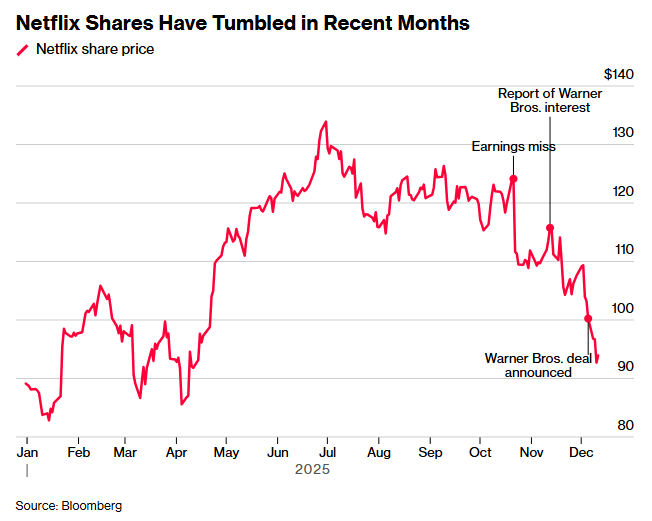
Group 1 - Market concerns over Netflix's (NFLX.US) proposed acquisition of Warner Bros. Discovery (WBD.US) led to a $40 billion drop in Netflix's market value within six trading days [1] - Retail investors view the decline as a strong buying signal, with Netflix becoming the third most actively traded stock on the Interactive Brokers platform during the week ending Monday [1][4] - Data from Morgan Stanley indicates robust retail buying interest, with Fidelity reporting buy orders outnumbering sell orders by more than three to one [1] Group 2 - Netflix's stock price fell 15% from December 2 to December 10, marking its worst six-day streak since May 2022, and has dropped 23% over the past two months due to concerns about revenue growth and risks associated with the Warner Bros. Discovery acquisition [1] - The potential for a bidding war, following Paramount Global's $108 billion hostile takeover bid for Warner Bros. Discovery, and antitrust concerns raised by former President Trump have heightened market anxiety [1] - Retail interest in Netflix has surged since late October when reports emerged about the company's exploration of acquiring Warner Bros. Discovery, with Vanda Research noting over $520 million in purchases by retail investors since then [4] Group 3 - Despite a strong start to the year with a 50% increase by mid-year, Netflix's stock has reversed course in the second half, declining 30% and becoming the seventh worst performer in the Nasdaq 100 index [4] - Currently, Netflix's stock is trading at a price-to-earnings ratio of 31 times expected earnings for the next 12 months, near its lowest level in over a year and below its five-year average of 34 times [4]

Alibaba stock price is crashing: here's why it's safe to buy the dip
Invezz· 2025-10-13 06:16
Core Viewpoint - Alibaba's stock price has significantly declined, reaching its lowest level since September 24, primarily due to ongoing geopolitical fears [1] Company Summary - Alibaba's Hong Kong shares have dropped by 14.50% from their highest point this year [1]


Dutch Bros Stock Sell-Off: Should You Buy the Dip?
The Motley Fool· 2025-04-25 09:45
Company Overview - Dutch Bros has experienced significant stock volatility, with shares rising 224% from a 52-week low to a high, but subsequently falling 32% from that peak due to economic concerns [1][2] - The company has been expanding rapidly, reaching 1,000 locations in February 2023, doubling its store count since September 2021 [2] Growth Potential - The leadership team is optimistic about future growth, increasing the target from 4,000 to 7,000 stores over the next 10 to 15 years, indicating a strong belief in the company's market potential [3] - Same-store sales increased by 6.8% in 2024, reflecting positive trends in customer volume at existing locations [4] - The rewards program is driving 71% of transactions, showcasing customer engagement and loyalty [4] Competitive Landscape - Despite its growth, Dutch Bros faces significant competition, particularly from Starbucks, which has a strong brand presence and cost advantages [7] - At its current scale of 1,000 stores, Dutch Bros is not yet considered to have a competitive moat, but there is potential for developing durable advantages as the company matures [8] Financial Considerations - The stock is currently trading at a price-to-sales ratio of 4.7, which is 52% higher than its historical average, indicating that it may be overvalued despite recent sell-offs [10] - There are concerns regarding potential margin pressures due to rising costs from tariffs on key inputs like coffee and paper products [9]


Lululemon Stock Sinks on Outlook, but Is It Time to Buy the Dip?
The Motley Fool· 2025-04-02 08:30
Core Viewpoint - Lululemon Athletica has faced significant stock price declines in 2024 and early 2025, attributed to changing fashion trends and previous product missteps, particularly the Breezethrough leggings launch [1][2] Financial Performance - Lululemon reported a fiscal fourth-quarter revenue increase of 13% year over year, reaching $3.61 billion, with adjusted earnings per share (EPS) rising by 16% to $6.14, surpassing analyst expectations [7] - Revenue growth was particularly strong in international markets, with China seeing a 46% increase in sales, while U.S. revenue grew by only 5% [8] - The company forecasts fiscal 2025 revenue between $11.15 billion and $11.3 billion, indicating growth of 5% to 7%, with projected EPS ranging from $14.95 to $15.15 [11] Consumer Insights - A consumer survey indicated that U.S. households are spending less due to economic fears and inflation, leading to slower traffic in the athleisure segment [4] - Despite economic concerns, consumers have responded positively to new product launches, suggesting a potential turnaround in customer engagement [5] Growth Strategy - Lululemon is focused on location expansion, having opened 18 new stores and optimized 16 existing ones, bringing the total store count to approximately 767 [6] - The company plans to increase its square footage by 10% this year, with new store openings globally, including a franchise model in select markets [6] Inventory and Margins - Gross margin improved by 100 basis points to 60.4%, indicating effective pricing strategies without heavy discounting [10] - Inventory levels increased by 9% year over year, which is below the 13% sales increase, suggesting healthy inventory management [10] Market Position - Lululemon's menswear category outperformed with a 12% revenue growth, while women's sales increased by 6% and accessories by 9% [9] - The company trades at a forward price-to-earnings (P/E) ratio of approximately 19.5, which is more attractive compared to Nike's 30 times forward P/E [14]