跨年攻势

Search documents
光控资本:A股大盘仍以结构性行情为主
Sou Hu Cai Jing· 2025-12-30 06:37
Group 1 - The A-share market experienced a volatile adjustment on Monday, with the Shanghai Composite Index achieving nine consecutive days of gains, indicating strong market enthusiasm for buying [1][3] - The market is expected to see continued improvement in liquidity and trading activity due to year-end and early-year reallocation demands and capital inflows [1] - Short-term market focus is on the selection of the new Federal Reserve chair and the implementation of domestic monetary and fiscal policies [1][2] Group 2 - On Monday, the A-share market faced resistance after a rise, with sectors such as banking, petrochemicals, wind power equipment, and software development performing well, while sectors like power metals, pharmaceutical commerce, batteries, and electricity lagged [2] - The domestic monetary policy is anticipated to maintain a stance of "moderate easing," with expectations that the Federal Reserve will continue its rate-cutting cycle into 2026, contributing to a more relaxed global liquidity environment [2] - The recent strengthening of the RMB has increased the attractiveness of RMB assets, likely aiding in capital inflows [2] Group 3 - The A-share market has shown structural trends, with over 3,000 stocks declining for two consecutive trading days, indicating a need for investors to pay attention to the sustainability of hot themes and the rotation rhythm among sectors [3] - Despite the upward trend in the index, there is a caution against potential technical adjustments following continuous gains, but the upcoming "spring rally" may present thematic investment opportunities [3] - In the medium term, as recent domestic and international macro events settle, macro factors' influence on the market is expected to diminish, with valuation and liquidity becoming the dominant factors [3]


【机构策略】A股大盘仍以结构性行情为主
Zheng Quan Shi Bao Wang· 2025-12-30 01:33
Group 1 - The A-share market experienced fluctuations and adjustments, with the Shanghai Composite Index achieving a nine-day winning streak, indicating strong market enthusiasm for buying [1] - Institutional reallocation demand and capital inflow are expected to improve market liquidity and boost trading activity as the year-end approaches [1] - The focus in the short term is on the selection of the new Federal Reserve chair and the implementation of domestic monetary and fiscal policies [1] Group 2 - The A-share market faced resistance after a rise, with sectors such as banking, petrochemicals, wind power equipment, and software development performing well, while energy metals, pharmaceutical commerce, batteries, and electricity lagged [2] - The domestic monetary policy is expected to maintain a stance of "moderate easing," and there is a general expectation that the Federal Reserve will continue its rate-cutting cycle into 2026, leading to a more accommodative global liquidity environment [2] - The recent strengthening of the RMB has enhanced the attractiveness of RMB assets, which is beneficial for attracting capital inflow [2]
长城宏观:跨年攻势开启,关注科技与内需轮动
Sou Hu Cai Jing· 2025-12-29 08:40
Group 1: Market Overview - The A-share market showed a strong upward trend last week, with major indices generally rising. The market style continued to favor resource products and technology growth, while consumer sectors experienced a pullback [1] - In terms of industry performance, sectors such as non-ferrous metals (precious metals + industrial resources), military industry (commercial aerospace), and power equipment (data center power) led the gains, while consumer, banking, and coal sectors turned downward [1] Group 2: Macroeconomic Analysis - The national fiscal work conference emphasized the continuation of a more proactive fiscal policy in 2026, focusing on expanding fiscal spending and ensuring necessary expenditure. Key tasks include boosting domestic demand, increasing investment in new productive forces, and promoting employment and income growth [2] - From January to November, the total profit of industrial enterprises above designated size reached 66,268.6 billion yuan, a year-on-year increase of 0.1%. The manufacturing sector's profit totaled 50,317.9 billion yuan, growing by 5.0%. Notable growth was seen in the computer, communication, and other electronic equipment manufacturing sectors, while the oil and gas extraction sector saw a decline of 13.6% [2] Group 3: International Economic Context - In the U.S., third-quarter economic data exceeded expectations, leading to a cooling of interest rate cut expectations. The GDP growth rate for Q3 was 4.3%, surpassing the expected 3.3% and the previous 3.8%. The resilience of the U.S. economy is attributed to strong personal consumption, increased public spending, and improved export contributions [3] - Structural weaknesses in the labor market and the upcoming Federal Reserve leadership change may influence future interest rate decisions [3] Group 4: Investment Strategy - The market is expected to take a significant step forward as the year ends, supported by factors such as a systemic decline in risk-free interest rates and an anticipated surge in asset management demand [4] - Capital market reforms are enhancing the investability of Chinese assets and improving market resilience to risks, suggesting a potential shift from a volatile market to a more stable one [4] Group 5: Investment Directions - The focus is on technology, financial services, and consumer sectors. Specific areas of interest include technology growth driven by advancements in AI and computing infrastructure, as well as financial sectors like brokerage and insurance benefiting from capital market reforms [5] - The domestic policy to expand internal demand is expected to strengthen, making it a key theme alongside technology. Emerging consumption trends and events like sports and winter tourism are highlighted as potential investment opportunities [5]
国泰海通证券开放式基金周报(20251221):均衡风格配置,重视科技、非银、消费-20251221
国泰海通· 2025-12-21 09:21
Group 1: Report Industry Investment Rating No relevant content provided. Group 2: Core View of the Report - The report suggests an equal - style asset allocation, with emphasis on technology, non - banking, and consumer sectors. It believes that the "transformation bull market" in China will regain momentum, and the cross - year offensive has begun. For the bond market, the weak and volatile pattern may continue until after the cross - year period. In the long run of low - level long - term capital interest rates, there is no trend investment opportunity in money market funds. From the perspective of long - term investment and hedging, gold ETFs can be appropriately allocated [3][4][15]. Group 3: Summary by Related Catalogs 1. Last Week's Market Review - A - shares: A - shares showed a pattern of first decline and then rise. The large - consumer and non - banking sectors performed well. The release of relevant policies catalyzed the strength of the large - consumer and non - banking sectors. As of December 19, 2025, the Shanghai Composite Index rose 0.03% for the whole week, while the Shenzhen Component Index fell 0.89%. In terms of styles, value outperformed growth. The trading volume of the two A - share markets decreased compared with the previous week. Among the industries, 19 out of 31 industries in the Shenwan primary industry classification rose [7]. - Bond market: The bond market fluctuated and rose. After the release of November's financial and economic data, the "supportive" tone is expected to continue next year. The yields of various bonds generally declined, the credit spread widened, the term spread narrowed, and the convertible bond index rose [8]. - Overseas market: US stocks fluctuated. European stock markets generally rose, while Asia - Pacific markets mostly declined. The US dollar index rose. Oil prices continued to fall due to pessimistic expectations about the US and global economic recoveries, while gold prices rose [9]. 2. Last Week's Fund Market Review - Stock funds: Stock - type funds fell 0.56% last week. Some funds heavily invested in the consumer and satellite sectors performed well. Index stock - type funds fell 0.54%, and actively - managed open - end stock funds fell 0.62% [10]. - Hybrid funds: Actively - managed open - end hybrid funds fell 0.42%. Among index funds, themes such as satellite, insurance, and petrochemical performed well [12]. - Bond funds: Bond - type funds rose 0.09%. Among them, index bond - type funds rose 0.11%, and actively - managed open - end bond funds rose 0.09%. Partially - debt funds and convertible - bond funds with non - banking and non - ferrous metals in the equity part performed well. Pure - bond funds mainly invested in high - grade credit bonds and medium - to long - term bonds performed well [12]. - Money market funds: The annualized yield of money market funds was 1.24% [12]. - QDII funds: Equity - type QDII funds fell 1.87%. Funds mainly investing in the Vietnamese market, US consumer stocks, and gold performed well. QDII bond - type funds rose 0.18% [13]. - Gold ETFs and their linked funds: Gold ETFs and their linked funds rose 1.15%, and commodity - type funds rose 1.02% [14]. 3. Future Investment Strategy - Stock and hybrid funds: Policy expectations are expected to be revised upwards, market trading is expected to be active. The "transformation bull market" in China will regain momentum, and the cross - year offensive has begun. It is advisable to adopt an equal - style allocation and focus on technology, non - banking, and consumer sectors [16]. - Bond funds: The weak and volatile pattern of the bond market may continue until after the cross - year period. It is recommended to focus on interest - rate bonds with flexible durations and products heavily invested in high - grade and highly - liquid credit bonds [17]. - Money market funds: There is no trend investment opportunity in the context of long - term low - level capital interest rates [17]. - Commodity funds: Gold ETFs can be appropriately allocated from the perspectives of long - term investment and hedging [17]. 4. Latest Fund Market Developments - Hong Kong - stock new funds: Since early October, 15 new Hong Kong - stock theme funds have ended their fundraising ahead of schedule. Many technology - theme ETFs have quickly increased their stock positions after establishment, showing a characteristic of "rapid issuance and construction" [18]. - QDII funds: On December 18, the subscription limit of the RMB share of the Morgan Nasdaq 100 Index Fund was adjusted to 10 yuan. Under the dual pressures of rigid foreign - exchange quota supply and strong overseas - allocation demand from investors, the investment enthusiasm for QDII funds is high, and many QDII funds have high premiums in the secondary market [19]. - Newly - established funds last week: A total of 34 new funds were established last week, with an average subscription period of about 21 days and an average raised share of 539 million. The total raised share was 1.8321 billion, and the largest - raised fund was the Xin'ao Fengxiang Interest - rate Bond Fund, with 5.251 billion shares [20]. - Fund dividends next week: There will be 64 fund shares for ex - rights registration in the coming days. The most notable one is the Huabao CSI 300 Index Enhancement Fund, which will distribute a dividend of 3.1 yuan per 10 shares [21].
长城基金汪立:布局春季行情,关注三大方向
Xin Lang Cai Jing· 2025-12-16 11:22
Group 1: Market Trends - The market continues to favor technology growth, while cyclical and consumer sectors are experiencing a pullback. AI-related optical modules and chips are gaining strength, alongside significant increases in controllable nuclear fusion and data center electricity, as well as heightened interest in smart grids and green energy consumption. Commercial aerospace remains highly active, while sectors like carbon black, phosphorus chemicals, methanol, real estate, and home textiles are lagging behind [1][6]. Group 2: Macroeconomic Analysis - The Central Economic Work Conference in China outlined five new understandings and eight key tasks to stabilize and promote economic growth. The focus is on a more proactive fiscal policy, leading investment recovery, and addressing real estate inventory issues. The conference emphasized the need for incremental policies based on changing circumstances [2][7]. - In November, China's core CPI rose to 0.7% year-on-year, while PPI fell to -2.2%. CPI was driven by food prices, consumer subsidies, and rising gold prices, while international oil price declines pressured PPI. The M1-M2 gap widened significantly, but M1 may stabilize marginally in the future. Exports in dollar terms grew by 5.9%, and imports increased by 1.9% [2][7]. Group 3: U.S. Federal Reserve Actions - The Federal Reserve announced a 25 basis point cut in the federal funds rate, bringing it to a target range of 3.50% to 3.75%. This decision aligns with expectations but reflects increasing internal divisions. The Fed's outlook on the U.S. economy and inflation has become more optimistic, and there may be further rate cuts anticipated due to a weakening labor market and upcoming leadership changes [3][8]. Group 4: Investment Strategy - A cross-year investment strategy is beginning, with expectations for policy adjustments to support market liquidity and activity. Historical patterns suggest that the spring market rally typically occurs from December to April, with large-cap stocks leading the way. Current market conditions may present a significant opportunity for positioning ahead of the spring rally [4][9]. - The investment outlook favors technology, financial services, and consumer sectors. Specific areas of interest include AI advancements, capital market reforms, and cyclical stocks that have seen valuation adjustments after three years of decline. Target sectors include internet, media, computing, and manufacturing with global competitive advantages, as well as low-priced consumer stocks and cyclical industries like non-ferrous metals and chemicals [5][10].
逆势布局?!创业板50ETF(159949)近20个交易日资金净流入3.4亿 机构:科技与先进制造或仍是2026年主线
Xin Lang Cai Jing· 2025-12-16 08:42
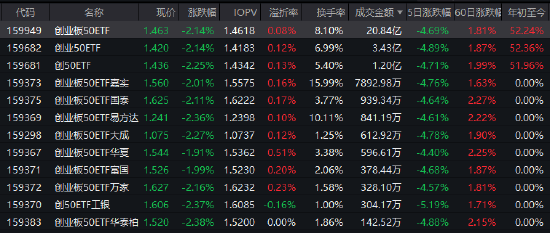
Market Overview - On December 16, the market experienced a day of volatility with all three major indices falling over 1%. The Shanghai Composite Index dropped by 1.11%, while the ChiNext Index fell by 2.10% [1][6] - The ChiNext 50 ETF (159949) declined by 2.14%, closing at 1.463 yuan, with a turnover rate of 8.10% and a trading volume of 2.084 billion yuan, making it the top performer among similar ETFs [1][6] Fund Performance - Despite a cumulative decline of 4.69% over the past five trading days, the ChiNext 50 ETF (159949) has seen continuous net inflows: 180 million yuan over the last five days, 340 million yuan over the last twenty days, and 30.45 million yuan over the last sixty days [2][7] - The ChiNext 50 ETF has achieved a cumulative return of 42.25% over the past three years, outperforming its benchmark and ranking 338th among 1,600 products. Its latest circulating scale is 26.171 billion yuan as of December 15, 2025 [4][9] Investment Outlook - Guotai Junan Securities indicates that a cross-year market rally has begun, suggesting that after a prolonged period of sideways movement, China's "transformation bull" market is set to regain momentum. Expectations for policy adjustments are likely to rise amid a stable yuan, with potential interest rate cuts by the central bank anticipated in early 2026 [3][8] - Shenwan Hongyuan Securities believes that the current market is still in a high-level consolidation phase, with cyclical and value styles expected to dominate in the first half of 2026. The second quarter may enter a bottoming phase, with technology and advanced manufacturing sectors likely to lead the market [4][9]

越跌越买!抄底来了
中国基金报· 2025-12-16 06:14
Core Viewpoint - The stock ETF market experienced a net inflow of nearly 7.5 billion yuan on December 15, despite a general market downturn, indicating strong investor interest in ETFs as a preferred investment vehicle during market fluctuations [2][4]. Group 1: Market Performance - On December 15, the A-share market saw a decline, with the Shenzhen Composite Index and the ChiNext Index both dropping over 1%. However, the consumer sector showed resilience, and commercial aerospace stocks remained active [2]. - Over the past three trading days, the net buying in the stock market has exceeded 18.5 billion yuan [3]. Group 2: ETF Inflows - The total net inflow into the stock ETF market on December 15 was approximately 7.457 billion yuan, with significant contributions from broad-based ETFs and Hong Kong market ETFs, which saw inflows of 4.318 billion yuan and 2.685 billion yuan, respectively [6]. - The CSI A500 Index ETF led the inflows with 4.942 billion yuan, with the Southern A500 ETF and Huatai-PB A500 ETF contributing over 3.9 billion yuan and 0.92 billion yuan, respectively [6][9]. Group 3: Fund Company Performance - Leading fund companies like E Fund and Huaxia Fund saw substantial inflows into their ETFs. E Fund's ETFs had a total scale of 818.24 billion yuan, with a net inflow of 1.19 billion yuan on December 15 [9]. - Huaxia Fund's A500 ETF and Sci-Tech 50 ETF also attracted significant inflows of 0.712 billion yuan and 0.462 billion yuan, respectively [9]. Group 4: Outflows from Specific ETFs - The CSI 300 Index ETF experienced the largest outflow, with a net outflow of 1.071 billion yuan, followed by the Securities ETF and Wine ETF, which saw outflows of 0.618 billion yuan and 0.420 billion yuan, respectively [11][12]. - Despite some broad-based and thematic ETFs experiencing outflows, institutional investors remain optimistic about the market outlook [15].

午评:沪指跌0.11% 乳业、保险板块走强
Zhong Guo Jin Rong Xin Xi Wang· 2025-12-15 04:03
Market Overview - The market experienced a morning surge followed by a decline, with the ChiNext Index dropping over 1%, leading the three major indices [1] - As of the midday close, the Shanghai Composite Index was at 3884.93 points, down 0.11%, with a trading volume of 509.9 billion yuan; the Shenzhen Component Index was at 13164.03 points, down 0.71%, with a trading volume of 674.3 billion yuan; the ChiNext Index was at 3153.07 points, down 1.29%, with a trading volume of 315.4 billion yuan [1] - The total trading volume for the Shanghai and Shenzhen markets was 1.18 trillion yuan, a decrease of 52.9 billion yuan compared to the previous trading day [1] Sector Performance - The insurance sector saw significant gains, with China Ping An rising nearly 5%, reaching a four-year high [2] - The consumer sector showed strength, particularly in dairy, with Sunshine Dairy hitting the daily limit; the liquor sector was also active, with Huangtai Liquor reaching the daily limit; retail stocks performed strongly, with Baida Group achieving three consecutive trading limits [2] - Conversely, the computing hardware sector experienced a collective decline, with Changfei Optical Fiber hitting the daily limit down [2] Institutional Insights - Guotai Junan expressed a more optimistic outlook for the market compared to consensus, highlighting the central economic work conference's focus on stabilizing economic growth and promoting investment recovery [3] - The conference emphasized the importance of a good start for the 14th Five-Year Plan, with expectations for policy adjustments to support economic activity [3] - The firm noted that the current market environment presents a crucial opportunity for positioning ahead of the spring market, with a focus on large-cap growth stocks benefiting from insurance capital allocations [3] Economic Data - The National Bureau of Statistics reported that in November, the total retail sales of consumer goods reached 43,898 billion yuan, a year-on-year increase of 1.3% [6] - Excluding automobiles, retail sales amounted to 39,444 billion yuan, growing by 2.5% [6] - From January to November, total retail sales reached 456,067 billion yuan, with a growth rate of 4.0% [6] Real Estate Market - In November, new residential sales prices in first-tier cities fell by 0.4% month-on-month, with the decline in major cities like Beijing and Shenzhen being more pronounced [7] - The report indicated that second-hand residential prices in first-tier cities also saw a month-on-month decline of 1.1% [7] Technology Developments - China Mobile released a white paper on 6G transmission technology and a prototype system, marking a significant step from theoretical research to practical validation [7] - The white paper outlines the vision, architectural design, and key technological directions for 6G transmission networks, emphasizing capabilities such as intelligent connection driven by business perception and distributed dynamic channel control [7]
A股小幅高开,沪深300ETF(159919)将实施年内第二次分红
Xin Lang Cai Jing· 2025-12-08 02:42
Group 1 - The A-share market opened slightly higher, with the CSI 300 Index rising by 0.31% as of 09:52, driven by significant gains in stocks such as Tianfu Communication (+13.15%) and Industrial Securities (+8.33%) [1] - The CSI 300 ETF (159919) will implement its second dividend distribution for 2025, with a cash dividend of 0.7280 yuan per 10 fund shares, based on a net asset value of 4.8485 yuan on the record date of November 19 [1] - The total dividend distribution for the CSI 300 ETF in 2024 reached 1.665 billion yuan, ranking among the top in public funds for the year [1] Group 2 - Guotai Junan Securities forecasts that the Chinese stock market will enter a new upward phase, supported by anticipated positive economic policies in 2026 and favorable conditions for monetary easing [2] - The top ten weighted stocks in the CSI 300 Index as of November 28, 2025, include Ningde Times, Kweichow Moutai, and China Ping An, collectively accounting for 22.51% of the index [2] Group 3 - The CSI 300 ETF (159919) closely tracks the CSI 300 Index, with a high allocation in core A-share assets such as electronics, banking, and non-bank financials [3] - Investors without stock accounts can access A-share core assets through the CSI 300 ETF linked fund (160724) for low-position investments [4]
国泰海通 · 晨报1208|非银、宏观、策略、煤炭
国泰海通证券研究· 2025-12-07 15:37
Group 1: Non-Banking Financial Institutions - The China Banking and Insurance Regulatory Commission (CBIRC) has lowered the risk factors for long-term holdings of certain stocks, which is expected to encourage insurance funds to increase their equity asset allocation while maintaining solvency constraints [2] - The policy aims to enhance the capital utilization efficiency of high-quality institutions, allowing leading brokerages to accelerate their development in proprietary trading, derivatives, institutional business, and wealth management [2] - The new regulations on financial leasing companies are expected to improve asset quality and risk pricing transparency, benefiting well-governed and clearly defined business leasing institutions [2] Group 2: Macro Economic Insights - The U.S. economy is showing signs of marginal decline, with industrial output and durable goods orders decreasing, while personal disposable income has slightly increased [6] - The European economy remains resilient, with mixed signals from industrial production and retail sales, while inflation rates show slight increases [6] - The Federal Reserve is expected to lower interest rates in December, with a high probability of around 87%, while the European Central Bank is likely to pause rate cuts [8] Group 3: Market Strategy - The Chinese stock market is anticipated to enter a "cross-year offensive" phase, with expectations of policy, liquidity, and fundamental support leading to upward movement in indices [11] - The focus is on sectors such as technology, finance, and consumer goods, with recommendations for stocks in internet, media, and manufacturing industries [14] - The demand for asset management is expected to surge as traditional fixed-income products decline, leading to a shift towards diversified investment strategies [12] Group 4: Energy Sector Insights - The U.S. is facing a clear electricity supply shortage, which is projected to expand by 2030, necessitating a systematic approach to energy solutions, particularly in natural gas and renewable sources [17] - The current energy system in the U.S. is transitioning towards a mix dominated by natural gas and clean energy, with coal playing a backup role [18] - By 2030, renewable sources are expected to contribute significantly to new electricity generation, while coal will serve as a stabilizing force in the energy mix [19]