
英国经济增长

Search documents
预算不确定性拖累企业与消费者,英国经济在2025年末表现疲软
Xin Lang Cai Jing· 2026-02-12 12:17
Economic Performance - The UK economy showed minimal growth in the last quarter of 2025, with a quarter-on-quarter increase of only 0.1%, matching the growth rate of the third quarter [1][3] - For the entire year of 2025, the UK economy grew by 1.3%, an improvement from 1.1% in the previous year, marking the highest annual growth rate since 2022 [4] Government and Market Reactions - Uncertainty surrounding the government budget announcement in late November led to a cautious approach from businesses and consumers, impacting investment and spending [2][5] - The Chancellor of the Exchequer, Rachel Reeves, was expected to potentially break a key promise not to raise income tax rates, but the actual tax increases were lower than market expectations [5] Future Projections - Economic indicators suggest a potential recovery in early 2026, but overall growth for the year is not expected to rise significantly [5] - The Bank of England has revised its growth forecasts downward for the next two years, lowering the 2026 growth estimate from 1.2% to 0.9% and the 2027 estimate from 1.6% to 1.5% [2][5] Political Implications - The Labour government's support has significantly declined since winning the election in 2024, partly due to economic performance [2][5] - The government aims to lower the main interest rate by 25 basis points to 3.50% in March, in light of weak growth and expected significant inflation reduction [5] Economic Strategy - Simon Pittaway, a senior economist at the Resolution Foundation, emphasized the need for the government to double down on its growth agenda to achieve sustainable economic recovery that benefits the public [3][6]
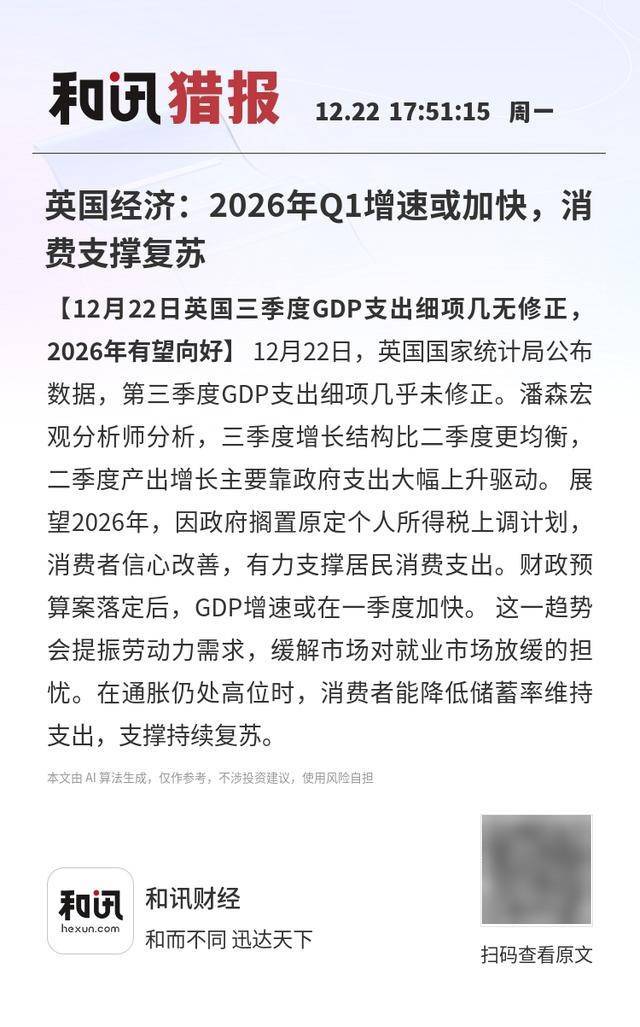
英国经济:2026年Q1增速或加快,消费支撑复苏
Sou Hu Cai Jing· 2025-12-22 10:39
Group 1 - The core viewpoint of the article is that the UK economy is expected to see improved growth in 2026, particularly in Q1, driven by consumer confidence and spending [1][2] - The third quarter GDP expenditure details showed minimal revisions, indicating a more balanced growth structure compared to the second quarter, which was heavily reliant on increased government spending [1][2] - The government's decision to postpone the planned increase in personal income tax is expected to bolster consumer confidence and support household spending [1][2] Group 2 - Following the finalization of the fiscal budget, GDP growth rate is anticipated to accelerate in the first quarter of 2026 [1][2] - This trend is likely to enhance labor demand and alleviate concerns regarding a slowdown in the job market [1][2] - Despite high inflation, consumers are expected to reduce their savings rate to maintain spending, which will support ongoing economic recovery [1][2]

英国经济连续两月收缩 贸易失衡加剧
Xin Hua Cai Jing· 2025-12-12 15:21
Economic Performance - In October, the UK's GDP decreased by 0.1% month-on-month, marking the fourth consecutive month of contraction [1] - The trade deficit widened significantly to £22.542 billion, the highest level since January 2022 [1] - Industrial output increased by 1.1% month-on-month, surpassing market expectations of 0.7%, representing the strongest monthly growth since February [2] Trade Dynamics - Goods exports fell by 0.3% to £77 billion, the lowest in four months, while imports rose by 4.5% to £81.82 billion, reaching a seven-month high [1] - Exports to the EU increased by 1.7%, driven by machinery and transport equipment, while exports to non-EU countries rose by 8.6%, led by chemicals and machinery [1] Sectoral Insights - Within the manufacturing sector, six out of thirteen sub-sectors reported growth, with transport equipment manufacturing rising by 3.6% [2] - The construction sector continued to expand but showed signs of weakening, with output growing by only 0.9% year-on-year, the slowest pace since January [2] Economic Forecasts - The Confederation of British Industry (CBI) raised its GDP growth forecast for 2025 from 1.0% to 1.3% and for 2026 from 1.2% to 1.4% [3] - CBI's chief economist emphasized a "cautiously optimistic" outlook, noting that the recent budget focused more on stability than growth [3] - The CBI expects limited room for interest rate cuts, projecting a reduction of 25 basis points in the near term, bringing the rate down to 3.5% [3]
英国10月经济再度萎缩 预算案增税前景加剧担忧
Xin Lang Cai Jing· 2025-12-12 13:29
Core Viewpoint - The UK economy has experienced a disappointing contraction for the fourth consecutive month in October, with GDP declining by 0.1%, as economic activity weakened ahead of the Autumn Budget announcement by Chancellor Rachel Reeves [1][5]. Economic Performance - The Office for National Statistics reported a 0.1% decline in GDP for October, following a similar decline in the previous month, while economists had anticipated a growth of 0.1% [1][5]. - The services sector fell by 0.3%, and the construction sector decreased by 0.6%, although this was partially offset by a 1.1% rebound in industrial production [1][5]. Market Reactions - Following the GDP data release, the British pound slightly weakened against the US dollar, dropping 0.1% to 1.3381, with traders increasing bets on potential interest rate cuts by the Bank of England next year [1][5]. Future Outlook - The GDP data serves as a precursor to upcoming employment and inflation figures, which will inform the Bank of England's final meeting of the year on December 18 [1][5]. - The report indicates that the UK economy remains sluggish entering the last quarter, struggling to regain the growth momentum seen in the first half of the year, when it outperformed other G7 countries [1][5]. Recent Trends - Over the past seven months, the UK GDP has recorded growth only once [3][7]. - Economic activity in November may be constrained due to ongoing budget uncertainties, with expectations of flat GDP growth for the last quarter of the year [4][8]. Consumer Behavior - Speculation about potential tax increases has placed significant pressure on households, which account for approximately 60% of the economy, leading to reduced consumer spending ahead of the budget announcement [4][8]. - Despite not raising income tax rates, the Chancellor's decision to extend the freeze on tax thresholds, combined with rising unemployment and weakening real wage growth, may lead consumers to remain cautious in the coming months [4][8].

GDP超预期+通胀预警!英国央行政策倒向“按兵不动”
Xin Hua Cai Jing· 2025-08-19 00:11
Core Viewpoint - The global financial market is betting that the Bank of England will maintain a 4% base interest rate for the remainder of the year, driven by rising inflation and resilient economic growth [1][2] Group 1: Economic Indicators - Recent data shows that the UK's GDP grew by 0.3% in Q2, surpassing economists' expectations of 0.1% and the Bank of England's own forecasts [2] - The labor market is also performing strongly, with multiple indicators exceeding analysts' prior expectations, reinforcing the resilience of the economic fundamentals [2] Group 2: Market Reactions - Following the shift in policy expectations, the British pound has appreciated by 2.5% against the US dollar this month, making it the best-performing currency among the G10 [2] - Analysts attribute the pound's strength to the Bank of England's quicker end to the rate-cutting cycle compared to other major central banks, creating a favorable interest rate differential [2] Group 3: Future Outlook - Market participants are closely monitoring upcoming key data, including the July inflation report and preliminary Q3 GDP figures, which will inform the Bank of England's policy direction [2] - Most institutions expect the Bank of England to likely keep interest rates unchanged in the September meeting while assessing whether inflation will exert sustained upward pressure [2]
【环球财经】英国第二季度GDP同比增长1.2% 内生动力存在不足
Xin Hua Cai Jing· 2025-08-14 15:01
Core Viewpoint - The UK economy showed signs of slowing growth in Q2, with GDP growth at 1.2% year-on-year, slightly down from 1.3% in Q1, but still above market expectations of 1% [1] Economic Performance - In June, UK GDP grew by 1.4% year-on-year, the highest since February, surpassing expectations of 1.1% and revised from a previous value of 0.7% to 0.9% [1] - The quarterly GDP growth for Q2 was 0.3%, indicating a modest recovery [1] - The service sector was a key driver, with output increasing by 0.3%, while industrial production rose by 0.7% and construction output grew by 0.3% [1] Monetary Policy Outlook - Economists from Santander and Berenberg suggest that the Bank of England may maintain the base interest rate at 4.0% for the remainder of 2025, given the better-than-expected economic data and anticipated inflation rise [1][2] - However, there are differing views in the market regarding the sustainability of UK economic growth, with some expecting a rate cut in December [2] Concerns on Growth Sustainability - Private consumption was weaker than expected, and business investment saw a significant decline, indicating insufficient internal growth momentum [2] - The strong performance in Q2 was primarily supported by government spending and net exports, which may not be sustainable in the long term [2] - Key components such as household consumption and business investment were notably weaker compared to Q1, raising concerns about future growth [2]
机构分析师:英镑可能进一步承压
news flash· 2025-07-11 09:00
Core Viewpoint - The British pound is likely to face further downward pressure due to weak GDP data released on Friday, indicating economic contraction in May [1] Economic Data - UK GDP unexpectedly shrank by 0.1% in May, highlighting downside risks to economic growth [1] - The weak economic performance has strengthened market expectations for a potential interest rate cut by the Bank of England in August, unless June inflation data shows unexpected improvement [1] Inflation and Market Sentiment - Stable inflation may provide some short-term support for the pound; however, medium-term outlook remains bleak due to fiscal tightening and weak labor market data [1] - Monthly GDP contraction further suggests that the pound will continue to face sustained pressure [1]
英国第一季度经济环比增长0.7%。
news flash· 2025-06-30 06:07
Core Insights - The UK economy experienced a quarter-on-quarter growth of 0.7% in the first quarter [1] Economic Performance - The growth rate of 0.7% indicates a positive trend in the UK economy, suggesting resilience amidst potential challenges [1]
6月30日电,英国第一季度经济环比增长0.7%,预期增长0.7%。
news flash· 2025-06-30 06:02
Group 1 - The UK economy grew by 0.7% in the first quarter, matching expectations for the same growth rate [1]
黄金期货结束六连跌 英国经济增长有放缓风险
Jin Tou Wang· 2025-05-16 07:02
Group 1: Macroeconomic Insights - HSBC reported that the UK economy grew by 0.7% in Q1, exceeding expectations, but may face a downturn due to global uncertainties [3] - The growth was supported by strong investment driven by one-off expenditures, but potential declines in trade are anticipated in Q2 [3] - Rising utility costs and increases in wage taxes and minimum wage are expected to impact corporate labor costs [3] Group 2: Currency and Market Reactions - The GBP's reaction to improved UK economic growth data has been muted, indicating cautious interpretation by investors [3] - Despite a 0.7% growth in Q1 following a 0.1% increase in the previous quarter, the growth was driven by unstable corporate investment factors [3] - The Bank of England is likely to interpret the economic slowdown risks as a reason to proceed with gradual interest rate cuts [3] Group 3: Gold Futures Analysis - Gold futures prices have ended a six-day decline, currently reported at 752.74 CNY per gram, with a 1.01% increase [4] - The highest price reached today was 759.20 CNY per gram, while the lowest was 746.44 CNY per gram [4] - Resistance levels for gold are identified between 819-829 CNY, with support levels at 712-722 CNY [4]