融资融券折算率调整

Search documents
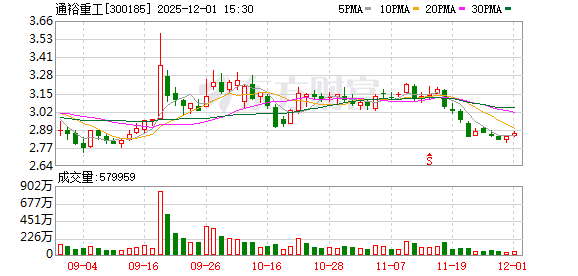
通裕重工:融资融券折算率系券商根据沪深交易所相关规则进行的正常调整
Zheng Quan Ri Bao· 2025-12-01 12:41
Core Viewpoint - Tongyu Heavy Industry stated that the adjustment of the financing and securities lending conversion rate is a normal adjustment made by securities firms in accordance with the relevant rules issued by the Shanghai and Shenzhen Stock Exchanges [2] Group 1 - The company responded to investor inquiries on its interactive platform [2] - The financing and securities lending conversion rate is subject to regular adjustments based on exchange rules [2]


刚刚集体杀跌!半导体芯片、锂电池等板块大跌
Zhong Guo Ji Jin Bao· 2025-10-10 02:51
Market Overview - The A-share market experienced a collective decline, with major indices such as the Shanghai Composite Index down by 0.45%, the Shenzhen Component Index down by 1.61%, and the ChiNext Index down by 3.05% [2][3] - The STAR 50 Index saw a significant drop of over 4% at the beginning of the trading session [2] Sector Performance - Semiconductor and lithium battery sectors faced substantial declines, with various indices such as the automotive chip index down by 3.73% and the lithium battery cathode index down by 4.43% [3][5] - The gas, coal, and textile sectors showed signs of recovery, while precious metals experienced a pullback [2] Individual Stock Movements - Notable declines were observed in individual stocks, with Dongxin Co. falling over 13%, and Yandong Micro and Baiwei Storage dropping over 10% [7][8] - In the lithium battery supply chain, companies like Xian Dao Intelligent and Yinghe Technology saw declines exceeding 10%, while CATL dropped over 5% [9][10] IPO Market Activity - The Hong Kong IPO market saw significant activity, with Jin Ye International Group's stock surging by 564% on its debut, reaching a peak of 3.32 HKD per share [16][17] - Another company, Zhi Da Technology, also performed well, with a rise of 183.92% on its opening [18] Regulatory Developments - The Ministry of Commerce and the General Administration of Customs announced export controls on superhard materials, lithium batteries, and artificial graphite anode materials, impacting related sectors [12]

刚刚,集体杀跌!
Zhong Guo Ji Jin Bao· 2025-10-10 02:44
Market Overview - The A-share market experienced a collective decline, with major indices opening lower, including a nearly 1% drop in the ChiNext Index and over 1% in the Shenzhen Component Index [1][3] - The STAR 50 Index saw a significant drop of over 4% at the beginning of trading [2] Sector Performance - The semiconductor chip sector, including memory, MCU, and GPU indices, faced substantial declines, with individual stocks like Dongxin Co. dropping over 13% [3][5][6] - The lithium battery sector also experienced a sharp decline, with stocks such as Xian Dao Intelligent and Yinghe Technology falling over 10% [7] - Precious metals saw a pullback, with gold stocks declining after a previous surge, as spot gold prices fell to $3972 per ounce [9][12] Notable Stocks - Semiconductor stocks like Zhongxin International and Baiwei Storage saw significant drops, with Zhongxin International down over 5% [4][6] - In the lithium battery sector, Ningde Times fell over 5%, while other stocks in the industry also reported declines [7] - The textile and apparel sector showed strength, with several stocks hitting the daily limit up, including Jin Chun Co. and Henghui Security [10][12] IPO Market Activity - The Hong Kong IPO market saw a surge, with Jin Ye International Group's stock price skyrocketing by 564% on its debut [14] - Deloitte's report indicated a strong performance in the Hong Kong IPO market, raising the forecast for the number of new listings in 2025 to over 80 [14]





中泰期货晨会纪要-20251010
Zhong Tai Qi Huo· 2025-10-10 02:33
Report Industry Investment Ratings - **偏空**: 沪锌、棕榈油、白糖、沪锡、沪金、沪铜、聚丙烯、热轧卷板、鸡蛋、锰硅、铁矿石、菜油、塑料、螺纹钢、豆二、焦煤、焦炭、沥青、PTA、玻璃、沪银、玉米淀粉 [6] - **震荡**: 沪铅、PVC、豆油、甲醇、橡胶、玉米、沖铝 [6] - **偏多**: 郑棉、菜粕、豆粕、橡胶 [6] Core Views of the Report - **Macro**: The cease - fire agreement in Gaza has been reached, China has implemented export controls on related items, and policies such as the adjustment of new energy vehicle purchase tax exemption requirements and the governance of price disorder have been introduced. The US government shutdown issue remains unresolved, and the Fed has different views on interest rate cuts [8][9][10] - **Macro Finance**: For stock index futures, consider buying on dips and focus on IH; for treasury bond futures, adopt an oscillatory approach and focus on the odds of short - term bonds [12][13] - **Black Metals**: Black metals are expected to maintain an oscillatory mid - term trend. Steel may experience an oscillatory or under - performing peak season. Double - coking prices may continue to oscillate weakly in the short term, and ferroalloys should be shorted on rallies in the medium - to - long term [16][17][18] - **Soda Ash and Glass**: Adopt a short - on - rallies approach for soda ash and a wait - and - see approach for glass [21] - **Non - ferrous Metals and New Materials**: For aluminum, adopt a wait - and - see approach; for alumina, consider shorting on rallies. Lithium carbonate is expected to oscillate, and industrial silicon and polysilicon will continue to oscillate within a range [23][24][25] - **Agricultural Products**: For cotton, short on rallies; for sugar, short on rallies in the medium - term and wait - and - see in the short - term. For eggs, short near - month contracts on rallies and adopt an oscillatory approach for far - month contracts. Go long on apples on dips, stay on the sidelines for corn, wait - and - see for red dates, and short near - month hog contracts on rallies [28][29][31] - **Energy and Chemicals**: Hold existing short positions in crude oil. Fuel oil, asphalt, and polyester chains are expected to follow the cost trend and be weak. For plastics, methanol, and caustic soda, adopt a weak - oscillatory approach. For liquefied petroleum gas, maintain a short - term bullish view and a long - term bearish view [37][38][44] Summaries Based on Related Catalogs Macro Information - **International**: A cease - fire agreement in Gaza has been reached. The US is selecting a new Fed chairman, and the US government shutdown bill has not passed. The Fed has different views on interest rate cuts, and spot silver prices have reached a high [8][9][10] - **Domestic**: China has implemented export controls on related items, adjusted new energy vehicle purchase tax exemption requirements, and issued a notice on governing price disorder. Some A - share stocks' margin trading conversion ratios have been adjusted to zero, and the property market during the holiday was generally flat [8][9] Macro Finance Stock Index Futures - **Strategy**: Consider buying on dips and focus on IH. The A - share market was high on the first trading day after the holiday, with sector differentiation. Some stocks' margin trading conversion ratios were adjusted to zero [12] Treasury Bond Futures - **Strategy**: Adopt an oscillatory approach and focus on the odds of short - term bonds. The capital market was balanced and loose, and the bond market was affected by multiple factors and is expected to oscillate [13][14] Black Metals - **Policy**: After the Politburo meeting in late July, the "anti - involution" policy cooled down. Pay attention to relevant meetings in October [16] - **Market Rhythm**: The peak season is approaching, but the real demand improvement for steel is limited. The market may oscillate or have an under - performing peak season [16] - **Supply and Demand**: Real estate demand is weak, while coil demand is okay. Steel mills' profits are low, and raw material costs are oscillating [16] - **Trend**: Black metals are expected to oscillate in the medium term. Steel spot prices vary in different regions, and iron ore trading volume has increased [17] - **Coal and Coke**: Double - coking prices may continue to oscillate weakly in the short term, and pay attention to the demand for finished products in the "Golden September and Silver October" [17] - **Ferroalloys**: Short on rallies in the medium - to - long term. The spread between silicon iron and manganese silicon is not currently worth participating in [18] Soda Ash and Glass - **Soda Ash**: Adopt a short - on - rallies approach. Inventory has increased, production is high, and the supply - demand contradiction is difficult to resolve [21] - **Glass**: Adopt a wait - and - see approach. Inventory has increased, and the market is affected by the macro environment and demand [21] Non - ferrous Metals and New Materials Aluminum and Alumina - **Aluminum**: Adopt a wait - and - see approach. Aluminum prices are high, demand is average, and prices are expected to oscillate at a high level [23] - **Alumina**: Consider shorting on rallies. Supply is high, inventory is increasing, and prices are expected to oscillate weakly at the bottom [23] Lithium Carbonate - **Trend**: Oscillate. Supply is approaching its peak, and demand is in the peak season, resulting in a de - stocking state [24] Industrial Silicon and Polysilicon - **Industrial Silicon**: Oscillate within a range. Consider going long on far - month contracts at the lower range limit [25] - **Polysilicon**: Oscillate within a range. The industry is affected by policies and terminal feedback [25][26] Agricultural Products Cotton - **Strategy**: Short on rallies. Supply is increasing, demand is uncertain, and the market is expected to be under pressure [28][29] Sugar - **Strategy**: Short on rallies in the medium - term and wait - and - see in the short - term. Global sugar supply is expected to be in surplus, and domestic production may be affected by weather [29][30] Eggs - **Strategy**: Short near - month contracts on rallies and adopt an oscillatory approach for far - month contracts. Supply is high, demand is weak, and the market is in a surplus state [31] Apples - **Strategy**: Go long on dips. The opening price of new - season apples is expected to be high, and pay attention to the impact of weather on quality [33] Corn - **Strategy**: Stay on the sidelines and sell out - of - the - money call options on the 01 contract. New - season supply is increasing, and prices are under pressure [34] Red Dates - **Strategy**: Wait - and - see. The market price is stable, and the opening price is expected to be high [35] Hogs - **Strategy**: Short near - month contracts on rallies. The market is in a state of high supply and low demand after the holidays [35] Energy and Chemicals Crude Oil - **Trend**: Prices are expected to decline. OPEC+ is increasing production, demand is weakening, and existing short positions can be held [37] Fuel Oil - **Trend**: Follow the oil price trend. Supply is loose, demand is weak, and it is affected by geopolitical and supply - demand factors [38] Plastics - **Trend**: Weakly oscillate. Supply pressure is high, and demand is weak [38] Rubber - **Trend**: Oscillate. The raw material price has support and pressure, and it is affected by multiple factors [39] Methanol - **Trend**: Weakly oscillate. Port inventory is high, and the supply - demand pattern is weak [39][40] Caustic Soda - **Trend**: Bearish. The supply - demand pattern is oversupplied [40] Asphalt - **Trend**: Follow the oil price trend. The spot price has declined, and the demand peak season is critical [41] Polyester Industry Chain - **Trend**: Follow the cost and be weak. Supply pressure is high, and the supply - demand pattern is loose [42][43] Liquefied Petroleum Gas - **Trend**: Bearish in the long - term. Supply is abundant, and demand may weaken [44]
突发跳水,半导体利空来了?真相竟是
中国基金报· 2025-10-09 11:41
Core Viewpoint - The semiconductor sector experienced a sudden decline, with significant adjustments in the margin trading rates for stocks like SMIC and BAWI Storage, which were set to zero due to high static P/E ratios [2][4]. Group 1: Market Reaction - On October 9, the semiconductor sector saw a sharp drop after an early gain of over 9% for SMIC, which later fell by more than 2% [2]. - Other companies in the sector, such as Huahong Semiconductor, also experienced declines, leaving long upper shadows on their candlestick charts [2]. Group 2: Margin Trading Rate Adjustments - The trading exchange mandated that A-share stocks with a static P/E ratio above 300 or negative would have their margin trading rates set to 0% [4]. - Investors received notifications that the margin trading rate for SMIC was adjusted from 0.70 to 0.00, and for BAWI Storage from 0.50 to 0.00 [4]. - Multiple brokerages confirmed these adjustments, indicating that while the margin rates were set to zero, it would not affect investors' ability to engage in margin trading [4][7]. Group 3: Historical Context and Future Adjustments - The regulation regarding margin trading rates has been in place since 2016, and is not a new rule as some market rumors suggested [7]. - Brokerages stated that the static P/E ratio of A-share stocks would be recalculated every week, and if the ratio falls between 0 and 300 in the future, the margin trading rates would be reassessed [7]. - Prior to the recent adjustments, several brokerages had already modified the margin trading rates for SMIC and BAWI Storage as early as September 30 [7]. Group 4: Specific Adjustments in Margin Rates - A table detailing the adjustments in margin trading rates shows that BAWI Storage's rate dropped from 30% to 0%, SMIC's from 65% to 0%, and other companies like Yongding and Tianma Technology also saw similar reductions [8].