
半导体芯片

Search documents
中原证券晨会聚焦-20260320
Zhongyuan Securities· 2026-03-20 00:17
Core Insights - The report highlights the current market conditions in China, indicating a mixed performance across various sectors, with energy and power industries leading the gains while others like precious metals and chemicals are underperforming [5][8][21] - The macroeconomic environment is influenced by geopolitical tensions in the Middle East, which have led to rising oil prices and concerns about inflation, impacting investor sentiment [8][12][21] - The report suggests that the average price-to-earnings ratios for the Shanghai Composite Index and the ChiNext Index are above their three-year median levels, indicating a potential for medium to long-term investment opportunities [8][12] Domestic Market Performance - The Shanghai Composite Index closed at 4,006.55, down 1.39%, while the Shenzhen Component Index closed at 13,901.57, down 2.02% [3] - The A-share market has shown volatility, with significant trading volumes, indicating active investor participation despite the market's fluctuations [8][12] International Market Performance - Major international indices such as the Dow Jones and S&P 500 have also experienced declines, reflecting a global trend of market uncertainty [4] Industry Analysis - The semiconductor industry is experiencing a recovery, with domestic sales and prices showing positive trends, particularly in memory chips, driven by strong demand from AI applications [15][16][17] - The food and beverage sector is facing challenges, with a decline in fixed asset investments and production volumes, particularly in alcoholic beverages and dairy products [25][29] - The photovoltaic industry is undergoing a significant adjustment phase, with expectations of a market rebound after a period of contraction, driven by policy changes and technological advancements [31][33] Investment Recommendations - The report recommends focusing on sectors such as energy, coal, and gas for short-term investment opportunities due to their current performance [8][12] - In the semiconductor space, domestic manufacturers are expected to benefit from rising demand and price increases, making them attractive investment targets [15][16][17] - The food and beverage sector may present opportunities in specific sub-segments like prepared foods and health products, despite overall market challenges [20][27]
中原证券晨会聚焦-20260318
Zhongyuan Securities· 2026-03-18 00:33
Core Insights - The report emphasizes the need for a more proactive fiscal policy in 2026, focusing on seven key areas including strengthening the domestic market and promoting technological self-reliance [5][10] - The report highlights the impact of geopolitical tensions in the Middle East on global oil prices, which has raised concerns about "stagflation" and affected market sentiment [11][12] - The semiconductor industry is experiencing a growth cycle driven by AI demand, with significant increases in sales and prices for memory products expected in 2026 [18][19] Domestic Market Performance - The Shanghai Composite Index closed at 4,049.91, down 0.85%, while the Shenzhen Component Index closed at 14,039.73, down 1.87% [4] - The average P/E ratios for the Shanghai Composite and ChiNext are 16.84 and 49.38, respectively, indicating a suitable environment for medium to long-term investments [11][12] - Trading volume in the two markets was 22,247 billion, above the three-year average, suggesting active market participation [11] Industry Analysis - The photovoltaic industry is undergoing a deep adjustment phase, with a focus on governance to reduce "involution" and improve market dynamics [33][35] - The food and beverage sector is experiencing a mixed performance, with certain segments like prepared foods and beer showing resilience, while overall market sentiment remains weak [25][29] - The semiconductor sector is benefiting from robust demand driven by AI applications, with significant price increases expected for DRAM and NAND Flash products [18][19] Investment Recommendations - The report suggests focusing on sectors such as financial services, photovoltaic equipment, and automotive components for short-term investment opportunities [11][12] - In the food and beverage sector, attention is drawn to upstream raw material companies that can benefit from rising inflation [28][30] - The semiconductor industry is recommended for investment due to its ongoing growth cycle and the increasing demand for AI-related products [18][19]

霍尔木兹海峡封锁下的行业影响
2026-03-09 05:18
Summary of Conference Call Records Industry and Company Involved - **Industry**: Global Oil Supply, Aluminum, Semiconductor, AI Investment, Robotics, Aerospace - **Key Focus**: Impact of the Hormuz Strait blockade on various sectors, including oil, aluminum, and semiconductor industries Core Points and Arguments Oil Market Dynamics - The blockade of the Hormuz Strait has resulted in a daily loss of over **15 million barrels** in global oil supply, leading to a significant increase in oil prices, with the TD3C shipping rate reaching a historical high of **$486,000 per day** [1][32] - Current oil price increases are similar to those seen during the 2022 Russia-Ukraine conflict, with prices rising by **30%-40%** [5] - The likelihood of a complete closure of the Strait is low; instead, a "partial blockade" is expected, which would have severe implications for global supply chains [5] - The oil market is currently driven by geopolitical factors, with prices expected to fluctuate significantly due to ongoing tensions [26] Aluminum Industry Impact - The aluminum sector is expected to benefit from the blockade due to disruptions in Middle Eastern supply, which accounts for **10%** of global aluminum production [1][21] - The price of aluminum is projected to exceed **30,000 yuan/ton**, driven by supply chain disruptions and rising energy costs in Europe [25] - The production of aluminum is highly dependent on continuous energy supply, and any disruption could lead to significant production risks [21] Semiconductor Industry Challenges - The semiconductor industry, particularly in Japan and South Korea, faces increased production costs due to high energy dependence on the Middle East [1][16] - The blockade could lead to a rise in semiconductor manufacturing costs and potential shortages, as energy prices and raw material costs increase [16][18] - China's semiconductor industry is expected to be less affected due to its diversified energy supply and lower reliance on Middle Eastern oil [20] AI and Technology Investments - AI investment is projected to remain stable, with North American computing power investments expected to reach **$600 billion** by 2025 and **$1 trillion** by 2026 [1][11] - Geopolitical tensions may cause slight disruptions in investment commitments, but the overall growth trajectory of AI remains intact [10][11] Robotics and Aerospace Sector - The robotics sector is anticipating the release of Optimism V3 in April, with small-scale production expected to begin in Q3 2026 [2][14] - The aerospace supply chain is stable, with demand projected to reach **70-80 GW** [2][15] Market Valuation and Investment Outlook - Chinese assets are currently undervalued compared to the high valuations in the US and Japanese markets, providing a buffer against external shocks [4] - The overall market sentiment is cautious, with concerns about high valuations in risk assets due to potential interest rate hikes [9] Additional Insights - The blockade's impact on energy prices is expected to create opportunities in energy-related sectors, including coal and power equipment [8] - The potential for increased demand for Chinese manufacturing and chemical sectors as they may replace disrupted supply chains from Japan and South Korea [8] - The aluminum market is particularly sensitive to energy price fluctuations, with significant implications for production and pricing strategies [24][25] Other Important but Possibly Overlooked Content - The geopolitical landscape is evolving, with the potential for further escalation in the Middle East affecting global supply chains and market dynamics [26][27] - The long-term sustainability of the Hormuz Strait blockade is uncertain, with pressures from both Gulf states and Iran likely to lead to a resolution [27] - The structural factors in the oil shipping market, including the concentration of shipping capacity, are contributing to elevated shipping rates and market dynamics [34]
国信证券晨会纪要-20260309
Guoxin Securities· 2026-03-09 01:15
Macro and Strategy - The macroeconomic report indicates a downward adjustment of GDP growth target to 4.5%-5.0%, which is aimed at creating space for structural optimization and high-quality development [8][9][10] - The report highlights a significant increase in global stagflation expectations due to rising oil prices, driven by geopolitical tensions, particularly in the Strait of Hormuz [11][12] - The employment data for February shows a decline in non-farm payrolls by 92,000, which is significantly below the expected 59,000, indicating a potential economic slowdown [8][11] Industry and Company Insights - The chemical industry report notes that the fluorochemical sector is expected to see a positive growth rate in air conditioning production in Q2 2026, with prices of fluorinated polymers continuing to rise [3] - The public environmental sector report emphasizes the upcoming review of the Ecological Environment Code, suggesting investment opportunities in integrated environmental companies [3] - The banking industry outlook for 2026 suggests a focus on stock selection as the industry transitions from policy support to performance recovery, with high-quality stocks leading the value reassessment [3] - The lithium battery industry report mentions BYD's launch of the second-generation blade battery and the EU's proposal for an industrial acceleration bill, indicating growth potential in the electric vehicle sector [3] - The agricultural sector report indicates that beef prices remain strong despite seasonal trends, while the pig farming industry is expected to continue capacity reduction post-holiday, influenced by rising oil prices [3] Market Performance - The report provides a snapshot of major market indices, with the Shanghai Composite Index closing at 4124.19 points, reflecting a 0.38% increase, while the Shenzhen Component Index rose by 0.59% [2] - The report also highlights the performance of various global indices, with the Dow Jones down by 0.94% and the Nasdaq down by 1.58%, indicating a mixed performance across markets [4] Fixed Income Insights - The fixed income report indicates that the long-term bond market remains stable despite geopolitical tensions, with a slight increase in trading activity observed [15][16] - The report notes that the yield spread between 30-year and 10-year government bonds is at a historically low level, suggesting potential upward pressure on long-term rates [15][16] - The convertible bond market report highlights a decline in most convertible bonds, with the overall market facing challenges due to high valuations and geopolitical risks [18][19]
霍尔木兹海峡局势变化,十大产业链危机脉络梳理
财联社· 2026-03-06 05:33
Core Viewpoint - The modern world order is built around efficiency and minimal costs, creating a highly interdependent system that can lead to widespread crises from localized disruptions, particularly in energy supplies like oil and LNG, which can trigger inflation and food shortages [1] Group 1: Supply Chain Vulnerabilities - The global polyester supply chain starts with petrochemical products, and disruptions in raw materials like naphtha or PTA can lead to significant reductions in polyester production, affecting the apparel industry [2][3] - The nitrogen fertilizer chain begins with natural gas; interruptions can lead to increased costs for farming inputs and pressure on the food system within a single planting cycle [3] - The extraction of copper and cobalt relies on sulfuric acid, which is dependent on the supply of sulfur; any disruption can halt copper extraction operations, impacting electrical and automotive sectors [4] - The polypropylene supply chain, starting from propylene, faces shortages in packaging and medical supplies if propylene supply is interrupted [5] - The chlor-alkali industry, reliant on salt and electricity, will see immediate pressure on water treatment and PVC production if disrupted [6] - The tire industry, starting from natural and synthetic rubber, will face production cuts and extended replacement cycles due to supply interruptions [7] - The steel industry, dependent on iron ore and metallurgical coal, will experience production cuts and delays in construction and manufacturing if raw materials are restricted [8] - The aluminum supply chain, starting from bauxite and requiring significant electricity, will see reduced smelting capacity affecting packaging and transportation sectors [9] - The flat glass supply chain, reliant on soda ash and natural gas, will face production challenges impacting construction and solar energy sectors if inputs are disrupted [10] - The semiconductor supply chain, starting from ultra-pure gases and stable electricity, will see yield issues and delivery delays if these inputs are affected [11] Group 2: Impact Timeline - The first level of impact involves disruptions in maritime energy transport, with significant daily oil and LNG logistics bottlenecks [13] - The second level involves shortages in refining and industrial chemicals due to the depletion of sour crude oil, leading to immediate sulfur shortages [15] - The third level sees mining and metal extraction affected by sulfur shortages, halting copper and cobalt extraction processes [17] - The fourth level indicates a worsening copper shortage affecting power transformers and electrical hardware, leading to extended delivery times [19] - The fifth level highlights semiconductor supply chain disruptions due to LNG shortages in Taiwan, causing voltage drops in manufacturing equipment [21] - The sixth level indicates a freeze in data center expansion due to silicon supply constraints and transformer unavailability [23] - The seventh level focuses on capital markets, where raw material cost inflation leads to severe profit compression and stock revaluation [25] - The eighth level discusses national responses involving strategic oil reserves, constrained by physical limitations [27] - The ninth level addresses the restructuring of trade frameworks, marked by a shift towards non-dollar energy settlements [29] - The tenth level emphasizes social stability, where energy and fertilizer inflation leads to structural food crises in emerging markets [30] - The eleventh level indicates a shift in industrial structure, with aluminum replacing copper facing engineering limits [31] - The twelfth level represents a long-term redesign of social civilization, prioritizing resource security over economic efficiency [33]


芯片公司TOP 20,第一无悬念
半导体行业观察· 2026-02-27 02:19
Core Viewpoint - The global semiconductor market is projected to reach $792 billion by 2025, marking a 25.6% growth compared to 2024, driven primarily by the surge in artificial intelligence (AI) demand [2] Group 1: Market Growth and Drivers - The growth in the semiconductor market is the strongest since 2021, with AI being the main driver, exemplified by Nvidia's revenue growth of 65% [2] - Major memory manufacturers, including Samsung, SK Hynix, and Micron, reported a collective revenue increase of 29%, attributing this to AI [2] - In Q4 2025, memory companies are expected to see revenue growth between 21% and 34%, while Nvidia anticipates a 20% revenue increase [2][3] Group 2: Company Performance - Nvidia's revenue for Q4 2025 is projected at $68.1 billion, with a 20% increase compared to the previous quarter [3] - Samsung's revenue is expected to reach $30 billion, reflecting a 33% increase, driven by AI [3] - Micron anticipates a 21% revenue increase, with a strong demand for AI driving price increases [3] Group 3: Future Outlook and Challenges - For Q1 2026, Micron expects a significant revenue increase of 37%, while SanDisk anticipates a 52% growth, and Kioxia expects a 64% increase [4] - However, companies like Intel, Qualcomm, and AMD are forecasting revenue declines due to seasonal factors and memory shortages impacting the PC and smartphone markets [4][5] - IDC predicts a decline in smartphone and PC shipments in 2026, with a potential drop of 0.9% to 2.4% [5] Group 4: Predictions for 2026 - Forecasts for 2026 growth rates vary, with lower estimates around 9.5% to 12%, while higher estimates range from 23% to 30% [6] - The semiconductor market is expected to continue benefiting from strong AI growth, with projections indicating over 20% growth for the year despite challenges in the smartphone and PC sectors [9]

扬杰科技2月25日获融资买入2.11亿元,融资余额11.95亿元
Xin Lang Cai Jing· 2026-02-26 01:33
Core Viewpoint - Yangjie Technology has shown significant financial performance with a notable increase in revenue and net profit, indicating strong growth potential in the semiconductor industry [2]. Group 1: Financial Performance - For the period from January to September 2025, Yangjie Technology achieved operating revenue of 5.348 billion yuan, representing a year-on-year growth of 20.89% [2]. - The net profit attributable to shareholders for the same period was 974 million yuan, reflecting a year-on-year increase of 45.51% [2]. - Cumulatively, since its A-share listing, Yangjie Technology has distributed a total of 1.717 billion yuan in dividends, with 1.18 billion yuan distributed over the past three years [3]. Group 2: Shareholder and Market Activity - As of February 25, 2025, Yangjie Technology's stock price increased by 2.89%, with a trading volume of 1.847 billion yuan [1]. - The company recorded a net financing purchase of 43.93 million yuan on February 25, with a total financing balance of 12.01 billion yuan, which is 2.44% of its market capitalization [1]. - The number of shareholders as of February 2, 2025, was 49,000, with an average of 11,064 circulating shares per person, indicating stable shareholder engagement [2]. Group 3: Institutional Holdings - As of September 30, 2025, Hong Kong Central Clearing Limited was the third-largest circulating shareholder, holding 8.312 million shares, an increase of 390,600 shares from the previous period [3]. - The fourth-largest shareholder, E Fund's ChiNext ETF, held 6.165 million shares, a decrease of 1.0355 million shares [3]. - Other notable changes include the exit of several funds from the top ten circulating shareholders, indicating shifts in institutional investment [3].

近一个月13家A股公司获超百家机构扎堆调研,芯片概念霸榜前五光伏紧随其后
Sou Hu Cai Jing· 2026-02-14 08:30
Group 1: Chip Sector Insights - A total of 13 A-share listed companies received over 100 institutional visits in the past month, with a strong focus on the chip sector, particularly companies like Yintan Zhikong, Jingzhida, Zhongji Xuchuang, Huanyu Electronics, and Obsidian Zhongguang leading in reception numbers [1] - Yintan Zhikong has transitioned from electronic component distribution to semiconductor chip R&D and manufacturing since 2019, with chip-related business now accounting for nearly 10% of total revenue, generating approximately 400 million yuan annually [3] - Jingzhida is advancing its next-generation high-speed testing products for ASIC chips and plans to accelerate the launch of high-end prototypes for computing power chip testers this year [3] - Zhongji Xuchuang is addressing high-end optical chip supply constraints by increasing supplier diversity and securing long-term production capacity as silicon photonics gain market share [3] - Huanyu Electronics has developed three business lines in AIDC related to computing power boards, optical communication, and server power supply, aligning with its parent company's advanced packaging technology [3] - Obsidian Zhongguang has established a comprehensive R&D matrix integrating chips, algorithms, and optical machines, successfully completing over 10 chip tape-outs to position itself in the embodied intelligence sector [3] Group 2: Photovoltaic Sector Insights - The photovoltaic sector is also attracting significant institutional interest, with Jinko Solar discussing the potential of perovskite solar cells in space applications, which could enhance energy density by 7 to 10 times compared to ground-based systems, potentially opening up trillion-level application scenarios [4] - Guoneng Rixin has disclosed strategic considerations for investing in Sanas Zhihui, aiming to create a complementary business loop in the operation and maintenance services of new energy power plants [4]

利好来了!刚刚,逆市拉升
Zhong Guo Ji Jin Bao· 2026-02-13 04:39
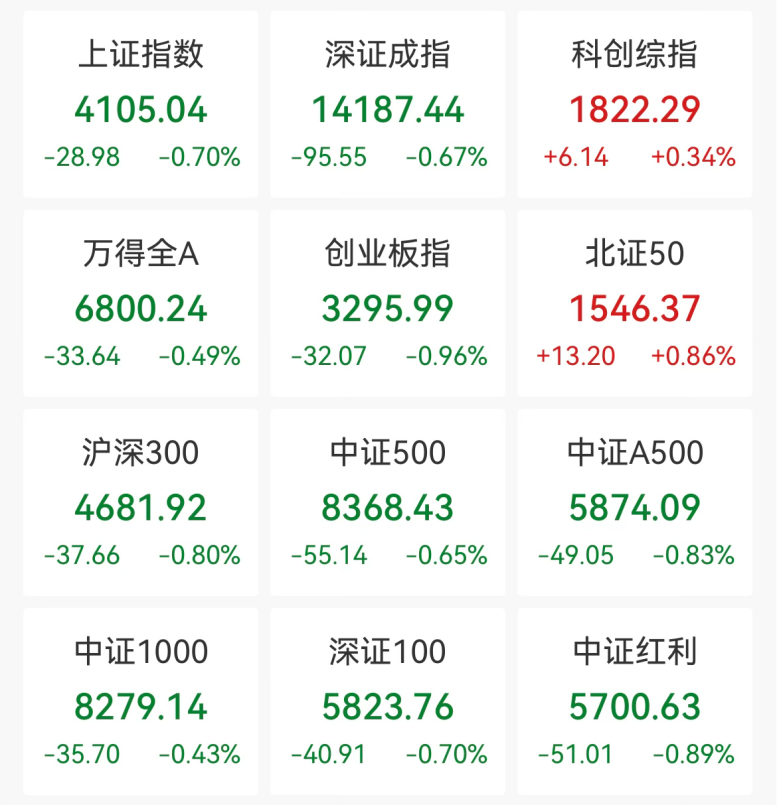
Market Overview - The A-share market opened lower and continued to decline, with the oil and gas sector leading the drop, while the commercial aerospace and semiconductor equipment sectors showed resilience [1][3] - As of midday, the Shanghai Composite Index was at 4105.04 points, down 0.7%, the Shenzhen Component Index fell 0.67%, and the ChiNext Index decreased by 0.96% [1][2] Oil and Gas Sector - The oil and gas sector experienced significant declines, with major companies such as China National Petroleum Corporation (down 4.53%), China Petroleum & Chemical Corporation (down 3.33%), and China National Offshore Oil Corporation (down 3.29%) all reporting losses [4][5] - The international oil prices fell nearly 3% due to decreased demand and expectations of increased supply, with NYMEX crude oil closing at $62.84 per barrel, down $1.79, and Brent crude at $67.52 per barrel, down $1.88 [4][5] Commercial Aerospace Sector - The commercial aerospace sector saw gains, with companies like Andavil reaching a 20% limit up, and other firms such as Hangzhou Aerospace Materials and Jiangxi Aerospace Equipment also experiencing significant increases [6][7] - A notable event was the completion of a financing round by a private commercial aerospace company, raising 5.037 billion yuan, setting a record for single financing in the sector [6] Semiconductor Equipment Sector - The semiconductor equipment sector showed a strong rebound, with stocks like Fuchuang Precision rising over 12% and Jingyi Equipment increasing by more than 7% [7][8] - A report from the Semiconductor Industry Association indicated that global semiconductor sales are expected to reach a record $791.7 billion in 2025, with a year-on-year growth of 25.6%, and China's semiconductor sales projected to exceed $200 billion for the first time [8][9] - The demand for semiconductor equipment is expected to grow significantly, driven by AI computing needs and strong demand for logic and memory chips [9]



中原证券晨会聚焦-20260211
Zhongyuan Securities· 2026-02-11 01:24
Key Insights - The report highlights the strong performance of the semiconductor industry, with a significant increase in capital expenditure from major cloud providers, indicating a robust demand for AI infrastructure [17][19][20] - The power and utilities sector is recommended for investment, with a focus on stable, high-dividend companies and emerging opportunities in virtual power plants and controlled nuclear fusion [22][24] - The chemical industry is experiencing a price recovery, with specific attention on sectors benefiting from anti-involution policies and rising oil prices [25][26] - The media sector is seeing growth driven by AI applications and favorable policy environments, with specific recommendations for gaming and film companies [37][39] Domestic Market Performance - The A-share market has shown slight upward movement, with the Shanghai Composite Index closing at 4,128.37, reflecting a 0.13% increase [3] - The average P/E ratios for the Shanghai Composite and ChiNext are 16.91 and 53.15, respectively, indicating a suitable environment for medium to long-term investments [8][12] International Market Performance - Major international indices such as the Dow Jones and S&P 500 have experienced slight declines, with the Dow down by 0.67% and the S&P 500 down by 0.45% [4] Industry Analysis - The semiconductor industry saw a 18.63% increase in January 2026, outperforming the broader market, with significant growth in integrated circuits and semiconductor materials [17][18] - The power sector's total installed capacity reached 3.89 billion kilowatts by the end of 2025, with a year-on-year growth of 16.1%, driven by renewable energy sources [22][23] - The chemical industry index rose by 10.13% in January 2026, with specific products like lithium hydroxide and butadiene showing strong price performance [25][26] Investment Recommendations - The report suggests a balanced investment strategy focusing on technology sectors, particularly AI and high-end manufacturing, while also considering consumer sectors for potential growth [5][9][12] - In the media sector, companies involved in gaming and film production are highlighted as having strong growth potential due to the integration of AI technologies [37][39]