
财务造假惩防

Search documents
两会|加强稳市机制建设 净化资本市场生态
证券时报· 2026-03-12 00:18
Group 1: Core Views - The development of a stable and healthy capital market relies on strong and effective regulation, with a focus on risk prevention, regulatory strength, and promoting high-quality development [1] - Strong regulation is essential for the high-quality development of the capital market, aiming to optimize the market ecosystem and create a fair trading environment [1] Group 2: Strengthening Market Stability Mechanisms - The capital market has made significant breakthroughs in establishing stability mechanisms and attracting long-term funds, with a focus on risk monitoring and enhancing strategic reserves [3] - The "stabilization fund" pilot program is expected to transition to a regular operation by 2026, serving as a stabilizing force in daily market operations [3] - Key measures include promoting long-term funds' entry into the market, enhancing regulatory tools, and improving investor protection mechanisms [4] Group 3: Combating Financial Fraud - Financial fraud is a significant threat to the capital market, with a comprehensive prevention and punishment system leading to a notable increase in the number of companies delisted for serious fraud [6] - The number of financial fraud cases accepted by courts has increased significantly, indicating a growing focus on accountability and deterrence [6] - Recommendations include increasing penalties for major stakeholders involved in financial fraud and enhancing the responsibilities of intermediary institutions [6][7] Group 4: Promoting Industry Norms - The healthy development of the capital market requires collaboration among all market participants, with a focus on guiding industry institutions to develop in a standardized manner [9] - There is an emphasis on enhancing compliance awareness and improving the quality of service among intermediary institutions [9] - The market is expected to see a continued strengthening of the alignment between public funds and investor interests, with new products and risk management tools being introduced [9][10]


证监会主席:创业板增设一套更加精准、更为包容的上市标准;允许在审企业面向老股东增资扩股;支持新型消费、现代服务业创业板上市
梧桐树下V· 2026-03-06 11:45
Core Viewpoint - The article emphasizes the importance of enhancing the inclusiveness and adaptability of the capital market to support high-quality development of emerging and future industries during the "14th Five-Year Plan" period [6][7][12]. Group 1: Capital Market Development - The capital market aims to achieve a direct financing amount of 64 trillion yuan during the "14th Five-Year Plan," with a direct financing ratio increasing to 31.97%, up by 3.2 percentage points from the end of the "13th Five-Year Plan" [6]. - The total market capitalization of A-shares exceeds 110 trillion yuan, with over 5,400 listed companies generating annual revenues exceeding half of the GDP [6]. - The proportion of strategic emerging industry companies in the CSI 300 index reaches 45%, indicating a growing momentum towards new and high-quality development [6]. Group 2: Regulatory Enhancements - The regulatory framework will focus on strengthening the supervision of listed companies, enhancing the detection and punishment of financial fraud, and ensuring strict enforcement of delisting requirements for fraudulent companies [2][17]. - The number of administrative penalties for market manipulation, insider trading, and financial fraud has increased by 82% and 39% in terms of quantity and amount, respectively, compared to the "13th Five-Year Plan" [6]. Group 3: Entrepreneurship Board Reforms - The article outlines plans to reform the ChiNext board to better support high-quality development of emerging industries by introducing more inclusive listing standards and promoting innovative enterprises [12]. - Key reforms include pre-IPO reviews for qualified innovative companies, allowing capital increases for companies under review, and optimizing new stock issuance pricing [12]. Group 4: Financing Mechanisms - The optimization of refinancing mechanisms is crucial for supporting listed companies in enhancing their strengths and fostering innovation [12][13]. - Measures will be taken to improve the convenience of refinancing processes, including optimizing the identification standards for strategic investors and enhancing the efficiency of review processes for high-quality companies [13]. Group 5: Investor Protection - The article emphasizes the need to strengthen the protection of investors' rights and interests, including improving dispute resolution channels and ensuring fair treatment in the market [19][20]. - The regulatory body will focus on preventing fraudulent activities that harm investors, ensuring that market participants adhere to principles of fairness and justice [20].

吴清最新表态
第一财经· 2026-03-06 11:39
Core Viewpoint - The article discusses the key points raised by the Chairman of the China Securities Regulatory Commission (CSRC), Wu Qing, regarding the reform and development of the capital market during the 14th National People's Congress, emphasizing the importance of high-quality development and risk prevention in the capital market [3]. Group 1: Capital Market Reforms - The CSRC plans to deepen the reform of the ChiNext board by introducing a more inclusive and precise set of listing standards to support innovative enterprises in new industries and services [5][6]. - A pre-review process for IPOs will be implemented for eligible ChiNext companies, allowing them to raise funds from existing shareholders and optimize new stock pricing [8]. - The CSRC aims to revise and introduce new regulations for securities companies and listed companies to enhance governance and protect investors [9]. Group 2: Investor Protection and Market Integrity - The CSRC will strengthen the protection of investor rights by improving dispute resolution channels and cracking down on market manipulation and misleading practices [10]. - There will be a focus on combating illegal activities in private equity funds and enhancing the regulation of high-frequency trading [11]. - The CSRC will enforce stricter regulations on refinancing practices to prevent misuse of raised funds [13]. Group 3: Market Stability and Quality - The CSRC emphasizes the importance of maintaining market stability and quality, with a commitment to rigorous enforcement against financial fraud and enhancing the quality of listed companies [15][21]. - The article highlights the need for a robust mechanism to ensure the authenticity of listed companies while improving their investment appeal [21]. - The CSRC aims to enhance the attractiveness of Chinese assets to international investors and promote deeper bilateral market openness [23].

吴清:进一步加大财务造假查处力度,对第三方配合造假强化一体打击
第一财经· 2026-03-06 10:19
Group 1 - The core viewpoint emphasizes the need for stricter enforcement against financial fraud in the capital market, highlighting that financial fraud is a significant threat to the market's foundation [1] - The China Securities Regulatory Commission (CSRC) has accelerated the establishment of a comprehensive system for punishing and preventing financial fraud, resulting in 16 listed companies being delisted due to severe fraud last year, a number significantly higher than in previous years [1] - The CSRC plans to enhance market discipline through multiple measures, including the introduction of new regulations and stricter enforcement against companies involved in financial fraud, aiming to eliminate the ecosystem that supports such fraudulent activities [1] Group 2 - Since the introduction of the new "National Nine Articles," the CSRC has focused on tackling major and severe violations, with 1,130 cases of securities and futures violations investigated in the past two years, resulting in fines totaling 30.8 billion yuan, setting a historical record [2] - The CSRC expresses a commitment to maintaining market stability while ensuring strict enforcement, indicating that while they do not wish to see record-high violations annually, they will respond decisively to any discovered cases [2] - The collaborative efforts from various parties have contributed to solidifying the foundation of market stability and enhancing the vitality of market activities [2]

A股大消息!刚刚,证监会主席吴清重磅发声
天天基金网· 2026-03-06 10:15
Core Viewpoint - The article discusses the upcoming reforms in China's capital markets, particularly focusing on the enhancement of the ChiNext board to support innovative enterprises and improve the overall quality of listed companies [2][3][22]. Group 1: ChiNext Board Reforms - The China Securities Regulatory Commission (CSRC) plans to deepen reforms on the ChiNext board, emphasizing its functional positioning and expanding its inclusivity and coverage [2]. - The CSRC will implement a set of more precise and inclusive listing standards to support new industries, new business formats, and new technology enterprises [2][3]. - The experience gained from the Sci-Tech Innovation Board (STAR Market) will be replicated in the ChiNext board, including priority reviews for IPOs and allowing qualified companies to raise funds from existing shareholders [3][17]. Group 2: Refinancing Mechanism Optimization - The CSRC aims to optimize the refinancing mechanism, enhancing the registration process and focusing on supporting high-quality listed companies with good governance and market recognition [5][18]. - New measures will include the introduction of shelf offerings and adjustments to the standards for strategic investors, promoting rational and effective financing [6][19]. - The emphasis will be on improving the efficiency of the review process for companies that meet the criteria of light assets and high R&D investment, extending these standards to the main board [5][18]. Group 3: Market Stability and Investor Protection - The article highlights the importance of maintaining market stability through robust risk monitoring and the introduction of long-term capital into the market [7][14]. - The CSRC will strengthen regulations to protect investor rights, including measures against market manipulation and financial fraud [13][27]. - The total market capitalization of A-shares has exceeded 110 trillion yuan, with over 5,400 listed companies generating revenue exceeding half of the GDP, indicating a strong market foundation [22][23]. Group 4: Financial Discipline and Governance - The CSRC will push for the establishment of new regulations for listed companies, enhancing the supervision of sponsor representatives and improving the governance standards [10][16]. - There will be a focus on combating financial fraud, with 16 companies delisted last year due to serious violations, and a commitment to strict enforcement against such behaviors [12][19]. - The article emphasizes the need for a comprehensive approach to enhance the quality and governance of listed companies, promoting better returns for investors [25].

高效监管护航资本市场新征程
Jing Ji Ri Bao· 2026-02-11 21:59
Core Viewpoint - In 2025, the capital market in China is navigating multiple risks while enhancing resilience and vitality, with the China Securities Regulatory Commission (CSRC) focusing on risk prevention, strong regulation, and promoting high-quality development [1] Regulatory Effectiveness - The effectiveness of capital market regulation is crucial for resource allocation efficiency, investor protection, and national financial security. In 2025, regulatory authorities emphasized stability while enhancing the five major regulatory chains: issuance, listing, trading, delisting, and ongoing supervision. A total of 701 cases were investigated, with fines amounting to 15.47 billion yuan, reflecting an increase in enforcement intensity and deterrent effects [2] - The regulatory practice in 2025 highlighted a strict tone, reinforcing precision and prevention, leading to enhanced regulatory effectiveness [2] Structural Challenges - The capital market faces three structural challenges: increasing market segmentation, more concealed and complex illegal activities, and a rapid increase in the number and types of market participants. These challenges necessitate a transformation in regulatory models to enhance effectiveness through legal, professional, technological, and collaborative approaches [3] Stringent Regulation - The CSRC maintained a strict regulatory approach in 2025, focusing on issues such as fraudulent issuance, financial fraud, market manipulation, and negligence by intermediaries. The regulatory framework was strengthened through on-site inspections of IPO applications, with 16 random checks and 4 problem-oriented checks conducted [4] - The quality of IPO applications improved significantly, with no withdrawals among the randomly selected companies, and 7 companies passing the review by the Shanghai Stock Exchange [5] Financial Fraud Prevention - The CSRC prioritized combating financial fraud in 2025, establishing a comprehensive accountability system and enhancing collaboration with various departments to tackle systemic and malicious fraud. The focus was on holding intermediaries accountable for negligence, thereby increasing the costs of illegal activities [5] Insider Trading and Market Manipulation - The regulatory authorities adopted a high-pressure approach against insider trading and market manipulation, utilizing technology to enhance detection and enforcement capabilities. In 2025, significant cases affecting small investors were swiftly addressed [6] Delisting Mechanism - A strict delisting mechanism was implemented in 2025, ensuring that companies involved in financial fraud or major violations were delisted, thus facilitating a market environment that favors quality companies [6] Legal Framework for Investor Protection - The legal framework supports investor rights through various avenues for compensation in cases of financial fraud or fraudulent issuance. This approach shifts investor protection from reactive to proactive measures [7] Institutional Innovation - Enhancing regulatory effectiveness requires both immediate enforcement and long-term institutional foundations. Recent cases signal a commitment to stringent regulation and precise enforcement [8] Future Regulatory Directions - The CSRC's 2026 work meeting outlined five key areas for regulatory focus: enhancing trading and information disclosure oversight, combating financial fraud, promoting investor protection, ensuring industry accountability, and leveraging technology for improved regulatory capabilities [9] Regulatory Team Development - The CSRC emphasized the importance of a competent regulatory team to maintain a high-pressure enforcement environment, focusing on significant cases of financial fraud and market manipulation [10] Capital Market Development - The capital market is at a critical stage of reform aimed at high-quality development, with a focus on zero tolerance for severe violations, precise regulation, technological empowerment, and collaborative governance [11][12]
证监会及多地证监局 “1号罚单”落地 哪些违规被率先处罚?
智通财经网· 2026-01-25 23:10
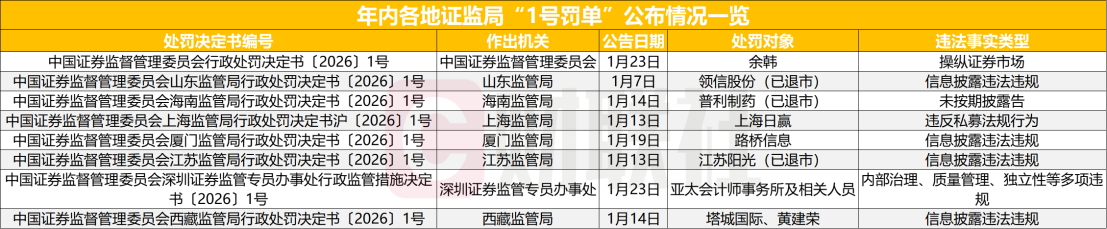
Regulatory Environment - The regulatory environment in China remains stringent, with multiple penalties issued by the China Securities Regulatory Commission (CSRC) and local regulatory bodies as of January 25, 2026 [1][2] - A total of eight "No. 1 penalty orders" for 2026 have been announced, indicating a clear trend of increased regulatory scrutiny [1][2] Penalty Orders Overview - The penalties cover various violations, including market manipulation, information disclosure violations, and internal governance issues [2] - Notably, several companies that have been delisted are still facing regulatory actions, reflecting a commitment to prevent the notion of "one delisting and done" [2][18] Case of Yu Han and Doctor Glasses - Yu Han was penalized for manipulating the stock price of Doctor Glasses (300622.SZ), with illegal gains of 5.11 billion yuan confiscated and an equal fine imposed, totaling 10.22 billion yuan [3][5] - The manipulation spanned 1,252 trading days and involved 67 accounts, marking it as one of the longest and most complex cases of individual market manipulation in recent years [5] Accounting Firms Under Scrutiny - The Shenzhen Securities Regulatory Bureau issued penalties to accounting firms, including Zhongshun Yatai, for serious issues in internal governance and audit quality [6][9] - Specific deficiencies included inadequate risk assessment and failure to comply with auditing standards, leading to regulatory measures against multiple firms [8][9] Delisted Companies and Accountability - Delisted companies are being held accountable for past violations, as seen in the case of Hainan Puli Pharmaceutical, which failed to disclose its annual report on time [10][11] - Jiangsu Sunshine also faced penalties for not timely disclosing significant related party transactions, resulting in fines for both the company and its executives [13][14] Overall Regulatory Trends - The regulatory framework is increasingly focused on preventing financial fraud and ensuring accountability among companies, as evidenced by the ongoing investigations into 91 delisted companies [18] - The collaborative efforts among regulatory bodies are enhancing the market ecosystem and improving compliance standards [18]

证监会及多地证监局出手,8张“1号罚单”落地
财联社· 2026-01-25 14:53
Core Viewpoint - The article highlights the ongoing strict regulatory environment in China's capital markets, evidenced by the issuance of multiple "first penalties" by various regulatory bodies in January 2026, targeting a range of violations including market manipulation and information disclosure failures [1][2]. Regulatory Actions - As of January 25, 2026, a total of eight "first penalties" have been issued by the China Securities Regulatory Commission (CSRC) and local regulatory bodies across several provinces [1]. - The penalties cover various violations such as market manipulation, information disclosure violations, and internal governance issues, with a notable focus on companies that have been delisted [2]. Notable Cases - The CSRC issued a significant penalty against Yu Han for manipulating the stock price of "BoShi Glasses," resulting in a total fine of 1.022 billion yuan, which includes the confiscation of illegal gains of 511 million yuan and an equal amount in fines [3][6]. - The manipulation involved 67 accounts over a period of 1,252 trading days, leading to a price increase of BoShi Glasses from 13.72 yuan to 37.81 yuan, a rise of 175.58% [3][6]. Accounting Firms Under Scrutiny - The Shenzhen Securities Regulatory Bureau issued penalties to multiple accounting firms, including ZhongShen YaTai, for serious issues related to internal governance and audit quality, leading to warnings and regulatory discussions [7][10]. - Specific deficiencies included inadequate risk assessments and failure to comply with auditing standards, affecting several listed companies [10][11]. Delisted Companies Accountability - Regulatory actions have also targeted delisted companies, such as Hainan Puli Pharmaceutical, which failed to disclose its annual report on time, resulting in a fine of 500,000 yuan for the company and 200,000 yuan for its chairman [12][13]. - Jiangsu Sunshine, another delisted company, faced penalties for failing to disclose significant related party transactions, leading to a total fine of 2 million yuan [16][19]. Overall Regulatory Environment - The regulatory stance reflects a commitment to preventing companies from evading accountability post-delisting, with 91 delisted companies under investigation for serious financial misconduct [22].

监管执法威慑不断提升 贵州资本市场生态不断净化
Zheng Quan Shi Bao· 2026-01-13 18:13
Core Viewpoint - Guizhou Securities Regulatory Bureau is committed to implementing the new "National Nine Articles" and enhancing regulatory measures to ensure the stable operation of the capital market, with a focus on combating financial fraud and improving market integrity [1][2]. Group 1: Regulatory Actions - In 2025, Guizhou Securities Regulatory Bureau conducted inspections on 111 companies and took 31 administrative regulatory measures along with 63 daily regulatory measures [1]. - Two financial fraud cases were seriously investigated, with proposed penalties amounting to 194 million yuan for two listed companies and 20 responsible individuals, including potential 5 to 10-year bans from the securities market for four individuals [1]. Group 2: Focus on Financial Fraud - Financial fraud is identified as a significant threat to market integrity and is met with a "zero tolerance" policy by the Guizhou Securities Regulatory Bureau, which aims to enhance the comprehensive punishment of such activities [1]. - The bureau emphasizes the importance of maintaining the principles of fairness, openness, and honesty in the market, which are essential for investor trust [1]. Group 3: Strengthening Oversight - The bureau plans to strengthen oversight of intermediary institutions such as sponsors, audit firms, law firms, and trustees, ensuring they fulfill their responsibilities diligently and improve their professional quality [1]. - A three-tier defense system is being established, focusing on corporate compliance, external audit supervision, and administrative regulation to enhance the governance structure of industry institutions [2]. Group 4: Future Directions - The Guizhou Securities Regulatory Bureau will continue to implement decisions from the central government and regulatory bodies, focusing on risk prevention, strict regulation, and promoting high-quality development in the capital market [2]. - The bureau aims to enhance regulatory effectiveness and protect investors' legitimate rights and interests while ensuring the stability of the capital market [2].
投融资改革协同推进 资本市场持续稳中向好
Shang Hai Zheng Quan Bao· 2026-01-12 18:35
Group 1: Long-term Capital Inflow - Since September 2024, various guidelines and implementation plans have been introduced to promote long-term capital inflow into the market, including long-cycle assessments and pilot programs for insurance funds' long-term stock investments [1] - By the end of 2025, the total market value of A-shares held by various long-term funds is expected to reach approximately 23 trillion yuan, a 36% increase from the beginning of the year, with equity fund sizes growing from 8.4 trillion yuan to around 11 trillion yuan [1] - The transformation towards "patient capital" is expected to be driven by policies such as tax incentives and long-term assessment mechanisms, encouraging social security funds, corporate annuities, and insurance funds to enter the market [1] Group 2: Regulatory Environment - Recent investigations into companies like Tianpu Co. and Changyao Holdings highlight the stringent regulatory environment aimed at enhancing market integrity and deterring financial fraud [2] - The China Securities Regulatory Commission (CSRC) has coordinated with multiple departments to build a well-regulated market ecosystem, resulting in 159 financial fraud cases being investigated and 111 administrative penalties issued since the beginning of 2024, amounting to 8.1 billion yuan in fines [2] - The establishment of a clear and severe punishment system is expected to deter fraudulent activities and redirect capital towards well-governed and competitive enterprises [3]