货币信用体系重构

Search documents
14连增!央行囤金不停,金价还能飞多高?
Guo Ji Jin Rong Bao· 2026-01-07 15:06
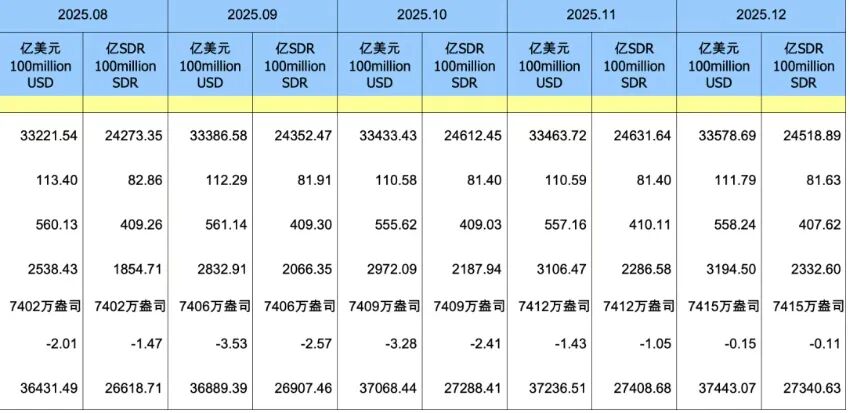
Core Viewpoint - As of December 2025, China's foreign exchange reserves reached $335.79 billion, marking an increase of $1.15 billion from the end of November, reflecting a growth rate of 0.34% [1] Group 1: Foreign Exchange Reserves - The foreign exchange reserves in China increased to $335.79 billion by the end of December 2025, up from $334.64 billion in November [1][2] - The rise in reserves is attributed to the depreciation of the US dollar index and fluctuations in global financial asset prices, alongside stable long-term economic conditions in China [3] Group 2: Gold Reserves - China's gold reserves reached 7.415 million ounces by the end of December 2025, an increase of 30,000 ounces from November, marking the 14th consecutive month of gold accumulation [2][3] - In 2025, China's total gold reserves increased by 860,000 ounces, reflecting a strong trend of central bank gold purchases globally [2][4] Group 3: Market Trends and Predictions - The global gold price saw a significant increase in 2025, with the London gold price rising over 60% throughout the year, driven by a restructuring of the monetary credit system and geopolitical tensions affecting the dollar's reserve status [3][4] - A survey by the World Gold Council indicated that 76% of central banks expect to increase their gold reserves over the next five years, up from 46% in 2022, highlighting a growing trend of gold accumulation as a hedge against inflation and economic uncertainty [4]

爆买潮来袭!黄金定价逻辑迎世纪之变,明年如何走?
Zheng Quan Shi Bao Wang· 2025-12-09 23:40
Core Viewpoint - Gold is experiencing a historic surge in 2025, with prices surpassing $4,300 per ounce, reflecting a significant shift in global capital's perception of monetary credit systems [1][2]. Group 1: Historical Context and Value of Gold - Throughout history, gold has maintained its status as a symbol of "constant value," contrasting with fiat currencies that rely on credit [1]. - The transition from the gold standard to a credit-based monetary system has not diminished gold's role as a "confidence anchor" over the past fifty years [2]. - Gold's price has risen from $35 per ounce in 1971 to current highs, demonstrating its stability during various economic crises [2]. Group 2: Changes in Gold Pricing Logic - Traditional gold pricing is influenced by its monetary, financial, and commodity attributes, which have shifted in importance over time [3]. - The classic pricing model has been disrupted since 2022, with gold's monetary attributes becoming the primary driver of its price, despite high real interest rates [4]. Group 3: Central Bank Behavior and Global Trends - Central banks are diversifying their foreign exchange reserves, with gold purchases exceeding 1,000 tons annually from 2022 to 2024, indicating a shift towards gold as a hedge against uncertainty [5]. - Emerging market central banks, including China's, have been particularly active in increasing gold reserves, reflecting a growing trend of using gold as a sovereign credit hedge [6]. Group 4: Geopolitical Factors and Demand for Gold - The complex global geopolitical landscape has heightened the demand for gold as a long-term safe-haven asset, reinforcing its role as a value consensus across cultures [6]. - Historical parallels suggest that current economic conditions, including excessive credit currency issuance and high fiscal deficits, align with previous gold bull markets [6]. Group 5: Market Dynamics and Future Outlook - The current gold price increase is part of a "consensus reinforcement positive cycle," driven by expectations of adjustments in the global monetary system [7]. - Historical data indicates that gold bull markets typically last around 32 months with an average increase of 172%, suggesting potential for further price appreciation [8]. Group 6: Investment Strategies and Recommendations - Investors are advised to view gold as a stabilizing asset in their portfolios rather than a speculative tool, with a recommended allocation of 5% to 10% of household assets [11][12]. - Gold ETFs, such as Huaxia (518850), offer a low-cost entry point for investors, with a management fee of only 0.2% [12]. - For those seeking higher risk and potential returns, gold equity ETFs provide exposure to the gold mining sector, which may benefit from rising gold prices [13].
2025年10月15日今日金价多少钱一克,各大品牌金店国内金价国际金价查询
Sou Hu Cai Jing· 2025-10-15 04:03
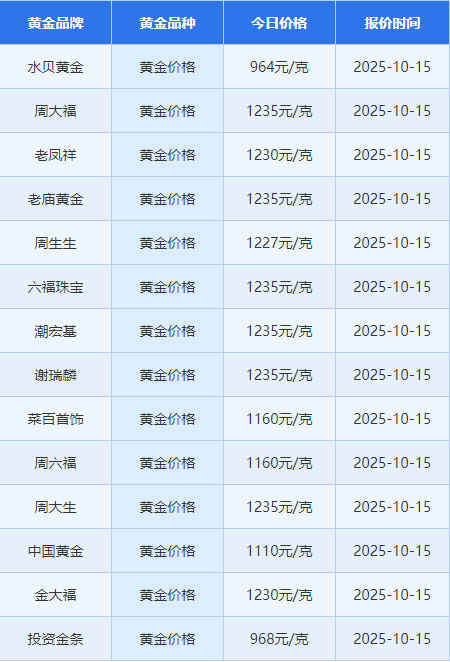
Core Insights - The current gold market is experiencing a strong cycle driven by "safe-haven demand + policy expectations," with technical breakthroughs opening up upward space after reaching historical highs [2] - Geopolitical tensions and Federal Reserve policy movements are key variables influencing short-term gold prices [2] - The global economic trend of "de-dollarization" and restructuring of the monetary credit system will continue to strengthen gold's strategic position in the medium to long term [2] Price Movements - As of October 15, 2025, spot gold prices surged by 1% to $4,186.61, while New York futures rose to $4,205.80, setting a new historical high [1] - The latest international gold spot price is $4,184 per ounce, equivalent to approximately ¥958 per gram [2] - Gold T+D is reported at ¥953.8 per gram, up by ¥11.95, a rise of 1.27% [3] - Shanghai gold main contract is priced at ¥956.74 per gram, increasing by ¥16.1, a rise of 1.71%, also reaching a historical high [3] Retail Prices - Retail prices for physical gold from brands like Chow Tai Fook and Chow Sang Sang exceed ¥1,230 per gram, with daily increases ranging from 1.65% to 1.99% [3] - Bank investment gold bar prices range between ¥959 and ¥988 per gram, with increases of 0.73% to 2.54% [3]
突发!金价大跌
Sou Hu Cai Jing· 2025-10-01 06:17
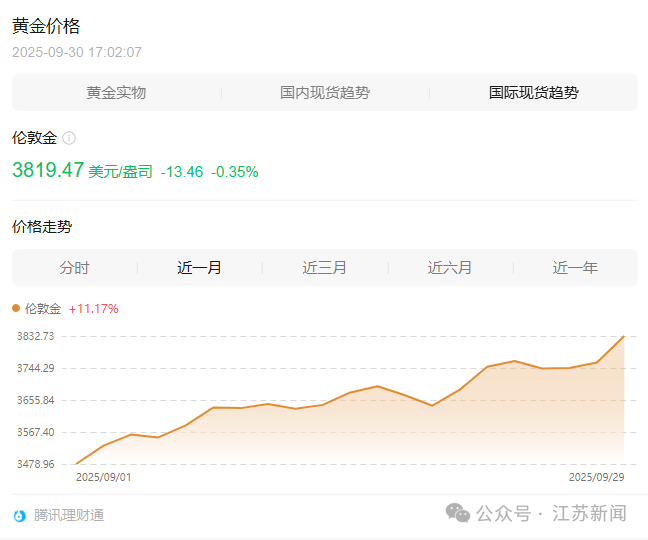
Core Viewpoint - The recent surge in gold prices has been attributed to a combination of factors including the Federal Reserve's shift towards interest rate cuts, strong global demand for safe-haven assets, and changes in gold's pricing logic due to de-dollarization trends and central bank purchases [3]. Group 1: Gold Price Movement - On September 30, the spot gold price reached a historic high of $3871.73 per ounce before retreating to $3819.47 per ounce [1]. - The upward trend in gold prices has persisted for seven days, breaking previous highs, with the last peak recorded at $3791.08 per ounce on September 23 [3]. Group 2: Factors Influencing Gold Prices - The Federal Reserve's entry into a rate-cutting phase has diminished the attractiveness of the US dollar, thereby enhancing the investment value of gold [3]. - High levels of US debt, increasing geopolitical uncertainties, and ongoing central bank gold purchases are contributing to the underlying support for gold prices [3]. Group 3: Changing Pricing Logic of Gold - The pricing logic of gold is undergoing significant changes, moving away from direct correlations with US dollar interest rates and inflation expectations [3]. - Factors such as de-dollarization, global central bank demand for gold, and the restructuring of the monetary credit system are positioning gold as a core asset in the new financial order [3].
金价突然大跌!
Sou Hu Cai Jing· 2025-09-30 15:51
Core Viewpoint - The recent fluctuations in gold and silver prices are attributed to a combination of factors including the Federal Reserve's shift towards interest rate cuts, strong global demand for safe-haven assets, and changes in the pricing logic of gold [1] Group 1: Price Movements - Spot gold prices experienced a rapid decline, breaking below $3,800 per ounce after reaching a record high of $3,871 per ounce earlier in the day, marking a daily drop of over 0.8% [1] - Spot silver fell by 1.88%, settling at $46.02 per ounce [1] - The recent rally in gold prices has lasted for seven days, consistently surpassing previous highs, with the last peak recorded at $3,791.08 per ounce on September 23 [1] Group 2: Underlying Factors - The Federal Reserve's entry into a rate-cutting phase has diminished the attractiveness of the US dollar, thereby enhancing the investment value of gold [1] - High levels of US debt, increasing geopolitical uncertainties, and ongoing gold purchases by central banks worldwide are contributing to the support for gold prices [1] Group 3: Changing Pricing Logic - The pricing logic of gold is undergoing significant changes, moving away from its traditional correlation with US dollar interest rates and inflation expectations [1] - Factors such as the trend of de-dollarization, global central bank demand for gold, and the restructuring of the monetary credit system are positioning gold as a core asset in the new financial order [1]

“一口价”产品也涨价了,黄金为何这么猛?
Sou Hu Cai Jing· 2025-09-30 00:56
Core Insights - The recent surge in gold prices has significantly impacted the market for fixed-price gold products, leading to price increases of 200 to 500 yuan for certain items, with some styles rising by several thousand yuan [1] - The price of spot gold reached a historical high of over 3700 USD per ounce in mid-September, marking a nearly 40% increase in gold prices this year, which has raised production, procurement, and inventory costs for brands [1][2] - The shift in gold pricing logic is influenced by factors such as de-dollarization, global central bank gold purchases, and the restructuring of the monetary credit system, positioning gold as a core asset in the new financial order [2] Market Dynamics - The Federal Reserve's recent decision to lower the federal funds rate by 25 basis points has diminished the attractiveness of the dollar and enhanced the comparative value of gold, as lower interest rates make non-yielding assets like gold more appealing [2] - Ongoing global demand for safe-haven assets, driven by high U.S. debt levels, geopolitical uncertainties, and continuous gold purchases by central banks, supports the upward trend in gold prices [2] - The increase in consumer discussions on social media reflects a growing sensitivity to future uncertainties, with some consumers expressing concerns over high processing fees for fixed-price gold products while others rush to purchase before further price hikes [1][3] Investment Considerations - Fixed-price gold products emphasize design and craftsmanship, often carrying a premium that exceeds real-time gold prices, suggesting limited potential for value appreciation compared to traditional gold investments [3] - For better investment opportunities, gold ETFs are recommended, such as the Huaxia Gold ETF (518850), which tracks a basket of gold spot contracts, and the gold stock ETF (159562), which invests in a range of gold companies, providing indirect benefits from rising gold prices [3] - The current gold price surge reflects a broader market sentiment, indicating that gold may play an increasingly important role in asset allocation as the Federal Reserve continues to lower rates and global central banks maintain their gold purchasing strategies [3]