质量文化

Search documents
探究海信的“信”循环:质量将信仰转化为信任
Zhong Guo Zhi Liang Xin Wen Wang· 2026-02-03 07:59
Core Viewpoint - Quality is not only the lifeline of manufacturing but also a crucial support for companies to gain an advantage in global competition and secure their future. The transformation of quality from a mere management target to a core belief driving sustainable growth is essential for long-term success in the industry [1]. Group 1: The Concept of "Trust" in Quality - The essence of quality at Hisense is rooted in the concept of "trust," which embodies honesty, user-centric commitment, and a moral imperative integrated into the company's culture [3][4]. - Hisense's commitment to quality is reflected in its historical lessons, particularly a significant quality issue in 1977 that shaped its understanding that "quality is the life of the enterprise" [4]. - The company established the "Quality Seven Military Regulations" in 2002, elevating quality principles to a high-level management mandate, making quality a critical performance metric for executives [5]. Group 2: Quality Management System - Hisense has developed a comprehensive global quality management system that spans research and development, supply chain, manufacturing, sales, and service, ensuring consistent quality across all operations [6]. - The introduction of the AI-driven "AI+SPACE management model" enhances quality management efficiency and effectiveness through intelligent, precise, and real-time quality control [7]. - Hisense actively participates in setting international standards, having led the development of 78 international standards and over 660 national and industry standards, using the strictest benchmarks to drive internal improvements [8]. Group 3: User Trust and Feedback Mechanisms - The company emphasizes that user trust can only be earned through reliable product delivery and exceptional experiences, which are integral to its quality management approach [6][9]. - Hisense has implemented the "VOC User Voice Insight Platform," which utilizes AI to analyze millions of user feedbacks, transforming user insights into actionable improvements across departments [11]. - The company's sponsorship of major global events, such as the FIFA World Cup, reflects its confidence in the quality of its products, which has led to increased brand loyalty and market share [11]. Group 4: The "Trust-Quality" Cycle - The interplay between "trust" and "quality" creates a positive feedback loop, where user trust reinforces the company's internal beliefs, driving continuous innovation and improvement [10][12]. - Hisense's commitment to quality has earned it numerous accolades, including nominations for the China Quality Award and the Asia Quality Excellence Award, showcasing its leadership in high-quality standards [12].



从一滴水到一瓶酒的质量坚守
Zhong Guo Zhi Liang Xin Wen Wang· 2025-10-23 08:26
Core Insights - Guizhou Xijiu held its 2026 Production and Quality Conference to enhance production quality and set new goals for the upcoming year [1][2] - The company aims to transition from quantity accumulation to quality enhancement, focusing on strategic layout, brand building, product quality, and organizational efficiency [2][7] - Xijiu's brand value reached 3090.86 billion, ranking 7th in China's liquor industry, showcasing its growth despite industry adjustments [2] Group 1: Quality Management and Cultural Initiatives - Xijiu emphasizes a strict quality management standard, with "quality is life" as a guiding principle throughout all processes [3][4] - The company promotes quality culture through various activities, including forums and training sessions, to enhance quality awareness among employees [4][8] - Xijiu has implemented a comprehensive quality management system, ensuring stable procurement, continuous improvement in process quality, and effective service quality [3][5] Group 2: Resource Development and Innovation - The company is strengthening its supply chain by expanding local raw material bases and ensuring stable grain supply [5][6] - Xijiu is enhancing its talent pool through a three-year development plan and collaboration with experts and educational institutions [5][6] - The company is investing in research and development, focusing on new technologies and processes to improve product quality and meet consumer demands [6][7] Group 3: Future Goals and Strategic Vision - Xijiu aims to achieve high-quality development and modernization, with 2025 marking the planning year for the "15th Five-Year Plan" [10] - The company is committed to maintaining its quality standards while balancing production and market demands, ensuring a sustainable growth trajectory [7][10] - Xijiu plans to leverage its cultural heritage and innovative practices to contribute significantly to the prosperity of the Chinese liquor industry [10]

别让“小变化”毁掉大质量——4M变更管理的真相
3 6 Ke· 2025-10-21 02:44
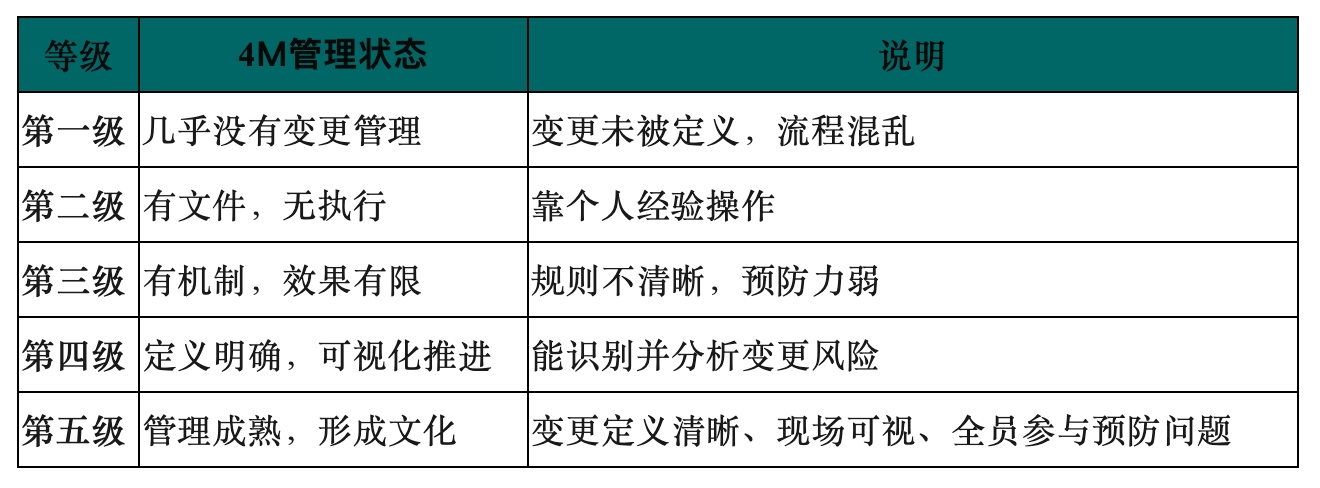
Core Insights - The essence of change point management is not merely to document changes but to identify risks, control changes, and prevent issues [3][4][22] - Effective factories integrate change point management into their operational culture, ensuring that every minor change in the 4M (Man, Machine, Material, Method) is recognized and acted upon [9][10][12] - A failure in change point management can lead to significant quality issues, as seen in the case of a factory that lost its "S-level" status due to unmonitored changes in inspection standards [14][21][22] Change Point Management - Change point management is crucial for identifying potential quality risks associated with changes in the four key elements: people, machines, materials, and methods [4][5] - Strong factories proactively assess changes, such as new suppliers, to ensure that product quality remains unaffected [5][6] - Many factories struggle with change management, often relying on paperwork without actual observation or preventive actions [11][28] Visibility and Awareness - Effective change management requires that all changes are visible and understood by all employees, fostering a culture of awareness regarding potential risks [34][35] - A clear definition of what constitutes a change is essential for effective management; vague terms can lead to misunderstandings and ineffective practices [30][33] - The management of changes should be a collective effort, with all employees engaged in recognizing and addressing changes [38] Case Study: Quality Crisis - A factory that was once trusted by clients faced a crisis when unapproved changes to inspection standards led to products that no longer met technical requirements [16][18] - The initial acceptance of deviations as exceptions became a norm, resulting in a gradual erosion of quality control [20][22] - The failure to manage changes effectively turned what should have been a controlled process into a habitual oversight, ultimately damaging client trust [22][24] Levels of Change Management - The effectiveness of change management can be assessed through a tiered system, ranging from no management to a mature culture of change awareness [38] - Strong factories are characterized by clear definitions of changes, visible tracking of modifications, and active participation from all employees in managing changes [38]
“质量月”升级“质量季”兴齐眼药打造企业质量文化亮丽标签
Zhong Guo Zhi Liang Xin Wen Wang· 2025-09-02 08:25
Core Viewpoint - The company is upgrading its "Quality Month" initiative to "Quality Season" to enhance quality management and cultural promotion, reflecting a commitment to quality standards and employee engagement [1][2][4]. Group 1: Quality Season Activities - The "Quality Season" will span two to three months starting in September, focusing on various dimensions such as quality culture, capability enhancement, innovation practices, and results promotion [3][4]. - Activities planned include management lectures, logo design competitions, quality management model presentations, quality knowledge lectures, skill competitions, and evaluations of outstanding quality personnel [3][4]. Group 2: Employee Engagement and Participation - The number of participants in quality activities has increased significantly, with over 2,600 employees involved in the 2024 "Quality Month," marking a new high [2]. - The company aims for deeper engagement, with participants taking on active roles in quality management rather than being mere observers [4]. Group 3: Strategic Importance - The initiative reflects the company's high-level commitment to quality work and culture, adhering to the principle that "first-class standards create first-class quality" [4]. - The transition to "Quality Season" is seen as a new starting point for deepening quality efforts within the company [4].

聊聊项目团队中管理者如何树立威信
Sou Hu Cai Jing· 2025-08-08 02:19
Core Insights - Establishing credibility in the internet industry relies on "professional credibility" and "team influence" due to its results-oriented nature [1] - Traditional authoritative management is ineffective in fast-paced internet teams, where credibility stems from the ability to solve problems others cannot [1] Group 1: Strategies for Building Credibility - New testing managers should focus on three key areas: using data to communicate (e.g., showing historical defect distribution), addressing team pain points (e.g., optimizing CI pipeline duration), and personally participating in key module testing [3] - Quantifying quality risks with data (e.g., "payment interface response delay P99 > 2s could lead to a 15% loss in order conversion during promotions") helps teams recognize unseen risks [4] - Providing actionable solutions alongside problem identification (e.g., "suggest using traffic recording playback to complete payment link automation, expected to reduce 50% regression manpower") is crucial [4] Group 2: Enhancing Team Collaboration - Creating visible value for testing engineers by allowing them to present automation tool results in cross-department meetings [5] - Applying engineering methods to improve efficiency, such as developing tools for test data generation and establishing knowledge bases for recurring issues [6] - Adapting communication to agile rhythms, like using daily stand-ups to highlight key risks and replacing lengthy reports with visual dashboards [6] Group 3: Fostering a Quality Culture - Initiating monthly "Best Quality Guardian" awards voted by product and operations teams promotes a culture of quality [8] - Setting up a "quality red-black list" in the office to publicly display key indicator improvements encourages accountability [8] - Emphasizing the importance of transforming business requirements into testable solutions rather than merely relaying them [8] Group 4: Indicators of Credibility - Trust capital accumulation can be verified through signals such as developers seeking input from the testing team during technical reviews [10] - Allocating time for risk assessment in scheduling meetings indicates the value placed on testing insights [10] - The mantra "Credibility = Professional Depth × Collaborative Warmth × Output Effectiveness" encapsulates the essence of sustainable leadership in fast-paced environments [10]