贸易结构升级

Search documents
从传统货物到“新三样”
Ren Min Ri Bao· 2026-01-28 23:16
Core Insights - The Lizi Port in Tibet, which opened in November 2023, is experiencing increased activity with domestic electric vehicles queuing for export, indicating a shift in trade dynamics [1] - By September 2025, the port is expected to link with the Shigatse International Land Port, with export values projected to exceed 100 million yuan [1] - The trade structure is evolving from primarily exporting basic products like mineral salt to higher value-added products such as "new three samples" and large machinery [1] Trade and Economic Impact - In 2025, the Lizi Port is projected to handle 13,710 tons of cargo with a total value of 75.4 million yuan [1] - The port's operations have facilitated smoother movement of goods and people, with approximately 46,000 travelers recorded in 2025, marking a year-on-year increase of over 50% [1] - Local economic development is being stimulated by the port, with initiatives like the establishment of specialty shops to promote local products, such as dried beef, benefiting the community [1]
解锁首破45万亿元外贸的成长密码
Zheng Quan Ri Bao· 2026-01-14 16:14
Core Insights - China's foreign trade achieved a record high of 45.47 trillion yuan in 2025, marking a 3.8% year-on-year growth and maintaining a growth trend for nine consecutive years [1][4] Group 1: Trade Structure Changes - The diversification of markets has strengthened China's foreign trade, with trade relations established with over 240 countries and regions, and over 190 of them experiencing import and export growth [1] - Trade with Belt and Road Initiative countries reached 23.6 trillion yuan, a 6.3% increase, accounting for 51.9% of total trade, with exports to emerging markets like Africa and Latin America growing by 18.4% and 6.5% respectively [1][2] Group 2: Export Structure Upgrade - High-tech product exports grew by 13.2%, significantly outpacing overall export growth, with green products like "new three items" and wind turbine generators seeing increases of 27.1% and 48.7% respectively [2] - The export of self-owned brand products rose by 12.9%, increasing their share of total exports by 1.4 percentage points, indicating a shift towards brand-oriented exports [2] Group 3: Corporate Vitality - Over 780,000 entities recorded import and export activities in 2025, with private enterprises' exports increasing by 7.1%, now accounting for 57.3% of total trade [3] - The customs authority has implemented 29 policy measures to facilitate cross-border trade, enhancing the interaction between policy support and corporate efforts [3] Group 4: Future Outlook - The foundation of China's foreign trade remains solid, with expectations for continued growth driven by new trade formats like cross-border e-commerce and market procurement [3][4] - The successful completion of the "14th Five-Year Plan" and the beginning of the "15th Five-Year Plan" provide a strong starting point for future trade development [4]
我国贸易顺差首次超1万亿美元
Sou Hu Cai Jing· 2025-12-10 05:45
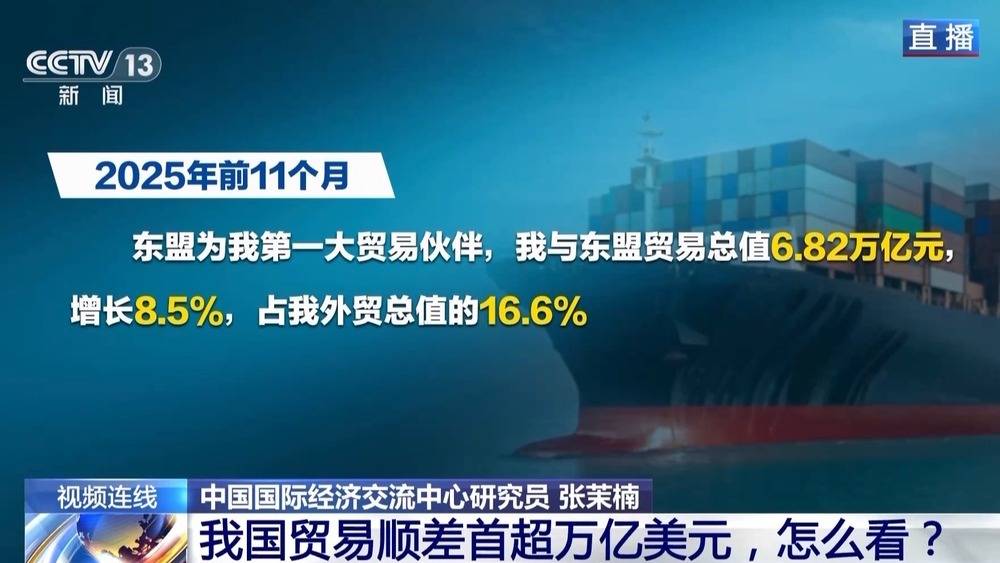
Core Insights - China's trade surplus has exceeded $1 trillion for the first time in the first 11 months of the year, with private enterprises accounting for 57.1% of the total foreign trade value [1] - The resilience of China's foreign trade is attributed to its comprehensive advantages in manufacturing and global trade, as well as the optimization of trade and industrial structures [1][3] Group 1: Trade Performance - China's position as the world's largest trading and manufacturing country is further emphasized, with a significant portion of industrial products ranking at the top globally [1] - The trade structure has been diversified, with emerging markets becoming key growth drivers, particularly in trade with ASEAN and the EU [1] - Despite a decline in exports to the U.S., China's overall trade surplus has increased, indicating a strengthening of trade relationships with other countries [3] Group 2: Trade Structure Changes - The trade structure between China and the EU has shifted significantly, with a 14.8% increase in exports to the EU in November, and the trade surplus expected to exceed €350 billion [4] - The similarity in the top ten export products between China and the EU suggests a transition from vertical to horizontal division of labor, which may lead to increased trade friction [4] - To mitigate potential trade tensions, China aims to enhance imports from the EU and increase investments to balance trade relations [4] Group 3: Economic Policy Adjustments - Future economic policies will focus on counter-cyclical and cross-cyclical adjustments, utilizing structural policy tools such as tax, financial, and credit measures [6] - This approach aims to provide targeted support to market participants and enterprises rather than relying on large-scale fiscal stimulus [6]
贸易顺差首超万亿美元 中国外贸韧性源自哪
Sou Hu Cai Jing· 2025-12-10 02:37
Core Insights - China's trade surplus has exceeded $1 trillion for the first time in the first 11 months of the year, with private enterprises accounting for 57.1% of the total foreign trade value [1] Group 1: Trade Resilience - China's position as the largest trading and manufacturing nation globally is a key factor in its trade resilience, supported by a comprehensive industrial structure and supply chain [2][4] - The diversification of trade, particularly with emerging markets, has contributed significantly to trade growth, with notable increases in trade with ASEAN and the EU [2][4] Group 2: Trade Structure Optimization - The trade structure is continuously optimizing, moving towards high-end industrial chains, with industrial products like integrated circuits, machinery, and automobiles being the main drivers of trade growth [4] - Despite a decline in exports to the U.S., China's overall trade surplus has increased, indicating a strengthening of trade relationships with other countries [5] Group 3: China-EU Trade Dynamics - There has been a significant shift in the trade structure between China and the EU, with a 14.8% increase in exports to the EU in November, and a projected trade deficit for the EU with China exceeding €350 billion [6] - The similarity in the top traded products between China and the EU suggests a shift from vertical to horizontal division of labor, which may lead to increased trade tensions [6] Group 4: Future Trade Strategies - China aims to balance trade relations with the EU by increasing imports of services and agricultural products, as well as enhancing investments in the EU [7] - Future macroeconomic adjustments will focus on counter-cyclical and cross-cyclical measures, utilizing structural policy tools for more precise market support [8]