资产分散化

Search documents
海外资金持续加码 美国30年期国债拍卖表现亮眼 公开竞标需求创历史新高
智通财经网· 2026-02-20 15:18
Core Viewpoint - The demand for long-term U.S. Treasury bonds remains strong amid ongoing macroeconomic uncertainties, indicating a sustained interest from investors in these assets [1] Group 1: Auction Results - The latest 30-year U.S. Treasury bond auction showed robust demand, with multiple bidding indicators performing exceptionally well, reflecting broad participation from various investor groups [1] - The public bidding demand reached a historical high, showcasing the depth of demand for long-term U.S. Treasuries [1] Group 2: Foreign Investment - The indirect bidders, representing overseas demand, received 69.8% of the allocation, significantly above the historical average of 64%, indicating that global investors still find long-term U.S. Treasuries attractive [1] - This interest is driven by considerations of yield, safe-haven attributes, and asset diversification [1] Group 3: Market Dynamics - Primary dealers only took up 5.9% of the issuance, suggesting that the actual demand from end investors was sufficient to absorb the entire issuance, indicating strong market absorption capacity [1] - The overall indicators from the auction suggest that the demand for long-term U.S. Treasuries remains robust, with no signs of diminished interest from investors [1]
年内涨幅超60%达利欧最新撰文,直面回答关于黄金的六大“高能”问题
Sou Hu Cai Jing· 2025-10-20 18:54
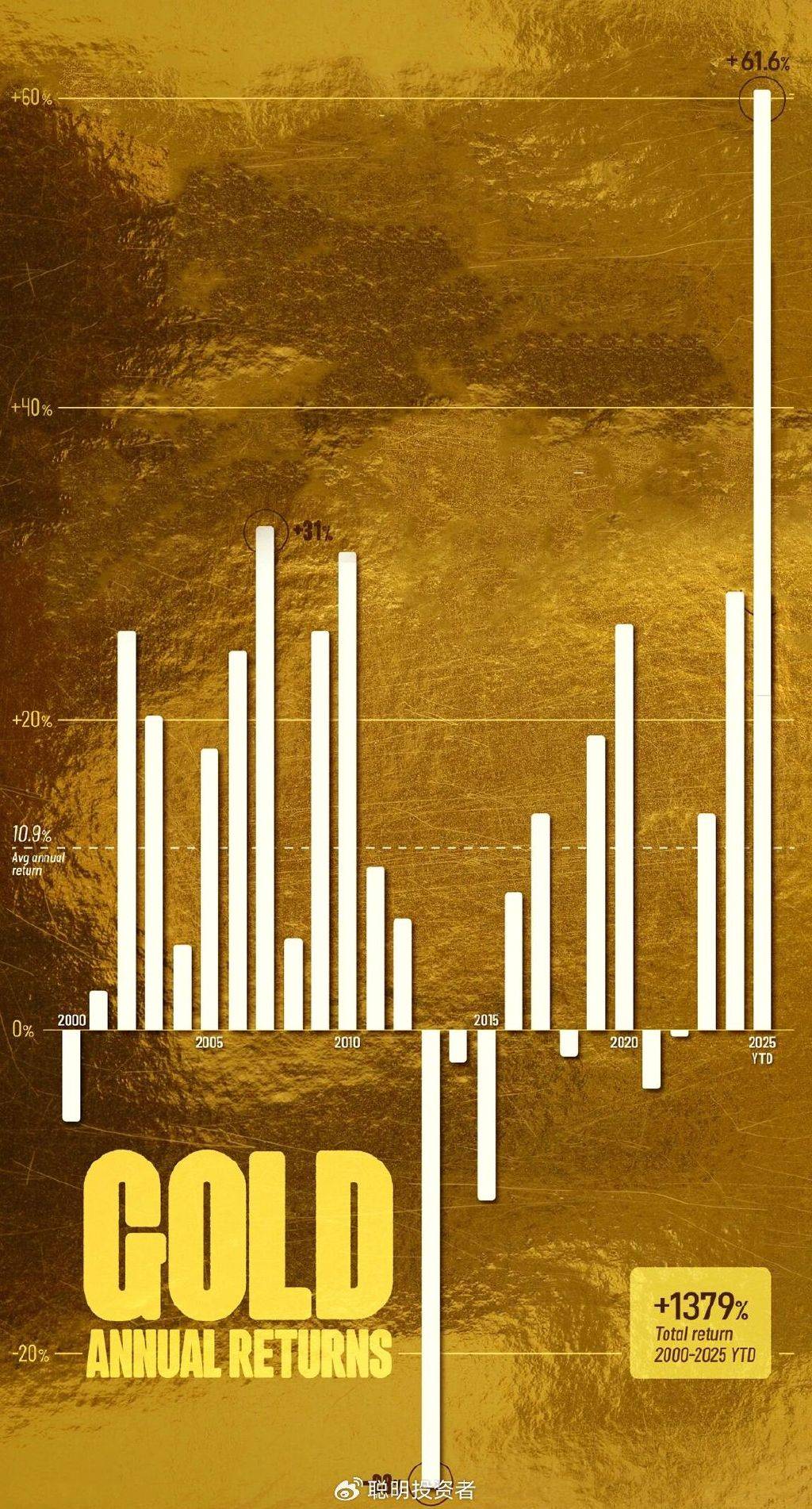
Core Viewpoint - The article highlights the significant rise in gold prices in 2024, with an increase of over 61% by October 17, 2025, marking it as one of the largest annual gains since 2000 [1][4]. Group 1: Gold Market Insights - Gold has been recognized as a major investment asset, with its price potentially reaching $5,000 to $10,000 according to JPMorgan CEO Jamie Dimon [4]. - Ray Dalio emphasizes the importance of gold as a stable form of currency rather than just a metal, arguing that it serves as a hedge against debt and currency devaluation [9][12]. - Dalio suggests that gold should constitute about 10% to 15% of an investment portfolio for optimal risk-return balance, especially during times of economic uncertainty [36][35]. Group 2: Comparison with Other Assets - Unlike other metals such as silver and platinum, gold is viewed as a unique asset due to its lack of credit risk and its role as a universal medium of exchange [17][18]. - Dalio argues that while AI stocks may have high growth potential, their long-term value is uncertain, and they are subject to market volatility, unlike gold which provides a more stable investment [29][30]. - The rise of gold ETFs has increased market liquidity, but they are still smaller in scale compared to physical gold and central bank reserves, thus not being the primary driver of gold price increases [38][39]. Group 3: Gold as a Safe Haven - Gold is increasingly being viewed as a "risk-free asset," replacing U.S. Treasury bonds in many institutional portfolios, particularly among central banks [40][41]. - The historical performance of gold demonstrates its resilience as a store of value, especially during periods of economic crisis when fiat currencies may depreciate [45][46]. - Dalio notes that the intrinsic value of gold is not dependent on any repayment promise, making it a reliable asset across different economic conditions [45][46].

年内涨幅超60%!达利欧回答关于黄金的六大“高能”问题
Ge Long Hui· 2025-10-20 07:11
Core Insights - The article emphasizes that 2024 is proving to be an exceptional year for gold, with prices rising significantly, surpassing 61% year-to-date as of October 17, 2025, making it one of the largest annual increases since 2000 [2][3] - Notable financial figures, including Jamie Dimon of JPMorgan, express uncertainty about gold's valuation, suggesting it could rise to $5,000 or even $10,000, indicating a shift in perception towards gold as a viable investment [2][3] - Ray Dalio's insights on gold's role in investment portfolios are highlighted, particularly in the context of economic uncertainty and debt crises [2][4] Group 1: Gold's Investment Value - Dalio argues that gold should be viewed as a form of currency rather than just a metal, emphasizing its historical stability and role as a hedge against debt and currency devaluation [7][10] - The article discusses the unique position of gold as a non-debt asset, contrasting it with other commodities like silver and platinum, which are more influenced by industrial demand [13][14] - Dalio suggests that a strategic allocation of 10% to 15% of an investment portfolio in gold is reasonable for most investors, optimizing risk and return [27][29] Group 2: Market Dynamics and Trends - The rise of gold ETFs has increased market liquidity and accessibility for retail and institutional investors, although they remain smaller than physical gold and central bank reserves [32] - Dalio notes that gold is increasingly replacing U.S. Treasury bonds as a "risk-free asset" in many institutional portfolios, highlighting its status as a mature form of currency [33][34] - Historical trends indicate that gold has maintained its value over time, unlike fiat currencies, which have often depreciated or disappeared [36][37]
年内涨幅超60%!达利欧最新撰文,直面回答关于黄金的六大“高能”问题
聪明投资者· 2025-10-20 03:34
Core Viewpoint - The article emphasizes that 2024 is a significant year for gold, with prices rising dramatically, and suggests that gold is increasingly viewed as a crucial asset in investment portfolios [2][3]. Group 1: Gold Price Trends - Gold prices have surged over 61% as of October 17, 2025, marking one of the largest annual increases since 2000 [3]. - The price of gold is projected to potentially reach $5,000 to $10,000, indicating a strong bullish sentiment among market leaders [5]. Group 2: Investment Perspectives - Ray Dalio argues that gold should be viewed as a form of currency rather than just a metal, highlighting its historical role as a stable monetary asset [10][11]. - Dalio believes that gold serves as a hedge against debt and currency devaluation, making it a fundamental investment choice [13][14]. Group 3: Comparison with Other Assets - Gold is preferred over other metals like silver and platinum due to its unique position as a widely accepted form of "non-debt" currency, which carries no credit risk [16][17]. - Unlike bonds, which are subject to government credit risk, gold is seen as a true "risk-free asset" in many institutional portfolios [36][37]. Group 4: Strategic Asset Allocation - Dalio suggests that a strategic allocation of 10% to 15% of an investment portfolio should be in gold to optimize risk and return [30][31]. - The article discusses the importance of maintaining a diversified portfolio, especially in light of potential economic downturns [24][28]. Group 5: Market Dynamics - The rise of gold ETFs has increased market liquidity and accessibility, but they are not the primary driver of gold price increases [35]. - Institutional investors are increasingly reallocating assets from U.S. Treasuries to gold, reflecting a shift in perception of risk and value [36][38].

新兴国央行增持黄金,中国连续7个月净买入
日经中文网· 2025-06-16 03:46
Core Viewpoint - Central banks, particularly in emerging markets, are increasingly purchasing gold as a safe asset, leading to a significant rise in gold prices, with predictions suggesting prices could reach between $3,100 and $3,500 per ounce in the second half of the year, and potentially up to $3,900 if trade tensions escalate [1][4]. Group 1: Central Bank Activities - The People's Bank of China (PBOC) has been consistently buying gold, with a net purchase of approximately 1.9 tons in May, marking seven consecutive months of net buying, bringing its total reserves to about 2,296 tons, which is 2.7 times that of Japan's central bank [1][2]. - China's gold holdings as a percentage of its foreign exchange reserves have increased to 6.7%, doubling over the past three years, reflecting a strategic move to reduce dependence on the US dollar [2][3]. - Poland's central bank has set a target for gold to constitute 20% of its foreign exchange reserves, achieving this goal in early 2025, driven by geopolitical tensions in the region [2]. Group 2: Market Predictions and Trends - The average gold reserve ratio among central banks globally is 22.2% as of March 2025, with many central banks aiming for a 20% target [2]. - The price of gold reached a historical high of over $3,500 per ounce in April, currently stabilizing between $3,300 and $3,400, with forecasts suggesting it could exceed historical highs if global economic uncertainties persist [4][5]. - JPMorgan forecasts an average gold price of $3,675 for the last quarter of 2025, maintaining an optimistic outlook due to sustained high levels of purchases by central banks and public institutions [5].
新兴国央行增持黄金,中国连续7个月净买入
日经中文网· 2025-06-16 03:46
Core Viewpoint - Central banks are increasingly purchasing gold as a safe asset, with predictions for gold prices to range between $3,100 and $3,500 per ounce in the second half of the year, potentially rising to $3,900 if trade tensions escalate and global economic uncertainty increases [1][4]. Group 1: Central Bank Activities - Emerging market central banks are significantly increasing their gold reserves, with China's gold holdings doubling in the past three years to 6.7% of its foreign exchange reserves [2][3]. - The People's Bank of China (PBOC) reported a net purchase of approximately 1.9 tons of gold in May, marking seven consecutive months of net buying, bringing its total reserves to about 2,296 tons, which is 2.7 times that of Japan's central bank [1][3]. - Poland's central bank aims for gold to constitute 20% of its foreign exchange reserves and has already surpassed this target in early 2025, driven by geopolitical tensions [3][4]. Group 2: Market Predictions and Trends - The average gold reserve ratio among central banks globally is 22.2%, with many considering a target of 20% [3][4]. - Gold prices are currently high, with the New York futures market reaching over $3,500 per ounce, and predictions suggest prices could remain between $3,100 and $3,500, with a possibility of exceeding historical highs if economic conditions worsen [4][5]. - JPMorgan forecasts an average gold price of $3,675 for the last quarter of 2025, reflecting a positive outlook due to sustained high levels of central bank purchases [5].