资产提升

Search documents
存20万元送电饭煲 银行鏖战开门红的双面策略
Xin Lang Cai Jing· 2026-02-11 16:40
Core Viewpoint - The traditional "deposit gift" activities in banks are diminishing due to stricter regulations and a shift towards asset management strategies, with banks focusing on enhancing their asset management scale (AUM) rather than merely attracting deposits through gifts [1][7]. Group 1: Changes in Banking Activities - Many banks have reduced traditional "deposit gift" activities, opting instead for incentive mechanisms that comply with regulations, such as point systems for new deposits [1][7]. - The atmosphere for the "opening red" season is less vibrant this year compared to previous years, attributed to regulatory pressures and a lack of urgency in attracting deposits [1][7]. - Banks are increasingly emphasizing asset enhancement strategies, moving away from the concept of merely attracting deposits [1][8]. Group 2: Incentive Programs - Some banks are offering point-based rewards for new deposits, where customers can exchange points for household items and small appliances, but the overall incentive strength is limited [2][3]. - The threshold for receiving gifts varies significantly between banks, with some requiring higher new deposit amounts for more valuable items [3][6]. - Despite the introduction of these incentive programs, customer engagement remains low, with few customers participating in these activities [3][6]. Group 3: Regulatory Environment - The regulatory environment has become stricter, with explicit prohibitions against using gifts to attract deposits, leading to a decline in such practices [6][7]. - Recent regulatory measures have reinforced the ban on deposit gifts, pushing banks to adapt their strategies accordingly [6][7]. - The shift towards compliance has resulted in a transformation of traditional activities into point redemption and rights acquisition, rather than direct gifts linked to deposits [7][8]. Group 4: Market Trends - The banking sector is experiencing a shift towards asset diversification, with customers increasingly considering investments in financial products beyond traditional deposits [8]. - The trend of rising stock market activity is leading to a more dynamic approach to deposits, with customers showing a willingness to diversify their financial portfolios [8].
存20万元送电饭煲,银行开门红从鼓励“薅羊毛”到“配资产”
Di Yi Cai Jing· 2026-02-11 13:51
Core Viewpoint - The banking sector is experiencing a shift in deposit strategies, moving away from traditional gift-giving practices to focus on asset management and customer engagement through incentive programs amid a low-interest-rate environment [1][5][6]. Group 1: Deposit Strategies - Banks are reducing traditional "deposit gift" activities due to stricter regulations and declining deposit interest rates, with a shift towards incentivizing asset management [1][5]. - The "opening red" period, crucial for banks to capture market share, is less vibrant this year due to regulatory pressures and a lack of urgency in deposit acquisition [1][6]. - Many banks are now offering points-based reward systems for new deposits, where customers can exchange points for household items and small appliances [2][3]. Group 2: Regulatory Environment - Regulatory bodies have prohibited banks from using gifts or cash incentives to attract deposits, leading to a significant reduction in such activities [5][6]. - The implementation of stricter internal controls and compliance measures has resulted in a decline in traditional gift-giving practices, with banks adapting to new incentive structures [5][6]. Group 3: Market Trends - The current market environment is characterized by a shift towards non-bank deposits and increased customer interest in diversified financial products, reflecting a change in risk appetite among depositors [6][7]. - Analysts predict an increase in M2 and M1 growth rates, indicating a potential rise in overall liquidity and a shift in consumer behavior towards more active asset management [6][7]. - The trend of banks focusing on enhancing the overall asset scale of customers, including deposits, investments, and insurance products, is becoming more pronounced as they adapt to the changing financial landscape [7].
瞄准年终奖!银行新动作,力推“资产提升”
券商中国· 2026-01-26 06:22
Core Viewpoint - Banks are launching "asset enhancement" activities to attract year-end bonuses and optimize their asset-liability structure, aiming to increase customer engagement and diversify their business offerings [2][3]. Group 1: Bank Activities - Multiple banks have introduced incentives for customers whose average financial assets increase, offering rewards such as WeChat discounts for meeting specific asset thresholds [2]. - For example, China Bank's Shenzhen branch offers WeChat discounts ranging from 100 to 260 yuan for customers increasing their average monthly assets to between 200,000 and 500,000 yuan [2]. - Everbright Bank has a special event for salary clients, allowing them to win consumption discounts by increasing their average monthly assets by specified amounts [2]. Group 2: Market Context - Analysts indicate that banks are targeting year-end bonuses as they represent stable and concentrated funds, which align with the banks' needs to optimize their liability structure and alleviate interest margin pressures [2][3]. - The wealth management business is becoming increasingly important for banks amid ongoing regulatory changes and pressure on interest margins [3]. Group 3: Investment Products - Major banks are promoting year-end bonus investment products through their wealth management subsidiaries, with some products offering annualized returns as high as 4.76% [3]. - The banking industry's wealth management market reached a scale of 33.29 trillion yuan by the end of 2025, reflecting an 11.15% growth from the beginning of the year [3]. Group 4: Customer Guidance - Analysts recommend that banks should enhance customer financial literacy and provide tailored investment solutions based on individual risk profiles and time horizons for using their year-end bonuses [4]. - Customers are advised to consider liquidity and risk when selecting investment products, with suggestions to avoid long lock-in periods for funds they may need in the short term [4].


存款江湖变天遇上开门红:大行拼“资产提升”,小行逆势提利率
Di Yi Cai Jing· 2026-01-14 16:57
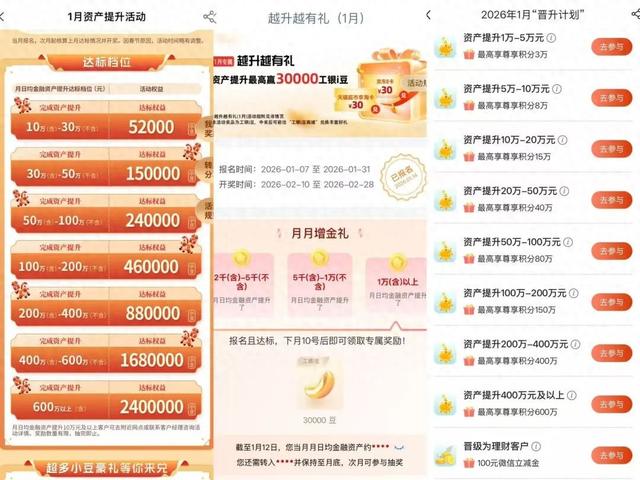
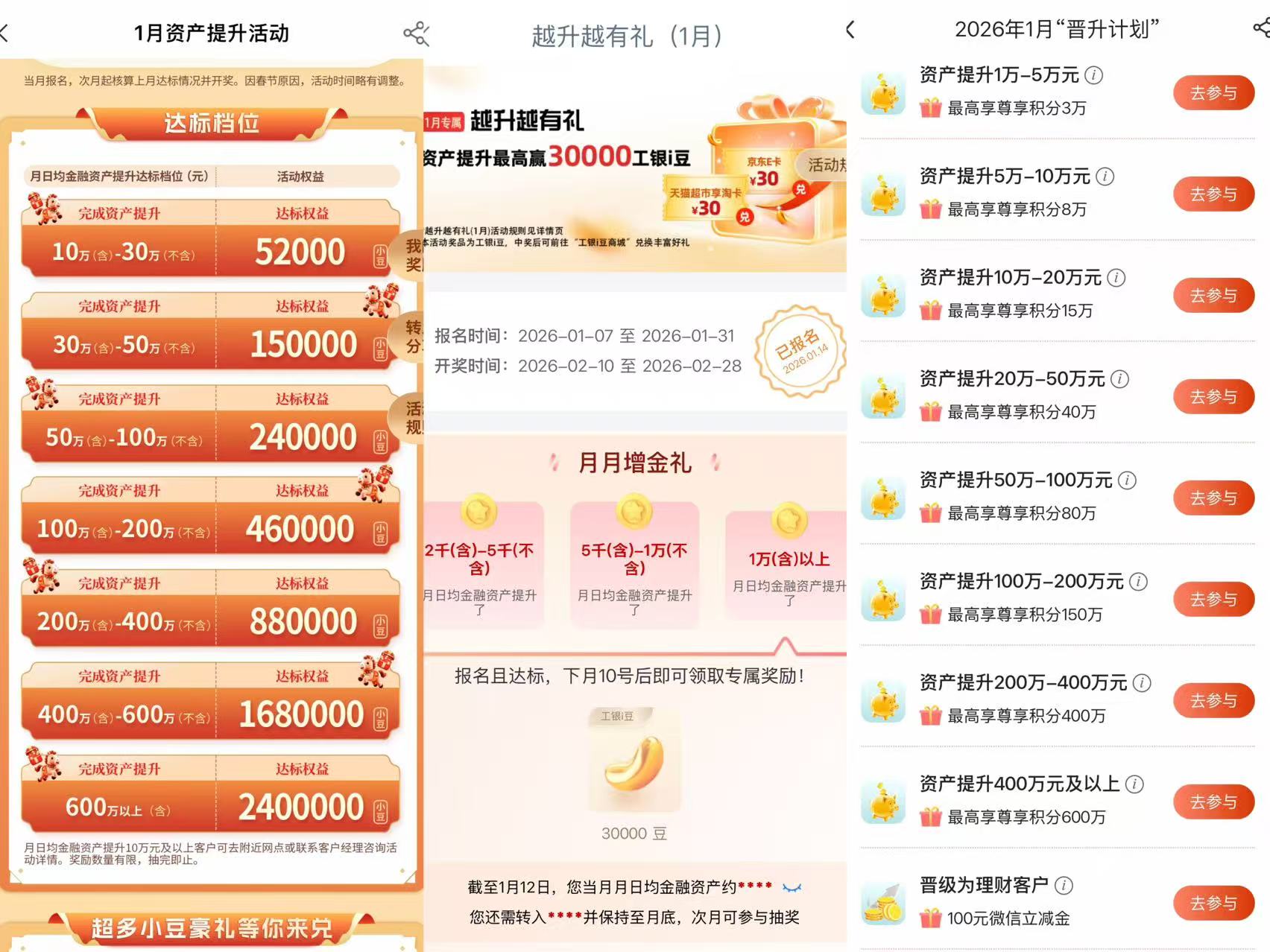
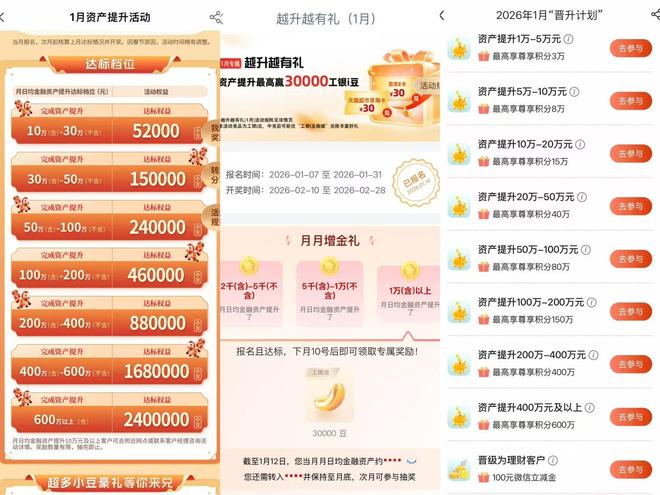
Core Insights - Major banks are launching "opening red" activities to attract depositors, focusing on enhancing various financial asset scales amid declining interest rates and expiring fixed deposits [1][9] - State-owned banks are shifting their strategy from merely attracting deposits to enhancing assets under management (AUM) and strengthening wealth management, with a clear urgency for retail strategy transformation by 2026 [1][10] Group 1: Asset Enhancement Activities - Agricultural Bank of China has initiated a "Unified Asset Enhancement Activity" from January to March 2026, offering rewards based on the increase in monthly average financial assets, with seven tiers of rewards ranging from 52,000 to 2,400,000 small beans [3][4] - Industrial and Commercial Bank of China (ICBC) has a similar program targeting customers with average financial assets below 10,000, offering rewards based on asset increases, with rewards ranging from 5,000 to 30,000 ICBC beans [5] - Other banks like China Construction Bank and Bank of China are also launching asset enhancement activities with various reward structures, indicating a competitive landscape among banks [5] Group 2: Interest Rate Adjustments - Some small and medium-sized banks are raising deposit interest rates to attract customers, with increases of up to 20 basis points, reflecting a strategy to counteract deposit outflows [1][9] - For instance, Hubei Macheng Rural Commercial Bank has raised rates on several deposit products, with the highest rate reaching 1.6% for certain terms [10][11] - Jiangsu Bank has also introduced high-interest fixed deposit products, indicating a trend among smaller banks to offer competitive rates to retain customers [11] Group 3: Customer Engagement Strategies - Social media platforms are buzzing with strategies shared by users on how to maximize benefits from various banks' asset enhancement activities, indicating a growing consumer awareness and engagement [7][8] - Banks are increasingly using these promotional activities not just for attracting deposits but also as tools for maintaining customer relationships, reflecting a shift in traditional banking strategies [10]




存款江湖变天
Di Yi Cai Jing Zi Xun· 2026-01-14 15:15
Core Viewpoint - Major banks are shifting their focus from attracting deposits to enhancing assets under management (AUM) and wealth management, especially as they face declining interest rates and pressure to reduce liability costs [2][3]. Group 1: Asset Enhancement Activities - National banks have launched attractive "asset enhancement" activities, with rewards for customers reaching up to over 10,000 yuan for meeting certain deposit thresholds [2]. - Agricultural Bank of China has set a unified asset enhancement activity from January to March 2026, with seven tiers of rewards based on AUM increases, ranging from 52,000 to 2,400,000 small beans [5][6]. - Industrial and Commercial Bank of China (ICBC) offers rewards based on monthly average financial asset increases, with tiers providing rewards of 5,000 to 30,000 ICBC beans [7]. Group 2: Market Dynamics and Strategies - Smaller banks are raising deposit rates to attract customers, with increases of up to 20 basis points, while larger banks focus on enhancing their wealth management strategies [2][10]. - The total amount of term deposits maturing in 2026 is estimated to be 67 trillion yuan, with a significant portion maturing in the first quarter, creating competitive pressure on banks [10]. - Banks are increasingly guiding customers with maturing deposits towards wealth management products, as traditional deposit rates are no longer competitive [11]. Group 3: Customer Engagement and Social Media Trends - Social media platforms are buzzing with strategies for customers to maximize benefits from various banks' asset enhancement activities, indicating a growing trend of consumer engagement in financial products [9]. - The competitive landscape is prompting banks to refine their customer relationship management, transforming traditional deposit products into tools for maintaining customer loyalty [11].
银行开门红新风向:大行推“资产提升” 小行逆势提利率
Di Yi Cai Jing· 2026-01-14 13:59
Group 1 - The core focus of major banks has shifted from attracting deposits to enhancing assets under management (AUM) and strengthening wealth management, particularly as they face pressures from declining interest rates and expiring fixed deposits [2][9] - State-owned banks have launched attractive "asset enhancement" activities, offering significant rewards for customers who increase their financial asset holdings, with some rewards exceeding 10,000 yuan [1][4] - Smaller banks are responding to year-end deposit acquisition pressures by temporarily raising deposit interest rates, with increases of up to 20 basis points reported [1][11] Group 2 - Agricultural Bank of China has introduced a structured "asset enhancement activity" from January to March 2026, with various reward tiers based on the increase in monthly average financial assets, allowing customers to earn up to 7.2 million "small beans" for meeting the highest tier [4][5] - Industrial and Commercial Bank of China has also launched similar initiatives, offering rewards based on the increase in monthly average financial assets, with potential rewards ranging from 5,000 to 30,000 "ICBC beans" [6][9] - Other banks, including China Construction Bank and Bank of China, have introduced their own asset enhancement programs, with varying reward structures and incentives for customers [6][8] Group 3 - The upcoming maturity of a significant volume of fixed deposits, estimated at 67 trillion yuan in 2026, presents both challenges and opportunities for banks as they navigate customer retention and interest rate adjustments [9][10] - Some banks are strategically guiding customers with maturing fixed deposits towards wealth management products, as traditional deposit rates are no longer competitive [10][11] - The competitive landscape is intensifying as banks adapt their strategies to maintain customer relationships and mitigate deposit outflows to smaller banks, which may offer more attractive rates [10][11]
银行开门红新风向:大行推“资产提升”,小行逆势提利率
Di Yi Cai Jing Zi Xun· 2026-01-14 13:13
Core Viewpoint - Major banks are shifting their focus from attracting deposits to enhancing assets under management (AUM) and wealth management, particularly as they face pressures from declining interest rates and expiring fixed deposits [2][11]. Group 1: Asset Enhancement Activities - State-owned banks have launched attractive "asset enhancement" campaigns, with rewards for customers based on the increase in their financial assets, with some rewards exceeding 10,000 yuan [1][2]. - Agricultural Bank of China has set up a structured asset enhancement activity with seven tiers based on the increase in AUM, offering rewards ranging from 52,000 to 2,400,000 "small beans" [4][5]. - The rewards can be exchanged for various goods and services, with the highest tier potentially offering over 12,000 yuan in value [5]. Group 2: Competitive Strategies - Banks are increasingly focusing on wealth management and middle-income strategies as a response to slow credit demand and ongoing cost reduction pressures [11]. - Some banks are adjusting their deposit rates, with smaller banks raising rates by up to 20 basis points to attract deposits amid competition [1][10]. - The shift towards enhancing AUM is seen as a strategic move to maintain customer relationships and prevent deposit outflows to smaller banks [11]. Group 3: Market Dynamics - The total amount of fixed deposits maturing in 2026 is projected to be 67 trillion yuan, with a significant portion maturing in the first quarter, creating a competitive environment for banks [10]. - The trend of increasing deposit rates by smaller banks poses a challenge to larger banks, which are focusing on maintaining customer loyalty through enhanced service offerings [11][12].
多家银行推出资产提升活动,奖励达标客户
Mei Ri Jing Ji Xin Wen· 2026-01-09 00:29
Group 1 - Several banks, including Jiangsu Bank, Agricultural Bank, Construction Bank, and Nanjing Bank, have launched asset enhancement activities to encourage customers to increase their bank assets [1] - Jiangsu Bank announced that customers who increase their average monthly assets in the first three months of the year compared to the end of the previous year will receive related rewards [1] - The trend of banks initiating asset enhancement programs indicates a competitive environment in the banking sector aimed at attracting and retaining customers [1]


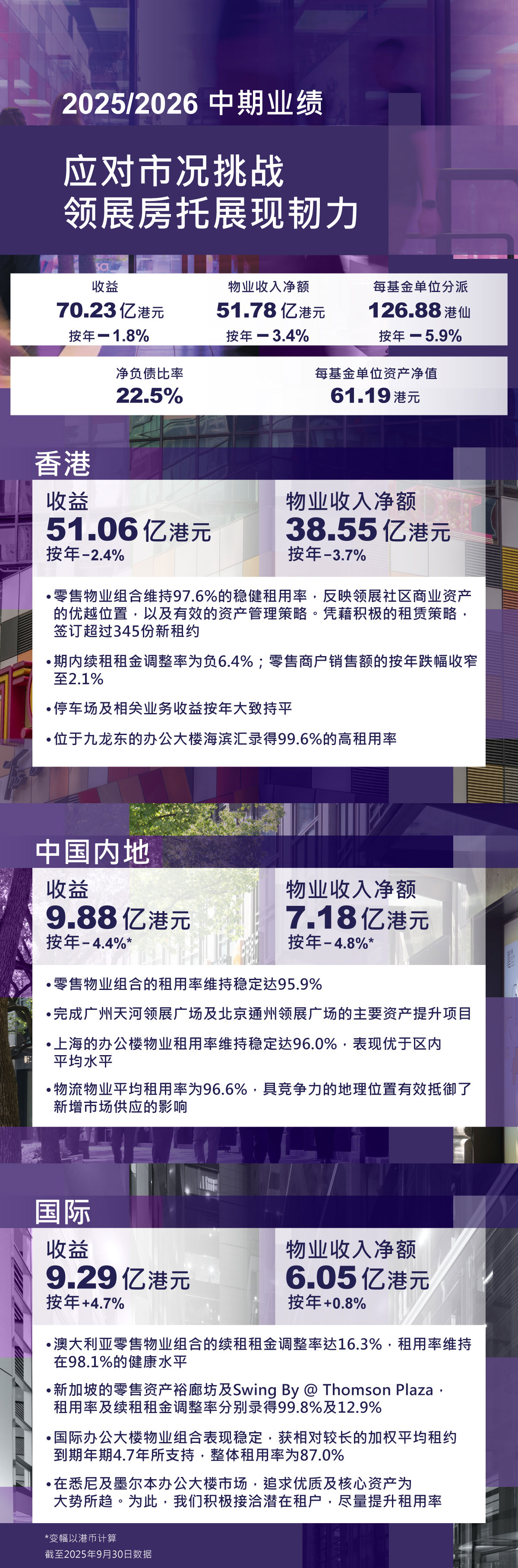
领展房托发布半年业绩 应对市况挑战展现韧力
Zheng Quan Shi Bao Wang· 2025-11-20 08:27
Core Viewpoint - Link REIT demonstrates resilience in its interim performance for the six months ending September 30, 2025, despite facing significant macroeconomic challenges and a complex market environment [1][2]. Financial Performance - Total revenue and property net income decreased by 1.8% and 3.4% year-on-year, reaching HKD 70.23 billion and HKD 51.78 billion, respectively, primarily due to negative rental adjustments in Hong Kong and mainland China [8]. - The total distributable amount fell by 5.6% year-on-year to HKD 32.83 billion, with the distribution per fund unit down by 5.9% to HKD 1.2688 [8]. - The net debt ratio remained low at 22.5% as of September 30, 2025 [8]. Property Performance - The retail property portfolio maintained a stable occupancy rate of 97.6%, reflecting effective asset management strategies [6][11]. - The rental adjustment rate for renewals was negative 6.4%, with retail sales declining by 2.1% year-on-year [11]. - In mainland China, the retail property portfolio's occupancy rate remained high at 95.9%, despite a negative rental adjustment rate of 16.4% [9]. Regional Insights - Hong Kong's retail sector shows signs of recovery, although the full realization of rental income will take time [11]. - The Australian retail property portfolio saw a rental adjustment rate of 16.3% and an occupancy rate of 98.1%, with tenant sales increasing by 15.3% year-on-year [14]. - Singapore's retail assets maintained strong performance with occupancy rates at 99.8% and a rental adjustment rate of 12.9% [14]. Capital Management - The company benefits from a solid capital base and liquidity, with a slight increase in the debt ratio to 24.1% as of September 30, 2025 [16]. - The total debt amount rose to HKD 55 billion, with fixed-rate debt comprising 65.8% of total debt [16]. - The average borrowing cost decreased from 3.58% to 3.22% [16].