
资源价值重估

Search documents
油价中枢抬高,哪些行业受益?
雪球· 2026-03-13 08:09
Group 1 - The article discusses the recent increase in oil prices and its impact on the upstream oil and gas sector, highlighting the revaluation of resource value and increased cash flow for upstream giants like CNOOC and PetroChina [4] - The oil service industry is expected to benefit from increased capital expenditure by oil and gas companies, leading to improved business for firms like China Oilfield Services and Jereh [4] - The coal chemical sector presents a unique structural opportunity in the A-share market, focusing on the cost advantage of coal over high-priced oil, with leading companies like Baofeng Energy and Hualu Hengsheng showing strong performance [4] Group 2 - Supply shocks from overseas production cuts are driving price increases in certain commodities, with companies like Yun Aluminum and Xingfa Group benefiting from China's stable energy supply and competitive export capabilities [5] - The resilience of the A-share market is noted, with strong performance across the identified sectors, and an expectation for increased trading volume in the future [6]




稀土价格创历史新高!中国管制措施加码,全球资源争夺战已打响
Sou Hu Cai Jing· 2026-02-11 11:16
Group 1 - Recent prices of various rare earth minerals have reached historical highs, with non-ferrous metals like copper, aluminum, and tin also experiencing significant price increases [1] - Analysts attribute the surge in rare earth prices to China's stricter export controls, and anticipate a comprehensive revaluation of key resources due to the U.S. "Treasury Plan" and China's increased copper strategic reserves [1] Group 2 - The rapid development of AI has made it a significant consumer of resources, with computational power demands doubling every 3.5 months, leading to increased demand for metals in data centers and power grid construction [3] - The World Economic Forum predicts that by 2035, global data center capacity will triple, and investments in power grids will reach trillions of dollars, enhancing the "AI value" of metals [3] - Vanadium, crucial for energy storage, has a value contribution of 29% in power grid facilities, while copper is essential across AI infrastructure, facing supply constraints due to resource depletion [3] Group 3 - Geopolitical dynamics are creating a "safety premium" for resources, with countries prioritizing strategic autonomy and recognizing key minerals as central to national security [4] - Historical precedents show that safety demands can surpass industrial cycles, leading to significant price surges for metals during geopolitical tensions [4][5] - Recent export control measures from resource-rich countries, such as cobalt bans from the Democratic Republic of Congo and rare earth controls from China, have further elevated safety premiums [5] Group 4 - Investment themes emerging from the intersection of AI demand and geopolitical risks include copper, which is vital for both AI infrastructure and defense industries, and rare earth elements like neodymium and dysprosium, which are critical for AI chips and military applications [7] - Vanadium is recognized as a rising star in energy storage, while lithium and aluminum are experiencing rapid demand growth driven by AI and electric vehicles [7] - Gold remains a traditional hedge against uncertainty, while silver offers both industrial and financial attributes, making it a flexible investment choice [7] Group 5 - The structural bull market for commodities may just be beginning, driven by the dual forces of the AI revolution and safety premiums, positioning resource assets as a new battleground for capital [8] - Investors are encouraged to focus on scarcity and strategic value, moving beyond traditional cyclical frameworks to capitalize on emerging opportunities in the commodities market [8]
紫金矿业,为何被高盛明确看好?
Ge Long Hui· 2026-02-11 10:05
Core Viewpoint - Goldman Sachs has identified a structural supply constraint in the global commodity market, leading to a revaluation of strategic metals like gold, copper, and lithium, with Zijin Mining receiving a dual buy rating for its A/H shares, targeting prices of 50 CNY and 52 HKD respectively [1][2]. Group 1: Market Dynamics - The global commodity market is entering a phase of supply constraints, driven by declining resource grades and geopolitical interventions, which is prompting a revaluation of strategic metals [1][3]. - Gold is viewed as a solid long-term investment due to ongoing central bank purchases and its role as a hedge against geopolitical tensions and inflation, with Goldman Sachs raising its 2026 gold price target to 5,400 USD/oz [4][5]. - The copper market is expected to face a supply gap of 330,000 tons by 2026, influenced by strikes in key producing countries and increasing demand from the renewable energy and AI sectors [7][8]. Group 2: Zijin Mining's Position - Zijin Mining is strategically positioned in the copper, gold, and lithium markets, aligning well with the current industry revaluation trends [3]. - The company has ambitious production targets for 2026, aiming for 1.2 million tons of copper, 105 tons of gold, and 120,000 tons of lithium, reflecting significant year-on-year increases [9][17]. - Zijin Mining's cost control measures, including advanced mining techniques, have resulted in lower production costs compared to industry averages, enhancing its competitive edge [12][13]. Group 3: Future Growth and Projections - Zijin Mining's projected return on equity (ROE) for 2026 is expected to reach 36%, indicating strong growth potential and profitability stability [16]. - The company plans to significantly increase its gold and lithium production by 2028, with gold output targets raised to 130-140 tons and lithium production expected to reach 270,000-320,000 tons, marking a tenfold increase from 2025 [17][18]. - The overall supply tightness in copper, gold, and lithium markets is anticipated to persist, supporting the company's growth trajectory and performance in the coming years [18].

紫金矿业,为何被高盛明确看好?
格隆汇APP· 2026-02-11 09:59
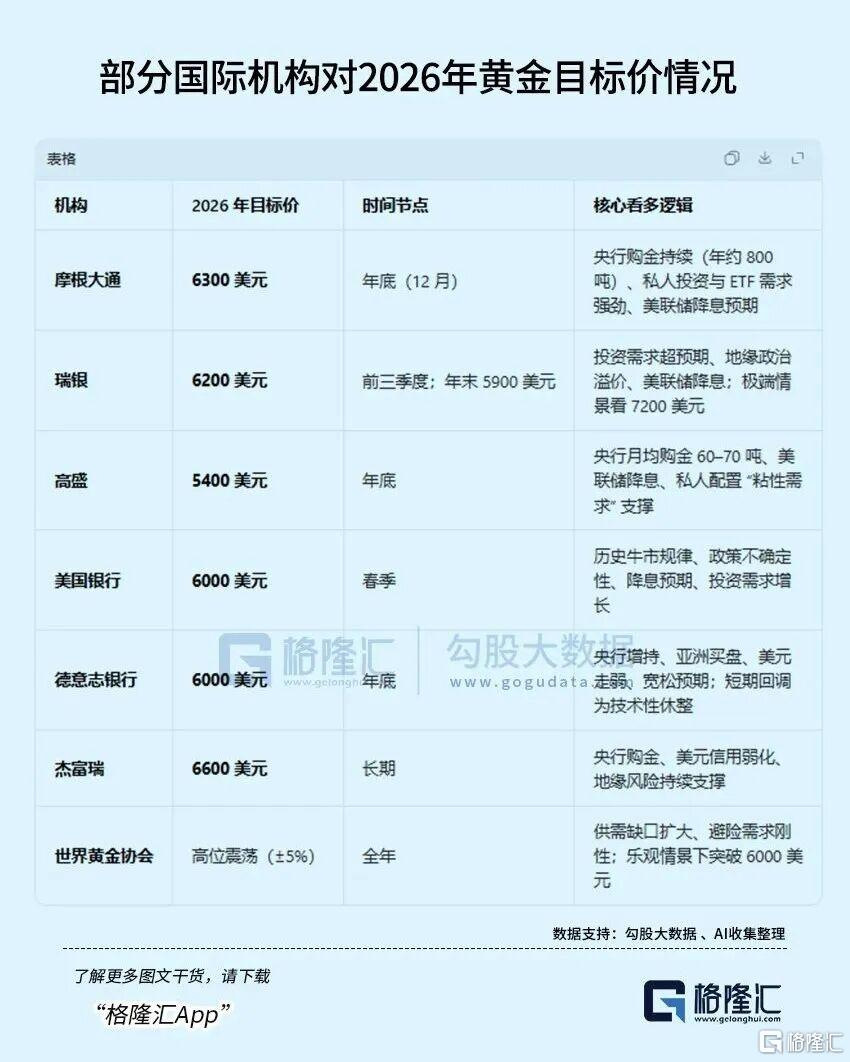
Core Viewpoint - Goldman Sachs has initiated a long-term bullish outlook on Zijin Mining, citing its clear capacity planning, strong cost control, and proactive global layout as key factors for stable future growth in the context of a structural supply constraint era in the global commodity market [3][4]. Group 1: Market Dynamics - The global commodity market is entering a structural supply constraint era due to declining resource grades and geopolitical interventions, leading to a revaluation of strategic metals like gold, copper, and lithium [3][4]. - Gold is viewed as a solid long-term investment due to ongoing central bank purchases, with 95% of central banks planning to increase their gold holdings in the next 12 months, making it a core tool for "de-dollarization" [5]. - Forecasts for gold prices in 2026 have been raised by major institutions, with Goldman Sachs projecting $5,400 per ounce, while JPMorgan and UBS have set targets of $6,200 to $6,300 per ounce [6]. Group 2: Copper and Lithium Outlook - The global copper deficit is expected to reach 330,000 tons by 2026, driven by supply constraints from major producing countries and increasing demand from the renewable energy and AI sectors [7]. - Lithium demand is projected to surge due to the growth of energy storage and electric vehicles, with a market gap of approximately 90,000 tons anticipated in 2026 [9]. Group 3: Zijin Mining's Strategic Position - Zijin Mining is strategically positioned in the copper, gold, and lithium markets, with ambitious production targets for 2026: 1.2 million tons of copper (up 110,000 tons YoY), 105 tons of gold (up 15 tons YoY), and 120,000 tons of lithium (five times 2025's output) [9][10]. - The company has initiated aggressive capacity expansion plans, focusing on resource-rich regions in Africa and Central Asia, ensuring a strong foothold in core resources [10]. Group 4: Cost Control and Efficiency - Zijin Mining has demonstrated superior cost control, with cash costs for copper at approximately 40,000 to 60,000 yuan per ton, which is 15% lower than the industry average [14]. - The company's gold production costs are around $1,000 per ounce, 30% lower than the industry average, showcasing its efficiency in operations [14]. Group 5: Financial Performance and Future Projections - Zijin Mining is expected to achieve a return on equity (ROE) of 36% by 2026, with a projected net profit of approximately 51 to 52 billion yuan for 2025, reflecting a significant year-on-year growth of 59% to 62% [16]. - The company has set ambitious production goals for 2028, aiming for 130 to 140 tons of gold and 270,000 to 320,000 tons of lithium, indicating a strong growth trajectory in the coming years [17].
和讯投顾华飞凡:能源金属的故事为何还能继续演绎
Sou Hu Cai Jing· 2026-01-22 02:59
Core Insights - The narrative of non-ferrous metals, particularly energy metals, will continue to evolve in 2026, driven by a complex interplay of supply-demand balance, liquidity easing, and resource value reassessment [1][4] - The simultaneous rise of copper and gold, traditionally viewed as inversely correlated, is attributed to three main factors: global liquidity easing, inflation-driven appreciation of physical assets, and the core drivers of each metal creating a resonance effect [1][2] Supply and Demand Dynamics - Copper prices are primarily driven by insufficient supply and strong demand from new sectors such as AI computing centers and grid modernization, while gold prices are supported by ongoing central bank purchases and concerns over the credibility of the US dollar [2] - The current supply-demand tightness is expected to persist until at least 2028, with new growth points in demand including energy storage, AI computing, global infrastructure projects, and increased military spending due to geopolitical tensions [2] Potential Investment Directions - Lithium, particularly lithium carbonate, is on the verge of a demand surge due to the expansion of energy storage applications, driven by new pricing policies [3] - Strategic minor metals such as rare earths, tungsten, molybdenum, cobalt, nickel, and tin are expected to see continued value reassessment, influenced by geopolitical factors and supply chain concentration [3] - Gold remains a key asset as a global ultimate currency, with a clear long-term upward trend due to the declining value of the US dollar and ongoing central bank purchases exceeding 1,000 tons annually [3]
历史首次!金银铜价齐破纪录,A股有色狂飙40余股翻倍
Sou Hu Cai Jing· 2025-12-27 06:08
Market Performance - Precious metals and industrial metals experienced a historic rally, with gold rising over 60% and silver more than doubling in price during the year [1][3] - Copper prices surged, breaking the $12,000 per ton mark, marking a 30% increase for the year [3][10] - The performance of minor metals like tungsten and cobalt also saw significant increases, with prices rising over 130% [3] Stock Market Reflection - The A-share market reflected the commodity market's enthusiasm, with the non-ferrous metal sector leading all industries with over 70% growth [5] - The overall performance of the non-ferrous metal industry improved significantly, with a 9.3% year-on-year revenue increase to 2.82 trillion yuan and a 41.55% increase in net profit [5] Driving Factors - The surge in metal prices is attributed to multiple factors, including a weakening dollar, expectations of interest rate cuts by the Federal Reserve, inflation concerns, and geopolitical tensions [8][10] - For industrial metals like copper, supply-demand imbalances are a key driver, with increased demand from electric vehicles and renewable energy sources [10] Industry Impact - The rise in metal prices is reshaping profit distribution within the industry, with the mining sector's profit share increasing to 28.3% [12] - Copper supply challenges have led to reduced processing fees, prompting some smelters to pay miners instead of earning processing profits [12] Future Outlook - Financial institutions predict a shift from a broad rally to structural differentiation in the metal market, with optimistic forecasts for copper and precious metals [14][16] - Gold prices are expected to challenge $5,000 per ounce by 2026, while silver may outperform gold due to favorable market conditions [14][16] - The demand for copper in AI data centers, electric vehicles, and grid construction is anticipated to continue growing [14]
钨价年内狂飙220%创历史新高,最具弹性标的佳鑫国际(03858)或有10倍空间?
智通财经网· 2025-12-20 01:11
Core Viewpoint - The price of tungsten has surged significantly, leading to a bullish trend in the metal market, with Jaxin International (03858) being recognized as a key player benefiting from this price increase [1][2]. Group 1: Tungsten Price Dynamics - Tungsten prices have increased by 12%-18% weekly, with a year-to-date increase exceeding 200%, making it one of the most aggressively rising metals expected to continue this trend into 2025 [1][2]. - Key tungsten products have reached new highs, with black tungsten concentrate priced at 430,000 CNY per standard ton (up 15.3% week-on-week), ammonium paratungstate (APT) at 650,000 CNY per ton (up 17.1% week-on-week), and tungsten powder surpassing 1,030 CNY per kilogram (up 13.2% week-on-week) [2][3]. - The price surge is driven by tight supply and structural demand growth, with domestic mining quotas decreasing and limited overseas production to fill the gap [2][3]. Group 2: Demand Drivers - Demand for tungsten is increasing across various sectors, particularly in photovoltaics, military, and high-end manufacturing, with significant projected growth in tungsten usage for solar applications and military hard alloys [3]. - The implementation of export restrictions on tungsten products in China is expected to further elevate overseas prices [3]. Group 3: Jaxin International's Position - Jaxin International is recognized as the "elastic king" in the tungsten market due to its substantial open-pit tungsten mine and strategic partnerships with state-owned enterprises, ensuring efficient production and market positioning [4][5]. - The company has a significant resource base with 107 million tons of ore and a tungsten resource of 227,300 tons, making it the largest open-pit tungsten mine globally [5]. - Jaxin's production capacity is set to increase significantly, with targets of 1.205 million tons of tungsten concentrate in 2025 and 1.37 million tons by 2027, alongside a projected reduction in production costs [6][7]. Group 4: Financial Outlook - Jaxin International's stock has seen a remarkable increase, with a historical high of 44.38 HKD per share, reflecting a 306% rise from its IPO price of 10.92 HKD [1][8]. - The company is expected to achieve a gross profit of 5.5 to 6 billion CNY by 2027, based on projected production and price levels, indicating strong potential for future profitability [8][9]. - The market anticipates that Jaxin's stock could replicate the tenfold growth seen by Zijin Mining in 2021, driven by resource value reassessment and production capacity realization [9].
长城基金投资札记:布局2026,关注市场结构性亮点
Xin Lang Cai Jing· 2025-12-05 20:06
Core Viewpoint - The market is entering a window period of upward resonance in policy, liquidity, and fundamentals as December approaches, with the upcoming Central Economic Work Conference expected to guide expectations for the macro economy in 2024 [1] Group 1: Market Outlook - A-shares are expected to have rebound potential, with a focus on the upcoming political bureau meeting and Central Economic Work Conference for macroeconomic guidance [1] - The market has released some valuation and sentiment risks after previous adjustments, leading to a more stable outlook [1] - The focus for investment opportunities should be on AI applications, overseas demand sectors due to the anticipated US interest rate cuts, resource stocks benefiting from a new round of dollar easing, and dividend stocks favored by domestic incremental capital [1] Group 2: Sector Focus - There is a need to identify new structural highlights as the market currently lacks a sustainable upward mainline, with funds rotating between different sectors [2] - The market may face short-term risks, but the Central Economic Work Conference and potential US interest rate cuts could create a window for preparing for next year's expectations [3] - Continued optimism for AI applications in the medical and consumer sectors, with a rational return of expectations after previous high anticipations [4] Group 3: Investment Themes - In the innovative drug sector, attention should be paid to the rhythm of clinical data releases and the globalization of business development (BD) for certain stocks [5] - Key events in December, such as the Central Economic Work Conference and the US Federal Reserve meeting, could influence domestic economic expectations and short-term liquidity in US markets, with price increases potentially becoming a trading focus [6] - Focus on domestic consumption, financial sectors, and capital goods, with expectations for improved competition and stability in certain industries [7][8] Group 4: Growth and Opportunities - A cautious optimism remains for the market, with some funds positioning for a potential "spring surge" in 2024, particularly in high-valuation growth and small-cap sectors [9] - AI continues to be viewed as a high-prospect area, with ongoing exploration of related opportunities and monitoring of energy storage developments [10] - Emphasis on sectors with independent logic in technology growth, new consumption, and exports, with a structural market trend expected to continue [11]
长城基金投资札记:市场或延续结构性震荡行情格局
Xin Lang Ji Jin· 2025-11-07 07:49
Group 1 - The market is expected to enter a phase of "self-centered" development following the recent US-China meeting, with a focus on domestic economic indicators and the "14th Five-Year Plan" [1] - The "14th Five-Year Plan" emphasizes upgrading traditional industries, technological self-reliance, and boosting domestic demand, which are key areas for investment [1] - The A-share market is likely to experience a period of consolidation after reaching a high point, with potential investment opportunities in the energy storage industry, cyclical industries, and traditional manufacturing upgrades [1] Group 2 - The market is anticipated to have a volatile performance in November, with limited upward and downward movement, focusing on sectors with reversal expectations such as AI applications and innovative pharmaceuticals [2] - Despite recent underperformance, the medical technology sector, including AI healthcare, is seen as a potential area for capital rotation, especially if industry trends continue to evolve positively [3] - There is a cautious optimism regarding the financial sector, with banks and insurance companies expected to see performance improvements in the coming year [5] Group 3 - Consumer demand is projected to have opportunities in the coming year due to low stock prices and a low base in consumption this year, suggesting potential for valuation recovery [6] - The long-term outlook for the non-ferrous metals sector remains positive, with expectations of upward price movements due to supply constraints [6] - The overseas expansion of Chinese companies in capital goods and consumer goods is viewed as a significant opportunity for growth [7] Group 4 - The market is expected to maintain a cautious optimism in the short term, with limited new capital inflow but a significant amount of capital waiting for a market correction to enter [8] - There is a focus on sectors with independent industrial logic and low correlation to overall economic trends, indicating a potential for structural market performance [9] - The ongoing US-China trade tensions are likely to lead to a prolonged period of market adjustments, with an emphasis on self-sufficiency and resource value reassessment [9]
私募最新调研路径曝光科技与医药仍是“心头好”
Shang Hai Zheng Quan Bao· 2025-10-12 15:11
Group 1 - Private equity firms are actively engaging in A-share company research, with over 900 firms participating in nearly 2800 research activities in September [1][2] - The technology and pharmaceutical sectors remain favored by private equity, with significant interest in companies like Maiwei Biotech, which received attention from 88 private equity firms [2][4] - The electronics sector had the highest research frequency, with 78 companies being researched 554 times, followed by mechanical equipment with 444 times [4] Group 2 - The current market environment, characterized by a weaker dollar and ongoing economic recovery in China, is expected to attract global funds to A-shares due to reasonable valuations and strong industry drivers [3] - Private equity firms are focusing on high-quality growth companies, particularly in the technology and pharmaceutical sectors, as they seek to capitalize on market fluctuations [2][4] - The coal industry and companies benefiting from "anti-involution" policies, as well as those in the technology innovation space, are highlighted as areas of potential investment opportunity [4]
