资源能源安全

Search documents
险资如何看当下市场
2026-03-24 01:27
Summary of Key Points from Conference Call Records Industry Overview - The records focus on the insurance industry, particularly the investment strategies and asset allocation of insurance companies in response to market conditions and regulatory changes. Core Insights and Arguments 1. **Investment Strategy Shift**: Under new accounting standards, insurance companies are shifting their equity allocation towards a "barbell" strategy, focusing on dividend blue chips to smooth profit volatility while also timing growth stocks. The proportion of stocks in the OCI (Other Comprehensive Income) account of listed insurance companies is expected to rise from less than 25% at the end of 2023 to about 40% by the end of 2025 [1][8]. 2. **Interest Rate Impact**: The decline in interest rates has intensified the risk of asset-liability duration mismatch. Insurance companies are increasing their allocation to 30-year local government bonds (yielding over 2.4%-2.5%) to extend duration and hedge against pressures on net assets and solvency [1][5]. 3. **Market Forecast and Strategy**: The annualized return target for 2026 is approximately 10%, with a strategic bottom range for the market index set between 3,700 and 3,800 points. If the 10-year government bond yield reaches 1.9%-2.0%, insurance funds will increase their allocation to long-duration assets [1][10]. 4. **ETF Utilization**: During market downturns, insurance companies prefer broad-based ETFs (such as A50 and CSI 300) as a core tool to absorb drawdowns. As the market recovers, they tend to reduce ETF holdings and shift towards individual stocks to capture alpha returns [1][9]. 5. **Investment Lines for 2026**: Seven key investment themes have been identified for 2026, including: - Dividend strategy (dividend yield > 4%) - Cyclical recovery (betting on PPI turning positive) - Resource and energy security - Anti-involution (sectors like photovoltaics and chemicals) - Emerging industries from the 14th Five-Year Plan - AI across the entire industry chain - High-quality overseas manufacturing [1][13]. Additional Important Content 1. **Seasonal Premium Income**: The first quarter typically accounts for 30%-50% of annual premium income, leading insurance companies to leverage financing to achieve early allocation and lock in cross-year returns [2][10]. 2. **Impact of Market Adjustments**: Recent stock market pullbacks have pressured the net profits and solvency of insurance companies. While some smaller firms may reduce equity positions to alleviate capital adequacy pressures, a systemic reduction across the industry is unlikely. Instead, a structural adjustment towards dividend and defensive styles is expected [3][10]. 3. **New Financial Instruments**: Starting in 2026, non-listed insurance companies will implement new financial instrument standards, necessitating careful planning of equity asset classification between TPL (Total Profit and Loss) and OCI [4][5]. 4. **Bond and Equity Strategy**: In a low-interest and high-volatility environment, insurance companies are advised to prioritize high-yield bonds and adjust their asset duration to better match liabilities. The strategy emphasizes taking advantage of every 10 to 20 basis point rebound in bond yields for reallocation [6][10]. 5. **Geopolitical Considerations**: There is a divergence of opinions among investment committees regarding the impact of geopolitical conflicts on the A-share market. However, the consensus is that the recent market volatility may have already priced in much of the pessimism, suggesting limited downside potential [12][10]. 6. **Focus on High Dividend Assets**: To mitigate performance pressure from high base effects in 2026, insurance companies are increasing their allocation to high-dividend assets, particularly those classified under OCI, to smooth profit fluctuations [7][8]. 7. **Long-term Investment Philosophy**: The investment decision-making process will adhere to the principles of "good direction, good stocks, good prices," ensuring strategic allocations when all three criteria align [15].
每周主题、产业趋势交易复盘和展望:AI交易切换:重视国产算力和电力建设-20260301
Soochow Securities· 2026-03-01 11:07
Investment Rating - The report suggests an "Overweight" rating for the industry, indicating a positive outlook for the next six months [48]. Core Insights - The report emphasizes the importance of domestic computing power and electricity infrastructure in the context of AI trading [1]. - It highlights two main lines for industry allocation in 2026: technology and security, and reform and growth, focusing on self-reliance and innovation in technology [42]. - The report identifies key sectors to watch, including AI capabilities, resource security, and energy safety, as well as consumer demand in non-durable goods and services [42]. Market Review - The average daily trading volume for the entire A-share market reached 2.44 trillion, an increase of over 300 billion compared to the previous week [8]. - Small-cap stocks outperformed large-cap stocks, with a balanced performance between value and growth styles [11][13]. Market Style Performance - The report notes that small-cap value stocks had a weekly increase of 4.44%, while the overall A-share index saw a rise of 1.98% [11]. - Growth stocks showed a relative disadvantage compared to value stocks, with performance fluctuating in negative territory [16] [19]. Sector Performance - The report provides insights into the performance of various sectors, indicating strong movements in certain industries while others lagged behind [28][31]. - It highlights the importance of monitoring the basic materials and energy sectors, particularly in relation to new energy developments [42]. Upcoming Industry Events - Key upcoming events include the World Mobile Communications Conference and the Apple Spring Product Launch, which may impact market sentiment and sector performance [41].
十大机构看后市:A股市场延续震荡特征,科技占优的条件依然未变
Xin Lang Cai Jing· 2025-12-14 07:59
Group 1 - The core focus of the Central Economic Work Conference is to expand domestic circulation, similar to last year, but with significant differences in expectations and pricing for domestic and foreign demand stocks [10][11] - There is a strong performance expectation for overseas exposure stocks, but the difficulty in valuation increases, while domestic demand stocks have potential for valuation recovery if they exceed expectations [10][11] - The market is expected to see a short-term positive trend following the conference, with historical data indicating that the market style tends to perform well in the week following the conference [12] Group 2 - The spring market is anticipated to be a small-scale rally, with a focus on short-term price-performance opportunities in technology and cyclical sectors [13][14] - Key themes from the conference include commercial aerospace, robotics, and other sectors related to the ocean economy and energy security [13][14] - The investment strategy should focus on sectors benefiting from supply-side reforms and consumer demand stimulation, particularly in services and non-durable goods [13][14] Group 3 - The market is characterized by volatility, with a recommendation to adopt a cautious approach and wait for better entry points [16][17] - Specific sectors to watch include brokerage firms, home appliances, and mechanical equipment, with a focus on stocks that are currently undervalued [16][17] - The policy environment is expected to support structural adjustments and "anti-involution" measures, creating opportunities in social services and resource sectors [16][17] Group 4 - The investment outlook for 2026 suggests a shift from valuation-driven to earnings-driven market dynamics, with continued monetary easing expected [18] - Key narratives for the future include AI technology, safety, and industry expansion, which are anticipated to provide medium to long-term investment certainty [18] - Asset allocation strategies should focus on passive investments for risk diversification and active management for capitalizing on market trends [19]
每周主题、产业趋势交易复盘和展望:调整之后,面向2026年哪些产业值得关注?-20251123
Soochow Securities· 2025-11-23 09:47
Market Overview - The average daily trading volume for the entire A-share market was 1.87 trillion CNY, a decrease of over 178.8 billion CNY compared to the previous week[8] - The Shanghai Composite Index experienced a weekly decline of 3.0%[12] Market Style Performance - Large-cap value stocks showed relative resilience, with a weekly decline of only 1.73%[12] - Small-cap growth stocks faced a more significant decline of 5.54%[12] Participant Performance - The active capital holding index led the decline with a drop of 7.0%[21] - The national team index decreased by 2.81%, while the social security heavy index fell by 4.0%[21] Market Sentiment - The margin trading balance increased to 2.5 trillion CNY before retracting[25] - The number of stocks hitting the daily limit up was 100, while 13 stocks hit the limit down during the week[25] Sector Performance - The report highlights strong sectors such as AI and energy security, while sectors like chemicals and steel are expected to see improved fundamentals[44] - The focus for 2026 will be on technology and security, as well as reform and growth strategies[44]
《国家安全法》10年来如何为国家“保驾护航”?个人如何维护好国家安全?一文速览↓
Yang Shi Wang· 2025-07-01 02:22
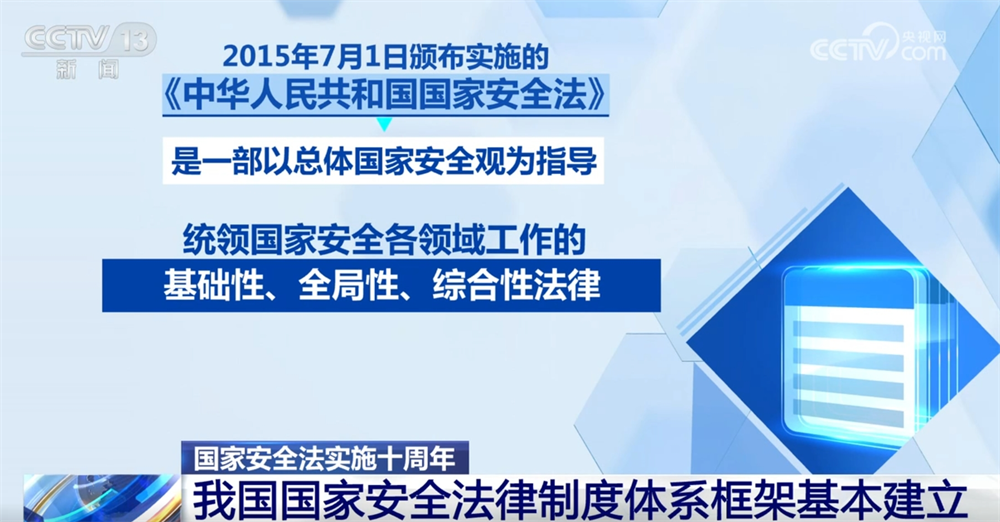
Core Points - The new National Security Law, implemented on July 1, 2015, serves as a foundational and comprehensive legal framework guiding various aspects of national security, including political, territorial, military, cultural, technological security, and more [1][3] - Over the past decade, the National Security Law has led to the establishment of a legal system with over 40 laws related to national security, including the Anti-espionage Law, National Intelligence Law, and Cybersecurity Law, among others [5] - The law has played a crucial role in ensuring food security, energy resource security, and the stability of supply chains, thereby supporting high-quality economic development and providing legal tools to counter external pressures and internal risks [8][9] Industry Impacts - The National Security Law has been instrumental in addressing threats to food security, particularly in light of increased espionage activities targeting China's agricultural sector, leading to significant legal actions against individuals and companies involved in such activities [11][13] - The law also emphasizes the importance of protecting strategic resources like rare earth elements, which are vital for high-end manufacturing and national defense, highlighting the need for vigilance against foreign exploitation [15][17] - Citizens are encouraged to actively participate in maintaining national security by reporting suspicious activities, with a structured reward system in place for those who contribute to national security efforts [22][24]