
电力建设

Search documents
每周主题、产业趋势交易复盘和展望:AI交易切换:重视国产算力和电力建设-20260301
Soochow Securities· 2026-03-01 11:07
Investment Rating - The report suggests an "Overweight" rating for the industry, indicating a positive outlook for the next six months [48]. Core Insights - The report emphasizes the importance of domestic computing power and electricity infrastructure in the context of AI trading [1]. - It highlights two main lines for industry allocation in 2026: technology and security, and reform and growth, focusing on self-reliance and innovation in technology [42]. - The report identifies key sectors to watch, including AI capabilities, resource security, and energy safety, as well as consumer demand in non-durable goods and services [42]. Market Review - The average daily trading volume for the entire A-share market reached 2.44 trillion, an increase of over 300 billion compared to the previous week [8]. - Small-cap stocks outperformed large-cap stocks, with a balanced performance between value and growth styles [11][13]. Market Style Performance - The report notes that small-cap value stocks had a weekly increase of 4.44%, while the overall A-share index saw a rise of 1.98% [11]. - Growth stocks showed a relative disadvantage compared to value stocks, with performance fluctuating in negative territory [16] [19]. Sector Performance - The report provides insights into the performance of various sectors, indicating strong movements in certain industries while others lagged behind [28][31]. - It highlights the importance of monitoring the basic materials and energy sectors, particularly in relation to new energy developments [42]. Upcoming Industry Events - Key upcoming events include the World Mobile Communications Conference and the Apple Spring Product Launch, which may impact market sentiment and sector performance [41].
“这行情你可能一辈子遇不到!” 中国投资者把铜“买飞了”
华尔街见闻· 2026-01-30 04:12
Core Viewpoint - The copper price has experienced its largest single-day increase in 16 years, driven by strong buying from Chinese investors, indicating a historic rally in the commodity market [1]. Group 1: Price Movements - On Thursday, copper prices surged by 11%, surpassing $14,500 per ton for the first time, and have risen approximately 21% since early December [2]. - Despite a sharp pullback after the initial surge, copper closed up 4.1% at $13,618 per ton on the LME, with intraday volatility marking the largest since 2009 [4]. - The Shanghai Futures Exchange (SHFE) also saw record trading volumes, with copper's single-day volume reaching its second-highest level ever [4]. Group 2: Market Drivers - The surge in metal prices coincided with the U.S. dollar index dropping to a four-year low, making dollar-denominated commodities more attractive to buyers [5]. - Concerns over further dollar weakness have led cautious investors to withdraw capital domestically, while expectations surrounding the Federal Reserve's policies have fueled the rally [6]. Group 3: Demand and Supply Dynamics - Despite the price surge, there are signs of weak physical demand, which contradicts the current bullish trend [7]. - The LME market is showing an expanded contango structure, indicating that supply remains ample [9]. - The Shanghai Futures Exchange has implemented measures to cool the market, including raising margin requirements and imposing trading restrictions on specific clients [9]. Group 4: Future Outlook - Investors remain optimistic about copper's role in energy transition and the growth of data centers, with companies like Tesla planning significant investments in AI and robotics, which are expected to benefit copper, aluminum, and tin [8]. - However, there are warnings that the remarkable price increases may have outpaced actual demand, potentially leading to a technical adjustment as physical buyers retreat due to high prices [9].

突发!金银大跳水,金价跌超5%,铜价冲高回落!布油盘中涨破70美元,特朗普考虑对伊朗动手,欧盟将伊斯兰革命卫队列为“恐怖组织”
Mei Ri Jing Ji Xin Wen· 2026-01-29 16:01
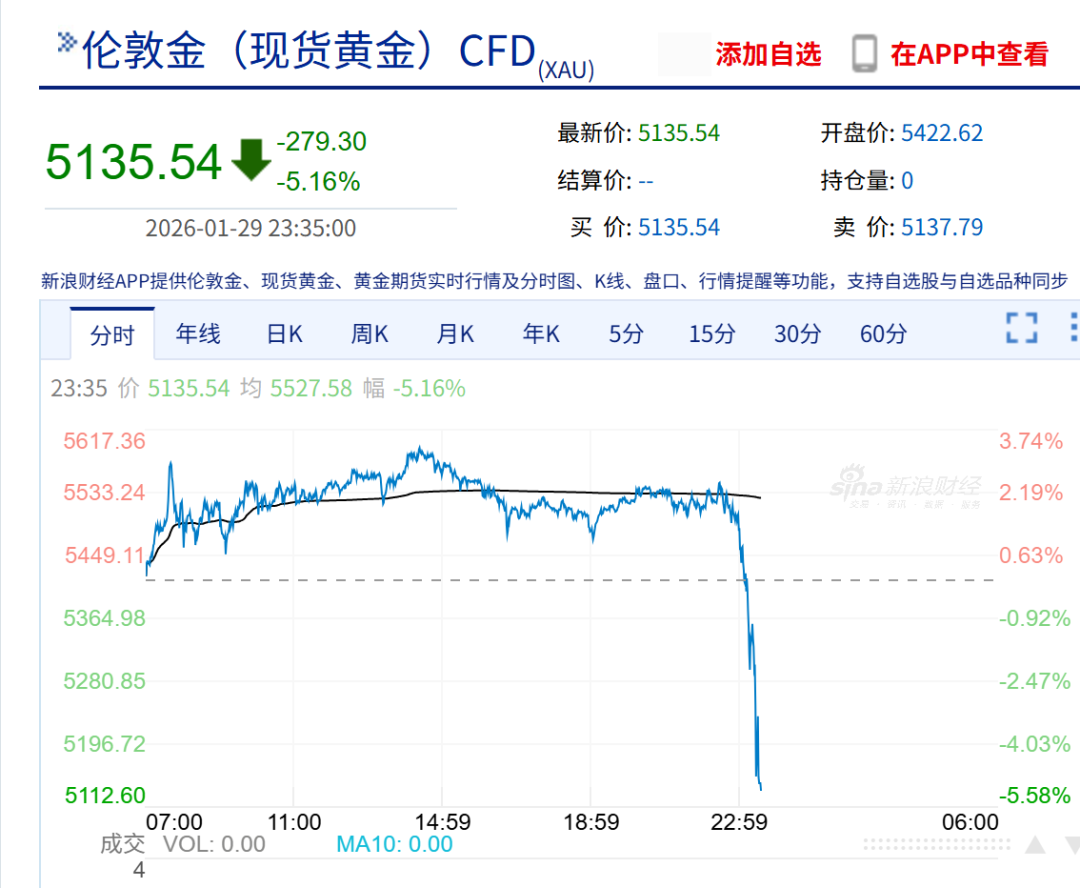
Group 1: Commodity Market Movements - On January 29, there was a significant reversal in the commodity market, with international gold and silver prices initially rising sharply before experiencing a drastic decline [1] - Spot silver saw an intraday increase of 3.5%, reaching $120.76 per ounce, while spot gold surged by 2% before falling below key levels of $5400, $5300, and $5200, ultimately closing down 5% at $5135 per ounce [2] - The London Metal Exchange (LME) three-month copper price initially rose by 10.32% but later narrowed its gains, closing at $14105 per ton [7] Group 2: Oil Price Surge - Brent crude oil prices surpassed $70 per barrel, currently reported at $70.33 per barrel, while WTI crude oil experienced a daily increase of 4.7%, reaching $66.2 per barrel [8][9] Group 3: Geopolitical Factors Impacting Commodities - Reports indicate that U.S. President Trump is considering significant military actions against Iran, which could influence global oil prices and market stability [11] - The European Union has imposed additional sanctions on Iran, including listing the Iranian Revolutionary Guard as a terrorist organization, which may further impact oil supply and prices [12]
再创历史新高!伦铜延续涨势站上1.4万美元
智通财经网· 2026-01-29 06:47
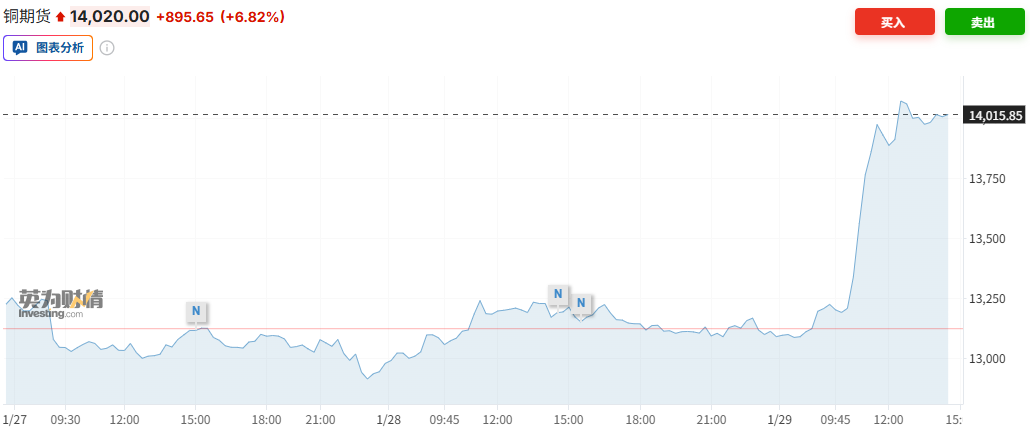
Core Viewpoint - The prices of base metals, particularly copper, have surged to historical highs due to strong U.S. economic growth and increased global spending in data centers, robotics, and power infrastructure [1][3] Group 1: Base Metal Price Movements - Copper prices reached a record high of over $14,000 per ton, driven by intense speculative trading and a significant single-day increase [1] - Other major metals also saw price increases, with aluminum nearing a four-year high and zinc rising nearly 3% [1] - The London Metal Exchange reported a peak copper price of $14,125 per ton, reflecting a 7.9% surge before a slight pullback [1] Group 2: Investor Behavior and Market Dynamics - Investors, particularly from the Shanghai Futures Exchange, are flocking to the base metals market, anticipating stronger U.S. economic growth and increased global spending [1] - Trading volume on the Shanghai Stock Exchange has exploded, making January the busiest month on record, with a significant spike in trading activity [1] - Optimism surrounding AI spending and the Federal Reserve's latest meeting has further fueled bullish sentiment among investors [1] Group 3: Broader Commodity Trends - Commodity prices have risen due to factors such as U.S. dollar depreciation, increased demand for physical assets, and geopolitical tensions exacerbated by the Trump administration's foreign policy [3] - Precious metals have also reached historical highs, alongside copper, indicating a broader trend in commodity price increases [3] - The recent rise in oil prices, which were previously under pressure due to global supply concerns, reflects the overall upward trend in commodity markets [3] Group 4: Future Outlook - Analysts suggest that the outlook for copper prices remains positive as long as the U.S. continues to advance in AI, chips, and power infrastructure, although precise price predictions are challenging [3] - Tesla's plan to invest $20 billion in robotics and AI this year highlights the investment potential in metals like copper, aluminum, and tin [3] - The decline in the dollar's value has made commodities more attractive to buyers, further supporting price increases [3]
铝2026年策略:经济复苏叠加产能天花板,铝价重心向上
Chang Jiang Qi Huo· 2025-12-08 05:25
1. Report Industry Investment Rating No information provided in the content. 2. Core Viewpoints - In 2026, alumina prices are expected to decline with reduced volatility due to a more relaxed ore supply and a slightly oversupplied production capacity [1][29][92] - The growth rate of domestic electrolytic aluminum production will slow down significantly as the operating capacity approaches the ceiling, and imports are expected to increase to offset the supply - demand gap. The downstream demand for aluminum is undergoing a structural transformation [2][45][92] - The price of aluminum alloy will still be pegged to the price of aluminum in 2026, but its seasonal performance will be weaker than before [3][53][93] - The price of aluminum and aluminum alloy is expected to show an upward trend in 2026, driven by factors such as global economic recovery, new - energy transformation, and power construction [3][93] 3. Summary by Relevant Catalog 3.1 2025 Market Review - In 2025, aluminum prices showed a trend of oscillating upward breakthrough, divided into three stages: oscillating upward from January to mid - March, oscillating downward from mid - March to early April, and oscillating upward from early April to November. The price fluctuations were affected by various factors such as policies, tariffs, inventory changes, and macro - events [6][7][8] 3.2 Supply Side 3.2.1 Bauxite - Domestic bauxite production increased slightly in 2025, with a growth rate of 5.2% from January to November. However, production was restricted in some areas due to safety and environmental regulations. Imported bauxite increased significantly, with imports from January to October reaching 171 million tons, a year - on - year increase of 30.4%. The price of imported bauxite decreased due to increased supply. There were some disturbances in the supply from Guinea, and the political situation in Guinea may affect future supply policies [14][16][18] 3.2.2 Alumina - In 2025, alumina production increased, with output from January to October reaching 78.222 million tons, a year - on - year increase of 9.56%. The price first declined, then rebounded, and then fell again. New production capacity was limited in 2025, mainly from Guangxi Huasheng Phase II, Shandong Chuangyuan New Materials, and Hebei Wenfeng. In 2026, new overseas production capacity will be mainly in India, Indonesia, and Vietnam. Alumina production capacity is expected to be slightly oversupplied in 2026, and prices will be determined by cost, showing an oscillating downward trend [22][24][29] 3.2.3 Electrolytic Aluminum - In 2025, the built - in and operating capacity of domestic electrolytic aluminum increased slightly, with production from January to October reaching 36.8908 million tons, a year - on - year increase of 2.57%. Many enterprises resumed production due to improved profitability, while some enterprises carried out technical upgrades and maintenance, resulting in production cuts. New production capacity mainly came from Shuangyuan Aluminum, Chalco Qinghai, and others. In 2026, new domestic production capacity will mainly come from Huomeihongjun Zhalv Phase II and Tianshan Aluminum. Overseas production capacity increased in 2025, mainly in Indonesia, Russia, and other countries, and is expected to increase by 1.8 million tons in 2026. The growth rate of domestic electrolytic aluminum production will slow down significantly in 2026, and imports are expected to increase [30][35][45] 3.2.4 Aluminum Alloy - Although the import of scrap aluminum was liberalized in 2024, there was no significant increase in 2025 due to factors such as the cancellation of export tax rebates, tariff differences, and tightened trade policies in some countries. The production of recycled aluminum alloy increased steadily, and the listing of aluminum alloy futures promoted production. After the listing of the futures, the production of cast aluminum alloy increased significantly, suppressing the price difference between ADC12 and A00, and the seasonal effect was weakened [48][50][52] 3.3 Demand Side 3.3.1 Real Estate - In 2025, the real estate market continued to decline. In 2026, the real estate market is expected to continue to bottom out, and the demand for aluminum in the real estate sector will continue to decrease. However, urban renewal and affordable rental housing will support part of the aluminum demand [54][56][58] 3.3.2 Infrastructure - In 2025, the issuance of local government special bonds increased, but part of the funds was used for debt repayment, resulting in a slowdown in infrastructure investment growth. The investment in the power grid reached a new high. In 2026, with the increase in special bond quotas and the promotion of power grid construction, the demand for aluminum in infrastructure is expected to increase by 5% [59][61][69] 3.3.3 Automobile - In 2025, the automobile market had good production and sales performance, with new - energy vehicle penetration exceeding 50%. In 2026, although consumption policies are expected to be strengthened and export demand is optimistic, factors such as the reduction of new - energy vehicle purchase tax exemption and the implementation of new battery standards may lead to flat demand for aluminum in the automobile industry [70][72][75] 3.3.4 Photovoltaic - In 2025, the new installed capacity of photovoltaic increased significantly in the first half of the year but decreased sharply after June due to the "430 New Policy" and "531 New Policy". In 2026, the new installed capacity of domestic photovoltaic is expected to decline significantly, and although the overseas new installed capacity is expected to grow at a rate of 25%, the overall demand for aluminum in the photovoltaic industry is expected to decrease [76][79][82] 3.3.5 Aluminum and Aluminum Product Exports - In 2025, the net export of aluminum products decreased, mainly due to the cancellation of export tax rebates and the imposition of tariffs. The export of aluminum products increased. In 2026, due to the continuation of policies and the strengthening of the domestic aluminum price, the net export of aluminum and aluminum products is expected to decline [83][85][86] 3.4 Inventory and Supply - Demand Balance - In the first half of 2025, aluminum inventories decreased significantly, while in the second half, they increased seasonally. In 2026, the domestic electrolytic aluminum market is expected to have a shortage of 100,000 tons [88][90][91] 3.5 2026 Outlook - Alumina prices are expected to decline with reduced volatility; the growth rate of domestic electrolytic aluminum production will slow down, imports will increase, and downstream demand will transform; the price of aluminum alloy will be pegged to aluminum with weaker seasonality; the price of aluminum and aluminum alloy is expected to rise [92][93]
地方能源局官员谈缺电:和AI无关,取决于能源规划、电力建设和产业管理
Xin Lang Ke Ji· 2025-11-13 07:33
Core Insights - The demand for electricity driven by big data is rapidly increasing, with a projected rise in electricity consumption in Zhangjiakou from 6 billion kWh to 8.7 billion kWh by 2024, and an estimated consumption of 9 to 10 billion kWh for the entire year [1][1][1] - The growth rate of electricity demand attributed to big data is approximately 50% [1] - There may be temporary electricity shortages in the future, but these are not related to AI and will depend on local government energy planning, power infrastructure development, and industrial management [1][1][1]