跨境贸易结算

Search documents
【金融街发布】国家外汇局:提升西部陆海新通道沿线企业跨境结算效率 降低贸易结算成本
Xin Hua Cai Jing· 2025-12-25 14:00
Core Viewpoint - The National Foreign Exchange Administration has introduced five measures to enhance cross-border settlement efficiency and reduce trade settlement costs for enterprises along the Western Land-Sea New Corridor [1] Group 1: Cross-Border Trade Settlement - The focus is on creating a more trustworthy and convenient foreign exchange service environment for cross-border trade [2] - Measures include encouraging enterprises to join high-level cross-border trade pilot programs, supporting multinational companies in integrated fund pool operations, and facilitating new trade models like market procurement and cross-border e-commerce [2][3] - Banks are supported to assist quality enterprises in handling compliant offshore trade cross-border fund settlements [2] Group 2: Cross-Border Investment and Financing - The administration aims to simplify business processes and broaden financing channels for enterprises along the corridor [2] - In the "bringing in" aspect, it cancels preliminary fee registration for foreign direct investment and optimizes reinvestment processes for foreign-invested enterprises [2] - For the "going out" aspect, it relaxes limits on preliminary expenses for overseas direct investment and supports advantageous industries in expanding international markets [3] Group 3: Digital Empowerment - The administration promotes the co-construction and sharing of cross-border financial service platforms in the corridor [3] - Currently, 13 scenarios have been applied in the "13+2" provinces, with Chongqing having a dedicated scenario that has served over 800 enterprises, facilitating nearly $60 billion in financing settlements [3][4] - Future plans include enhancing national scenarios, supporting local innovations, and replicating successful models in other regions [4]

央行等八部门:支持符合条件的银行为优质企业办理服务贸易代垫和分摊服务
Xin Lang Cai Jing· 2025-12-24 07:45
12月24日金融一线消息,近日,中国人民银行、国家发展改革委、财政部、交通运输部、商务部、金融 监管总局、中国证监会、国家外汇局联合印发《关于金融支持加快西部陆海新通道建设的意见》(以下 简称《意见》)。《意见》提出,便利跨境贸易结算。支持符合条件的银行按照"了解客户、了解业 务、尽职审查"原则,为优质企业办理真实、合规的货物贸易和服务贸易结算。支持符合条件的银行为 优质企业办理服务贸易代垫和分摊服务。支持市场采购贸易方式、跨境电子商务等贸易新业态本外币跨 境结算便利化。鼓励符合条件的银行为优质企业自主办理真实合规的新型离岸转手买卖、全球采购、委 托境外加工、承包工程境外购买货物等新型离岸国际贸易跨境资金结算业务。 12月24日金融一线消息,近日,中国人民银行、国家发展改革委、财政部、交通运输部、商务部、金融 监管总局、中国证监会、国家外汇局联合印发《关于金融支持加快西部陆海新通道建设的意见》(以下 简称《意见》)。《意见》提出,便利跨境贸易结算。支持符合条件的银行按照"了解客户、了解业 务、尽职审查"原则,为优质企业办理真实、合规的货物贸易和服务贸易结算。支持符合条件的银行为 优质企业办理服务贸易代垫和分摊 ...
外贸订单里,“人民币结算”正升温
Sou Hu Cai Jing· 2025-10-17 02:36
Group 1 - The core viewpoint of the articles highlights the increasing trend of using the Renminbi (RMB) as a trade settlement currency among various companies, particularly in the context of cross-border trade and investment [2][3][4] - Reports from institutions like China Construction Bank and CICC indicate a significant growth in the use of RMB for cross-border trade settlements and financing from 2024 to 2025, driven by geopolitical changes and reduced reliance on the US dollar [3][6] - Companies such as Suzhou Grun德 Electric and Jiangsu Jinpeng Group report a noticeable increase in clients opting for RMB settlements, with specific examples showing a shift from USD to RMB in their transactions [5][6] Group 2 - The trend of RMB usage is particularly pronounced in emerging markets, with Southeast Asia, the Middle East, Africa, and Central Asia increasingly accepting RMB for trade settlements [4][6] - Data from the Bank of China indicates that the cross-border RMB settlement volume is expected to exceed 43 trillion yuan in 2024, reflecting a year-on-year growth of 31% [6][7] - Companies are expanding their international presence, with significant investments in regions like ASEAN, which saw a 12.6% increase in investment from China [7][8] Group 3 - Despite the positive outlook, challenges remain for companies using RMB in international markets, including low liquidity and high financial costs associated with offshore RMB usage [8][9] - A survey indicates that 60% of companies face challenges due to low liquidity and high costs, while nearly half report difficulties with counterparties unwilling to use RMB [8][9] - Optimism persists among surveyed companies, with 57% of domestic firms and 69% of foreign firms expecting to increase their use of RMB in cross-border trade settlements by 2025 [9][10]




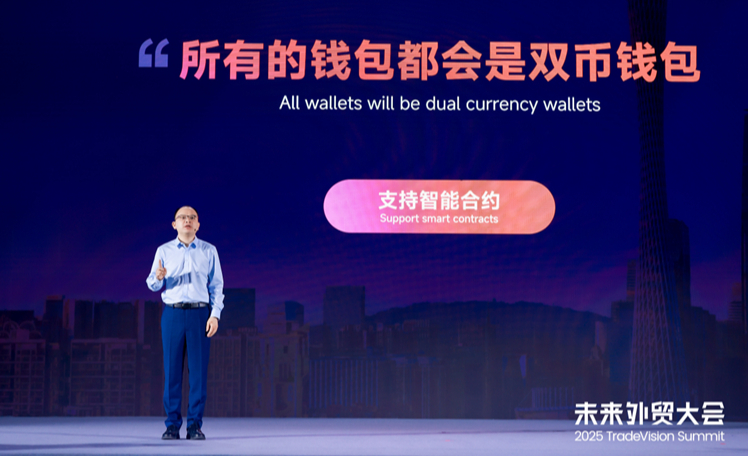
XTransfer创始人邓国标:稳定币将成跨境贸易结算新基础设施
Guo Ji Jin Rong Bao· 2025-08-27 14:17
Core Insights - Stablecoins are poised to become the new infrastructure for cross-border trade settlements, with all payment companies and banks needing to support them to avoid obsolescence [1][3] - The traditional cross-border payment system is plagued by high fees and long transaction times, which stablecoins can address through blockchain technology [3] Group 1: Industry Trends - The transition to stablecoins in B2B cross-border payments is expected to lead to significant changes in wallet structures, with a rise in dual-currency wallets that support both fiat and stablecoins [3] - The use of stablecoins can drastically reduce transaction costs, with fees previously ranging from $50 to $100 per transaction being minimized, and transaction times reduced to minutes or even seconds [3] Group 2: Future Outlook - Despite the rapid development of stablecoins, they are not expected to fully replace fiat currencies; instead, a long-term demand for the exchange between stablecoins and fiat will persist [3] - The dual-currency wallet model will become a standard in the B2B cross-border trade payment sector, allowing businesses to choose between fiat and stablecoin based on their specific needs [3]
数字人民币智能合约在跨境贸易结算中的应用场景设计及与SWIFT系统的协同机制
Sou Hu Cai Jing· 2025-07-13 11:19
Core Viewpoint - The application of digital currency, particularly the digital yuan (e-CNY), is becoming a significant trend in international payments and cross-border trade settlements, representing China's strategic move to enhance its competitiveness in the global economic system [1] Group 1: Digital Yuan and Smart Contracts - The digital yuan is not just a digital form of the renminbi but a strategic initiative by China to deepen reforms and enhance competitiveness in the global economy [1] - Smart contracts, based on blockchain technology, can automatically execute contract terms without relying on third-party intermediaries, improving efficiency and transparency in cross-border trade settlements [1][3] Group 2: Advantages Over Traditional Payment Systems - Traditional cross-border payment systems rely on intermediaries, making the process cumbersome and time-consuming, while the digital yuan's smart contracts can automatically trigger payments upon consensus between trading parties [3] - The use of digital yuan can effectively reduce risks associated with exchange rate fluctuations by minimizing foreign exchange conversion steps, thus enhancing payment stability and reliability [3] Group 3: Integration with SWIFT System - The SWIFT system remains a crucial infrastructure for cross-border payments, but it has limitations such as long transaction times and high costs, which the digital yuan's smart contracts can help address [5] - Integrating digital yuan smart contracts into the SWIFT system can enhance cross-border payment efficiency, reduce costs, and improve interoperability within the global payment system [5][7] Group 4: Future Implications - The collaboration between digital yuan and the SWIFT system can simplify settlement processes by allowing direct payments between buyers and sellers, reducing operational risks and disputes arising from information asymmetry [7] - The synergy between digital yuan and SWIFT is expected to drive the intelligent transformation of global cross-border payments, ushering in a new era of efficient, secure, and convenient payment solutions [9]