
黄金类ETF

Search documents
贵金属进入“高波动阶段” 资金策略转向波段操作
Zhong Guo Jin Rong Xin Xi Wang· 2026-02-09 03:39
Core Viewpoint - The precious metals market has experienced significant volatility, with gold and silver prices fluctuating dramatically, leading to a shift in investment strategies towards short-term trading [1][2][4]. Group 1: Market Volatility - The London gold spot price had a maximum daily fluctuation of around $300 per ounce, while silver experienced 11 instances of over 5% volatility in just seven trading days, with a monthly volatility rate exceeding 100% [1][2]. - Gold ETFs have faced substantial redemptions, with seven ETFs linked to the SGE gold 9999 index shrinking by over 22 billion yuan in a week [2][8]. - The COMEX gold futures speculative net long positions decreased by 27,983 contracts, dropping to 93,438 contracts, indicating a shift in market sentiment [2][9]. Group 2: Regulatory Changes and Market Sentiment - The Chicago Mercantile Exchange has raised silver futures margin requirements seven times since December 2025, indicating a response to extreme volatility [3][10]. - Analysts suggest that the tightening of margin requirements often signals a critical turning point in market trends, raising concerns about whether precious metals have peaked [3][10]. - The current market sentiment has shifted from viewing gold as a safe-haven asset to a high-volatility risk asset, with short-term trading becoming the dominant strategy [2][9]. Group 3: Institutional Warnings and Future Outlook - Various institutions have lowered their short-term expectations for precious metals, warning investors to be cautious of potential pullbacks [4][11]. - Analysts predict that gold may not see bullish trends in the short term due to recent sell-offs, and silver may need to digest previous excessive gains before any rebound [5][11]. - Despite short-term volatility, the long-term fundamentals for gold remain strong, supported by limited supply and ongoing central bank purchases [6][12].
贵金属进入“高波动阶段”,资金策略转向波段操作
Di Yi Cai Jing Zi Xun· 2026-02-09 01:38
Core Viewpoint - The precious metals market has experienced significant volatility, with gold and silver prices undergoing drastic fluctuations, leading to a shift in investment strategies and market sentiment [2][3][4]. Group 1: Market Volatility - The London gold spot price saw a daily maximum price difference of around $300 per ounce, while silver experienced 11 instances of over 5% fluctuations in just seven trading days, with a monthly volatility exceeding 100% [2]. - Gold ETFs faced substantial redemptions, with seven ETFs linked to the SGE gold 9999 index shrinking by over 22 billion yuan in total during the week [2][3]. - Speculative positions in COMEX gold futures decreased significantly, with net long positions dropping by 27,983 contracts to 93,438 contracts as of February 3 [3]. Group 2: Regulatory Changes and Market Sentiment - The Chicago Mercantile Exchange has raised margin requirements for silver futures multiple times, indicating a potential turning point in market conditions [5]. - Analysts warn that the current market sentiment has shifted, with gold transitioning from a traditional safe-haven asset to a high-volatility risk asset, leading to increased short-term trading strategies [4][5]. Group 3: Institutional Warnings and Future Outlook - Various institutions have lowered short-term expectations for precious metals, cautioning investors about potential further sell-offs [6]. - Analysts predict that silver may need to digest previous excessive gains before any rebound, with potential price drops to around $60 per ounce [6]. - Despite the current volatility, the long-term fundamentals for gold remain strong, supported by limited supply and ongoing central bank purchases [7].

贵金属进入“高波动阶段”,资金策略转向波段操作
第一财经· 2026-02-09 01:27
Core Viewpoint - The precious metals market has experienced significant volatility, with gold and silver prices undergoing drastic fluctuations, leading to a shift in investment strategies towards short-term trading [2][4][6]. Group 1: Market Volatility - The London gold spot price saw a daily maximum price difference of around $300 per ounce, while silver experienced 11 instances of over 5% fluctuations in just seven trading days, with a monthly volatility exceeding 100% [2]. - Gold ETFs faced substantial redemptions, with a total shrinkage of over 22 billion yuan in the week, indicating a shift in investor sentiment [2][4]. - Speculative positions in COMEX gold futures decreased significantly, with net long positions dropping by 27,983 contracts, reflecting a change in market dynamics [4]. Group 2: Regulatory Changes and Market Sentiment - The Chicago Mercantile Exchange has raised silver futures margin requirements seven times since December 2025, indicating heightened volatility and potential market turning points [5]. - Analysts warn that the current market sentiment has shifted, with gold transitioning from a traditional safe-haven asset to a high-volatility risk asset, leading to increased short-term trading [4][5]. Group 3: Institutional Warnings and Adjustments - Various institutions have lowered short-term expectations for precious metals, cautioning investors about potential further sell-offs [7]. - Analysts from MKS PAMP predict that silver may need to digest previous excessive gains before any rebound, with prices potentially dropping to $60 per ounce [7]. - Investment strategies are being adjusted to account for high volatility, with a focus on waiting for market speculation to subside before making further investments [7]. Group 4: Long-term Outlook - Despite short-term volatility, the long-term fundamentals for gold remain strong, supported by limited supply and ongoing central bank purchases [8]. - China's official gold reserves increased to 74.19 million ounces as of January 2026, reflecting a continuous accumulation trend by the central bank [8]. - Factors such as de-globalization, a weakening dollar, and persistent central bank buying provide structural support for gold prices in the long run [8].
贵金属进入"高波动阶段",资金策略转向波段操作
Di Yi Cai Jing· 2026-02-08 11:11
Core Viewpoint - The precious metals market is experiencing significant volatility, with a shift in investment strategies from long-term allocation to short-term trading, leading institutions to warn of an impending consolidation phase in the coming weeks [1][5]. Group 1: Market Volatility - The past week saw extreme fluctuations in the precious metals market, with London gold spot prices showing a maximum intraday price difference of around $300 per ounce, and silver experiencing 11 instances of over 5% volatility within seven trading days, resulting in a monthly volatility rate exceeding 100% [2]. - Gold ETFs faced substantial redemptions, with seven ETFs linked to the SGE gold 9999 index shrinking by over 22 billion yuan in total during the week [2][3]. - Speculative positions in COMEX gold futures decreased significantly, with net long positions dropping by 27,983 contracts to 93,438 contracts, indicating a shift in market sentiment [3]. Group 2: Regulatory Changes and Market Sentiment - The Chicago Mercantile Exchange has raised margin requirements for silver futures seven times since December 2025, with the latest increase on February 5, reflecting heightened volatility and signaling potential market turning points [4]. - Analysts from various institutions have lowered short-term expectations for precious metals, warning investors of potential further sell-offs, particularly in gold and silver [6]. Group 3: Long-term Outlook - Despite short-term volatility, the long-term fundamentals for gold remain strong, supported by limited supply and ongoing increases in central bank gold reserves, with China's official gold reserves rising to 74.19 million ounces as of January 2026 [7]. - Factors such as de-globalization, a weakening dollar, and continuous accumulation of gold by global central banks provide structural support for gold prices in the long run [7].
黄金类ETF领跌!资金火速进出
Sou Hu Cai Jing· 2026-02-05 13:26
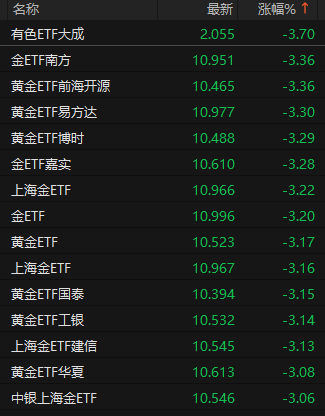
Core Viewpoint - The recent significant fluctuations in gold prices have led to a sharp decline in gold ETFs, with many products experiencing drops exceeding 3% as of February 5 [2][3]. Group 1: Market Performance - On January 30, COMEX gold futures fell sharply by 8.35%, followed by a further decline of 1.35% on February 2, before rebounding with a cumulative increase of over 6% in the subsequent two days [3]. - As of February 5, gold ETFs were among the worst performers in the ETF market, with several products, including the Yongying and Huaxia gold ETFs, seeing declines of over 5% [3][4]. Group 2: Causes of Fluctuation - The primary reason for the recent drop in gold prices is attributed to market concerns regarding the hawkish stance of the new Federal Reserve chair, leading to a rapid outflow of previously invested funds [4]. - The market had previously experienced a significant surge in gold prices, resulting in a concentrated long position among investors, which created a situation of "overbought" conditions as indicated by technical indicators [4]. - The increase in margin requirements for gold futures by CME has further pressured short-term leveraged funds, making the market highly sensitive to negative news, which triggered large-scale long position liquidations [4]. Group 3: Investment Strategies - Despite the volatility, some professional institutions are focusing on the long-term value of gold and are willing to enter the market during downturns, disregarding short-term fluctuations [7]. - For instance, the "Jiaoyin Multi-Asset Preferred" fund increased its holdings in gold ETFs on February 3, indicating a strategy to capitalize on relatively certain investment opportunities [7]. - Industry experts suggest that different types of investors should adopt differentiated strategies in response to the short-term volatility and the long-term positive outlook for gold [7][8].
行业竞争激烈 黄金类ETF产品不断优化
Shang Hai Zheng Quan Bao· 2026-01-18 18:40
Core Viewpoint - The gold market is experiencing significant growth, leading to an increase in the scale of related ETFs, with competition among similar products intensifying [1][3]. Group 1: ETF Adjustments - E Fund announced adjustments to its gold ETF, reducing the minimum subscription and redemption units from 300,000 shares to 100,000 shares, and the minimum gold contract from 3,000 grams to 1,000 grams, effective January 19, 2026 [2]. - The ETF will only accept the Au99.99 spot contract from the Shanghai Gold Exchange for physical transactions, enhancing liquidity and execution efficiency [2]. Group 2: Market Competition - The net subscription volume for gold ETFs reached nearly 20 billion shares in 2025, with the Huazhong Gold ETF surpassing 100 billion yuan in scale by January 15, 2026 [3]. - Fund companies are accelerating product optimization, as seen with the Huazhong CSI Hong Kong Gold Industry ETF, which revised its dividend policy to enhance flexibility in profit distribution [3]. Group 3: Industry Dynamics - The gold ETF market is dominated by five major fund companies: Huazhong, E Fund, Bosera, Guotai, and Huaxia, indicating a "Matthew Effect" where the strong continue to grow stronger [4]. - The demand for gold as an asset class is expected to drive long-term growth in gold ETFs, necessitating continuous product optimization by fund companies to enhance competitiveness [4].
黄金长牛!黄金如何配置最优?
Sou Hu Cai Jing· 2026-01-04 10:34
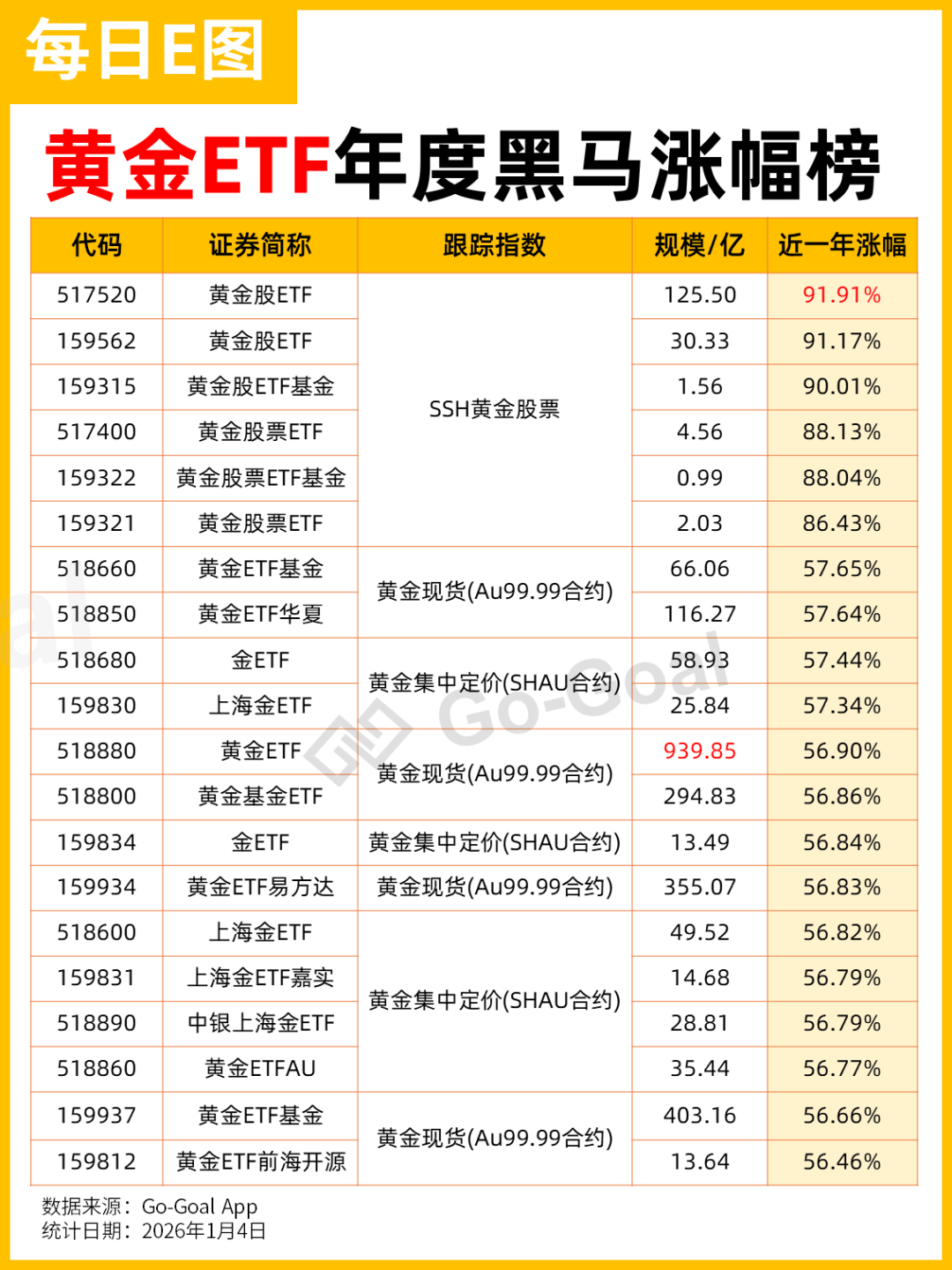
Group 1 - The core viewpoint of the article highlights the significant rise in gold and silver prices throughout the year, driven by geopolitical tensions, expectations of interest rate cuts by the Federal Reserve, and continuous accumulation by central banks [1][2] - Gold's primary attributes of long-term value preservation and risk hedging make gold ETFs suitable for long-term asset allocation, smoothing out short-term volatility while capturing long-term trends [2] - Short-term trading in gold is challenging due to complex and volatile driving factors, making it difficult to predict price movements accurately [2] Group 2 - The article provides a list of top-performing gold ETFs based on annual growth rates, with the leading ETF, code 517520, showing a remarkable increase of 91.91% [3] - The article also details the recent inflows into gold ETFs over the past three months, with the top ETF, code 518880, attracting 175.03 million in inflows [5] - The data indicates a strong interest in gold ETFs, reflecting investor sentiment and market dynamics, with several ETFs showing significant growth in both size and inflows [5]
大涨控制不住,现货黄金首次涨破4500美元关口
Sou Hu Cai Jing· 2025-12-24 02:45
Group 1 - Global gold prices have reached a new high, surpassing $4500 per ounce for the first time, currently reported at $4520 per ounce, with a year-to-date increase of 71% [2] - COMEX silver has also seen significant gains, reaching a peak of $70.155 per ounce, with a year-to-date increase of 138%, leading the precious metals market [2] - Domestic gold jewelry prices have been adjusted upwards by several brands, with prices for pure gold jewelry reported as follows: Lao Feng Xiang at 1406 CNY per gram, Lao Miao Gold at 1402 CNY per gram, Chow Sang Sang at 1411 CNY per gram, Chow Tai Fook at 1410 CNY per gram, and Liufuk Jewelry at 1401 CNY per gram [2] Group 2 - Gold is on track for its best annual performance since 1979, with major international institutions predicting gold prices will exceed $4000 by 2026 [3] - Gold ETFs have become a primary focus for ETF fund inflows, with net inflows exceeding 100 billion CNY this year, accounting for approximately 10% of total ETF inflows during the same period [3]
金价癫了!有知名投资者“撤退”
Sou Hu Cai Jing· 2025-12-23 12:24
Core Viewpoint - International gold prices have surged, reaching a new high of $4530.8 per ounce, driven by factors such as the restructuring of the credit currency system, geopolitical uncertainties, and continued central bank purchases of gold [1][3]. Group 1: Gold Price Trends - COMEX gold futures have seen a year-to-date increase of over 60%, with significant milestones at $3000, $3500, $4000, and $4500 per ounce [3]. - Retail gold prices have also risen, with prices for gold jewelry reaching around 1403 yuan per gram as of December 23 [3]. - Predictions from major institutions suggest that gold prices could exceed $4000 per ounce by 2026, with some forecasts even suggesting a potential rise to $5000 per ounce [1][7]. Group 2: Central Bank Activities - Global central banks have been net buyers of gold, with purchases exceeding 1000 tons annually from 2022 to 2024. In the first three quarters of this year, net purchases totaled 634 tons [3][5]. - The International Monetary Fund (IMF) reported a decline in the dollar's share of global foreign exchange reserves, indicating a potential shift in reserve currency dynamics [4]. Group 3: ETF Inflows - Gold ETFs have become a significant focus for investment, with net inflows exceeding 100 billion yuan this year, accounting for about 10% of total ETF inflows [5]. - The demand for gold ETFs is driven by geopolitical risks and expectations of interest rate cuts by the Federal Reserve [5]. Group 4: Market Sentiment and Predictions - Some investors have begun to exit the gold market, citing historical trends of long-term bear markets in gold prices [6]. - Despite some selling activity, institutions like Morgan Stanley and JPMorgan remain optimistic about gold prices, predicting continued support from macroeconomic factors [6][7]. - The recent sale of gold reserves by the Russian central bank has raised concerns about future demand and price stability [7][8].
金价癫了!
Xin Jing Bao· 2025-12-23 12:08
Group 1 - The international gold price has reached a new peak, with COMEX gold futures hitting $4530.8 per ounce on December 23, marking a historical high after two months of volatility [1][8] - The driving factors for gold prices include the restructuring of the credit monetary system, heightened demand for hedging against geopolitical and policy uncertainties, and continuous gold purchases by global central banks [1][2] - Major institutions predict that gold prices will exceed $4000 per ounce by 2026, but there is disagreement on whether prices will surpass $5000 per ounce [1][8] Group 2 - Gold has emerged as one of the best-performing assets in the capital market this year, with COMEX gold futures increasing by over 60% year-to-date [2][9] - The retail price of gold jewelry has also surged, with prices for gold per gram reaching around 1403 RMB for major brands as of December 23 [2][9] - Central banks globally have been purchasing gold, with net purchases totaling 634 tons in the first three quarters of this year, although this is lower than the previous three years' highs [2][9] Group 3 - The share of the US dollar in global foreign exchange reserves has declined, dropping from 57.79% to 56.32% between the first and second quarters of 2025, marking 11 consecutive quarters below 60% [3][10] - Gold ETFs have become a primary focus for ETF fund inflows, with over 100 billion RMB net inflows this year, accounting for about 10% of total ETF inflows [3][10] - Geopolitical tensions, including the US's "reciprocal tariffs" and conflicts in Ukraine and the Middle East, have highlighted gold's safe-haven attributes [3][10] Group 4 - Some prominent investors have exited the gold market, with notable figures selling their holdings at the $4500 per ounce mark [4][11] - Historical trends indicate that central bank actions, such as large-scale gold sales, can significantly impact long-term gold prices [4][11] - The recent sale of gold reserves by the Russian central bank serves as a critical signal for the market, indicating potential shifts in gold demand [5][11][12] Group 5 - Major financial institutions remain optimistic about gold prices, with Morgan Stanley predicting prices could reach $4800 per ounce by the end of 2026, while JPMorgan forecasts $5055 per ounce based on strong future demand [5][12] - Goldman Sachs anticipates a 14% increase in gold prices by December 2026, projecting prices to reach $4900 per ounce, with ongoing demand from central banks [5][12] - The future trajectory of gold prices hinges on whether central banks will continue to purchase gold and the sustained demand from the market [5][12]