轻资本转型

Search documents
基于“黄金时代”到“新常态”的基本面深度复盘:从规模扩张到价值创造:中国银行业二十年演进与中外模式比较
HUAXI Securities· 2026-01-24 09:31
Investment Rating - The report maintains a "Recommended" rating for the Chinese banking industry, reflecting confidence in its long-term investment value amid macroeconomic development [4][6]. Core Insights - The Chinese banking industry is transitioning from a "scale-driven, interest-dominated" model to a "balanced, multi-driven" approach, indicating a fundamental shift in growth dynamics [2][3]. - The industry's return on equity (ROE) is currently at 9.50%, which is stable but in a phase of decline, primarily due to increased capital constraints and narrowing net interest margins [1][10]. - There is significant reliance on net interest income (39.92%) compared to international peers, while fee and commission income (7.40%) remains low, highlighting potential areas for revenue structure optimization [1][10]. Summary by Sections Industry Overview - The report provides a comprehensive review of the evolution of the Chinese banking industry over the past two decades, emphasizing the impact of macroeconomic cycles, policy directions, and financial regulations [13][14]. - The banking sector has experienced various phases, including the "Golden Era" (2002-2008) characterized by rapid growth, the "Silver Era" (2008-2017) driven by infrastructure and real estate, and the current "New Normal" focusing on high-quality development [17][19][21]. Performance Analysis - Profitability has been stable, but the ROE is under pressure due to systemic increases in capital adequacy ratios and declining net interest margins [2][10]. - The asset scale growth is slowing, with a notable increase in financial asset investments, while loan growth rates are tapering off [3][10]. International Comparison - The report compares the Chinese banking model with international counterparts, identifying the U.S. model as a high-performing, diversified approach, while the European and Japanese models adapt to low-interest environments with lower profitability [2][10]. Future Outlook - The future trajectory of the Chinese banking industry is expected to focus on transforming from "scale banks" to "value banks," with an emphasis on innovation and service to the real economy [3][5]. - Key growth areas include technology innovation, green finance, and inclusive finance, which are anticipated to provide new credit demand and growth points [3][5]. Investment Recommendations - Investors are advised to focus on two types of institutions: large state-owned banks and leading joint-stock banks with strong customer bases and risk resilience, as well as high-quality regional banks with distinctive features in niche markets [6][10].
杭州银行发布2025年业绩快报:2025年净利润增长12.05%,总资产突破2.3万亿元
Zheng Quan Shi Bao Wang· 2026-01-23 11:08
Core Viewpoint - Hangzhou Bank demonstrated resilient performance in 2025, achieving a revenue of 38.799 billion yuan and a net profit of 19.030 billion yuan, reflecting a year-on-year growth of 1.09% and 12.05% respectively, amidst a complex economic environment [1] Group 1: Financial Performance - The bank's net interest income, a cornerstone of its revenue, grew by 12.83% to 27.594 billion yuan, supported by stable asset growth and optimized liability costs [2] - Non-interest income reached 4.207 billion yuan, up 13.10%, accounting for 10.84% of total revenue, indicating successful light-capital transformation [2] - Total assets exceeded 2.3649 trillion yuan, increasing by 11.96%, with total loans rising by 14.33% to 1.071876 trillion yuan, and total deposits growing by 13.20% to 1.440579 trillion yuan [2] Group 2: Customer Service and Business Strategy - The bank focused on serving the real economy, with significant growth in loans to manufacturing (22.25%), technology (23.44%), and green loans (22.75%) [3] - Retail financial services saw a 15.73% increase in total assets under management (AUM), while loans to small and micro enterprises grew by 17.06% [3] Group 3: Asset Quality and Risk Management - The bank maintained a low non-performing loan (NPL) ratio of 0.76%, with a high provision coverage ratio of 502.24%, indicating strong risk mitigation capabilities [4] - The ratios of overdue loans to NPLs and loans overdue for more than 90 days to NPLs decreased by 16.87 and 10.17 percentage points respectively, reflecting stringent risk assessment standards [4] Group 4: Capital and Dividend Policy - In July 2025, the bank completed a 15 billion yuan convertible bond redemption, enhancing its capital position, with a core Tier 1 capital adequacy ratio of 9.64%, up 0.79 percentage points [5] - The mid-year dividend increased from 0.37 yuan to 0.38 yuan per share, with total cash dividends rising over 24%, resulting in a dividend payout ratio of 23.62%, up 1.4 percentage points from the previous year [5] Group 5: Future Outlook and Strategic Planning - The bank engaged with over thirty institutions to discuss its 2026 credit strategy and future five-year plan, aligning with national and regional development strategies [6] - The bank aims to become a "value-leading bank in China," focusing on executing its "Five Major Financial Articles" strategy effectively [7]

宁波银行业绩快报:2025年净利润稳健增长8.13%,总资产突破3.6万亿元
Jing Ji Guan Cha Wang· 2026-01-21 07:52
Core Viewpoint - Ningbo Bank's 2025 performance report highlights its resilience and sustainable growth amidst a complex economic environment, showcasing a solid operational performance with key financial metrics reflecting both quantity and quality improvements [2][8]. Financial Performance - The bank achieved an operating income of 71.968 billion yuan, a year-on-year increase of 8.01%, and a net profit attributable to shareholders of 29.333 billion yuan, up 8.13% [2]. - Total assets exceeded 3.6 trillion yuan, growing by 16.11% compared to the beginning of the year [2]. - Net interest income, a key revenue driver, rose by 10.77% to 53.161 billion yuan, supported by asset expansion and a significant reduction in funding costs [3]. - Non-interest income, particularly from fees and commissions, reached 6.085 billion yuan, marking a substantial increase of 30.72%, indicating the success of the bank's light-capital transformation strategy [3]. Efficiency and Cost Management - The bank's business and management expenses decreased by 0.51%, with the cost-to-income ratio improving by 2.80 percentage points, reflecting enhanced operational efficiency through digital transformation and refined management practices [4][6]. - Basic earnings per share were 4.29 yuan, up 8.61%, while the return on equity (ROE) stood at 13.11%, slightly down by 0.48 percentage points but still among the top in the industry [6]. Asset and Liability Management - Total loans increased by 17.43%, significantly outpacing total asset growth, with loans comprising 47.77% of total assets, indicating a strategic focus on supporting the real economy [6]. - Total deposits grew by 10.27%, with a notable structural improvement where demand deposits accounted for 70.84% of new deposits, leading to a 33 basis point decline in the average interest rate on deposits [6]. Risk Management - The non-performing loan ratio remained stable at 0.76%, with a high provision coverage ratio of 373.16%, ensuring robust risk mitigation capabilities [7]. - The bank's risk management culture emphasizes integrating risk awareness into all business processes, supported by an independent credit approval system and thorough industry research to enhance asset quality [7]. - This proactive risk management approach is crucial for navigating economic transitions and safeguarding long-term stability [7]. Strategic Outlook - Ningbo Bank's performance illustrates a regional bank's strategic resilience and operational strength, effectively addressing market concerns regarding the sustainability of profitability and growth potential [8]. - The bank has successfully balanced speed and quality in its growth strategy through customer engagement, technological empowerment, and structural optimization [8].



杨秀明掌舵两年破局,重庆银行成A股唯一双位数增长上市银行
Sou Hu Cai Jing· 2026-01-16 03:23
Core Insights - Chongqing Bank has achieved impressive financial results in the first three quarters of 2025, with revenue of 11.74 billion yuan, a year-on-year increase of 10.40%, and a net profit attributable to shareholders of 5.196 billion yuan, also up 10.42%, making it the only bank among 42 listed A-share banks to achieve double-digit growth in both revenue and net profit [2] - Under the leadership of Chairman Yang Xiuming, the bank has transformed its performance, with total assets surpassing 1.02 trillion yuan, a growth of 19.39% compared to the end of the previous year, and a stock price increase of 21.56%, ranking fifth among A-share listed banks [2] Financial Performance - The bank's total loans and advances reached 520.385 billion yuan, an increase of 18.1% from the end of the previous year, which has laid a solid foundation for net interest income growth [2] - Chongqing Bank has differentiated itself by focusing on high-yield credit sectors such as manufacturing, wholesale retail, and business leasing, leading to a rebound in net interest margin from 1.27% in 2024 to 1.35%, with a slight decrease in net interest yield of 0.03 percentage points to 1.39% [3] Risk Management - The bank has prioritized risk control, implementing a "three checks and three controls" risk management model to ensure comprehensive risk management throughout the loan process, resulting in a reduction of non-performing loan ratio from 1.33% in Q1 2024 to 1.14% [3] - The provision coverage ratio has increased from 233.2% to 248.11%, providing a stronger financial cushion for performance growth [3] Capital Management - The bank's core Tier 1 capital adequacy ratio stands at 8.52%, above the regulatory minimum of 7.5%, with 13 billion yuan in convertible bonds available to enhance capital adequacy if fully converted [4][5] - Chongqing Bank is focusing on wealth management and other light capital businesses, with a 33% year-on-year increase in wealth management income, indicating a clear growth potential in this area [5] Employee and Market Outlook - The bank has shown confidence in its growth by increasing employee compensation, with a more than 8% rise in labor costs and over 5% increase in average salary, despite a modest increase of only 28 employees [5] - Several brokerages have positive forecasts for the bank's growth, with expected net profit growth rates of 11.99%, 9.60%, and 9.41% for 2025-2027 [5] Strategic Transformation - Yang Xiuming's leadership has transformed Chongqing Bank from a lower-tier performer to a bank with unique double-digit growth, balancing current credit expansion with long-term light capital transformation [6] - The bank faces the ongoing challenge of balancing scale growth with the expansion of light capital businesses under capital constraints [6]

券业定增,一家获批,一家终止!
Zhong Guo Ji Jin Bao· 2025-11-04 09:29
Group 1 - Nanjing Securities' private placement plan has been approved by the China Securities Regulatory Commission, allowing the company to raise up to 5 billion yuan [2][3] - The funds from the private placement will be allocated to four main business lines: investment banking, wealth management, asset management, and alternative subsidiaries [2][3] - The company aims to enhance its capital strength and operational support through this fundraising, reflecting a strategic shift towards optimizing its business structure [3] Group 2 - Guiding Compass has terminated its private placement plan, which was intended to raise up to 2.905 billion yuan for its subsidiary, Maigao Securities [4][5] - The decision to terminate the plan was influenced by the company's internal and external environment, as well as its strategic goals [4] - Despite the termination, the overall refinancing activity in the industry remains steady, with other firms successfully obtaining approvals for their private placements [5][6]


券业定增,一家获批,一家终止!
中国基金报· 2025-11-04 09:20
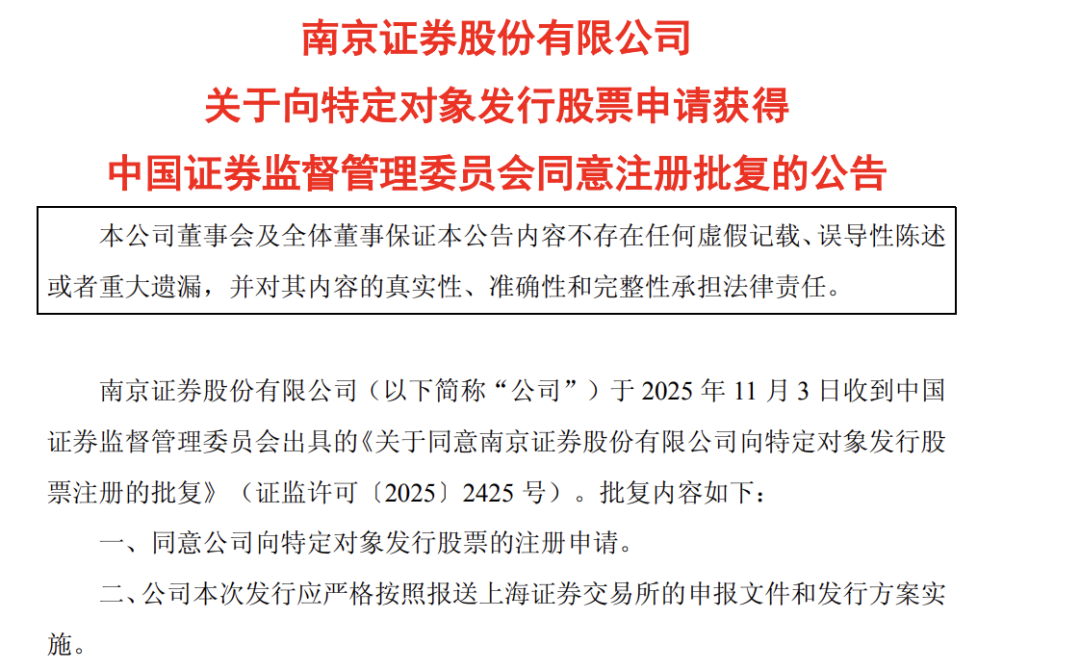
Core Viewpoint - The article discusses the recent developments in the capital increase plans of Nanjing Securities and the termination of the capital increase plan by Guiding Compass, highlighting the trends in the securities industry regarding refinancing and capital allocation strategies [2][8]. Nanjing Securities - On November 3, Nanjing Securities announced that its application for a capital increase was approved by the China Securities Regulatory Commission, aiming to raise up to 50 billion yuan [4]. - The focus of the fundraising has shifted from securities investment to light capital businesses such as wealth management and asset management [4][6]. - The capital raised will be allocated to four main business lines: investment banking (5 billion yuan), wealth management (5 billion yuan), asset management (5 billion yuan), and alternative and private subsidiaries (10 billion yuan) [5][6]. - The company aims to optimize its business structure and enhance its capital strength to support future development [6]. Guiding Compass - Guiding Compass announced the termination of its capital increase plan, which had been in consideration for three years, with a proposed fundraising amount of up to 29.05 billion yuan for its subsidiary, Maigao Securities [8][9]. - The decision to terminate the plan was influenced by the significant improvement in Maigao Securities' financial performance, which reported a net profit of 70.36 million yuan in the first half of 2025, a 614.55% increase year-on-year [9]. - The termination reflects a shift in the funding needs and strategic goals of the company, aligning with regulatory requirements for prudent capital management [9]. Industry Trends - The overall trend in the securities industry indicates a steady progress in refinancing, with other firms like Zhongtai Securities and Dongwu Securities also pursuing significant capital increases [9]. - Regulatory focus has shifted towards enhancing quality and efficiency in refinancing, encouraging firms to align funding with core business operations and reduce capital-intensive activities [9].

乐山商行:经营稳健增长,绘就发展新图景
和讯· 2025-09-30 14:02
Core Viewpoint - Leshan Commercial Bank has demonstrated steady growth and optimization of key indicators in its operations, maintaining its position as a leading city commercial bank in Sichuan, with total assets reaching 215.5 billion as of June 2025, following its entry into the "200 billion club" in 2024 [1] Compliance Management - The bank has enhanced its internal control and compliance systems, leading to improved risk management and operational efficiency. It ranked 505th in the "2025 World’s Top 1000 Banks" by The Banker, rising 68 places from 2024, and has maintained an AA+ credit rating for three consecutive years [2] Risk Management - Leshan Commercial Bank has focused on maintaining asset quality while expanding its loan portfolio, implementing a comprehensive risk management mechanism that includes risk identification, assessment, response, and monitoring [3] Legal Rights Protection - The bank actively combats debt evasion to protect the interests of depositors and shareholders, collaborating with legal authorities to ensure the enforcement of financial obligations and maintain a healthy financial ecosystem [4] Strict Governance - The bank has strengthened its governance and compliance oversight, establishing a robust supervisory system that integrates various compliance functions to support high-quality development [5] Financial Innovation - In response to market trends, the bank is transitioning towards a light capital model, focusing on enhancing middle business operations and capital efficiency, while leveraging digital transformation to improve operational processes [6] Community Financial Support - As a state-controlled bank, Leshan Commercial Bank has prioritized financial services that support local economic development, optimizing risk management while expanding its lending capabilities across multiple cities in Sichuan [7] Tourism and Cultural Financing - The bank integrates financial services with tourism development, providing tailored financial solutions to support the local economy and enhance the region's appeal as a global tourist destination [8]

银国宏,重磅发声!
Zhong Guo Ji Jin Bao· 2025-09-27 03:05
Core Viewpoint - Financial Street Securities, formerly known as Hengtai Securities, is entering a new development phase following its rebranding, aiming to leverage its unique advantages and focus on a "small but beautiful, light but stable" brokerage model [1][2]. Group 1: Company Transformation - The rebranding to Financial Street Securities marks a significant shift, supported by new shareholders and strategic resources, enhancing the company's market presence [2][3]. - The company aims to integrate its operations with the broader strategy of Financial Street Group, focusing on asset pricing, resource allocation, risk management, and market connectivity [3][4]. Group 2: Strategic Focus - The company will prioritize capital market service and technological innovation, enhancing its strategic implementation capabilities [1][8]. - Financial Street Securities plans to strengthen its wealth management, investment banking, and asset management sectors, leveraging the resources of Financial Street Group [3][4]. Group 3: Business Development - The company is focusing on improving its service capabilities, product innovation, and technology investment to provide personalized financial services [4][11]. - A three-tier management structure is being established to enhance operational efficiency and regional advantages [11][12]. Group 4: Wealth Management and Differentiation - Financial Street Securities is committed to transforming into a wealth management-focused firm, emphasizing its unique capabilities in product configuration and sales [12][13]. - The company aims to build a comprehensive ETF ecosystem, providing a full lifecycle of services from research to trading [13][14]. Group 5: Research and Asset Management - The establishment of a specialized research institute is underway to enhance collaboration between brokerage and public fund operations, focusing on macroeconomic and industry research [14][15]. - Financial Street Securities is actively working to improve its asset management performance and is adopting competitive incentive mechanisms to attract talent [14].
嘉银、小赢、宜人3家助贷平台2025二季报:预计暂缓扩张趋势
Xin Lang Cai Jing· 2025-09-01 09:48
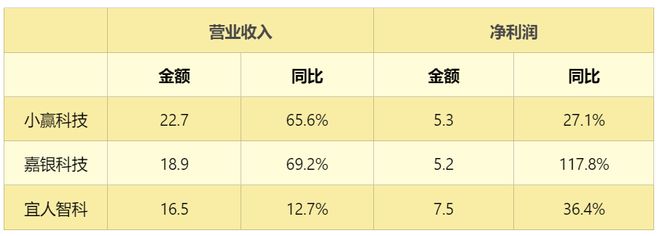
Core Insights - The article highlights the strong growth in business scale and performance of three listed loan facilitation platforms in Q2, while indicating a potential pause in high growth for mid-tier platforms due to upcoming regulatory changes [1][5]. Performance Growth - In Q2, Xiaoyin Technology, Jiayin Technology, and Yirendai achieved double-digit revenue growth, with Jiayin Technology's net profit doubling to 520 million yuan, Xiaoyin Technology's net profit growing by 27.1% to 530 million yuan, and Yirendai's net profit increasing by 36.4% to 750 million yuan [2][3]. - Revenue and net profit figures for Q2 are as follows: - Xiaoyin Technology: Revenue of 2.27 billion yuan (up 65.6%), Net profit of 530 million yuan (up 27.1%) - Jiayin Technology: Revenue of 1.89 billion yuan (up 69.2%), Net profit of 520 million yuan (up 117.8%) - Yirendai: Revenue of 1.65 billion yuan (up 12.7%), Net profit of 750 million yuan (up 36.4%) [2]. Loan Facilitation Scale - The loan facilitation scale for the three platforms grew significantly, with Xiaoyin Technology's scale increasing by 71.4% year-on-year to 39 billion yuan, Jiayin Technology's by 54.6% to 37.1 billion yuan, and Yirendai's by 57.4% to 20.3 billion yuan [6][5]. Sales and Marketing Expenses - The platforms have increased their sales and marketing expenditures significantly, with Xiaoyin Technology's costs rising by 133.7% to 760 million yuan, Jiayin Technology's at 710 million yuan (37.7% of revenue), and Yirendai's at 350 million yuan (26.7% of revenue) [3][7]. Signals of Contraction - The upcoming regulatory changes are prompting mid-tier platforms to signal a contraction in growth. Yirendai expects Q3 revenue to decline slightly to between 1.4 billion and 1.6 billion yuan, while Jiayin Technology and Xiaoyin Technology plan to reduce their loan facilitation scale in Q3 [5][7]. Asset Quality Trends - Xiaoyin Technology reported a decrease in its 31-60 day overdue rate from 1.25% in Q1 to 1.16% in Q2, indicating improved asset quality [8]. - Jiayin Technology's 90-day overdue rate decreased slightly, while Yirendai's 1-30 day overdue rate increased to 1.7% [8][4]. Shift in Business Strategy - Jiayin Technology is reportedly reducing its heavy capital loan business, as indicated by a 70.2% year-on-year decrease in revenue from releasing guarantee liabilities to 130 million yuan [10].
沪农商行(601825):存款成本优化显效 中期分红比例提升
Xin Lang Cai Jing· 2025-08-31 06:32
Core Viewpoint - The company shows signs of recovery with positive growth in revenue and net profit in Q2 2025, driven by stable scale growth and an increase in non-interest income [1][3] Group 1: Financial Performance - In H1 2025, the company's revenue decreased by 3.4% year-on-year, but the non-recurring revenue increased by 0.38% [1] - The net profit attributable to shareholders increased by 0.6% year-on-year, showing improvement from Q1 [1] - The annualized weighted average ROE was 11.11%, down by 0.78 percentage points year-on-year [1] - In Q2, revenue and net profit grew by 0.76% and 0.86% year-on-year, respectively, indicating a gradual improvement in performance [1] Group 2: Interest Income and Loan Growth - The company's net interest income decreased by 5.45% year-on-year, but the decline has narrowed [2] - The net interest margin (NIM) was 1.39%, down by 11 basis points from the beginning of the year [2] - Total loans increased by 2.51% year-to-date, with corporate loans being the main growth driver, up by 5.12% [2] - Retail loans decreased by 1.69% year-to-date, with mortgage loans showing a positive growth of 1.89% [2] Group 3: Non-Interest Income and Asset Quality - Non-interest income increased by 2.19% year-on-year, with a positive growth trend in Q1 [3] - Investment income surged by 44.63%, contributing significantly to the non-interest income growth [3] - The non-performing loan (NPL) ratio was stable at 0.97% as of June, with a decrease in corporate NPLs [3] - The company maintained a strong provision coverage ratio of 336.55%, indicating sufficient risk mitigation capacity [3] Group 4: Strategic Positioning and Shareholder Returns - The company has a strong presence in Shanghai, leveraging its regional advantages [4] - The company is focusing on enhancing shareholder returns, with a mid-year dividend payout ratio of 33.14%, an increase from the previous year [4] - The company is expected to maintain a solid asset quality and risk mitigation capability while transitioning towards retail finance and light capital models [4]